Blog Archives: News Releases

“Restoring the Natural Function of Mauiʻs Ahupuaʻa to Protect Mauiʻs Coral Reefs” to be Topic of Maui Nui Marine Resource Council Meeting

in /by

Maui Nui Marine Resource Council invites the public to a free presentation at its Wednesday, June 6 meeting on “Restoring the Natural Function of Mauiʻs Ahupuaʻa to Protect Mauiʻs Coral Reefs.” The meeting will take place at Pacific Whale Foundationʻs classrooms, downstairs at the Maʻalaea Harbor Shops, from 5 to 6:30 pm with free refreshments and conversation from 6:30 pm to 7:00 pm.

The free talk will be presented by guest speaker Jennifer Vander Veur, Maui Program Manager of Coral Reef Alliance (CORAL).

Vander Veur will speak about work that CORAL is doing to restore natural filtration processes within Mauiʻs ahupuaʻa (watersheds) to prevent land-based water pollution from flowing into the sea and degrading coral reefs. Sheʻll be sharing the progress made by CORAL in the Wahikulu watershed of West Maui. In this area, CORAL is working with farmers, Hawaiian communities, local nonprofits, private businesses and the government to pilot stream restoration techniques that combine modern technology with native vegetation and traditional agricultural practices.

“CORAL is focusing on reducing the sediments from degraded agricultural land and roads from reaching our coral reefs. We are utilizing vetiver grass to stabilize sediments and help native plants become established in these altered systems,” said Vander Veur. “Through our partnerships we aim to restore the mid-slope streams and help restorate and reconnect the ahupua’a of this region.”

Vander Veur is a graduate of the University of Hawaiʻi at Hilo, where she earned two Bachelor’s degrees in Marine Science and Conservation Biology. Upon graduation, she gained a position with the state of Hawaiʻi to establish the Aquatic Invasive Species Program on the island of Hawaiʻi. Vander Veur later completed a Master’s of Science in Marine Biology from Victoria University in Wellington, New Zealand.

For the past 10 years she has worked for the Kahoʻolawe Island Reserve Commission (KIRC) managing the marine resources around the island of Kahoʻolawe. Her work included fisheries management, protected species management, integrating traditional cultural resource management with modern scientific methods and community engagement.

Established in 2007, Maui Nui Marine Resource Council is a community-based nonprofit dedicated to clean ocean water, healthy coral reefs and abundant native fish for Maui County.

To learn more, visit www.mauireefs.org.
 

Hui O Ka Wai Ola Ocean Water Quality Testing Program Expands Again – Now Testing 48 Maui Sites

1 Comment/in /by

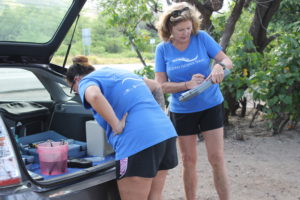
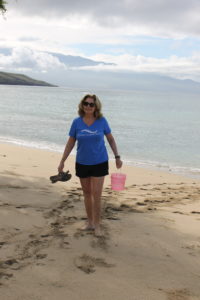
The volunteer-based Hui O Ka Wai Ola ocean water quality testing program has expanded again, with the addition of 12 more testing sites in South Maui in early March 2018.  With this expansion, the program is now covering 48 shoreline locations where trained volunteers routinely test water quality on Maui every 2 to 3 weeks.

The Hui O Ka Wai Ola program, whose name means “Association of the Living Waters,” is the first community-based water quality monitoring to measure for nutrients (including nitrogen and phosphorus), along with turbidity, salinity, dissolved oxygen, pH and temperature in Maui’s coastal waters.

The program first launched in June 2016 in West Maui with 17 sites. One West Maui site was added in February 2017 (Napili Bay), and 6 additional West Maui sites were added in June 2017.

The program expanded to include a dozen new test sites in South Maui in November 2017. The latest expansion in 2018 added another 12 South Maui sites. In all, the group of volunteers are testing 48 sites on Maui.

A Partnership at Work
The program is made possible through the volunteers’ efforts and a joint partnership of Maui Nui Marine Resource Council, The Nature Conservancy, West Maui Ridge to Reef Initiative and the State of Hawaii Department of Health. Financial support for the program is provided by the partners, along with the County of Maui Office of Economic Development, National Fish and Wildlife Foundation, North Beach West Maui Benefit Fund, Napili Bay and Beach Foundation, Pride of Maui, Maui Ocean Center and individual donors and supporters

“Our goal is to support the State of Hawaii Department of Health and Maui County efforts to improve coastal water quality so that coral reefs and native fish populations thrive, and our residents and visitors are safe,” said Robin Newbold, co-founder and chairwoman of the Maui Nui Marine Resource Council. “We want to help identify problem areas, so remedial action may be taken as needed.”

Trained Volunteers and a Quality Assurance Plan
To prepare for the expansion in March, a group of ten new volunteers completed intensive training in the classroom, in the lab and in the field. The volunteers work under the guidance of experienced team leaders and regional coordinators. The sampling follows strict guidelines set under a Quality Assurance plan approved by the Department of Health. A QA officer reviews the data before it is submitted.

The volunteers bring equipment to the field for onsite testing; they also freeze and ship water samples to the SOEST (UH School of Ocean and Earth Science and Technology) laboratory on Oahu for additional analysis.

Poor Water Quality Undermines the Health of our Reefs
Hui O Ka Wai Ola’s program tests water samples for nutrients, such as nitrogen and phosphorous compounds, which can indicate pollution from wastewater and runoff from agriculture, landscaping and golf courses. High nutrient content in the water can cause an increase in growth of invasive algae, which could damage coral reefs.

In addition, research has shown that sustained, nutrient rich, lower pH submarine groundwater discharging onto nearshore coral reefs off West Maui lowers the pH of seawater and exposes corals to nitrate concentrations 50 times higher than normal. Rates of coral calcification — the rate at which coral polyps produce calcium carbonate which forms the hard structure of the reef — are substantially decreased. As a result, the reef degrades faster and the reef ecosystem is more likely to collapse.

“With many of Maui’s coral reefs in significant decline, it is critical that we reduce stressors to our reefs on a local scale as quickly as possible,” notes Tova Callender, coordinator supporting the West Maui Ridge to Reef Initiative. “Our water quality studies will help us understand the source of pollutants, which is the first step in addressing the stress to the reefs caused by impaired water quality and will hopefully make our reefs more resilient to climate change.“

Data provided by Hui O Ka Wai Ola will be used to supplement Health Department water quality monitoring on Maui and can be viewed on the group’s website, www.huiokawaiola.com.

A State of Hawaii Department of Health employee tests water quality for enterococcus bacteria, a marker for potentially harmful bacteria in the water, The additional nutrient data provided by Hui O Ka Wai Ola provides an enhanced view of changing water quality conditions that can harm coral reefs and humans.

Community Support Sought
The cost of testing for each site is about $3,800 per year, which includes analysis and the shipping of samples to Oahu. Maui Nui Marine Resource Center is asking companies, canoe clubs, community organizations and individuals to each sponsor a site with a $3,800 donation. To donate, visit https://www.mauireefs.org/membership-and-giving/adopt-a-beach/

The goal of Hui O Ka Wai Ola is to bring more awareness to local coastal water quality issues and support better-informed decisions and policies regarding water quality.

To learn more, visit HuiOKaWaiOla.com.

Maui Nui Marine Resource Council May 2 Meeting to Feature Guest Presentation on “Updates on efforts to restore streamflow to Maui’s reefs and effects on fisheries”

in /by

Maui Nui Marine Resource Council invites the public to its next meeting on Wednesday, May 2, featuring guest presentations by Lucienne De Naie and Adriane Raff Corwin.

Lucienne De Naieʻs presentation will be on “Updates on efforts to restore streamflow to Maui’s reefs and effects on fisheries.” Adriane Raff Corwin will be speaking about the Hukilike No Maui Coalition and also efforts to keep harmful sunscreen chemicals out of our nearshore ocean ecoystems.

The meeting will take place from 5 pm to 6:30 pm at Pacific Whale Foundationʻs classrooms at the Maʻalaea Harbor Shops. Admission is free, everyone is invited and refreshments will be provided.

Lucienne De Naie lives in rural east Maui and is active with stream and watershed restoration projects. She is a a founding member and a director of Maui Nui Marine Resource Council, as well as a founding member of Maui Cultural Lands, Inc. and the Maui Coastal Land Trust (now Hawaiian Islands Land Trust). Lucienne has served on the Mayor’s Open Space Zoning Advisory Committee, the Maui General Plan Advisory Committee and serves as Conservation Chair and hike leader for the Maui Sierra Club. She also authored a report on the status of Mauiʻs freshwater resources.

Adriane Raff Corwin is the Sierra Club Group Coordinator. Adriane has been a community organizer for over ten years and received her Master’s Degree in Political Science and Futures Studies from the University of Hawaiʻi at Mānoa.

The meeting will include updates on Maui Nui Marine Resource Councilʻs work as a nonprofit community organization to restore clean ocean water, protect coral reefs and bring back abundant native fish to the nearshore areas of the islands of Maui County.

To learn more about Maui Nui Marine Resource Council, please visit www.mauireefs.org.

Lucienne De Naie

Adriane Raff Corwin


Free presentation on Maui’s coral reef soundscapes to be featured at Maui Nui Marine Resource Council April 4 meeting

in /by

MA’ALAEA, HI – Ever hear the crackling sounds of snapping shrimp while you snorkeled? Those noises are just part of the rich soundscape of a coral reef — soundscapes that can provide helpful clues about the health of the reef. The public is invited to learn more about what was discovered during an acoustic study of seven Maui reefs at a free presentation by Eden Zang at the Wednesday, April 4 meeting of Maui Nui Marine Resource Council.

The meeting will take place from 5 pm to 7 pm at Pacific Whale Foundation’s Discovery Center classrooms at the ocean level of the Ma’alaea Harbor Shops. Admission is free and everyone is welcome.
Eden Zang, Managing Director of Oceanwide Science Institute, will explain how passive acoustic monitoring can be utilized to reveal clues about coral reef communities and will share results from a 16 month acoustic study from seven reefs around Maui.

“The soundscape of coral reefs may provide a way to track animal activities and community level structure,” comments Zang. “To do so, it is critical to identify how reef soundscapes are influenced by biotic (living) and abiotic (non-living) factors, and establish how soundscapes change over time and across habitats.”

“We’re excited about the use of acoustic monitoring to gain more information about our local reefs,” says Robin Newbold, co-founder and chair of Maui Nui Marine Resource Council. “This promises to be a fascinating presentation for anyone who is interested in Maui’s coral reefs.”

Eden Zang joined Oceanwide Science Institute (OSI) in March 2014 as a Research Specialist and is now OSI’s Managing Director. In addition to managing day-to-day operations, Eden’s focus is on processing and analyzing acoustic data, scientific diving, assisting in the coordination of field efforts, and marine mammal vessel based surveys. She has been involved with projects that involve whales, dolphins, fish, marine invertebrates, and effects of anthropogenic noise in the marine environment.

Zang has a B.A. in Human Communication and participated in University of Hawaii’s Marine Option Program. In addition to OSI, Eden is the Maui Marine Mammal Response Network Assistant for NOAA Fisheries, (contractor with Lynker Technologies, Inc.) and has held various positions with private, state and federal organizations in animal husbandry, scientific diving, and protected resource management.

The meeting will also provide updates about ocean water quality testing and other projects that are underway at Maui Nui Marine Resource Council, the host of the meeting. Refreshments will be served. 

Maui Nui Marine Resource Council is a nonprofit organization celebrating its 10th anniversary of working for clean ocean water, healthy coral reefs and abundant native fish for the islands of Maui County. To learn more about Maui Nui Marine Resource Council, visit www.mauireefs.org.

Oceanwide Science Institute (OSI) is a non-profit organization that was founded in April 1998 on the island of Oahu, Hawaii. The mission of OSI is to share knowledge through innovation and expertise. To learn more about Oceanwide Science Institute, visit oceanwidescience.org.

Aquatic Biologist Russell Sparks of Hawaii Department of Aquatic Resources to be Guest Speaker at March Meeting of Maui Nui Marine Resource Council

in /by

MA’ALAEA, HI — A free presentation offering updates on the State of Hawaii’s management of Maui’s nearshore fisheries and coral reef resources will be featured at the Wednesday, March 7 meeting of the nonprofit Maui Nui Marine Resource Council. The talk will be presented by guest speaker Russell Sparks, Aquatic Biologist of State of Hawaii, Department of Land and Natural Resources, Division of Aquatic Resources. Sparksʻ presentation will also include an update on the status of Mauiʻs reefs following the bleaching event of 2015.

The meeting will take place from 5 to 7 pm at Pacific Whale Foundation’s Discovery Center Classrooms at Ma’alaea Harbor Shops at 300 Ma’alaea Rd, Wailuku (next to Maui Ocean Center). The talk is free and everyone is invited. Refreshments will be served.

Maui Nui Marine Resource Council (MNMRC) is a Maui-based nonprofit working for healthy coral reefs, clean ocean water and the restoration of abundant native fish in the nearshore waters of the islands of Maui County.

At the March 7 meeting, MNMRC staff will be offering updates on their recent and ongoing projects, including the expansion of a volunteer-based water quality monitoring program to include 48 sites in South and West Maui and a study of corals off Olowalu.

Sparks received his B.S. in Biology from Oregon State University. He received his M.S. in Marine Biology from University of Hawaii at Manoa in 1996. Since 1998 Russell has worked for the State of Hawaii, Department of Land and Natural Resources, Division of Aquatic Resources as an education specialist and more recently as an aquatic biologist. He is currently responsible for leading the design, implementation, and overall management of the Maui marine monitoring program, and for working with stakeholders and communities to develop marine management programs aimed at adaptively managing nearshore fisheries and coral reef resources.

Using Algal Turf Scrubbers to Improve Wastewater Quality to be Subject of February 7 Meeting of Maui Nui Marine Resource Council

in /by

The public is invited to attend a free presentation on harnessing local algae and sunlight to improve the quality of treated municipal wastewater at the Wednesday, February 7 meeting of the nonprofit Maui Nui Marine Resource Council.

The meeting will take place from 5 pm to 7 pm at Pacific Whale Foundation’s classrooms at the Harbor Shops at Maʻalaea at 300 Maʻalaea Road. Refreshments will be served.

Guest presenter, Travis Liggett, will be speaking about Algal Turf Scrubbers, a cutting-edge technology which can improve wastewater quality by harnessing local algae and sunlight to lower nutrient levels, increase oxygen concentration, and reverse acidification in wastewater.

“Algal Turf Scrubbers have a place on the island of Maui to provide an added stage of treatment to municipal wastewater before entering the marine environment via injection wells serving Kahului-Wailuku, Kihei-Wailea and Lahaina,” says Liggett.

Liggett holds a MS in Aerospace Engineering from University of Colorado Boulder and a BS in Mechanical Engineering from University of California, Berkeley. He served as an Algae Manager at Maui Tropical Algae Farm and also worked as an Aerospace Research Engineer with NASA. Mr. Liggett is working with Dr. Dean Calahan, a Smithsonian researcher focused on expanding the use of Algal Turf Scrubber technology.

Liggett holds a MS in Aerospace Engineering from University of Colorado Boulder and a BS in Mechanical Engineering from University of California, Berkeley. He served as an Algae Manager at Maui Tropical Algae Farm and also worked as an Aerospace Research Engineer with NASA.

The evening will also include a discussion about general wastewater issues on Maui, including the 12,000 cesspools located here, which handle 7.9 million gallons of untreated wastewater per day.

Dana Reed, West Maui Regional Coordinator of Hui O Ka Wai Ola, the ocean water quality testing program led by Maui Nui Marine Resource Council, The Nature Conservancy, West Maui Ridge 2 Reef and University of Hawaii Maui College, will be presenting some preliminary findings about ocean water quality at West Maui beaches and the Hui’s efforts to use algae (limu) to collect more information about Maui’s coastal water.