
Blog Archives: News Releases

60 Bags of Trash Removed by 17 Volunteers Along 1/2 Mile Stretch of Ma’alaea Ditch in 2 Hours

in /by

MA’ALAEA, MAUI, HI – Seventeen volunteers took part in Maui Nui Marine Resource Council’s cleanup of Ma’alaea Ditch on Saturday, December 8, removing 60 large bags of trash and an additional truck load of large items from the waterway in two hours.

“This was our Christmas gift to the ocean,” said Amy Hodges, Programs Manager at Maui Nui Marine Resource Council. Hodges explained that the ditch empties into Ma’alaea Bay, and upcoming winter rains would have washed all of that trash into the ocean, had it not been removed by the volunteer team.

The group cleaned up a length of the ditch that measured about a half mile.
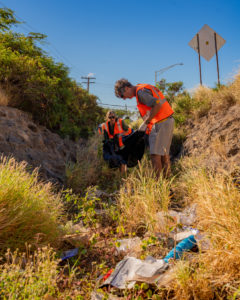
“In many parts of the ditch, there was so much plant material that  at first, we didn’t think there was any human-created trash,” said Anne Rillero, Communication, Community Outreach and Development Manager at Maui Nui Marine Resource Council. “But once we looked under the grasses and bushes, we found lots of hidden debris, including plastic bottles, straws, drink lids, plastic bags, cigarette butts and old coolers.”

“Because this section of the ditch is along the Honoapiiilani Highway, it accumulates trash from passing cars and trucks,” said Hodges.”When it rains, all of this trash goes ‘whoosh’ right into the ocean, where it can harm or kill marine life.”

The ditch is part of a series of engineered waterways which run along the base of the West Maui Mountains all the way from Waihee to Ma’alaea. It was named as a source of trash and sediment entering Ma’alaea Bay in a stormwater management plan created for Maui Nui Marine Resource Council by the consulting firm, Maui Environmental Management.

Maui Nui Marine Resource Council will be implementing additional recommendations of the plan in 2019, as part of its program to improve ocean water quality in Ma’alaea Bay, an area that is home to a popular fishing area, famous surfing spot, two beaches, a sea turtle grazing area and coral reefs.

“Ma’alaea Bay is a valuable community resource and is also an important nearshore ocean habitat for corals, turtles and other marine wildlife,” says Hodges.

In addition to tackling the recommendations in the stormwater management plan, Maui Nui Marine Resource Council is working on a proposed pilot project to install oysters in Ma’alaea Harbor to help improve ocean water quality in the area. Oysters are filter feeders that can remove chemicals, oil, sediment, PCBs and pollutants from ocean water, as well as the bacteria that cause skinborne illnesses like Staph and MRSA.

“Corals need clean water to thrive and all people want clean ocean water for recreation and enjoyment,” said Robin Newbold, co-founder and chair of Maui Nui Marine Resource Council. “We’re grateful that so many volunteers came out to help us work for clean ocean water by cleaning up this section of the ditch.”

Celebrating 11 years, Maui Nui Marine Resource Council is a Maui-based nonprofit organization working for clean ocean water, healthy coral reefs and abundant native fish for the nearshore areas of Maui County. To learn more, visit www.mauireefs.org.

PHOTOS BY: TY FREIBERG
Volunteers Needed for Pre-Rainy Season Ma’alaea Ditch Cleanup on Saturday, December 8

in /by

Maui Nui Marine Resource Council is seeking volunteers to help remove trash from a short section of the stormwater ditch along the Honoapi’ilani Highway in Ma’alaea on Saturday, December 8 from 9 am to 11 am.

Unless removed soon, the trash will likely end up in Ma’alaea Bay when winter rains arrive and stormwater flows through the ditch into the ocean. The ditch is located adjacent to the highway and is notorious for accumulating large amounts of man-made debris.

“The time you volunteer is truly a gift for the ocean, for the coral reefs and marine wildlife,” says Amy Hodges, Program Manager at Maui Nui Marine Resource Council. “We need volunteers to help us now, to keep all of the accumulated trash out of the ocean.”

Participants are asked to meet at 9 am at the parking lot that contains the EV charging stations between Maui Ocean Center and Carl’s Jr. Please wear closed-toe shoes and long pants, and bring a water bottle, sunscreen and hat. Gloves and trash bags will be provided.

The clean-up is part of an overall plan by Maui Nui Marine Resource Council to help improve ocean water quality in Ma’alaea Bay, home to a sea turtle grazing area, coral reefs, a famous surf break, public fishing area and beaches, as well as a busy small boat harbor.

Cleaning up Ma’alaea Ditch is one project that Maui Nui Marine Resource Council is undertaking to improve ocean water quality in Ma’alaea Bay.

The organization paid for a Stormwater Management Plan for the areas upslope of Ma’alaea Bay to identify additional ways to reduce stormwater runoff laden with sediment and pollutants from flowing into the bay.

Maui Nui Marine Resource Council is also working on a pilot project to use caged oysters to help improve the water quality in Ma’alaea Harbor. A free presentation about the oyster project will be presented at Maui Nui Marine Resource Council’s December 5 meeting, from 5:30 pm to 7:30 pm at Pacific Whale Foundation’s classrooms. The public is invited, admission is free and refreshments will be served.

To sign up for the Ma’alaea Ditch clean-up, please email [email protected] with your name and cell phone number, so that the team at Maui Nui Marine Resource Council can contact you in the event of rain in Ma’alaea or the West Maui Mountains, which would result in the postponement of the Ma’alaea Ditch clean-up in the interest of volunteer safety.

To learn more about Maui Nui Marine Resource Council, visit www.mauireefs.org.

Free Presentation on “Proposed Use of Oysters for Water Quality Improvement in Ma’alaea Harbor”

1 Comment/in /by

The public is invited to a free presentation on a proposed plan to use oysters to improve ocean water quality in Ma’alaea Harbor during Maui Nui Marine Resource Council’s monthly meeting on Wednesday, December 5, from 5:30 pm to 7:30 pm.

The presentation will be offered by Rhiannon “Rae” Tereari‘i Chandler-‘Īao, Executive Director and O‘ahu Waterkeeper for Waiwai Ola Waterkeepers Hawaiian Islands. It will take place at Pacific Whale Foundation’s classrooms at the Ma’alaea Harbor Shops, 300 Ma’alaea Road. Admission is free and refreshments will be served.

Oysters are filter feeders that remove pollutants from the water column including sediment, bacteria, heavy metals, PCBs, oil, microplastics, oxybenzone, and other harmful sunscreen-related chemicals. Oysters also digest the type of bacteria that cause skin-borne illnesses such as Staph and MRSA. These oysters are for restoration, they cannot be consumed. Oysters for consumption are grown in clean water only.

Oysters are currently at work in harbor waters of New York and New Jersey, where Waterkeeper Alliance member projects have installed more than 42 million oysters to help clean the water and protect the coastline from wave action. Similar efforts are also being employed in Baltimore’s Chesapeake Bay to improve ocean water quality.

Pacific oysters, the type of oyster considered for the pilot project in Ma’alaea Harbor, were originally introduced by the State in the 1950’s and 1960’s and are found in locations throughout the Hawaiian Islands. Adult Pacific oysters can filter more than 50 gallons of water per day. The proposed pilot project would involve the installation of approximately 1,000 oysters in cages beneath the docks of Ma’alaea Harbor away from boat traffic. Trained staff and volunteers will monitor the oysters to evaluate survival rates and their success in improving water quality. At the end of one year, the pilot project will yield a report to help determine the feasibility of expanding the project within the harbor.

“In 2017, Hawai‘i’s Department of Land and Natural Resources (DLNR), Division of Aquatic Resources (DAR) conducted a successful grow trial using Pacific oysters,” says Chandler-‘Īao “This DAR study, conducted in West Loch, demonstrated the oysters’ ability to remove various pollutants water column. We’re excited to see what is possible to improve conditions in Ma‘alaea Harbor.”

Maui Nui Marine Resource Council (MNMRC) is partnering with Waiwai Ola Waterkeepers Hawaiian Islands to conduct the one-year pilot oyster project in Ma’alaea Harbor. The project is part of MNMRC’s overall plan to address land-based impacts to water quality in Ma’alaea Bay.

Recently, MNMRC commissioned and funded a study of the watershed that drains into Ma’alaea Harbor. With the study in hand, the nonprofit is now evaluating recommendations for action steps, and will be selecting those that can be implemented in 2019 and beyond. “We are looking at ways we can work upslope to improve water quality throughout Ma’alaea Bay,” notes Amy Hodges, Programs Manager at Maui Nui Marine Resource Council, who has been meeting with local landowners, MECO, Hawai‘i’s Division of Forestry and Wildlife, Ma’alaea Community Association, and others to talk about ocean water quality in Ma’alaea.

“Ma’alaea Bay is home to a popular surf break, beaches, a sea turtle feeding area, fishing areas, and coral reefs both inside and outside the harbor,” says Hodges. “Improving water quality in the harbor will benefit recreational users of the area and help marine wildlife.”

At the meeting, MNMRC will provide information on new volunteer opportunities associated with this project, including helping MNMRC regularly monitor the oysters and clean the cages to remove excess algae.

Doors will open at 5 pm, with complimentary holiday-themed refreshments. The presentation will begin at 5:30 pm and will include time for questions and comments from the public. To learn more, visit www.mauireefs.org.

About our presenter:
Rhiannon “Rae” Tereari‘i Chandler-‘Īao serves as the Executive Director and O‘ahu Waterkeeper for Waiwai Ola Waterkeepers Hawaiian Islands. She earned a B.A. in Ethnic Studies from the University of Hawai‘i at Mānoa in 2004. After graduating from William S. Richardson School of Law in 2016 with certificates in both Native Hawaiian Rights Law and Environmental Law, she worked as a Post J.D. Research & Teaching Fellow at Ka Huli Ao Center for Excellence in Native Hawaiian Law. Prior to attending law school, Rhiannon served as the Executive Director of the environmental non-profit organization Community Work Day Program, d.b.a. Mālama Maui Nui. While on Maui, she served as a member of the Maui County Cultural Resources Commission, the Maui Nui Marine Resource Council, and the Steering Committee of Ka Ipu Kukui Fellows Leadership Program.

About Maui Nui Marine Resource Council:
Maui Nui Marine Resource Council is a nonprofit organization based on Maui, dedicated to healthy coral reefs, clean ocean water and abundant native fish. Founded in 2007, Maui Nui Marine Resource Council is celebrating its 11th anniversary this year. Some of the organization’s accomplishments include:

• Formation of Maui Coral Reef Recovery Team and the Maui Coral Recovery Plan, the first of its kind in the state.

• Forming Community Managed Makai (CMMA) areas, in which local residents work together to manage their marine resources.

• Creating Hui O Ka Wai Ola in partnership with The Nature Conservancy and West Maui Ridge to Reef. This volunteer citizen-based ocean water quality testing program is now in its 2nd year of testing ocean water quality at 39 locations along Maui’s south and west shorelines every 3 weeks.

To learn more, visit www.mauireefs.org

Free talk on the status of Maui’s streams, estuaries and native freshwater species by Aquatic Biologist Skippy Hau

in /by

The status of Maui’s streams, estuaries and the native freshwater species that live there will be the subject of a free presentation by Skippy Hau, Aquatic Biologist with the State of Hawaii Department Land and Natural Resources Division of Aquatic Resources, at the Wednesday, November 7 meeting of Maui Nui Marine Resource Council. The meeting will take place at Pacific Whale Foundation’s classrooms at the Ma‘alaea Harbor Shops at 300 Ma‘alaea Road. Hau will also be discussing his work with Maui’s sea turtles, including nesting sea turtles, hatchlings and the removal of an 8-pound tumor from a turtle.

The public is invited and refreshments will be served starting at 5:00 pm when the doors open. The presentation by Skippy Hau will begin at 5:30 pm. The meeting will conclude at 7:30 pm.

According to Hau, Hawai‘i’s streams were once prime habitats for an abundance of native freshwater species including five native species of fishes, two species of crustacean and three species of mollusk.

Hau will discuss his research about Maui’s streams and estuaries and will present information on what happened to them and the animals that once inhabited them in great numbers. He will also be presenting information on the impact of recent moves to restore water flow to Maui’s streams.

“We are delighted that Skippy Hau will be our featured presenter at our November meeting of Maui Nui Marine Resource Council,” says Amy Hodges, Programs Manager at Maui Nui Marine Resource Council. “He is a wealth of knowledge about Maui’s streams and estuaries, and is passionate about sharing his findings about these aquatic resources with the public.”

“The health of our streams, estuaries and watersheds has a direct impact on the health of our coral reefs and the quality of our nearshore ocean water,” says Hodges. “We are especially curious about how stream health has improved since the recent restoration of freshwater to our streams and look forward to Skippy’s observations on this topic.”

Skippy Hau has served as the Aquatic Biologist with the State of Hawaii Department of Land and Natural Resources Division of Aquatic Resources on Maui for 33 years.

He grew up in Kaneohe (Oahu) and attended public schools (Benjamin Parker Elementary, Samuel Wilder King Intermediate, and James B. Castle High School.) He obtained his Bachelor of Science in Biology and a Marine Option Program Certificate at the University of Hawaii at Manoa.

After graduating from University of Hawaii in 1979, Hau worked his way up to Aquatic Biologist at the Hawaii Department of Land and Natural Resources Division of Aquatic Resources and worked on projects including the Waikiki-Diamond Head Fisheries Management Project; Topminnow Baitfish Project; and Northwestern Hawaiian Islands Bottomfish Surveys Project before moving to Maui in 1985.

Maui Nui Marine Resource Council, the host of the meeting, is a nonprofit organization founded in 2007 by marine biologist Robin Newbold and the late Hawaiian activist/kupuna Edwin Lindsey. The organization works for clean ocean water, healthy coral reefs and an abundance of native fish for the islands of Maui County. To learn more, visit www.mauireefs.org.

New Campaign Urges Maui Visitors to “Get a Jump on Protecting Maui’s Coral Reefs” by Making the Sunscreen Switch Today

in /by

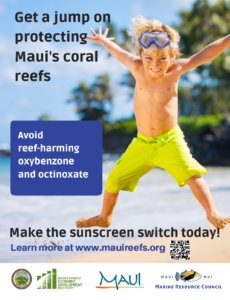
KIHEI, HI — Hawaii’s recently passed sunscreen law (HI SB 2571) doesn’t go into effect until January 1, 2021, but a Maui-based marine conservation organization is launching an educational campaign to urge visitors and residents to “Get a Jump on Protecting Maui’s Coral Reefs” by switching to environmentally friendly sunscreen products now.

Maui Nui Marine Resource Council (MNMRC) is a Maui-based nonprofit celebrating 10 years of working for healthier coral reefs, clean ocean water and abundant native fish for the islands of Maui, Molokai, and Lana’i.

Maui Visitors Bureau and the County of Maui Mayor’s Office of Economic Development are supporting partners of MNMRC’s sunscreen educational campaign.

The campaign will be launched in November and will use social media, public service announcements, news releases and other outreach to urge visitors and residents to protect Maui County’s reefs by avoiding the use of sunscreen products that contain oxybenzone and octinoxate, two chemicals known to be toxic to corals and other marine life.

“The sale of sunscreens containing oxybenzone and octinoxate will be banned under Hawaii’s sunscreen law in 2021, but why wait until then?,” said Robin Newbold, co-founder and chair of Maui Nui Marine Resource Council. “Coral reefs in Hawaii and around the world are under stress due to warming ocean waters, sediment runoff, pollution and other human-related causes. While it’s important that we tackle those issues, switching to a more environmentally friendly sunscreen now is an easy way for individuals and families to help protect the reefs.”

Newbold noted that new sunscreen products made without oxybenzone and octinoxate are readily available and easy to use.

“Please read the labels before you purchase sunscreen for your trip to Maui, and avoid those products with octinoxate and oxybenzone,” said Amy Hodges, Programs Manager at Maui Nui Marine Resource Council. “Look instead for mineral-based sunscreens featuring titanium dioxide or zinc oxide. Read the labels carefully so you know how much to apply and when to reapply for ideal protection. Options such as hats, rash guards and swim tights, available online and at Maui stores, can also protect your skin and dramatically reduce the amount of sunscreen that you need to apply.”
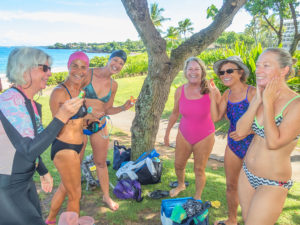
Sunscreen users are also urged to skip spray-on products, which can leave residues on beach sand that eventually get washed into the ocean. Apply sunscreen at least 20 to 30 minutes before entering the ocean, to reduce the amount that washes off into the water.

The Hawaii bill, signed into law in July by Hawaii Governor David Ige, points out the issues with oxybenzone and octinoxate, stating “the legislature finds that two chemicals contained in many sunscreens, oxybenzone and octinoxate, have significant harmful impacts on Hawaii’s marine environment and residing ecosystems, including coral reefs that protect Hawaii’s shoreline.  Oxybenzone and octinoxate cause mortality in developing coral; increase coral bleaching that indicates extreme stress, even at temperatures below 87.8 degrees Fahrenheit; and cause genetic damage to coral and other marine organisms.  These chemicals have also been shown to degrade corals’ resiliency and ability to adjust to climate change factors and inhibit recruitment of new corals.  Furthermore, oxybenzone and octinoxate appear to increase the probability of endocrine disruption.”

Even in tiny amounts, oxybenzone quickly bleaches coral and impedes their growth. A single drop in 4.3 million gallons of water — about six and a half Olympic-size swimming pools — can be deadly to corals.

An estimated 14,000 tons of sunscreen lotions end up in ocean waters around coral reefs around the world each year.
Even if you live away from the ocean, chemicals from your sunscreen will wash off your body and eventually find their way into the water table and ultimately into the ocean.

Maui Nui Marine Resource Council asks that you choose to be sunscreen smart wherever you live, to do your part to protect your skin and coral reefs.

For helpful tips on making the sunscreen switch, visit https://www.mauireefs.org/10-ways-become-sunscreen-smart/

To learn more about Maui Nui Marine Resource Council, visit www.mauireefs.org.

About Maui Nui Marine Resource Council:
A Maui-based nonprofit organization founded in 2007, Maui Nui Marine Resource Council is working for healthy coral reefs, clean ocean water and abundant native fish for the islands of Maui County. Current projects include ocean water quality testing in South and West Maui, work to improve ocean water quality in Ma’alaea Bay, ongoing studies of corals in Olowalu and Ma’alaea, and outreach programs to educate visitors about protecting Maui’s coral reefs.

Photo credit:

“Swimmers testing out reef-safe sunscreens” courtesy Don Bloom, Tropical Light Photography


Maui Nui Marine Resource Council Recipient of Funds Raised at September Meeting of 100+ Women Who Care – Maui

in /by

Maui Nui Marine Resource Council’s community-based ocean water quality monitoring program was awarded $12,500 in funds raised at the September 2018 meeting of “100+ Women Who Care – Maui,” a group that holds quarterly meetings to raise funds for local nonprofits, charities and causes.

According to the 100+ Women Who Care – Maui website, the group’s members meet four times each year, with each meeting lasting one hour. Each member (and their guest) brings a check for $100 or more. Any member can nominate local charities, non-profits, or worthy causes, whose names are put into a hat. Three names are drawn at random. The group then votes by secret ballot to choose one of the organizations or causes to support, with a collective donation that typically amounts to $10,000 or more.

Michelle Griffoul, a member of 100+ Women Who Care – Maui and a board member of Maui Nui Marine Resource Council, nominated Maui Nui Marine Resource Council to support the organization’s work for clean ocean water, including its ocean water quality testing program (Hui O Ka Wai Ola – Association of Living Waters). She spoke from the heart about her firsthand experience as a volunteer with this innovative monitoring program, which works with dozens of local volunteers to regularly test ocean water quality at 39 locations along the south and west coastlines of Maui.

The members voted by secret ballot and selected Maui Nui Marine Resource Council as the recipient of the funds raised at the meeting.

“We’re grateful to all of the community-minded women in this group who chose to support our efforts for clean ocean water, including our ocean water quality testing program,” says Robin Newbold, MNMRC co-founder and chair. “Maui Nui Marine Resource Council is proud to be a co-manager of this unique program and we are grateful for all in our community who make it possible.”

“Clean ocean water is essential for healthy coral reefs. It’s also important to visitors and residents who enjoy swimming, snorkeling, diving, paddling, fishing and surfing along Maui’s coasts,” said Newbold. “Our ocean water quality testing program and the data it generates is critical in our work for clean ocean water for Maui.”

Founded in 2007, Maui Nui Marine Resource Council is a Maui-based nonprofit organization that works for healthy coral reefs, clean ocean water and an abundance of native fish for the islands of Maui County. To learn more about Maui Nui Marine Resource Council or to donate, please visit www.mauireefs.org.

To learn more about 100 Women Who Care – Maui, please visit https://100womenwhocaremaui.org

Public Invited to Free Presentation on “Sunflower Farming: A Sustainable Model for Maui’s Former Sugar Cane Lands That Benefits Local Coral Reefs” on Wednesday, October 3 

in /by

Can fields of cheerful golden-yellow sunflowers be a model for creative and sustainable ways to use Maui’s former sugar cane lands that also have a positive impact on Maui’s coral reefs? Come explore this topic at a free presentation by Pacific Biodiesel at Maui Nui Marine Resource Council’s monthly meeting on Wednesday, October 3 from 5:30 to 7:30 pm at Pacific Whale Foundation’s classrooms at the Ma’alaea Harbor Shops. The public is invited, admission is free and refreshments will be served.

“Maui Nui Marine Resource Council is a local nonprofit that works for clean ocean water, healthy coral reefs and restoring an abundance of native fish,” says Robin Newbold, co-founder and chair of the organization. “We strongly believe that coral reef conservation requires a ‘mauka to makai’ (mountains to sea) approach, which means looking at upslope activities including use of our island’s former sugar cane lands. We’re pleased to present this talk about one farming model that ties together sustainable agriculture and protection of our local environment, including the reefs.”

The presenter will be Joy Galatro, marketing director at Maui-based Pacific Biodiesel, a renewable energy company that has devoted the past two decades to keeping used cooking oil out of our local landfill by recycling it into a renewable fuel. Trilogy Excursions and Extended Horizons use this non-toxic, biodegradable fuel (called biodiesel) to help power their vessels for snorkeling, whalewatching and other cruises.

During the past two years, Pacific Biodiesel has converted 200 acres of former sugar cane land in Maui’s central valley into fields of sunflowers, raised without pesticides or herbicides, no GMO crops, requiring little irrigation and home to 15 thriving bee hives. Once harvested, the sunflower seeds are pressed into a full-flavored oil that has won favor by local chefs.

Recently, the company has incorporated the oils into its new Kuleana® natural beauty products line — including its newly launched Kuleana® Sunscreens made from plant-based oils including the company’s Maui Sunflower Oil, minerals, and other reef-safe natural ingredients. The new sunscreen does not contain ecologically harmful chemicals such as oxybenzone and octinoxate – two chemicals known to be toxic to corals and other marine life and recently banned by Hawaiʻi’s new sunscreen law.

In addition to its environmentally friendly formulation, Kuleana Sunscreen aims to support environmental organizations in the state through its membership in 1% for the Planet, a global organization that connects dollars and doers to accelerate smart environmental giving.

“We are proud to offer consumers another natural product that aligns with our state’s environmental goals to protect and preserve fragile marine ecosystems, including coral reefs,” said Galatro, “Practicing sustainability and protecting the environment are central to our company’s mission.” For more information, visit Biodiesel.com and KuleanaBeauty.com.

About Maui Nui Marine Resource Council:
A Maui-based nonprofit organization founded in 2007, Maui Nui Marine Resource Council is working for healthy coral reefs, clean ocean water and abundant native fish for the islands of Maui County. Current projects include ocean water quality testing in South and West Maui, work to improve ocean water quality in Ma’alaea Bay, ongoing studies of corals in Olowalu and Ma’alaea, and outreach programs to educate visitors about protecting Maui’s coral reefs. To learn more, visit www.mauireefs.org.

Free Talk: “Dr. Dolittle Meets CSI on the Coral Reefs of Maui” on September 5, 2018

in , /by

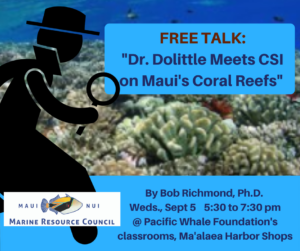
Forensics and diagnostics are all part of the scientific study of coral reefs, which is why Bob Richmond Ph.D., Research Professor and Director of Kewalo Marine Laboratory at the University of Hawaii at Manoa, will be presenting a free talk titled, “Dr. Dolittle Meets CSI on the Coral Reefs of Maui” at the upcoming September 5 meeting of the Maui Nui Marine Resource Council. This event will take place from 5:30 to 7:30 pm at Pacific Whale Foundation’s classrooms at the ocean-facing lower level of the Ma’alaea Harbor Shops, 300 Ma’alaea Road, Ma’alaea (next to Maui Ocean Center).

Dr. Richmond’s talk will explain how his team is using diagnostics and forensics to identify causes of stress to Maui’s reefs at Olowalu, Waihikuli, amd Honokowai, along with ways to enhance the reef’s resistance to these stressors.
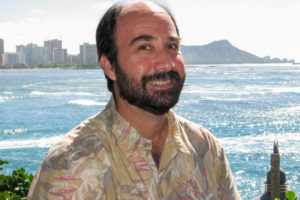
Dr. Richmond’s childhood fascination with Dr. Dolittle helped inspire his approach to studying reefs by “listening” to coral reefs and other reef creatures through the use of ecological indicators and molecular biomarkers.

“Maui has some of the most well developed coral reefs in the Main Hawaiian Islands, but these have been negatively affected by local and global stressors including land-based sources of pollution and sedimentation from watershed discharges, overfishing, and bleaching due to climate change,” said Dr. Richmond.

“Our research blends traditional ecological knowledge with ecology and molecular biology to both diagnose and treat the causes of coral reef decline,” he noted. “Our approach can best be described as Dr. Dolittle meets CSI (crime scene investigations) on coral reefs and uses a combination of diagnostics and forensics.”

“The results of our reef studies on reefs at Waihikuli, Honokowai and Olowalu will be presented and ideas for helping these reefs recover will be discussed,” he said.

Dr. Richmond is the Chair of the Maui Coral Reef Recovery Team, a group of Hawaii’s most recognized coral reef scientists, resource managers, fishers, cultural advisors and communitymembers, first convened by Maui Nui Marine Resource Council in 2010. The group wrote the Maui Coral Reef Recovery Plan, a 101-page science-based plan that outlines specific goals and steps to protect Maui’s coral reefs. Team members continue to meet regularly to provide guidance and monitor progress toward implementing the plan.
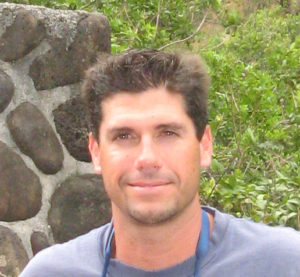
Dr. Richmond has spent the majority of his professional career studying coral reefs in Micronesia, Hawaii, Japan, Central America, the Galapagos Islands and the Caribbean. His research interests are in the area of marine conservation biology, with a focus on coral reefs. His research programs include studies of coral reproductive biology, ecotoxicology, coral reef ecology, the impacts of climate change and bridging sound science to policy development and implementation.

Dr. Richmond received a Ph.D. in Biological Sciences from the Dept. of Ecology and Evolution, SUNY at Stony Brook, and subsequently spent two years as a postdoctoral fellow at the Smithsonian Tropical Research Institute in Panama, 18 years on the faculty of the University of Guam Marine Laboratory, and has been a Research Professor at the Pacific Biosciences Research Center, University of Hawaii at Manoa, since 2004.

Maui Nui Marine Resource Council is funding Dr. Richmond’s studies of corals in Olowalu and Ma’alaea. A nonprofit organization founded in 2007, Maui Nui Marine Resource Council is working for clean ocean water, healthy coral reefs and an abundance of native fish for the islands of Maui County. To learn more, visit www.mauireefs.org.

View movie about this talk.

Dr. Mark Deakos to Present Talk on “Chasing Happiness and Its Impact on the Planet” at Maui Nui Marine Resource Council’s August 1 Meeting

in /by

MA’ALAEA, HI – Many people know Dr. Mark Deakos as a researcher, scientist and community activist, known for his studies of Maui’s manta rays and his efforts to protect our local coral reefs. Deakos will be presenting a talk with a larger, more global perspective, on the topic of “Chasing Happiness and Its Impact on the Planet” as part of Maui Nui Marine Resource Council’s upcoming August meeting.

The public is invited to this free presentation and meeting on Wednesday, August 1, from 5:30 pm to 7:30 pm at Pacific Whale Foundation’s classrooms at the ocean level of the Ma’alaea Harbor Shops at 300 Ma’alaea Road. (Please note the later start time.) Refreshments will be served. The doors open at 5:00 pm.

“Is it possible to have long, healthy and happy lives for all people across the globe without destroying our planet’s natural resources?,” asks Deakos. “My talk will explore the science of happiness and how pursuing selfish interests can actually be good for the planet.”
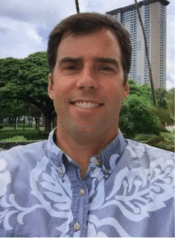
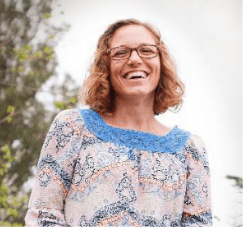

At one time a competitive swimmer and water polo player, Deakos now spends much of his time in saltwater as an avid scuba diver, free diver, kayaker and mariner. His chosen career working in wildlife biology and marine research is an extension of his passion for the natural world and his marvel of the ocean environment.

“I was fortunate to experience living in various countries around the globe during my early years,” says Deakos. “A common thread in my life has always been water.”

Dr. Deakos obtained his biology degree from the University of Waterloo in Canada where he began pursuing his interest in wildlife biology. After working with several avian and reptile species, his interests rapidly returned to the ocean and towards marine mammals, which eventually led him to Hawaii in 1996.

At the University of Hawaii, he completed his master’s degree studying humpback whale behavior, and completed his doctoral degree in 2010 focusing on manta ray ecology. In 2004, he founded The Hawai’i Association for Marine Education and Research (HAMER), a not-for-profit 501 (c) 3 corporation with the mission of better understanding and protecting Hawaii’s marine resources.

Aside from his continued involvement to learn about and protect manta rays here in Hawaii, Mark is the Deputy Program Manager for HDR Environmental, Operations, and Constructions Inc., Norfolk, Virginia, tasked with managing the Navy’s Protected Species Monitoring Program in the Pacific. He is also an active member of various community groups working towards solutions to some of our greatest environmental threats, and is a founding member of Maui Nui Marine Resource Council.

The host of the event, Maui Nui Marine Resource Council, is a nonprofit Maui-based organization which recently celebrated its 10th anniversary of working for clean ocean water, healthy coral reefs and abundant native fish for the islands of Maui County.

Maui Nui Marine Resource Council’s work includes an ocean water quality testing program known as Hui O Ka Wai Ola, which currently tests 39 locations from Makena to Kapalua, a program to reduce water pollution in Ma’alaea Harbor and a study to determine which genetic strains of Olowalu’s corals are most resistant to stressors such as temperature and pollution. To learn more about Maui Nui Marine Resource Council, please visit www.mauireefs.org.

Public Invited to Free Presentation on Impacts of Climate Change on Maui’s Coastal Areas 

in /by

The public is invited to learn more about the impacts of climate change on Maui’s coastal areas, including big waves, flooding, erosion and more, at Maui Nui Marine Resource Council’s meeting on Wednesday, July 11. The meeting takes place from 5 to 7 pm at Pacific Whale Foundation’s classrooms at the Ma’alaea Harbor Shops. All are invited.

The climate change presentation will be offered by these guest presenters:

– Bradley Romine, PhD, Coastal Management and Resilience Specialist, University of Hawaii Sea Grant Program, Center for Coastal and Climate Science and Resilience.

– Tara Owens, Coastal Processes and Hazards Specialist, University of Hawaii Sea Grant College Program (partnered with Maui County’s Planning Department).

Attendees are welcome to bring questions about managed retreat, beach replenishment and other issues relating to the impact of climate change on Maui’s shorelines.

The meeting is free and open to all. Refreshments will be provided.

Established in 2007, Maui Nui Marine Resource Council (MNMRC) is a community-based nonprofit dedicated to clean ocean water, healthy coral reefs and abundant native fish for Maui County. The meeting will include updates on our projects, including the Hui O Ka Wai Ola water quality monitoring program, Olowalu coral reef study and efforts to improve water quality in Ma’alaea Harbor. Copies of MNMRC’s 10th anniversary annual report will be available to take home.

To learn more, visit www.mauireefs.org.

Presenter bios:

Bradley Romine, PhD
Coastal Management and Resilience Specialist
University of Hawaii Sea Grant College Program,
Center for Coastal and Climate Science and Resilience

Brad’s role as University of Hawaiʻi Sea Grant extension faculty is to provide bridges between the university, our communities, and government to meet the complimentary goals of conserving coastal environments and reducing natural hazards risk to shoreline development. He works closely with the Office of Conservation and Coastal Lands at the Hawaiʻi Department of Land and Natural Resources (DLNR) and interfaces with other government agencies and the public on collaborative projects to support planning and decision-making based on the latest and best-available coastal and climate science. Recently, he provided scientific and technical guidance to the DLNR for the development of the Hawaiʻi Sea Level Rise Vulnerability and Adaptation Report. He is also leading the development of science-based planning tools and guidance to improve resilience to coastal hazards and sea level rise in Hawaiʻi through funding from the National Oceanic and Atmospheric Administration. Brad completed his PhD in Geology and Geophysics at the University of Hawaiʻi at Mānoa in 2013 and has published research articles on coastal geology, beach processes, shoreline change, and sea level rise impacts in Hawaiʻi.

Tara Owens
Coastal Processes and Hazards Specialist
University of Hawaii Sea Grant College Program

Tara Owens is Extension Faculty with the University of Hawaii Sea Grant College  Program,  specializing  in  coastal  processes  and  coastal  hazards.    Partnered  with  Maui  County’s  Planning  Department,  Tara’s  role  is  to  “bridge  the  gap”  between  science  and  policy  and  planning  for  improved  coastal  management  by  providing  technical  guidance,  consultations,  site  visits,  and  public  outreach.  Tara  also  interfaces  with  other  government  agencies  and  the  public  on  collaborative  projects  pertaining  to   coastal  hazards,  including  beach  erosion  and  sea-level  rise  impacts.   Tara  earned  a  bachelor  of  science  degree  in  marine  science  from  Coastal  Carolina  University,  and  a  master’s  degree  in  coastal  geology  from  the  University  of  Hawaii.   She  was  hired  by  UH  Sea  Grant  and  moved  back  to  Hawaii  in   2010  after  working  for  7  years  in  the  federal  government  at  the  U.S.  Geological  Survey  in  St.  Petersburg,  Florida  and  then  at  the  NOAA  Coastal  Services  Center  in Charleston, SC.

Beach photo by John Seebart