Blog Archives: News Releases

Clean Ocean Water Viewed as a Priority to Help Mauiʻs Corals Survive
 Warming Ocean Temperatures and Coral Bleaching

in /by

MAʻALAEA, MAUI, HI –   With the New Year approaching, Maui residents are looking back at the widespread coral bleaching that occurred in 2019 and considering ways to help their local coral reefs better survive warming ocean waters in the future.

One answer is to work for cleaner ocean water in the nearshore areas where Maui’s fringing coral reefs are found. That’s where a unique volunteer-based ocean water quality monitoring program comes in. The program, called “Hui O Ka Wai Ola” (Association of Living Waters), monitors ocean water quality at 41 locations in South and West Maui, working with more than 35 dedicated volunteers from the community.

“Coral reefs are extremely susceptible to even slight changes in ocean chemistry,” says Amy Hodges, Programs Manager at Maui Nui Marine Resource Council, an award-winning nonprofit that helped create and continues to co-manage the monitoring program with partner organizations The Nature Conservancy and West Maui Ridge to Reef Initiative. “To protect the corals, we need to understand the ocean chemistry of our coastal areas, so we can better protect our reef ecosystems from harm and improve their resiliency against stressors such as warming ocean water.”

The program works in close partnership with the State of Hawaii Department of Health Clean Water Branch, following strict protocol to generate reliable data that will help local government and the community identify where and why ocean water quality is impaired, to better identify causes and enact solutions.

The program gathers data on 13 water quality factors, including turbidity, temperature, salinity, dissolved oxygen (DO), pH and dissolved nutrients including nitrogen and phosphorous at each site.

“Excessive amounts of nutrients such as nitrogen and phosphorous from fertilizers or wastewater can cause excessive overgrowths of algae, which can smother corals,” says James Strickland, Project Manager. “Sediment washing into the ocean from unused agricultural fields, construction sites or areas where wildfires have stripped away vegetation can also stress corals.”

“We gather this data to help our community solve these ocean water quality problems, and ultimately, to give Mauiʻs reefs their best shot at survival,” says Strickland.

Hui O Ka Wai Ola is supported by Hawaii Tourism Authority, Maui County’s Mayor’s Office of Economic Development, grants and donations. Lab space is donated by Hawaiian Islands Humpback Whale National Marine Sanctuary and Lahainaluna High School. View the data at  www.huiokawaiola.com.

Caption: A volunteer with the Hui O Ka Wai Ola ocean water quality monitoring program on Maui records data collected at one of the 41 locations monitored every three weeks. The volunteers conduct initial testing using mobile labs transported in their cars, then bring the water quality samples to indoor lab space donated by the Hawaiian Islands Humpback Whale National Marine Sanctuary and Lahainaluna High School for additional testing. The program is supported by Hawaii Tourism Authority, County of Maui Mayorʻs Office of Economic Development, Napili Bay and Beach Foundation, North Beach West Maui Benefit Fund, Honua Kai West Maui Community Fund, LUSH Cosmetics Charity Pot, Makana Aloha Foundation and other groups and individuals.
On Maui, the “World’s Best Island,” Citizens Volunteer to Support Clean Ocean Water

in , /by

PRNewswire/ — For 20 years, Maui has been voted the world’s #1 island in the annual Conde Nast Readers’ Choice Awards. In addition to spectacular beaches, breathtaking scenery and a rich cultural heritage, Maui can also boast about the dozens of residents who are so passionate about clean ocean water that they volunteer year-round to help monitor Maui?s coastal water quality.

“Our volunteers are keenly aware that clean ocean water is essential for healthy coral reefs, and important for all who enjoy recreating in our coastal waters,” explains Robin Newbold, chair and co-founder of Maui Nui Marine Resource Council (MNMRC) an award-winning Maui-based nonprofit.

Three years ago, MNMRC joined forces with The Nature Conservancy and West Maui Ridge to Reef Initiative to launch a unique community-based ocean water quality monitoring program called Hui O Ka Wai Ola (Association of Living Waters). The program partners with Hawaii’s State Department of Health Clean Water Branch to provide quality-assured data that can be relied upon by local, state and federal government, as well as community groups and researchers.

“Our goal is to generate scientific data that identifies where Maui’s nearshore ocean water quality is impaired or declining, so we can work with the community to identify the causes and find solutions,” said Newbold.

With over 40 trained volunteers and donations from the community, including support from the County of Maui Mayor’s Office of Economic Development and Hawaii Tourism Authority, the program personnel are able to regularly test ocean water quality at 41 locations in South and West Maui year’round.

The volunteers test for water clarity, as well as pH, dissolved oxygen, water temperature, and nutrients including nitrogen and phosphorous. The resulting data is shared openly on the www.HuiOKaWaiOla.com website and at community meetings.

“In West Maui, the primary water quality issue is sediment in the water, which research has shown is due to the legacy of plantation agriculture which caused top soil to erode into streams and gulches,” says James Strickland, Program Manager of Hui O Ka Wai Ola. “In South Maui, the major issue is excessive nutrients, from sources such as fertilizers and wastewater. Both sediment and nutrients degrade coral reefs.”

The program is supported by Hawaii Tourism Authority, County of Maui Mayor’s Office of Economic Development, foundations and donors.

For info, visit www.mauireefs.org or www.huiokawaiola.com

Photo caption: Along the coast of Maui, a group of trained volunteers practices gathering ocean water quality samples through the unique community-based Hui O Ka Wai Ola (Association of Living Waters) monitoring program. Nearly 40 volunteers sample water quality at 41 beaches in South and West Maui every three weeks year-round. Data from the program is readily accepted by the State of Hawaii Department of Health Clean Water Branch and is shared publicly at www.huiokawaiola.com and at www.mauireefs.org.

Public Invited to Free Talk by Duane Sparkman on “Preventing Ocean Pollution: Proven Alternatives to Herbicides and Pesticides for Your Home, Business and Landscaping”

in /by

The public is invited to learn about ways to prevent harmful ocean pollution by choosing tested alternatives to herbicides and pesticides for their homes and businesses, and all of their landscaping, at a free presentation by Duane Sparkman, Assistant Chief Engineer and Landscaping Manager at The Westin Maui Resort & Spa.
The talk is part of Maui Nui Marine Resource Council’s “Know Your Ocean Speaker Series” and will take place on Tuesday, January 7, 2020 at 5:30 pm at The Sphere at Maui Ocean Center. Admission is free, but reservations are encouraged, due to limited seating at The Sphere. To make a free reservation, please go to https://bit.ly/DuaneSparkman.

Sparkman offers a wealth of practical first-hand experience about what works to control pests and weeds, based on his years of experience as a professional landscaper, designing and maintaining luxury resort properties and private residences, his work at Haleakala National Park’s Vegetation Management Division and recently, as the Assistant Engineer and Landscaping Manager at The Westin Maui.

At The Westin Maui, Sparkman has successfully implemented measures to reduce the resort’s use of herbicides and pesticides, showcasing alternatives that are safer and more environmentally friendly.

“We are offering this presentation as part of launching the New Year, hoping that more people will resolve to find ways to protect our coral reefs and marine environment by reducing or avoiding the use of herbicides and pesticides in their homes, yards and at their places of employment, including golf courses and resorts,” says Robin Newbold, Chair of Maui Nui Marine Resource Council.

Newbold points out that most people don’t realize how porous our soil is on Maui and how readily chemicals from pesticides and herbicides find their way into the ocean, causing harm to fish, birds and corals.

According to the NOAA Ocean Service Education website, pesticides are designed to be toxic to a target organism, but they often kill other organisms as well. “The insecticide azinphos-methyl, for example, which is used to control insects such as biting mites and aphids, is also very toxic to fish and birds.” The website notes that many of the compounds used today are toxic at very low concentrations.

Herbicides also penetrate coral tissues and rapidly, within minutes, can reduce the efficiency of the beneficial algae (zooxanthellae ) that live within the corals, as reported in “Chemical Pollution on Coral Reefs: Exposure and Ecological Effects Ecological Impacts of Toxic Chemicals, 2011,” written by Joost W. van Dam, Andrew P. Negri, Sven Uthicke and Jochen F. Mueller, and published in the book, Ecological Impacts of Toxic Chemicals, by Bentham Science Publishers Ltd.  The zooxanthellae convert the energy from the sun into food for the corals through photosynthesis, providing corals with about 90% of their food. When herbicides enter the ocean, they can cause the corals to suffer due to reduced food availability.

“We owe it to our coral reefs and ocean water to find better ways to manage pests and weeds without adding harmful chemicals to our land- and marine-ecosystems,” says Newbold. “We’re grateful that Duane Sparkman is willing to share his practical, hands-on knowledge and experience with us all.”

Maui Nui Marine Resource Council also acknowledges and thanks Maui Ocean Center for providing free meeting space at The Sphere for this event.

About Duane Sparkman:
A resident of Maui since 1995 arriving here from Texas, Duane is an avid photographer who aspires to capture “rare moments”. His life’s passion is to preserve intact Hawaiian forests and the perpetuation of Hawaiian Culture. Duane is a professional landscaper by trade, designing and maintaining luxury resort properties, private residences, and working on projects within the Haleakala National Park, Vegetation Management Division. When he is not working or volunteering his time with various Hawaiian reforestation projects “putting back what belongs” he enjoys spending time with his wife, Erin and 2 children, Evan and Isabella cultivating his back yard native forest.

About The Westin Maui Resort & Spa:
Centrally located on pristine Ka’anapali Beach, the spectacular transformations within this resort will completely reimagine many areas of the 12-acre tropical paradise. Surrounded by lush gardens with cascading waterfalls, the 770-room beachfront resort abounds with ways to rejuvenate. Guests can indulge in six outdoor pools that include a brand new family pool and dedicated adults-only pool, spa rejuvenation, unique dining experiences and cultural activities. It is mere steps away from snorkel and sunset cruises, neighboring Whalers Village and championship golfing. Visit www.westinmaui.com.


About Maui Nui Marine Resource Council

Maui Nui Marine Resource Council is a community-based nonprofit organization celebrating 11 years of working for healthy coral reefs, clean ocean water and abundant native fish throughout Maui County. Our work includes co-managing the Hui O Ka Wai Ola Ocean Water Quality Monitoring Program at 41 sites in South and West Maui, efforts to reduce pollution in Ma‘alaea Bay (through erosion-control efforts in the Pohakea watershed and using oysters to filter sediment and pollutants from ocean water), coral reef research, visitor education programs and more. Learn more at www.mauireefs.org.

About Maui Ocean Center 
Since 1998, Maui Ocean Center has fostered understanding, wonder and respect for Hawaiʻi’s marine life, drawing thousands of visitors from across the globe. The three-acre marine park, located in Wailuku, Maui, faithfully replicates the natural ocean ecosystem featuring only animals who are native to Hawai’i. The center features the largest collection of live Pacific corals in the world, over 60 exhibits, 20 daily presentations by marine naturalists, outdoor tide pools and a 750,000-gallon Open Ocean exhibit with a 240-degree view acrylic tunnel. Maui Ocean Center operates in compliance with a County of Maui ordinance prohibiting the exhibit of cetaceans (whales and dolphins) and offers exploration of these creatures through interpretive displays, including its cutting-edge “Humpbacks of Hawai‘i” Exhibit & Sphere. Under the guidance of Kahu Dane Maxwell, the aquarium integrates Hawaiian culture in presentations, exhibits, special events, and also in the marine park’s standards of operations and service.  For more information, please visit https://mauioceancenter.com.


Free Talk on “The Coral Pledge” Initiative Created by Hawaii’s DLNR to Reduce Human Impacts on Hawaii’s Coral Reefs

in /by

Maui Nui Marine Resource Council invites the public to a free talk on Monday, December 9 at 5:30 pm at The Sphere at Maui Ocean Center to learn about the “The Coral Pledge,” a new initiative to reduce human impacts on Hawaiiʻs reefs year-round.

The presenter will be Dan Dennison, Senior Communications Manager for the Hawaii Dept. of Land and Natural Resources (DLNR). The Coral Pledge was created by the DLNR Division of Aquatic Resources and was introduced statewide earlier this month.

The eveningʻs presentation will include details about The Coral Pledge and will feature a showing of “Saving Coral,” a  half-hour television special created by DLNR to educate the public about threats to Hawaii’s coral reefs. Dennison will also provide updates on “30 x 30” which is a State of Hawaii commitment to effectively manage 30% of Hawaiiʻs nearshore ocean waters by 2030.

At the conclusion of the evening, Maui Ocean Center will also provide a special holiday treat for attendees: a viewing of the movie, “Humpbacks of Hawaii,” to be shown in 3D at The Sphere.

“The Coral Pledge provides a simple set of recommendations to help reduce human impacts to Hawai‘i reefs year-round, but particularly during bleaching events,” says Dennison. “While all ocean users can learn from the recommendations in The Coral Pledge, we especially encourage commercial tour operators and businesses who work in and around the ocean, and who regularly interact with visitors, to attend to learn about The Coral Pledge and hopefully to sign up to participate in this initiative.”

Admission to this event is free and the public is invited. Because seating is limited in The Sphere, the public is encouraged to make a free reservation by visiting https://bit.ly/coralpledge. 

Maui Ocean Center is donating the use of The Sphere to Maui Nui Marine Resource Council for this presentation. This new facility features comfortable movie-style seating, excellent acoustics and state-of-the-art video equipment with a large presentation screen.

Maui Nui Marine Resource Council holds free public presentations on the first Wednesday of each month, as part of its “Know Your Ocean Speaker Series.” However, this Monday, December 9 presentation on The Coral Pledge will replace Maui Nui Marine Resource Council’s regularly scheduled meeting for December.

About Dan Dennison


Dan Dennison currently serves as the Senior Communications Manager for the Hawaii Dept. of Land and Natural Resources. Dan brings more than four decades of broadcast journalism experience to his current position.

Prior to joining DLNR in 2014, Dan served as news director at six, top-rated television stations, in four states, including KHON2 and KHNL/K5 in Honolulu. He began his news management career in his native Colorado after being a television reporter and photographer for 25 years covering Western Colorado for Denver television stations. He has multiple Emmy awards, state broadcaster association awards, and Edward R. Murrow awards both as a reporter and news director.

At DLNR, Dan has been responsible for the production of more than 1.000 videos to date, including seven television specials. He supervises a team of communications specialists who handle all internal/external communications, media relations, and social media.

Dan has served on numerous state and national boards both as a broadcaster and now as a government communications professional. He is an avid hiker, bicyclist, snorkeler, skier, and loves to play tennis and Frisbee. He says he is both blessed and honored to document the work of DLNR staff and its many partners in the mountains, forests, and waters that comprise Hawaii Nei. “The best job in the world,” he says.


About Maui Nui Marine Resource Council

Maui Nui Marine Resource Council is a community-based nonprofit organization celebrating 11 years of working for healthy coral reefs, clean ocean water and abundant native fish throughout Maui County. Our work includes co-managing the Hui O Ka Wai Ola Ocean Water Quality Monitoring Program at 41 sites in South and West Maui, efforts to reduce pollution in Ma‘alaea Bay (through erosion-control efforts in the Pohakea watershed and using oysters to filter sediment and pollutants from ocean water), coral reef research, visitor education programs and more. Learn more at www.mauireefs.org.

Photo caption:
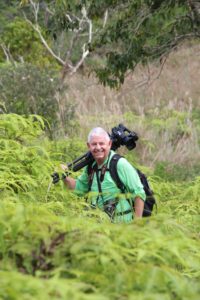
Dan spends a great deal of time shooting video and photographs in remote areas of Hawai’i to provide material for media coverage.


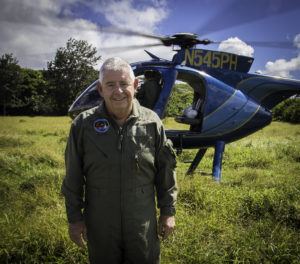
Dennison has been involved from the beginning in producing media materials to raise public awareness about Rapid Ohia Death.


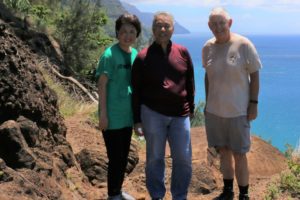
Dan Dennison with Governor and First Lady Ige, hiking the Kalalau Trail in conjunction with the reopening of the Napali Coast State Wilderness Park and Ha’ena State Park on Kaua’i.

Maui Nui Marine Resource Council Presents Free Talk on “Wildfire and Sediment: Addressing Two of the Biggest Threats to Māʻalaea Bay and its Coral Reefs”

in /by

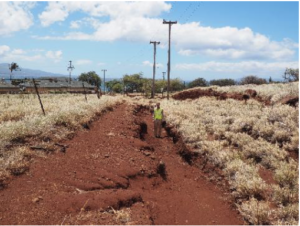
Wildfire and sediment are two of the biggest threats to ocean water quality in Māʻalaea Bay. Wildfires burn away the plant cover on upslope lands, creating prime conditions for soil erosion. Erosion results in sediment in the ocean, which harms coral reefs, hindering their ability to feed, grow and reproduce.

What can be done about these threats to Māʻalaea Bay? Maui Nui Marine Resource Council invites you to learn more at a free talk on Wednesday, November 13 at 5:30 pm at The Sphere at Maui Ocean Center. Admission is free and the public is invited. Seating is limited, so advance reservations are suggested. To make your complimentary reservation, visit https://bit.ly/wildfireandsediment

Speaker Michael Reyes, Senior Ecologist at Maui Environmental Consulting, will take participants on a virtual trip to the Pohakea watershed above Māʻalaea, to learn about plans to mitigate wildfires in the area and resolve problems that currently contribute to erosion.

Reyes will be sharing the findings and the action steps outlined in the “Vision for Pohakea” plan that Maui Environmental Consulting created on behalf of Maui Nui Marine Resource Council.

Maui Nui Marine Resource Council is in the process of taking the first steps to implement that plan.

The evening will also include updates on Maui Nui Marine Resource Councilʻs pilot project to use caged oysters to help improve ocean water quality in Māʻalaea Harbor. Amy Hodges, Maui Nui Marine Resource Council’s Programs Manager will speak about this project and will show photos of the oysters that are being raised for this project.

To arrange for your free reservation, follow this link: https://bit.ly/wildfireandsediment

About Michael Reyes:

Michael Reyes is the Principal and Senior Ecologist at Maui Environmental Consulting, LLC (MEC). His educational and professional experiences have provided him with an extensive background in several aspects of ecology and water quality. He has experience in environmental assessments, water quality evaluations, surface water monitoring, listed species surveys, and numerous wetland delineations/evaluations. Mike has been certified by the National Society for Wetland Scientists as a Professional Wetland Scientist (PWS#2303). He serves as an Associate Director for the Central Maui Soil and Water Conservation District and acts as the Watershed Coordinator for the Southwest Maui Watershed Plan.

Working with Maui Nui Marine Resource Council, MEC developed the Pohakea Stormwater Management Plan. This project involved canvassing the Pohakea watershed for current landscape conditions affecting water quality within Māʻalaea Bay. While this study focused on erosion and sediment transport caused by surface water flow during stormwater events, any on-site observations of nutrient, pathogen, or other pollutant sources, as well as any other land management practices that may be contributing to water quality degradation in Maʻalaea Bay or Maʻalaea Harbor were recorded. Implementation projects were then designed to address these sources of pollution. Michael will be offering a brief review of the Pohakea Stormwater Management Plan.

About Maui Nui Marine Resource Council
Maui Nui Marine Resource Council is a community-based nonprofit organization celebrating 11 years of working for healthy coral reefs, clean ocean water and abundant native fish throughout Maui County. Our work includes co-managing the Hui O Ka Wai Ola Ocean Water Quality Monitoring Program at 41 sites in South and West Maui, efforts to reduce pollution in Ma‘alaea Bay (through erosion-control efforts in the Pohakea watershed and using oysters to filter sediment and pollutants from ocean water), coral reef research, visitor education programs and more. Learn more at www.mauireefs.org.

“Ola Nā Papa i Pūlama ‘ia:  A Tribute to Maui’s Living Coral Reefs” To Be Presented on November 6 by Maui Nui Marine Resource Council

in /by

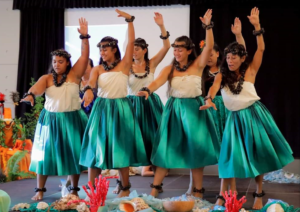
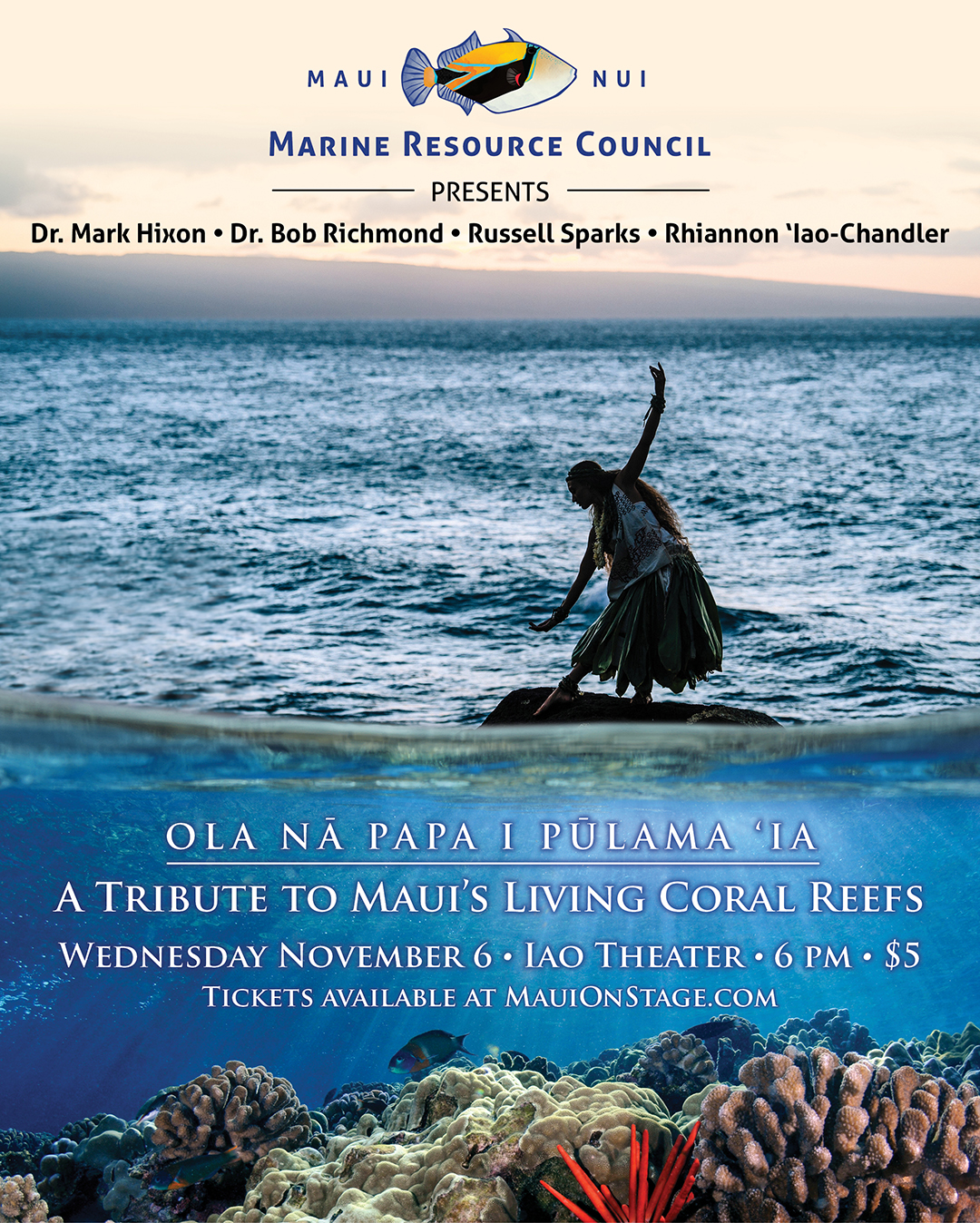
KAHULUI, HI — An event titled “Ola Nā Papa i Pūlama ‘ia:  A Tribute to Maui’s Living Coral Reefs” will be presented by Maui Nui Marine Resource Council on Wednesday, November 6 at 6 pm at ‘Iao Theater in Wailuku. The purpose of the event is to bring together Hawaiian culture and science to celebrate Hawaiʻiʻs coral reefs and promote better understanding of these remarkable undersea communities. It will feature presentations by three of Hawaii’s most noted coral scientists, Dr. Mark Hixon, Dr. Bob Richmond and Russell Sparks, plus a presentation on the significance of coral reefs in Hawaiian culture by Rhiannon ‘Chandler-‘Īao and a hula performance by local Maui hulau, Hula Alapa’i i Malu’ulolele of Ka ‘imi Na’auao o Hawai’i Nei.

“The evening will feature hula plus four short presentations, each by an expert on coral reefs or Hawaiian culture,” said Christina Lizzi, Executive Director of Maui Nui Marine Resource Council. “This event is part of Maui Nui Marine Resource Council’s new ‘Know Your Ocean’ speaker series which kicked off in October with a presentation by Nainoa Thompson.”

This event is funded in part by the County of Maui Mayorʻs Office of Economic Development. Tickets are $5 (all inclusive) and are available at MauiOnstage.com. Complimentary tickets for students and teachers can be obtained by emailing [email protected].

Doors open at 5:30 pm and the presentations will begin at 6:00 pm.

The Tribute to Maui’s Living Coral Reefs will feature these presentations:

Performance by Hula Alapa’i i Malu’ulolele of Ka ‘imi Na’auao o Hawai’i Nei
This 20 minute performance will feature dances related to the themes of kumulipo, limu, fish, rains and the ocean.  The performance will close with Mo’olele, which was composed Lahaina’s doublehull sailing canoe (Mo’olele) and starts with “let’s go holoholo…take us into our voyage of the night.”


The value of Hawaiiʻs coral reefs as natural and cultural  resources
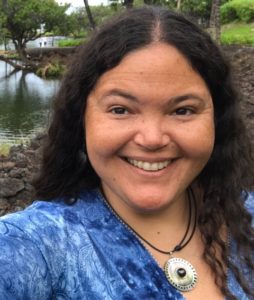
Rhiannon “Rae” Renee Tereari’i Chandler-‘Īao

The Kumulipo, the creation chant of the Hawaiian people, tells us that ʻuku koʻakoʻa or the coral polyp, was the first living organism. Discover the immeasurable value of our coral reefs to the Native Hawaiian culture and as a natural resource through this talk by Rhiannon “Rae” Renee Tereari’i Chandler-‘Īao.

Chandler-‘Īao is the Executive Director of Waterkeepers Hawaiian Islands. Chandler-‘Īao earned a B.A. in Ethnic Studies from the University of Hawai‘i at Mānoa in 2004 and graduated from the William S. Richardson School of Law in 2016 with certificates in both Native Hawaiian Rights Law and Environmental Law.  After graduating, she worked as a Post-JD Research & Teaching Fellow at Ka Huli Ao Center for Excellence in Native Hawaiian Law.  Prior to attending law school, Rhiannon served as the Executive Director of the environmental non-profit organization Community Work Day Program, d.b.a. Mālama Maui Nui.  While on Maui, Chandler-‘Īao served as a member of the Maui Nui Marine Resource Council, Maui County Cultural Resources Commission, a board member of the Maui Non-Profit Directors Association and a Steering Committee member of Ka Ipu Kukui Fellows Leadership Program.

Saving the Uhu (Parrotfishes) Can Help Save Our Reefs
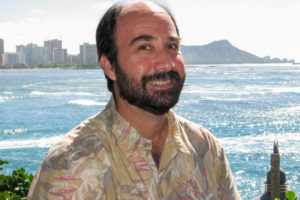
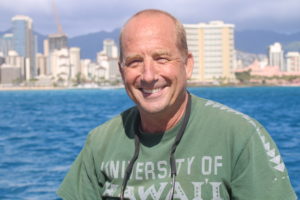
Dr. Mark Hixon

Brilliantly colored with big “smiles” created by their fused upper teeth, uhu are not only beautiful, but are also very important in helping to save both our reefs and our beaches during this time of climate disruption. Dr. Mark Hixon will explore the essential role of uhu in Hawai‘i’s coral reef ecosystem.

Dr. Hixon has been recognized as the “most cited American scientific author on coral reefs” (2003, ISI Citation Index). He is a Fulbright Senior Scholar, an Aldo Leopold Leadership Fellow, and a Fellow of the International Coral Reef Society. Dr. Hixon is the Hsiao Endowed Chair in Marine Biology at the Department of Biology, University of Hawaiʻi at Mānoa, and he serves on the scientific advisory committee for the Sustainable Hawai‘i Initiative plan for effectively managing nearshore ocean waters. Dr. Hixon has given TEDx talks about coral reefs and has published scientific studies of reefs in Hawaiʻi, Australia, French Polynesia, the Bahamas, and the Virgin Islands.

Cockroach Corals and the Sounds of our Reefs
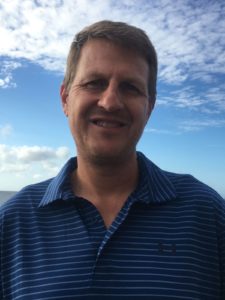
Dr. Bob Richmond

You know how hard it can be to kill a cockroach? Some corals are just as resilient, thriving in impaired, sediment-laden ocean water – conditions that normally undermine coral reef health. Dr. Bob Richmond has been studying these “cockroach corals” in Ma’alaea Harbor and Olowalu. He’ll share theories about how these corals are so resilient and their possible role in replenishing reefs harmed by climate change. Dr. Richmond will also bring examples of the sounds emitted by coral reefs and help us understand why these sounds are a useful diagnostic tool to evaluate reef health.

A Pew Fellow in Marine Conservation, a Leopold Fellow in Environmental Leadership and Past President of the International Society for Reef Studies, Dr. Richmond is the chair of the Maui Coral Recovery Team convened by Maui Nui Marine Resource Council and is a co-author of the Maui Coral Recovery Plan.

Coral Bleaching Off Maui: How Bad? And What’s Next?
Russell Sparks


Hawaiʻi is facing an unprecedented coral bleaching event, caused by overly warm ocean waters. What happened to our reefs during the last major bleaching event in 2015 and what did we learn about coral survival rates? What can we theorize about this current bleaching event and bleaching events of the future?

Russell Sparks is the Aquatic Biologist of the Division of Aquatic Resources of the State of Hawaiʻi Department of Land and Natural Resources. Sparks received his B.S. in Biology from Oregon State University. He received his M.S. in Marine Biology from University of Hawaiʻi at Mānoa in 1996. Since 1998, Russell has worked for the State of Hawaiʻi Department of Land and Natural Resources, Division of Aquatic Resources as an education specialist and more recently as an aquatic biologist. He is currently responsible for leading the design, implementation, and overall management of the Maui marine monitoring program, and for working with stakeholders and communities to develop marine management programs aimed at adaptively managing nearshore fisheries and coral reef resources.

About Maui Nui Marine Resource Council
Maui Nui Marine Resource Council is a community-based nonprofit organization celebrating 11 years of working for healthy coral reefs, clean ocean water and abundant native fish throughout Maui County. Our work includes co-managing the Hui O Ka Wai Ola Ocean Water Quality Monitoring Program at 41 sites in South and West Maui, efforts to reduce pollution in Ma‘alaea Bay (through erosion-control efforts in the Pohakea watershed and using oysters to filter sediment and pollutants from ocean water), coral reef research, visitor education programs and more. Learn more at www.mauireefs.org.

Maui Nui Marine Resource Council Receives Resilient Communities Grant

in /by

With support from the Wells Fargo Foundation and the National Fish and Wildlife Foundation, Maui Nui Marine Resource Council will enhance local capacity to address resilience challenges and prepare for natural disasters

KAHULUI, HI – Oct. 2, 2019 — Maui Nui Marine Resource Council announced today that it is the recipient of a $300,000 Resilient Communities Grant, made possible by the National Fish and Wildlife Foundation (NFWF) and the Wells Fargo Foundation, to enhance forest reserve resiliency through fuels management in the Pohakea watershed.

With funds from this grant, Maui Nui Marine Resource Council will establish and improve fuel breaks in strategically placed corridors to mitigate the pervasive cycle of wildfire and protect 3,414 acres of Forest Reserve in Ma’alaea, part of the Pohakea watershed.

According to the Hawaii Wildfire Management Organization, wildfires are increasing in frequency, size and severity on every Hawaiian Island and threaten property and access to several Maui communities. Protecting native habitats ensures the Hawaiian community can perpetuate its culture and way of life.

“It is extremely timely that we are announcing this grant today, as a wildfire rages near the windmills and the Lahaina Pali trail,” said Christina Lizzi, Executive Director, Maui Nui Marine Resource Council. “In addition to the danger they pose to people, and the road closures they cause, wildfires in this area strip vegetation off steeply-sloped land, creating prime conditions for soil erosion in heavy rain or strong winds. This ultimately leads to more sediment-laden runoff flowing into the ocean, which is harmful to coral reefs and marine wildlife.”

According to Lizzi, the Pohakea watershed drains into Ma’alaea Bay. Sediment-laden run-off from the watershed flows into the bay through ditches and culverts emptying into Ma’alaea Harbor.

“Ma’alaea Bay is home to two popular beaches, a small boat harbor, a popular surf break, coral reefs and an area where sea turtles feed,” said Lizzi. “Maui Nui Marine Resource Council is working to improve ocean water quality in this bay, through our work to prevent erosion in Pohakea watershed and also through a planned pilot project to utilize caged oysters to help remove pollutants in Ma’alaea Harbor.”

Maui Nui Marine Resource Council will engage more than 10 partner organizations plus community volunteers to create fuel breaks and establish fire-resistant plants in Pohakea watershed. The project will improve Maui’s resilience by restoring and preserving the native habitats that mitigate the negative effects of forest fires.

The grant will unlock $430,478 in matching funds, for a total conservation impact of $730,478 for Maui County.

The Maui Nui Marine Resource Council grant was among 11 Resilient Communities Program grants awarded this year, totaling $2.9 million in grants, generating an additional $5.6 million in matching contributions for nonprofit organizations and tribes across the U.S. to help communities address and mitigate the impact of natural disasters. By investing in green infrastructure and providing conservation and resilience training for community leaders, the funded projects aim to enhance the protections naturally provided by ecosystems.

“This grant is significant because it represents money that will come into Maui County, to pay local contractors to create firebreaks and help us reduce the impact of wildfires in this dry, windy area,” says Lizzi. “This grant will also help our community achieve greater resiliency in this time of drier weather and climate change.”

To date, the Resilient Communities Program has supported 27 projects in Puerto Rico and U.S. states with more than $8.9 million in program funding distributed and $29.3 million in federal and local matching funds. These projects are restoring and protecting more than 40,000 acres of land and engaging 21,500 people in conservation and capacity building. The 2019 grant winners were selected from a highly competitive pool of more than 170 applications.

“The 11 grants announced today with Wells Fargo will work to build resilience locally and to meet future challenges through natural systems and resources while also benefitting habitats for birds, fish and other wildlife,” said Jeff Trandahl, executive director and CEO of the National Fish and Wildlife Foundation. “This program demonstrates how local communities can use the benefits of natural ecosystems to provide for a more resilient future.”

Stephanie Rico of Sustainability and Corporate Responsibility at Wells Fargo said, “The devastating effects of extreme weather and longer fire seasons on local communities are impossible to ignore and tend to disproportionally impact low- and moderate-income communities. Resiliency planning is essential to the ongoing vitality of communities. By strengthening native ecosystems and building skills at the local level, we can protect where people live and work so that communities are able to thrive despite the challenges posed by a changing climate.”

About Resilient Communities
In 2017, the National Fish and Wildlife Foundation and Wells Fargo Foundation created the Resilient Communities program to boost community capacity to prepare for impacts associated with coastal sea-level rise, water quantity, and quality issues and extended wildfire seasons. The program empowers communities to advance and employ natural features like urban tree canopies, wetlands, healthy upstream watersheds, resilient shorelines and forests that provide natural protections against extreme weather events. The Resilient Communities program also prioritizes inclusion and aiding historically underserved, low- and moderate-income communities.

A detailed listing of the 2019 grants made through the Resilient Communities program is available at https://www.nfwf.org/resilientcommunities/Pages/home.aspx.

About Maui Nui Marine Resource Council
Maui Nui Marine Resource Council is a community-based nonprofit organization celebrating 11 years of working for healthy coral reefs, clean ocean water, and abundant native fish for Maui County. Our work includes co-managing the Hui O Ka Wai Ola Ocean Water Quality Monitoring Program at 41 sites in South and West Maui, our efforts to reduce pollution in Ma’alaea Bay (through erosion-control efforts in the Pohakea watershed and using oysters to filter sediment and pollutants from ocean water), coral reef research, visitor education programs and more.

Maui Nui Marine Resource Council is a nonprofit 501(c)(3) organization). Donations are tax-deductible to the extent allowed by U.S. law.

Learn more and support Maui Nui Marine Resource Council at www.mauireefs.org

###

Christina Lizzi Joins Maui Nui Marine Resource Council as Executive Director

in /by

KIHEI, HI – Maui Nui Marine Resource Council (MNMRC), a community-based nonprofit celebrating 11 years of working for healthy coral reefs, clean ocean water and abundant native fish for the islands of Maui County, has announced that Christina Lizzi, Esq. has joined the organization as Executive Director.

Christina received her Juris Doctor from the University of Hawaii at Mānoa William S. Richardson School of Law, graduating summa cum laude with certificates in environmental law and Native Hawaiian rights. She earned her B.A. from George Washington University, magna cum laude. She most recently served as a judicial law clerk for Associate Justice Sabrina S. McKenna and Associate Justice Richard W. Pollack at the Hawaiʻi Supreme Court. She is also a lecturer in law at the William S. Richardson School of Law and a member of the IUCN World Commission on Environmental Law.

Christina brings both local and international experience to her position with MNMRC. During law school, she was a delegate of Richardson’s Environmental Law Program to the 2016 IUCN World Conservation Congress; studied for a semester at O.P. Jindal Global Law School in Sonipat, India; externed at the National Green Tribunal of India in New Delhi; and was a Sam L. Cohen International Human Rights Fellow. Locally, Christina assisted the Hawaiʻi State Environmental Council with drafting updates to Hawaiʻi Administrative Rules Chapter 11-200, Environmental Impact Statement Rules, which were recently signed into law. Christina also spent four years working at the University of Hawaiʻi Center on Disability Studies on a variety of projects to increase employment opportunities for people with disabilities statewide. Prior to moving to Hawaiʻi in 2012, Christina was a policy analyst and national community organizer on fisheries issues at Food & Water Watch, a non-profit organization based in Washington, D.C.

“Christina has demonstrated a tremendous commitment to the environment and to the well-being of Hawaiʻi,” said Robin Newbold, co-founder and Chair of Maui Nui Marine Resource Council. “Her professionalism, excellent communication skills, ability to bring people together, experience with environmental nonprofits, and love of the ocean are qualities that will serve our organization well as we expand our projects and programs on behalf of our local coral reefs.” 


“It is a great honor to be joining MNMRC,” Christina expressed. “We are at an environmental turning point. The actions we take today as a community are critical to ensuring future generations will have an opportunity not only to enjoy Maui’s water-based lifestyle and to continue traditional and customary practices as those today do, but so that tomorrow’s keiki may thrive in renewed relationship with the environment, with healthy coral reefs, clean water, and abundant native fish for years to come. I look forward with hope, humility, and enthusiasm to leading MNMRC’s efforts to achieve this vision.”

Maui Nui Marine Resource Council is best known for its role as a co-founder and managing partner of Hui O Ka Wai Ola, a unique volunteer-based ocean water quality monitoring program that routinely tests ocean water quality at 39 locations in South and West Maui. Other current work includes a pilot project to utilize oysters to remove pollutants and sediment from the ocean water at Maʻalaea Harbor, a program to install firebreaks and native plants in the 4,000 acre Pohakea watershed above Maʻalaea to prevent wildfires that contribute to sediment runoff into Maʻalaea Bay, a visitor education program about protecting coral reefs, a monthly speaker series on topics pertaining to marine conservation and Mauiʻs environment, and support of coral reef research in Olowalu and Maʻalaea.

Maui Nui Marine Resource Council also helped establish and continues to support the Maui Nui Makai Network, a bottom’s up approach to protecting coastal reef and fish populations patterned after traditional Hawaiian approaches. The organization also assembled the Maui Coral Reef Recovery team — a group of eminent scientists, fishers, county government and community representatives — to write a Coral Reef Recovery Plan and provide guidance on its implementation.

To learn more about Maui Nui Marine Resource Council, visit www.mauireefs.org.

An Evening with Nainoa Thompson: “Mālama Honua (Care for Island Earth): In a Changing World, Hope Comes With Action”

in /by

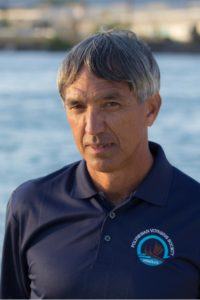
Maui Nui Marine Resource Council is pleased to present a special event on Tuesday, October 8 at 6:00 pm at ʻIao Theater: “An Evening with Nainoa Thompson: “Mālama Honua (Care for Island Earth): In a Changing World, Hope Comes With Action.”

President of the Polynesian Voyaging Society and a master in the traditional Polynesian art of non-instrument navigating, Nainoa Thompson led Hōkūleʻa’s global “Mālama Honua (Care for Island Earth) Voyage.” Inspired by his kūpuna, his teachers, he has dedicated his life to exploring the deep meaning of voyaging. On long voyages, Nainoa came to appreciate the Hawaiian concept of “mālama” (caretaking).

“Our ancestors learned that if they took care of their canoe and each other,” Nainoa often told his crew, “and if they marshaled their resources of food and water, they would arrive safely at their destination.”

Nainoa is the recipient of numerous community awards, including the Unsung Hero of Compassion, awarded to him by His Holiness XIV Dalai Lama on behalf of the organization Wisdom in Action, the Native Hawaiian Education Association’s Manomano Ka ‘Ike (Depth and Breadth of Knowledge) Educator of the Year Award, the NOAA National Marine Sanctuary Foundation Lifetime Achievement Award, the BLUE Ocean Film Festival Legacy Award, the Peter Benchley Ocean Award for Excellence in Marine Exploration, the National Geographic Society’s Hubbard Medal, and the Explorers Club Medal.

Don’t miss this inspiring presentation on Tuesday, Oct. 8 at the historic ʻIao Theater in Wailuku. It is presented as part of the “Know Your Ocean” Speaker Series, presented by the nonprofit Maui Nui Marine Resource Council with support from the County of Maui Mayor’s Office of Economic Development and Maui Visitors Bureau. Tickets are $10 – $20 per person with reserved seating. Doors open at 5:30 pm. Presentation at 6:00 pm.

For tickets, please visit https://bit.ly/NainoaThompson.

Presentation by Dr. Paul Brewbaker: “Overtourism and Sea Level Rise:  Some Economic Dimensions”

in /by

On Weds., Sept. 4, Maui residents and visitors will have the opportunity to attend a free presentation by Hawaii’s best known and most-quoted economist, Paul H. Brewbaker, Ph.D. and CBE, speaking on some of the economic dimensions of overtourism and sea level rise in Hawaiʻi.

This free talk is part of Maui Nui Marine Resource Council’s monthly meeting. It takes place from 5:30 pm to 7 pm at The Sphere at Maui Ocean Center in Ma’alaea. Doors open at 5 pm and admission is free, but advance reservations are strongly recommended, as seating is limited. Make your complimentary reservation at https://bit.ly/BrewbakerTalk

Paul H. Brewbaker is the Principal of TZ Economics, a Hawaiʻi economics consultancy. His background in research on the Hawaiʻi economy and financial risk analytics stems from a 25-year affiliation with Bank of Hawaiʻi, concluding as its Chief Economist. He is a graduate of Stanford University, did graduate work at the University of Wisconsin, and received his Ph.D. in Economics from the University of Hawaiʻi. He has lectured extensively in international, monetary, and financial economics. He is a member of the American Economic Association, the American Finance Association, and the National Association for Business Economics, from which he holds the Certified Business Economist designation.

“Just as ‘resilience is the new sustainability,ʻ overtourism is the new GMO,” said Dr. Brewbaker.  “Decision-makers have jumped to the default public policy intervention:  prohibition.”

“Surely undocumented vacation rentals seeking a pathway to citizenship confront us with more nuanced issues to tackle, since what bothers most of us is congestion and natural resource degradation,” he noted. “For both of these negative externalities well-understood economic policy interventions exist; neither externality has anything to do with bigotry (the official name for the assertion that people unlike you ‘are changing the character of the neighborhood’).” 

“In this presentation, we explore some of the economic implications of overtourism for Hawaiʻi, and relate economic policy responses to those which confront sea level rise attendant to global climate change,” he said.”Seemingly unrelated policy interventions might prove surprisingly similar.”

“One of the hottest topics on Maui right now is tourism — and how much is too much for our environment and way of life,” says Amy Hodges, Programs Manager at Maui Nui Marine Resource Council. “We are pleased to bring Dr. Brewbaker’s insights and perspective into the discussion, as we look at some of the economic dimensions of tourism and sea level rise for Maui and all of Hawaiʻi.”

Maui Nui Marine Resource Council thanks Maui Ocean Center for providing free meeting space for this event.

Maui Nui Marine Resource Council is a Maui-based nonprofit celebrating 11 years of working toward clean ocean water and healthy coral reefs. To learn more, visit www.mauireefs.org.