Blog Archives: News Releases

Invasive Roi in Hawaii: What should be done?

in , , , /by

Presented as part of Maui Nui Marine Resource Council’s Know Your Ocean Speaker Series

Photo by Keoki Stender

Perhaps you’ve heard of “roi roundups” – efforts by the community to spearfish and kill roi, commonly known as the peacock grouper, to remove these invasive fish from our local reefs.

Roi were introduced to Hawaii in the 1950s from French Polynesia with the idea that it could provide a food source for people. An aggressive predator that eats smaller reef fish, roi flourished – especially when Hawaii residents found that the fish carried ciguatera, a type of food poisoning, and avoided eating them.

Alarmed by roi’s voracious appetite for smaller native fish, and concerned that the ciguatoxin carried in roi can move up the food chain and spread to other species, communities throughout the main Hawaiian islands have organized roi roundups.

How much of a problem are roi? What are recent scientific studies finding about the impact of roi on native reef fish? Should we try to rid our reefs of roi? Watch the video to get answers to these and other questions about this invasive fish. This video was presented as part of MNMRC’s monthly “Know Your Ocean” Speaker Series.

Presented by:
Alan Friedlander
, Chief Scientist, Pristine Seas, National Geographic Society, and director of the Fisheries Ecology Research Lab at the University of Hawaiʻi, and Russell Sparks, Aquatic Biologist, Department of Land and Natural Resources, Division of Aquatic Resources on Maui.

Our guest emcee was Darla Palmer-Ellingson, local radio show host of the public affairs program, Island Environment 360, made possible by H-Hawaii Media.

“We’ve heard concerns about a recent increase in roi sightings in the reefs of ‘Ahihi Kinau Natural Area Reserve, and thought this would be a good time to bring in these scientists to meet with the community to talk about roi,” said Robin Newbold, co-founder and chair of Maui Nui Marine Resource Council. “It’s always good to start with the latest scientific facts as we work towards answers and solutions.”

This free Zoom webinar is part of Maui Nui Marine Resource Council’s monthly “Know Your Ocean” Speaker Series now being held via Zoom due to COVID-19. Special thanks to the County of Maui Mayor’s Office of Economic Development for their support of the “Know Your Ocean” Speaker Series.

About Maui Nui Marine Resource Council
Maui Nui Marine Resource Council is a community-based nonprofit organization celebrating 12 years of working for healthy coral reefs, clean ocean water and abundant native fish throughout Maui County. Our work includes co-managing the Hui O Ka Wai Ola Ocean Water Quality Monitoring Program at 41 sites in South and West Maui, efforts to reduce pollution in Ma‘alaea Bay (through erosion-control efforts in the Pohakea watershed and using oysters to filter sediment and pollutants from ocean water), coral reef research, visitor education programs and more. Learn more at www.mauireefs.org.

About Darla Palmer-Ellingson:
With a strong passion for volunteerism on environmental issues, Darla produces and hosts Island Environment 360, Maui’s only commercially broadcast public affairs show on environmental and related Hawaiian cultural topics. Darla is a member of the County of Maui Citizens Advisory Committee on the Climate Crisis and a member of Vice President Al Gore’s Reality Project, Hawaii chapter. Her company, 360 Social Business, LLC provides website design, content, social media management, general business and marketing consulting.

Free webinar: home gardening without toxic chemicals

in /by

Part of Maui Nui Marine Resource Council’s Know Your Ocean Speaker Series

Americans are taking up gardening in record numbers during the COVID-19 pandemic, and Maui residents are joining the trend.

Growing your own produce, as well as doing your own landscaping and yard care, are great ways to save money, get exercise, be outdoors and engage your keiki in hands-on science learning.

Unfortunately, many people turn to toxic herbicides and chemicals when weeds and pests appear. In fact, the average yard contains 10 times more chemicals per acre than a typical commercial farm, says Consumer Reports.

Learn tips for skipping those toxic herbicides and pesticides and growing a productive garden and a beautiful yard at a free Zoom presentation by landscape and gardening expert Duane Sparkman on Thursday, June 4 at 3:30 pm. Sparkman is the Assistant Chief Engineer and Landscaping Manager at The Westin Maui Resort & Spa.

Our guest emcee is Darla Palmer-Ellingson, local radio show host and owner of 360 Social Business.

Sparkman will take you into his own yard via Zoom to demonstrate non-toxic gardening and landscaping practices in action. You’ll discover how you can achieve great results in your yard, save money and keep family and pets safer. Because chemicals travel through Maui’s porous soil into the ocean, switching to organic methods will also help protect our local coral reefs and nearshore fish populations.

This free Zoom presentation is part of Maui Nui Marine Resource Council’s “Know Your Ocean Speaker Series” now being held via Zoom due to COVID-19. To make a free reservation, please go to https://bit.ly/MauiGardeningWebinar.

Sparkman offers a wealth of practical firsthand experience about what works to control pests and weeds based on his years of experience as a professional landscaper, designing and maintaining luxury resort properties and private residences, his work at Haleakala National Park’s Vegetation Management Division and recently, as the Assistant Engineer and Landscaping Manager at The Westin Maui.

At The Westin Maui, Sparkman has successfully implemented measures to reduce the resort’s use of herbicides and pesticides, showcasing alternatives that are safer and more environmentally friendly.

“We are offering this presentation with the hope that more people will resolve to find ways to protect our coral reefs and marine environment by reducing or avoiding the use of herbicides and pesticides in their home gardens and yards,” says Robin Newbold, Chair of Maui Nui Marine Resource Council.

Newbold points out that most people don’t realize how porous our soil is on Maui and how readily chemicals from pesticides and herbicides find their way into the ocean, causing harm to fish, birds and corals.

According to the NOAA Ocean Service Education website, pesticides are designed to be toxic to a target organism, but they often kill other organisms as well: “The insecticide azinphos-methyl, for example, which is used to control insects such as biting mites and aphids, is also very toxic to fish and birds.”

The website notes that many of the compounds used today are toxic at very low concentrations.

Herbicides also penetrate coral tissues and rapidly, within minutes, can reduce the efficiency of the beneficial algae (zooxanthellae ) that live within the corals, reports the book, Chemical Pollution on Coral Reefs: Exposure and Ecological Effects. The zooxantellae convert the energy from the sun into food for the corals through photosynthesis, providing corals with about 90% of their food. When herbicides enter the ocean, they can cause the corals to suffer due to reduced food availability.

“We owe it to our coral reefs and ocean water to find better ways to manage pests and weeds without adding harmful chemicals to our land- and marine-ecosystems,” says Newbold. “We’re grateful that Duane Sparkman is willing to share his practical, hands-on knowledge and experience with us all.”

Special thanks to the County of Maui Mayor’s Office of Economic Development for supporting Maui Nui Marine Resource Council’s “Know Your Ocean” Speaker Series.


About Duane Sparkman:
A resident of Maui since 1995 arriving here from Texas, Duane is an avid photographer who aspires to capture “rare moments”. His life’s passion is to preserve intact Hawaiian forests and the perpetuation of Hawaiian Culture. Duane is a professional landscaper by trade, designing and maintaining luxury resort properties, private residences, and working on projects within the Haleakala National Park, Vegetation Management Division. When he is not working or volunteering his time with various Hawaiian reforestation projects “putting back what belongs” he enjoys spending time with his wife, Erin and 2 children, Evan and Isabella cultivating his back yard native forest.

About The Westin Maui Resort & Spa:
Centrally located on pristine Ka’anapali Beach, the spectacular transformations within this resort will completely reimagine many areas of the 12-acre tropical paradise. Surrounded by lush gardens with cascading waterfalls, the 770-room beachfront resort abounds with ways to rejuvenate. Guests can indulge in six outdoor pools that include a brand new family pool and dedicated adults-only pool, spa rejuvenation, unique dining experiences and cultural activities. It is mere steps away from snorkel and sunset cruises, neighboring Whalers Village and championship golfing. Visit www.westinmaui.com.

About Maui Nui Marine Resource Council:
Maui Nui Marine Resource Council is a community-based nonprofit organization celebrating 11 years of working for healthy coral reefs, clean ocean water and abundant native fish throughout Maui County. Our work includes co-managing the Hui O Ka Wai Ola Ocean Water Quality Monitoring Program at 41 sites in South and West Maui, efforts to reduce pollution in Ma‘alaea Bay (through erosion-control efforts in the Pohakea watershed and using oysters to filter sediment and pollutants from ocean water), coral reef research, visitor education programs and more. Learn more at www.mauireefs.org.

About Darla Palmer-Ellingson:
With a strong passion for volunteerism on environmental issues, Darla produces and hosts Maui’s only commercially broadcast public affairs show on environmental and related Hawaiian cultural topics. Darla is a member of the County of Maui Citizens Advisory Committee on the Climate Crisis and a member of Vice President Al Gore’s Reality Project, Hawaii chapter. Her company, 360 Social Business, LLC provides website design, content, social media management, general business and marketing consulting.

Scientists to Study “Molokini Without Tourists”

in /by

Maui Nui Marine Resource Council Helping to Raise Funds
 to Support This Once-in-a-Lifetime Research Opportunity

According to a 2007 report published in the scientific journal Ecological Applications, Molokini Marine Life Conservation District was considered the most effective marine protected area in Hawaiʻi1,2. However, during the past decade, Molokini’s ecosystem health has declined, likely related to pressures from intensive tourism at this mid-ocean reef system3,4.

During this time of COVI D-19, when tourism is switched off and there are no tour boats or snorkelers at Molokini, there is a once-in-a-lifetime opportunity to study how human activity impacts marine life in the Molokini Marine Life Conservation District.

The question: now that there is no tourism, is the wildlife changing how it uses the reserve?

“Molokini Crater is one of the most dramatic natural areas in the main Hawaiian Islands, and harbors coral reefs as well as fishes, sharks, manta rays and other wildlife,” says Maui resident Russell Sparks, Aquatic Biologist, Department of Land and Natural Resources, Division of Aquatic Resources on Maui. “Under normal conditions, tourism activity is very high at Molokini, with diving and snorkeling boats visiting continually. Now, there is no tourism.”

“How have important species changed their use of Molokini’s reef habitats in the absence of tourism?” asks Sparks. “We now have the opportunity to find out.”

Led by Sparks, a small team of scientists with expertise in animal tracking, underwater survey methods, wildlife ecology and past Molokini research experience is hoping to answer this question.

The team of Hawaiʻi-based scientists has extensive experience with coral reef ecology and animal movement studies in the Hawaiian Islands: Kevin Weng, Associate Professor at the Virginia Institute of Marine Science; Alan Friedlander, Chief Scientist, Pristine Seas, National Geographic Society, and director of the Fisheries Ecology Research Lab at the University of Hawaiʻi; and Whitney Goodell, National Geographic Fellow and marine ecologist with the Fisheries Ecology Research Lab, University of Hawaiʻi.

Friedlander has studied Molokini extensively and is the co-author of five research publications on Molokini conducted in collaboration with the Maui Division of Aquatic Resources.

The scientists plan to work at Molokini this summer (May and June) to conduct diver surveys of fishes and other wildlife. They will install a network of tracking receivers and tag animals with telemetry devices. Vessel activity will be counted using a time-lapse camera. This builds on previous work conducted by Friedlander’s lab in collaboration with the Maui Division of Aquatic Resources1,2,3,4 and offers a unique opportunity to compare current conditions with a robust, existing baseline.

The local nonprofit Maui Nui Marine Resource Council is raising funds for the team of scientists to conduct this study. The organization has set up a GoFundMe page for this project at gofundme.com/f/molokini-during-covid-19-research-study.

“Molokini is normally visited by 1,000 tourists every day and is one of the most visited marine protected areas in the world,” reports Robin Newbold, Co-founder and Chair of Maui Nui Marine Resource Council. “Many Maui residents are wondering what’s happening there now that the tourists are gone. We’re excited that these scientists have stepped forward to collect data relating to this important question.”

Newbold explains that the scientists are donating their time and resources for this study and have organized some parts of the expedition. However, they require support in a number of areas, since the urgent nature of the project has prevented the normal routes of science funding and planning.

The scientists have permits to travel and go to work at Molokini. They have a boat and captain, science equipment and telemetry tags ready to go.

As of July 15, they are seeking the use of a car or rental car, and a place to park an 18 foot boat overnight and when not in use. If you can help, please email [email protected].

“On behalf of the scientists, we are asking for help from the community for this project,” says Newbold. “Perhaps you have a car that’s not being used that you could share with the researchers.”

“We also welcome cash donations,” says Newbold. “100% of the donations collected by Maui Nui Marine Resource Council for this project will go directly to this research.” To donate, visit GoFundMe at gofundme.com/f/molokini-during-covid-19-research-study.

Maui Nui Marine Resource Council is a nonprofit 501 (c)(3) organization working for healthy coral reefs and clean ocean water for Maui’s nearshore areas. To learn more, visit www.mauireefs.org.
———————-
1 Friedlander AM, Brown EK, Monaco ME. 2007. Coupling ecology and GIS to evaluate efficacy of marine protected areas in Hawaii. Ecological Applications 17:715-730.

2 Friedlander AM, Donovan MK, Koike H, Murakawa P, Goodell W. 2019. Characteristics of effective Marine Protected Areas in Hawai‘i. Aquatic Conservation: Marine and Freshwater Ecosystems. Aquatic Conservation, 29(S2):103-117. DOI: 10.1002/aqc.3043

3 Filous, A., Friedlander, A.M., Koike, H., Lammers, M., Wong, A., Stone, K. and Sparks, R.T., 2017. Displacement effects of heavy human use on coral reef predators within the Molokini Marine Life Conservation District. Marine Pollution Bulletin 121:274-281.

4 Filous A, Friedlander A, Wolfe B, Sparks R. 2017. Movement patterns of reef predators in a small isolated Marine Protected Area with implications for resource management. Marine Biology, 164(1). DOI: 10.1007/s00227-016-3043-3

Photo credit:
 Molokini photographed by Bossfrog, 4 December 2015, under Creative Commons, via Wikipedia.

Free Oct. 7 Webinar by Daniel Amato, Ph.D. on “Sewage Impacts on Hawaiʻi’s Coastlines: Past, Present and Future”

in /by

What will determine the future impacts of sewage on Hawai’i’s nearshore ecosystems and public health? Learn more at a free Zoom webinar titled “Sewage Impacts on Hawaiʻi’s Coastlines: Past, Present and Future” by Daniel Amato, Ph.D., which will include recent research and latest information on Hawaiʻi’s wastewater saga. The webinar will take place on Wednesday October 7 at 5:30 pm and is free and open to the public. It is presented by Maui Nui Marine Resource Council as part of their monthly “Know Your Ocean Speaker Series.” Advance reservations are recommended as the Zoom webinar is limited to 100 attendees. Make your free reservation at https://bit.ly/MauiSewage

“My talk will share reports on how injection wells and cesspools continue to pollute Hawaiʻi’s waters, with an emphasis on recent Maui studies,” says Dr. Amato. ”I will also present recent decisions from the Hawaiʻi State Legislature and the current status of their effort to phase out cesspools.”

Dr. Amato will also discuss the current situation with sewage pollution in Hawai’i, and will present community efforts and new technological developments in sewage detection that show promise for the future.

A water quality specialist, Dr. Amato’s professional work focuses on the detection and impacts of land-based pollution in the Pacific Ocean and the development of new technology to assist in detecting the DNA of fecal indicator bacteria (FIB) in the water.Dr. Amato is a Marine Research Specialist at the University of Hawaiʻi at Manoa, an Environmental Scientist at Element Environmental LLC, and serves as the coordinator for Surfrider-Oahu’s Blue Water Task Force.

“We are offering this webinar by Dr. Amato to share important information about sewage and its impact on Maui’s coastlines, including ocean water quality and our nearshore coral reefs,” says Amy Hodges, Programs and Operations Manager at Maui Nui Marine Resource Council. “It’s a critically important topic, at a time when our coral reefs need the benefit of clean ocean water, to survive the impacts of climate change and warming water.”

“We thank the County of Maui Mayorʻs Office of Economic Development for supporting our Know Your Ocean Speaker Series,” says Hodges.

For reservations for this talk, visit https://bit.ly/MauiSewage.

About Maui Nui Marine Resource Council:
Maui Nui Marine Resource Council is a community-based nonprofit organization celebrating 12 years of working for healthy coral reefs, clean ocean water and abundant native fish throughout Maui County. Our work includes co-managing the Hui O Ka Wai Ola Ocean Water Quality Monitoring Program in South and West Maui, efforts to reduce pollution in Mā‘alaea Bay (through erosion-control efforts in the Pohakea watershed and using oysters to filter sediment and pollutants from ocean water), coral reef research, visitor education programs and more. Learn more at www.mauireefs.org.


Free Materials Available to Help Educate Public About Sunscreen Choices

in /by

KIHEI, HI – Want to help get the word out about switching to sunscreens that are free of reef-harming oxybenzone and octinoxate? Looking for ways to explain “reef safe” sunscreen choices to guests and customers?

The nonprofit Maui Nui Marine Resource Council, with support from the County of Maui Mayor’s Office of Economic Development, has materials to help.

Maui Nui Marine Resource Council recently printed wallet-sized sunscreen information cards that provide a friendly, simple explanation about avoiding sunscreens with reef-harming oxybenzone and octinoxate. The cards are being offered free to Maui businesses and concierge, for distribution to visitors and residents.

“The cards require very little space on a counter or desk, yet provide all of the information needed to help a guest or customer avoid reef-harming oxybenzone and octinoxate, two chemicals that have been proven to harm or kill corals,” says Anne Rillero, Communications, Community Outreach and Development Manager at Maui Nui Marine Resource Council.

For those with more space, Maui Nui Marine Resource Council is offering free 8 1/2” x 11” color posters, with the message, “Get a Jump on Protecting Maui’s Coral Reefs: Make the Sunscreen Switch Today.”

Rillero notes that Hawaii’s sunscreen ban of these two reef-harming ingredients doesn’t go into effect until January 1, 2021, but our local coral reefs need help – which is why Maui Nui Marine Resource Council is urging all ocean users to make the sunscreen switch now. Maui Nui Marine Resource Council is partnering with Maui Visitors Bureau and the County of Maui Mayor’s Office of Economic Development on a campaign to raise awareness about sunscreen choices.

“The sale of sunscreens containing oxybenzone and octinoxate will be banned under Hawaii’s sunscreen law in 2021, but why wait until then?,” said Robin Newbold, co-founder and chair of Maui Nui Marine Resource Council. “Coral reefs in Hawaii and around the world are under stress due to warming ocean waters, sediment runoff, pollution and other human-related causes. While it’s important that we tackle those issues, switching to a more environmentally friendly sunscreen now is an easy way for individuals and families to help protect the reefs.”

Newbold noted that new sunscreen products made without oxybenzone and octinoxate are readily available and easy to use.

Maui Nui Marine Resource Council has also produced a short video about sunscreen choices which can be viewed at https://youtu.be/szB9xNZV85A .

The organization provides a website page that offers details on safer-for-the-reef sunscreens at https://www.mauireefs.org/sunscreens/.

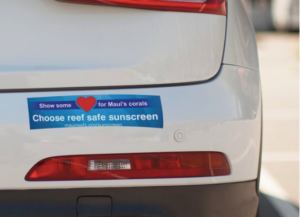
Maui Nui Marine Resource Council has also printed bumperstickers, with the message, “Show some love for Maui’s corals. Choose reef-safe sunscreen” that are offered free to the public.

To arrange for any of these free materials, please email [email protected]. Please include the name of your business, resort or vacation rental, along with your name and contact information, and the items requested.


A Maui-based nonprofit organization founded in 2007, Maui Nui Marine Resource Council is working for healthy coral reefs, clean ocean water and abundant native fish for the islands of Maui County. Current projects include ocean water quality testing in South and West Maui, work to improve ocean water quality in Ma’alaea Bay, ongoing studies of corals in Olowalu and Ma’alaea, and outreach programs to educate visitors about protecting Maui’s coral reefs.

Free Talk by Mark Deakos on 
”Creating a Future for Manta Rays and Coral Reefs By Creating Living Buildings and Communities that Restore and Support Thriving Ecosystems”

in /by

Mark Deakos first began studying Maui’s manta rays for his Ph.D. By 2010 he had described the largest known population of manta rays in the United States with over 400 unique individuals. But over the past decade, much has changed. At one time aggregations as large as 30 manta rays could be seen but today, sightings of even a single adult are rare.

To learn more about the status of Maui’s manta ray population – and solutions to restore the health of our nearshore marine environment, including water quality, our coral reefs and our precious manta ray populations, join us for a talk by Mark Deakos at Maui Nui Marine Resource Council’s “Know Your Ocean Speaker Series” event on Wednesday, March 4 at The Sphere at Maui Ocean Center.

This event is free and open to all, but seating is limited. Advance reservations are recommended. Reserve at https://bit.ly/Deakos

In addition to sharing some amazing video footage of Maui’s manta rays, Deakos will present a framework of regenerative design that is sweeping the country; building and community designs that restore habitat and culture, control stormwater, recharge aquifers and streams, and improve the health and well-being of the people, plants and animals and our coral reefs.

“Imagine nurturing places that promote healthy lifestyles for people and have a positive impact on our coral reefs and marine wildlife,” says Deakos. “Come learn about Living Buildings and Living Communities that generate their own energy, capture and treat all the water they need, eliminate toxins and waste, and support the restoration of our nearshore ocean environment.”

The talk will include details on the Living Building Challenge and Living Community Challenge, performance standards born out of the International Living Future Institute (ILFI) which offer global strategies for lasting sustainability. By partnering with local communities, the International Living Future Institute works to inspire and incentivize green building and infrastructure solutions, on scales ranging from single room renovations to neighborhoods or whole cities.

“This type of sustainable development is fully possible on Maui,” says Deakos.

The “Know Your Ocean Speaker Series” is presented by Maui Nui Marine Resource Council to introduce the public to marine research and conservation efforts to protect Maui’s ocean resources. This series offers a free presentation every month, usually on the first Wednesday of the month. Maui Ocean Center generously donates the use of The Sphere for these presentations. The series is supported by the County of Maui Mayor’s Office of Economic Development.

Reserve your seat at https://bit.ly/Deakos


About Mark Deakos:
Mark Deakos came to Hawaii in 1996 to complete his master’s at UH Manoa, studying humpback whales and his PhD studying manta rays. He later founded the Hawaii Association for Marine Education and Research in 2004, a 501(c)(3) non-profit dedicated to protecting Hawaii’s marine resources. After two decades of marine science and scientifically describing the degradation of our natural resources caused by the increasing threats from unsustainable growth, he switched his focus on solutions. In his new role as Chief Sustainability Officer for 3-P Consulting, his ambition is to connect business owners, developers, planners and decision makers with sustainable, regenerative solutions that not only eliminate the threats but allow us to restore the damage we have caused.

About Maui Nui Marine Resource Council:
Maui Nui Marine Resource Council is a community-based nonprofit organization celebrating 11 years of working for healthy coral reefs, clean ocean water and abundant native fish throughout Maui County. Our work includes co-managing the Hui O Ka Wai Ola Ocean Water Quality Monitoring Program at 41 sites in South and West Maui, efforts to reduce pollution in Ma‘alaea Bay (through erosion-control efforts in the Pohakea watershed and using oysters to filter sediment and pollutants from ocean water), coral reef research, visitor education programs and more. Learn more at www.mauireefs.org.

About Maui Ocean Center:

Since 1998, Maui Ocean Center has fostered understanding, wonder and respect for Hawaiʻi’s marine life, drawing thousands of visitors from across the globe. The three-acre marine park, located in Wailuku, Maui, faithfully replicates the natural ocean ecosystem featuring only animals who are native to Hawai’i. The center features the largest collection of live Pacific corals in the world, over 60 exhibits, 20 daily presentations by marine naturalists, outdoor tide pools and a 750,000-gallon Open Ocean exhibit with a 240-degree view acrylic tunnel. Maui Ocean Center operates in compliance with a County of Maui ordinance prohibiting the exhibit of cetaceans (whales and dolphins) and offers exploration of these creatures through interpretive displays, including its cutting-edge “Humpbacks of Hawai‘i” Exhibit & Sphere. Under the guidance of Kahu Dane Maxwell, the aquarium integrates Hawaiian culture in presentations, exhibits, special events, and also in the marine park’s standards of operations and service. For more information, please visit https://mauioceancenter.com.

Oyster Pilot Project Launched in Māʻalaea Bay; Will Test Viability of Oysters for Improving Ocean Water Quality in Māʻalaea Bay

in /by

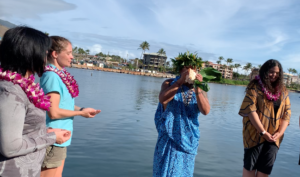
MĀʻALAEA, MAUI, HI – A pilot project to use oysters to improve ocean water quality in Māʻalaea Harbor was launched today by Maui Nui Marine Resource Council, with a blessing by Kimokeo Kapahulehua and a short ceremony attended by local VIPs, the media and the organization’s staff and board members.

“Oysters are nature’s most efficient water filters; they eat by pumping large volumes of water through their bodies and in the process, they capture sediment and pollutants from the water column,” says Amy Hodges, Programs Manager at Maui Nui Marine Resource Council. “Estimates are that a single oyster can filter up to 50 gallons of ocean water in a day depending on conditions.”

“Our goal is to use the oyster’s natural filter feeding abilities to make Māʻalaea Bay cleaner and healthier for fishing, swimming, paddling and surfing,” notes Hodges.

The oyster pilot project in Māʻalaea is supported by the County of Maui Mayor’s Office of Economic Development. Additional support is provided by Hawaii Tourism Authority’s Aloha Aina Program.

Maui Nui Marine Resource Council is conducting this project in partnership with O‘ahu Waterkeeper, a neighbor island nonprofit who installed oysters at Pearl Harbor, Kāne‘ohe Bay Marine Corps Base, and Ala Wai Harbor in 2019 for the purpose of improving ocean water quality and clarity.

Hodges explains that the oysters installed in Māʻalaea are Pacific oysters (Crassostrea gigas) which are found throughout the main Hawaiian Islands. “The broodstock for the oysters that we are installing in Māʻalaea came from Hawai‘i, and were then raised in ideal conditions at the Pacific Aquaculture and Coastal Resources Center (PACRC) at the University of Hawai‘i at Hilo,” she says.

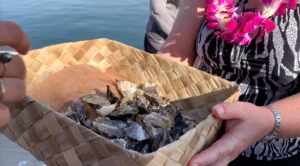
After months at PACRC, the young oysters are now believed to be large and hardy enough to survive the heavily sedimented waters of Māʻalaea Harbor. The oysters will live in cages below the water surface and away from boat traffic. They were raised triploids, meaning they are sterile and likely unable to reproduce.

“Oysters are used around the world to help improve water clarity and quality.  Cleaner water allows for sunlight penetration, which is important for corals and other animals,” says Rhiannon Chandler-‘Īao, Executive Director of Waterkeepers Hawaiian Islands.

“Hawai‘i’s nearshore ocean waters are not supposed to have too much phytoplankton, but fertilizers and wastewater nutrients such as nitrogen, phosphorous and potassium cause algae blooms,” says Hodges. “Oysters feed on microalgae, which ultimately makes the water clearer and better for corals.”

“It’s important that the public understand these oysters are not suited for eating,” says Hodges. “There’s too much pollution here to make it safe to consume them. You don’t want to get sick with diarrhea and vomiting due to eating oysters from polluted water.  Instead, please get your oysters from places with clean water and leave these oysters to do their work of making Māʻalaea Bay better for fishing, surfing and ocean recreation for everyone.”

Every two weeks, MNMRC staff and volunteers will be pulling up the cages to monitor the condition of the oysters and clean cages. If the oysters thrive, the pilot project will be expanded to include more oysters later in 2020.

Oysters have also been put to work in the Chesapeake Bay, where the U.S. Army Corps of Engineers has been rebuilding traditional oyster reefs using shells from mollusks consumed in restaurants. In New York Harbor, an ambitious project called the Billion Oyster Project hopes to install enough oysters to totally filter the entire harbor every three days.

The oyster project in Māʻalaea is part of a two part program by Maui Nui Marine Resource Council to improve ocean water quality in the bay. Upslope, the group is working in the 4,000 acre Pohakea Watershed, implementing projects outlined in the Pohakea Stormwater Management Plan to reduce sediment-laden runoff flowing into Māʻalaea Bay.

“MNMRC commissioned the extensive Pohakea Plan by Maui Environmental Consulting,” says Hodges. “We have been writing grants and raising funds to enact this plan over a multi-year period.” To review the plan, please visit https://bit.ly/Pohakea

To gather baseline data about current ocean water quality in Māʻalaea Bay, Maui Nui Marine Resource Council is conducting regular kayak-based ocean water monitoring throughout the bay, using an electronic monitoring probe that provides a stream of data in real-time as the kayak travels through the water. The probe was purchased as the result of a grant from Lush Cosmetics Charity Pot.

This project is made possible with support from National Fish and Wildlife Foundation, County of Maui Mayorʻs Office of Economic Development and Hawaii Tourism through the Aloha ʻĀina program.

About Maui Nui Marine Resource Council:
Maui Nui Marine Resource Council is a community-based nonprofit organization celebrating 12 years of working for healthy coral reefs, clean ocean water and abundant native fish throughout Maui County In addition to the oyster project and its work in Pohakea watershed, the nonprofit co-manages the Hui O Ka Wai Ola Ocean Water Quality Monitoring Program at 41 sites in South and West Maui, provides visitor education programs and materials to protect Maui’s coral reef ecosystems and offers its educational “Know Your Ocean Speaker Series” each month. Learn more at www.mauireefs.org.

Free Talk on Factors Contributing to Declining Humpback Whale Sightings in Hawaiʻi and Alaska

in /by

What are the factors contributing to the decline in observed sighting rates of humpback whales in Hawaiʻi and Alaska? Three humpback whale researchers will be presenting information on a collaborative study that is examining this question on Tuesday, February 4, as part of Maui Nui Marine Resource Council’s “Know Your Ocean Speaker Series.”

This evening of presentations is free and open to the public. It will take place from 5:30 to 7 pm at The Sphere at Maui Ocean Center. Seating is limited so advance reservations are recommended. You can arrange for your free reservation at https://bit.ly/fewerwhales

The presenters will be Jens Currie, Chief Scientist at Pacific Whale Foundation; Dr. Adam Pack, a full professor at the University of Hawaii, Hilo; and Lars Bejder, Director of the Marine Mammal Research Program (MMRP) at the Hawaii Institute of Marine Biology, University of Hawaii at Manoa.

The researchers are collaborating on a project to gain an understanding of changes in the body condition of humpback whales throughout their feeding and breeding seasons. The researchers are also looking at the variability in body condition of humpback whales from year to year and how it might impact the number of whales that migrate between Hawaiʻi and Alaska.

“Last year, Pacific Whale Foundation joined a collaborative research project to quantify the bioenergetic demands of humpback whales migrating between Alaskan foraging grounds and Hawaiian breeding grounds,” says Stephanie Stack, Chief Biologist at Pacific Whale Foundation. “Working with the University of Hawaiʻi at Mānoa Marine Mammal Research Program, the University of Hawaiʻi at Hilo, and the Alaska Whale Foundation, the project aims to identify potential factors contributing to the decline in observed sighting rates of humpback whales in Hawaiʻi and Alaska.”

In 2016, the Hawaiʻi distinct population segment of humpback whales was taken off the Endangered Species List. However, since then, sighting rates of humpback whales in Hawaiʻi and southeast Alaska have dropped, notes Slack. There is currently a lack of understanding of why humpback whale sighting rates have reduced.

This project will contribute to efforts investigating the possible causes of this recent trend focusing on relationships to changes in body condition and animal health.

“Migrating has a cost to the animal’s body and health,” says Stack. “Understanding this cost may provide insight into a potential shift in the whales’ survival strategy and an increased understanding of the recent trends we’re seeing in Hawai’i and Alaska.

The “Know Your Ocean Speaker Series” is presented by Maui Nui Marine Resource Council to introduce the public to marine research and conservation efforts to protect Maui’s ocean resources. This series offers a free presentation every month, usually on the first Wednesday of the month (although our February presentation is on the first Tuesday of the month). Maui Ocean Center generously donates the use of The Sphere for these presentations. The series is supported by the County of Maui Mayor’s Office of Economic Development.

To learn more, visit www.mauireefs.org.
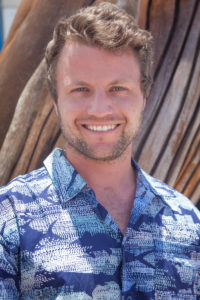
About Jens Currie:
Jens Currie is the Chief Scientist for Pacific Whale Foundation, a non-profit research, education, and conservation organization based in Maui, Hawaii. Jens has a wide and varied background including studying lobster fecundity in the Northwest Atlantic Ocean, modelling the impacts of aquaculture pens in Canada on the surrounding environment, and evaluating ecosystem goods and services in coastal South Africa. Jens currently serves as research chair (alternate) on the Hawaiian Islands Humpback Whale Marine Sanctuary advisory council, is an invited member of the Scientific Committee of the International Whaling Commission, a member of the Society for Marine Mammalogy, and a first responder for NOAA’s Marine Mammal Stranding and Large Whale Entanglement Response teams in Hawaii.

Jens’s research focus is on distance sampling, modelling cetacean population dynamics, and quantifying cetacean interactions with marine debris. He is currently studying the abundance and distribution of odontocetes in Maui Nui, the efficacy of legislation on marine debris accumulation, and the impacts of climate change on humpback whales.

All research activities are conducted in accordance with NOAA permits 20311-01, 19703, 14585 and 19655. All UAV activities are conducted in accordance with FAA Part 107 regulations.
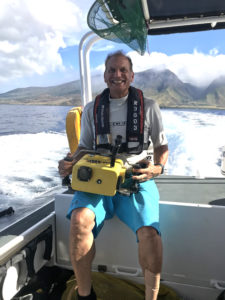
About Dr. Adam A. Pack:
Dr. Adam A. Pack is a Full Professor at University of Hawaii at Hilo (UHH) with a joint appointment in the Departments of Psychology and Biology. His many professional “hats” include: current chair of the Psychology Department, cooperating faculty member of UHH’s Master of Science Degree Program in Tropical Conservation Biology and Environmental Science, co-creator of the UHH LOHE Bioacoustics Laboratory, Cooperative Faculty at UH Manoa’s Psychology and Biology Departments and Marine Science Graduate Program, former chair of the Hawaiian Islands Humpback Whale National Marine Sanctuary Advisory Council, associate editor of the journal Marine Mammal Science, and co-founder and current president and director of The Dolphin Institute, a not-for-profit Hawaii-based organization dedicated to dolphins and whales through education, research and conservation.

Dr. Pack is the co-recipient of the American Psychological Association’s 1999 F.A. Beach Comparative Psychology Award and the recipient of the 2017 UH Hilo University of Hawaii Board of Regents Award for Excellence in Teaching. In 2008, Dr. Pack developed the UHH Marine Mammal Research Laboratory. His research program focuses on scientific studies of marine mammal behavioral ecology and cognition. For more than 30 years, he has been conducting research on dolphin sensory perception, cognition and communication abilities as well as humpback whale social organization and habitat use, migratory and residency patterns, social behavior and communication systems in the Hawaiian breeding grounds and Alaska feeding grounds. Over the course of his research career, he has published over 60 papers, book chapters and reports and given over 80 presentations and invited addresses. Dr. Pack’s research has been featured widely in print media such as the New York Times, the Economist and National Wildlife and in television documentaries such as National Geographic’s Humpbacks: Inside the Pod and PBS’s Mystery of the Humpback Whale Song.

About Dr. Lars Bejder:
Dr Bejder is the Director of the Marine Mammal Research Program (MMRP) at the Hawaii Institute of Marine Biology, University of Hawaii at Manoa where he supervises higher degree research students (PhDs and MScs) and is responsible for the academic and strategic development of the MMRP. He has studied various aspects of cetacean biology, ecology and conservation in New Zealand, Australia, Mexico and US (Hawaii, Florida and California). He has published >120 research journal articles and book chapters on cetaceans focusing on behavioral ecology, analysing and developing quantitative methods to evaluate complex animal social structures; evaluating impacts of human activity (coastal development, tourism, habitat degradation) and health assessments. He works closely with wildlife management agencies to optimise the conservation- and management outcomes of his research. He advises on anthropogenic impacts on cetaceans to: IUCN Cetacean Specialist Group, US Marine Mammal Commission; US National Marine Fisheries Service; International Whaling Commission; Australian Federal Government; Western Australian Department of Parks and Wildlife; New Zealand Department of Conservation. He currently serves on the Pacific Scientific Review Group (NOAA), and on the Scientific Committee of the International Whaling Commission (IWC). Dr Bejder is an adjunct Professor at Murdoch University, Perth, Western Australia and at Aarhus University, Denmark.

The focus of his research includes both empirical and applied research themes, many of which support conservation and management objectives. Studies addressing anthropogenic impacts focus on the quantification of the specific effects and overall biological significance of human activities on cetaceans, and the development of appropriate mitigation approaches and management strategies. Research on cetacean population dynamics and behavior involves efforts to assess population connectivity and identify appropriate units for management, to estimate abundance at local and regional scales and assess spatial and temporal patterns in abundance, and to measure and quantify individual behavior in order to examine social structures. His research includes the use of innovative technology (non-invasive suction cup tagging and unoccupied aerial systems; UAS, drones) to quantify fine‐scale habitat use, movements, communication, calf suckling rates and body condition of marine mammals.

About Maui Nui Marine Resource Council:
Maui Nui Marine Resource Council is a community-based nonprofit organization celebrating 11 years of working for healthy coral reefs, clean ocean water and abundant native fish throughout Maui County. Our work includes co-managing the Hui O Ka Wai Ola Ocean Water Quality Monitoring Program at 41 sites in South and West Maui, efforts to reduce pollution in Ma‘alaea Bay (through erosion-control efforts in the Pohakea watershed and using oysters to filter sediment and pollutants from ocean water), coral reef research, visitor education programs and more. Learn more at www.mauireefs.org.

About Maui Ocean Center:
Since 1998, Maui Ocean Center has fostered understanding, wonder and respect for Hawaiʻi’s marine life, drawing thousands of visitors from across the globe. The three-acre marine park, located in Wailuku, Maui, faithfully replicates the natural ocean ecosystem featuring only animals who are native to Hawai’i. The center features the largest collection of live Pacific corals in the world, over 60 exhibits, 20 daily presentations by marine naturalists, outdoor tide pools and a 750,000-gallon Open Ocean exhibit with a 240-degree view acrylic tunnel. Maui Ocean Center operates in compliance with a County of Maui ordinance prohibiting the exhibit of cetaceans (whales and dolphins) and offers exploration of these creatures through interpretive displays, including its cutting-edge “Humpbacks of Hawai‘i” Exhibit & Sphere. Under the guidance of Kahu Dane Maxwell, the aquarium integrates Hawaiian culture in presentations, exhibits, special events, and also in the marine park’s standards of operations and service. For more information, please visit https://mauioceancenter.com.

Maui Nui Marine Resource Council Announces New Partnership with Hawaiian Islands Humpback Whale National Marine Sanctuary

in /by

Maui Nui Marine Resource Council (MNMRC) located in Maui County, Hawaii is pleased to announce a new partnership with Hawaiian Islands Humpback Whale National Marine Sanctuary (HIHWNMS), located in Kihei, HI.

A Memorandum of Agreement has been signed this month between NOAA’s Office of National Marine Sanctuaries and MNMRC. The agreement opens the possibility of the two entities to work together to initiate new research, education, and outreach projects throughout Maui County.

“We are always open to new partnerships that help increase our understanding of our local marine ecosystems,” said Allen Tom, HIHWNMS Superintendent.

“As a community-based nonprofit working for clean ocean water and healthy coral reefs, we have firsthand experience with the tremendous power of partnerships and the accelerated positive outcomes that can result to benefit the marine environment,” noted Robin Newbold, co-founder and Chair of Maui Nui Marine Resource Council. “We are very excited about our partnership with the Hawaiian Islands Humpback Whale National Marine Sanctuary and the opportunity to collaborate on new research, education and conservation projects to improve our local marine eco-systems.”

“The HIHWNMS has collaborated with us on our unique, community-based Hui O Ka Wai Ola ocean water quality monitoring program, by providing free lab space for our water quality testing, and sharing meeting space where we have presented findings about our water quality data to the community,” says Newbold. “Clean ocean water is important for the health of all marine ecosystems around Maui and within the Hawaiian Islands.”

The Hui O Ka Wai Ola program relies on the efforts of more than 35 local volunteers, who regularly test ocean water quality at 41 locations in South and West Maui, providing valuable data to the State of Hawaii Department of Health Clean Water Branch.

The HIHWNMS includes information about Hui O Ka Wai Ola ocean water quality program in its free public presentations, “45 Ton Talks” offered every Tuesday and Thursday at 11 am at the Hawaiian Islands Humpback Whale National Marine Sanctuary Visitor Center at 726 S Kihei Rd, Kihei, HI.

Maui Nui Marine Resource Council is also working on improving ocean water quality in Mauiʻs Ma’alaea Bay, an area where humpback whales are frequently observed during the months of November through April. MNMRC will be working in the 4,000 acre Pohakea watershed, upslope of the bay, to reduce soil erosion and sediment-laden runoff into the ocean.

The HIHWNMS is one of 15 federally protected marine sanctuaries in the United States, which includes the nation’s largest National Marine Monument, Papahanaomokuakea, and the newest marine sanctuary, Mallows Bay National Marine Sanctuary, in Chesapeake Bay, Maryland.

Each U.S. National Marine Sanctuary is a federally designated area within United States waters that protects areas of the marine environment with special conservation, recreational, ecological, historical, cultural, archeological, scientific, educational, or aesthetic qualities. The program began in 1972 in response to public concern about the plight of marine ecosystems. The National Marine Sanctuary System consists of 14 marine protected areas that encompass more than 783,000 square miles (2,030,000 km2). Individual areas range from less than 1 to 583,000 square miles (3 to 1,509,963 km2).

To learn more about the Hawaiian Islands Humpback Whale National Marine Sanctuary, please visit https://hawaiihumpbackwhale.noaa.gov/

For information about Maui Nui Marine Resource Council, please visit www.mauireefs.org.


Maui Nui Marine Resource Council Announces New Coral Reef Conservation Displays at Kahului, Airport

in /by

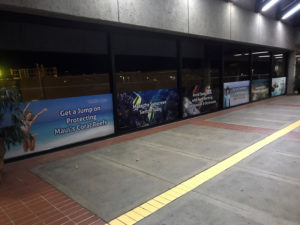
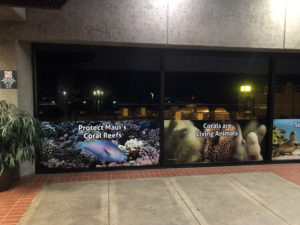
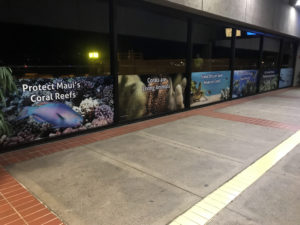
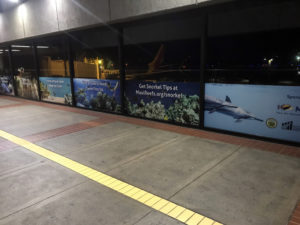
Just in time for the holiday rush and the winter peak travel season, the nonprofit Maui Nui Marine Resource Council has introduced new coral reef conservation displays in the Kahului, Maui Airport. The displays, installed along the bottom edge of twelve 90” wide windows in the Southwest concourse, feature eye-catching photography of Maui’s local coral reefs and beaches with easy to grasp messages relating to coral reef conservation. Among the messages are reminders to protect Maui’s coral reefs by standing only on sand, never on coral, and to choose sunscreens that are free of reef-harming oxybenzone and octinoxate.

The displays are made possible through support from the County of Maui Mayor’s Office of Economic Development and Maui Visitors Bureau, along with Pacific Media Group/Hawaii Airport Advertising, with photos donated by Drew Sulock Creations and DavidFleetham.com. Graphic design was provided by Geoff Moore of Silver Moon Maui Art & Design, located in Haiku. Printing and installation was provided by Tony Johnson of Phat Digital Design of Kahului.

“The overall messaging on these signs is that Maui’s community cares about our local coral reefs and wants to educate our visitors so everyone can actively help to protect our reefs while snorkeling, diving, swimming or exploring our reefs,” says Robin Newbold, co-founder and Chair of Maui Nui Marine Resource Council. “Based on our experiences with talking with visitors, we believe that visitors want to do the right thing to protect our coral reefs; they sometimes just need some education about what the ‘right thing’ means.”

Maui Nui Marine Resource Council has created a resource page for snorkelers with helpful advice about protecting the reefs and identifying fish and corals. To access the page, please visit www.mauireefs.org/snorkel.

The airport displays are part of a visitor education project by Maui Nui MarineResource Council that includes public service ads on local radio stations about safer-for-the-reef sunscreen choices recorded by local waterman Archie Kalepa; paid and public service announcement ads on local radio stations about ways individuals can prevent ocean water pollution by reducing their use of herbicides and pesticides; print ads in local publications about avoiding sunscreens with reef-harming chemicals; social media announcements about protecting Maui’s reefs; printed rack cards about coral reef protection for the tourism industry and more.

Maui Nui Marine Resource Council is seeking donations from local businesses and individuals to expand these campaigns in 2020. To donate, please visit www.mauireefs.org.

About Maui Nui Marine Resource Council
Maui Nui Marine Resource Council is a community-based nonprofit organization celebrating 12 years of working for healthy coral reefs, clean ocean water and abundant native fish throughout Maui County. Our work includes co-managing the Hui O Ka Wai Ola Ocean Water Quality Monitoring Program at 41 sites in South and West Maui, efforts to reduce pollution in Ma‘alaea Bay (through erosion-control efforts in the Pohakea watershed and using oysters to filter sediment and pollutants from ocean water), coral reef research, visitor education programs and more. Learn more at www.mauireefs.org.