Blog Archives: News Releases

Dr. Steven Businger to Speak on “Severe Weather in a Warming World”

in /by

MA’ALAEA, HI – A free presentation titled “Severe Weather in a Warming World” will be offered by Dr. Steven Businger on Wednesday, August 7 at The Sphere at Maui Ocean Center, as part of Maui Nui Marine Resource Council’s monthly meeting. The talk takes place from 5:30 pm to 7 pm. Doors open at 5 pm.

This presentation is open to the public and admission is free. Seating is limited so advance reservations are recommended. For reservations, visit https://bit.ly/hurricanetalk

Dr. Businger is the Professor and Chair of the Department of Atmospheric Sciences at the University of Hawaii and has devoted the past 30 years to researching the evolution and structure of destructive atmospheric storms.

“My talk will cover the evolution of recent hurricanes and other severe weather events that have threatened Hawaii, including how and why they form, how their structure affects the hazards they produce, and the role that a warming climate may play in these events,” said Dr. Businger. “I will also cover the similarities and differences between hurricanes and kona lows (a winter half year phenomenon).”

“We are offering this presentation because hurricanes have a profound impact on Maui’s coastal areas, causing erosion, storm surges and damage to homes and property – and possibly to coral reefs,” said Robin Newbold, co-founder and Chair of Maui Nui Marine Resource Council. “The weather and the future of our reefs are inextricably linked.”

“Right now, we are fortunate to have our local coral reefs providing an estimated $377.1 million worth of protection from storm surges and big waves to Maui’s coastlines every year, according to a recently released study from the U.S. Geological Survey, The Nature Conservancy and UC-Santa Cruz,” noted Newbold.

“However, coral bleaching caused by warming ocean temperatures can make corals weak and brittle, and more likely to be broken off in strong waves,” said Newbold. “If the height of our corals is reduced, we can expect more storm-related damage along our coasts. If sea level rises, it will also be harder for corals to break up big waves.”

“Please attend this talk to learn about hurricanes and severe weather events in Hawaii, so we can all be better prepared and safer,” says Newbold.

A nonprofit Maui-based organization working for healthy coral reefs and clean ocean water, Maui Nui Marine Resource Council hosts monthly meetings on the first Wednesday of each month featuring guest presenters speaking on issues, ideas and new advances relating to Maui County’s nearshore ocean environment. The meetings are free and open to all. Maui Ocean Center generously donates space for these monthly meetings at The Sphere, its new high-tech facility featuring advanced audio and visual projection and comfortable movie-style amphitheater seating.
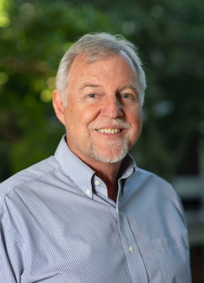
About Dr. Steven Businger:
Dr. Steven Businger is Professor and Chair of the Department of Atmospheric Sciences at the University of Hawaii. He has made notable contributions to the atmospheric sciences in several important, yet diverse areas. For the past 30 years Professor Businger has been active in researching the evolution and structure of destructive atmospheric storms, resulting in fundamental contributions to our understanding of the formation of storm systems in cold air streams and in the tropics (e.g., Kona lows and tropical cyclones). To date he has over 80 peer-reviewed journal publications, published 2 academic textbooks, and seven book chapters.

Dr. Businger was elected Fellow of the American Meteorological Society (AMS) in 2010. He is an AMS Certified Consulting Meteorologist, and in 2011 Professor Businger received the UH Mānoa Chancellor’s Citation for Meritorious Teaching.

About Maui Nui Marine Resource Council:
An award-winning, community-based organization, Maui Nui Marine Resource Council is celebrating 11 years of working for healthy coral reefs, clean ocean water and abundant native fish. Maui Nui Marine Resource Council co-founded and co-manages Hui O Ka Wai Ola, a unique volunteer-based ocean water quality monitoring program that gathers data at 39 shoreline locations in South and West Maui. Maui Nui Marine Resource Council is working to restore clean ocean water at Ma’alaea Bay, through a pilot program to use oysters to improve ocean water quality in Ma’alaea Harbor and through upslope projects in the adjoining Pohakea Watershed. The organization also sponsors visitor education programs to encourage respect, protection and responsible use of our local coral reefs. To learn more visit www.mauireefs.org.
Report on West Maui Ocean Water Quality at Free Presentation on July 30

in /by

How clean is the ocean water along the shores and at the beaches of West Maui? The public is invited to learn the answer to this question at a free presentation showcasing the results gathered by Hui O Ka Wai Ola, a unique community-based coastal water quality monitoring program co-managed by Maui Nui Marine Resource Council, The Nature Conservancy and West Maui Ridge to Reef Initiative.

The presentation will take place on Tuesday, July 30 from 6 pm to 7:30 pm at the Lahainaluna High School Cafeteria in Lahaina. Admission is free. Residents and visitors are welcome. The evening will feature results from two years of ocean water quality monitoring at 19 West Maui locations from Honolua Bay to Papalaua near the Pali.

“Come learn about the scientific data that our volunteers and staff have gathered through their diligent work in the field and in the lab,” says James Strickland III, Project Manager of Hui O Ka Wai Ola. “We encourage everyone to attend, to learn about the water quality issues that we’ve found in West Maui.”

A Unique Community-Based Effort
Hui O Ka Wai Ola (“Association of Living Waters”) is the first citizen science-based water quality monitoring program of its kind in Hawai’I that works in close cooperation with the State of Hawai‘i Department of Health Clean Water Branch to provide scientific, quality-assured data for use by State and County government, community groups, researchers and the public. More than 40 Maui residents volunteer with Hui O Ka Wai Ola. Since monitoring began in 2016, the program has collected and analyzed over 700 water quality samples from 49 sites in West and South Maui.

“Our primary motivation for launching this program was the health of Mauiʻs coral reefs,” says Robin Newbold, co-founder and Chair of Maui Nui Marine Resource Council. “Coral reefs need clean ocean water to survive; especially during this time of warming ocean water, sea level rise and climate change. Having this data is an important step in working for clean ocean water along our coasts.”

Quality Assured Data

The Hui O Ka Wai Ola program follows a strict Department of Health (DOH) approved Quality Assurance Project Plan (QAPP). As a result, the DOH readily accepts the Hui’s data, and incorporates it into its reports and databases.

Every three weeks, trained volunteers wade into knee deep water to gather ocean water samples from the 39 monitored locations in leeward Maui, conducting evaluations of salinity, water temperature, dissolved oxygen, pH and turbidity (sediment) at portable labs carried in the volunteersʻ cars. Additional analysis of the samples takes place in labs that are hosted pro bono by the Hawaiian Islands Humpback Whale National Marine Sanctuary and Lahainaluna High School. The samples are also frozen and shipped to the SOEST Analytical Laboratory on O‘ahu for additional analysis of nitrogen and phosphorous compounds.

Data is the First Step Toward Solving Maui’s Ocean Water Quality Issues

By identifying where water is impaired and why, the community can begin to identify the sources of the impairment. “For example, when we find areas with high levels of nutrients, we can look for upslope issues like chemically intensive landscape management practices or historic agricultural that impacts the ocean through runoff or via the groundwater,” says Tova Callender, Coordinator of the West Maui Ridge to Reef initiative.

All data collected by the Hui is made available to the public at HuiOKaWaiOla.com, PacIOOS, and Zenodo. The data has also been uploaded to the Environmental Protection Agency’s STORET database for use by State and Federal agencies. This volunteer-based citizen science water quality monitoring group’s data has been included in the State of Hawai‘i Clean Water Branch’s Integrated Report to the EPA, “2018 State of Hawai‘i Water Quality Monitoring and Assessment Report”.

“This community-based program is an excellent example of how people can organize to supplement the efforts of our hard-working State agencies,” says Kim Falinski, Marine Science Advisor for The Nature Conservancy. “Our program has paralleled State-collected data protocols and developed standards available for groups in Hawai‘i and beyond to adopt in creating similar programs.”

The Hui O Ka Wai Ola program is a partnership between the Maui Nui Marine Resources Council, The Nature Conservancy, and the West Maui Ridge to Reef Initiative, and is supported by Maui County Office of Economic Development (OED), Hawai‘i Tourism Aloha ‘Āina Program, North Beach West Maui Benefit Fund, Napili Bay and Beach Foundation, National Fish and Wildlife Foundation, Lush Cosmetics, The Makana Aloha Foundation, Honua Kai West Maui Community Fund, as well as individuals, families and local businesses. To learn more, please visit www.huiokawaiola.com or at www.mauireefs.org.


Maui Nui Marine Resource Council to Host Free Talk on 
“Catch and Release:  Large Whale Entanglement Response” by Edward Lyman On Tuesday, July 2

in /by

During the 4th of July holiday week when the United States celebrates freedom and liberty, Maui Nui Marine Resource Council will be hosting a free talk about freeing large whales from ropes, nets and other life-threatening entanglements.

This free presentation, titled, “Catch and Release: Large Whale Entanglement Response,” will be offered by Edward Lyman on Tuesday, July 2 at 5:30 pm at The Sphere at Maui Ocean Center. The event is open to the public. The presentation will include amazing video footage from pole- and helmet-mounted cameras showing some of the whale rescues in Hawaii by the network of responders that are authorized to assist with such entanglements,

Seating is limited, so reservations (free of charge) are recommended and can be arranged at https://bit.ly/WhaleRescueTalk.

Lyman, the Hawaiian Islands Humpback Whale National Marine Sanctuary’s Natural Resources Management Specialist, has responded more than 120 times to calls to free large whales and other marine animals from entangling gear over the past 25 years, resulting in more than 50 large whales being freed.

“For over 17 years the Hawaiian Islands Humpback Whale National Marine Sanctuary, working with NOAA Fisheries’ Marine Mammal Health and Stranding Response Program and the on-water community, has led a successful community-based network of experienced responders to free large whales, like the humpback whales found seasonally around Hawaiʻi, from life-threatening entanglements,” said Lyman. “As a result, the sanctuary and its partners have removed gear from more than 30 large whales and gained a wealth of information to mitigate the threat and its broad impacts.”

During his presentation, Lyman will describe the difficult and sometimes dangerous task of disentangling 40-ton, likely free-swimming whales, using techniques modified from those employed to catch large fish or used historically by whalers to kill the animals.

The talk will be part of the July monthly meeting of Maui Nui Marine Resource Council, a nonprofit organization working for healthy coral reefs and clean ocean water. It will take place at The Sphere at Maui Ocean Center, located at 192 Maʻalaea Road at the Maʻalaea Harbor Shops.

Doors will open at 5 pm and the talk will begin promptly at 5:30 pm.

“We are grateful to Maui Ocean Center for generously donating the use of The Sphere for this presentation,” said Amy Hodges, Programs Manager at Maui Nui Marine Resource Council. “We are also very thankful to Ed Lyman for making time to give this talk during a holiday week celebrating ʻlife, liberty and the pursuit of happinessʻ — important for whales as well as people.”

About Edward Lyman:
Ed Lyman is currently the Hawaiian Islands Humpback Whale National Marine Sanctuary’s Natural Resources Management Specialist and Large Whale Entanglement Response Coordinator under NOAA’s Office of National Marine Sanctuaries. He works closely with NOAA Fisheries, and under their Marine Mammal Health and Stranding Response Program. For more than 25 years Ed has worked with NOAA, state agencies, and others to better understand the animals and to address the threats that impact them, especially ship-strikes and entanglements. His efforts encompass Alaska, the East and West Coasts, Hawaiʻi and other countries. Ed has worked with the Hawaiian Islands Humpback Whale National Marine Sanctuary for more than 17 years.

Ed has participated in over 120 disentanglement efforts and helped free more than 50 large whales – 30 off Hawaiʻi. He assists NOAA in coordinating a community-based network to provide safe and authorized response to entangled large whales. However, the ultimate goal is working with fishermen, scientists, managers, and others to gain valuable information that may reduce entanglement threat in the future.

Ed graduated from the University of New Hampshire, where he received a Master’s of Science studying semi-aquatic mammals and island biogeography. He worked for the Shoals Marine Laboratory and Sea Education Association, where he gained a strong marine background. He has studied whales since 1994, when he worked for the Provincetown Center for Coastal Studies, a non-profit whale research and rescue organization. Ed also worked for the Massachusetts Division of Marine Fisheries, where he worked with fishermen to reduce entanglement impacts.


About Maui Nui.Marine Resource Council:
Maui Nui Marine Resource Council is a Maui-based nonprofit organization celebrating 11 years of working for healthy coral reefs, clean ocean water and an abundance of native fish for the islands of Maui County. In addition to co-managing the Hui O Ka Wai Ola ocean water quality testing program, which tests ocean water quality at 39 locations along the south and west shores of Maui, the nonprofit is working to improve ocean water quality in Ma’alaea Harbor through the installation of caged oysters in the harbor. Maui Nui Marine Resource Council is also working in the Pohakea watershed above Ma’alaea Bay to prevent stormwater runoff to protect ocean water quality and the coral reefs located in the bay. To learn more, visit www.mauireefs.org


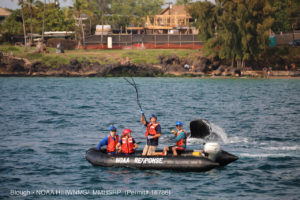
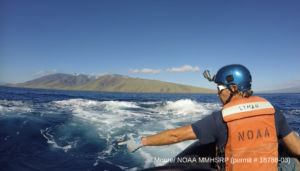
A video camera mounted on Ed Lyman’s helmet records the many steps involved in rescuing entangled large whales. Videos of whale rescues and disentanglements will be shown at Ed Lyman’s talk on July 2 at The Sphere at Maui Ocean Center.          Moore/ NOAA MMHSRP (permit # 18786-03)
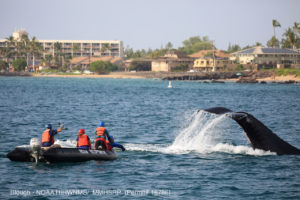
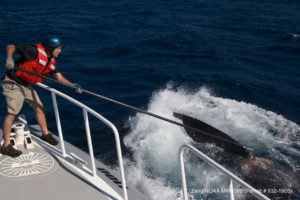
Ed Lyman works with a trained and NOAA-authorized response team to free an entangled humpback whale off Maui.

Ed Lyman uses a hooked knife on the end of a pole to disentangle a whale. Once approachable, rescuers safely assess the animal and entanglement, and attempt to free the animal of all entangling gear.

Ed Lyman lifts coaxial cable the team has just cut free of a humpback whale off Maui. Over 800 feet of the cable was removed and recovered. Entangling gear is not always fishing gear.

Public Invited to Free June 12 Presentation on South Maui Ocean Water Quality Monitoring Results

in /by

How clean is the ocean water at your favorite South Maui beach?

Get answers at a free presentation about ocean water quality along the coast of South Maui from ‘Āhihi-Kīnau (Makena) to Haycraft Park (Mā‘alaea) on Wednesday, June 12 at 6 pm. The talk will feature data collected at 20 South Maui sites by the community-based ocean water quality monitoring program Hui O Ka Wai Ola (Association of Living Waters). The presentation will take place at the Hawaiian Islands Humpback Whale National Marine Sanctuary at 726 South Kīhei Road in Kīhei. Admission is free and the public is invited.

“Sharing what we have observed in our first full year of data gathering in South Maui is a big milestone for our unique community-based program,” says James Strickland III, Project Manager. “We’ve learned some surprising things about our coastal water quality in South Maui, which we are looking forward to sharing with everyone at our presentation.”

The free presentation will also include information about why clean ocean water is so important to the future of Maui’s coral reefs.

The Hui O Ka Wai Ola program is co-managed by Maui Nui Marine Resource Council, The Nature Conservancy and West Maui Ridge to Reef Initiative, working in cooperation with the State of Hawai‘i Department of Health Clean Water Division. More than 40 Maui residents volunteer with Hui O Ka Wai Ola, covering 39 locations along Maui’s leeward shoreline.

“Clean ocean water is important for healthy coral reefs and for all ocean recreation,” says Tova Callender, Watershed Coordinator of West Maui Ridge to Reef Initiative. “To work towards clean ocean water along our shorelines, we need to understand where the water is impaired and what pollutants are to blame.”

“The Hui O Ka Wai Ola program follows a strict Department of Health approved Quality Assurance Project Plan (QAPP),” says Callender. “This allows the Hui to provide data the Department of Health can readily incorporate into its reports and databases, which are shared with County, State and Federal agencies, scientists, community groups and the public.”

Every three weeks the Hui team measures sediments, nutrients, and other pollutants from land-based sources that might be having a negative impact on water quality. They collect data for ocean salinity, pH, temperature, organic nutrients (nitrogen and phosphorous compounds), dissolved oxygen (DO), and turbidity). Nutrients, including nitrogen and phosphorus, can indicate agricultural runoff and sewage pollution. Sediments, which block sunlight and smother corals, can be carried from the land to the ocean by streams, flooding, and storm water runoff.

“We’ll be discussing all that we’ve found, the implications for the reef and marine wildlife, and the clues the data provides about the sources of any pollutants,” says Robin Newbold, Chair and co-founder of Maui Nui Marine Resource Council. “Ultimately, our goal is to use our data to bring about clean ocean water for Maui’s coastal areas, for all to enjoy.”

The Hui O Ka Wai Ola program is supported by Maui County Office of Economic Development (OED), Hawai‘i Tourism Aloha ‘Āina Program, North Beach West Maui Benefit Fund, Napili Bay and Beach Foundation, National Fish and Wildlife Foundation, Lush Cosmetics, The Makana Aloha Foundation, Honua Kai West Maui Community Fund, as well as individuals, families and local businesses. To learn more or to donate, please visit www.huiokawaiola.com or at www.mauireefs.org.

June 5 Meeting of Maui Nui Marine Resource Council 
to Feature Free Presentation on Carrying Capacity Study of Popular Oahu Snorkeling Site

in /by

When considering Maui’s most popular reefs, how many snorkelers are too many? What’s the impact of hundreds or possibly thousands of snorkelers per day at our reefs? How do we determine the right amount of snorkelers at our local reefs?

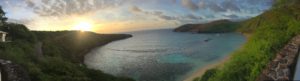
If you’ve wondered about the answers to these questions, Maui Nui Marine Resource Council invites you to a free talk that will share methodology and findings from a carrying capacity study of O‘ahu’s heavily visited Hanauma Bay by researchers from The Coral Reef Ecology Lab (CREL). The free presentation will take place at the Wednesday, June 5 meeting of Maui Nui Marine Resource Council from 5:30 pm to 7:30 pm at The Sphere at Maui Ocean Center. Doors open at 5 pm. Seating is limited so advance reservations are strongly recommended. To reserve, visit https://bit.ly/snorkelers

The featured guest presenters will be Sarah Jane Leicht Severino, Research Associate, and Ku‘ulei Rodgers, PhD, Principal Investigator of The Coral Reef Ecology Lab (CREL) at the University of Hawai‘i, Hawai‘i Institute of Marine Biology campus. They will speak about CREL’s Hanauma Bay Biological Carrying Capacity study, which quantifies the extent of human influence and determines the acceptable limits of disturbance to the marine resources of Hanauma Bay. For the past year, CREL has performed observational and manipulative experimentation within the Bay documenting the interactions between visitors and the marine environment as they relate to human use, coral tramping, sedimentation, and visual water clarity.
“The findings of the Hanauma Bay research should prove valuable in helping communities throughout Maui County evaluate the impacts of snorkelers at our popular reefs,” says Amy Hodges. “This talk is an excellent opportunity to explore how Maui County might most effectively answer the question of how many snorkelers — and under what circumstances — are too many snorkelers  at our local reefs?” 

About Dr. Ku’ulei Rodgers:

Dr. Ku‘ulei Rodgers has been working at the Hawai‘i Institute of Marine Biology’s (HIMB) Coral Reef Ecology Lab since 1992 under the direction of Drs. Paul Jokiel and Fenny Cox, as an HIMB faculty member since 2005 and as the Principal Investigator of the Coral Reef Ecology Lab since 2016. Over 100 of her articles have been published in peer-reviewed journals, published reports, and conference proceedings. She was in the top five most read PeerJ journal articles in 2017.

Since 2005, she has provided graduate advising, mentoring, and training for 15 graduate students, 40 undergraduates, interns, and technicians, and 2 post-docs. Ku‘ulei has been heavily involved as Principal Investigator, Co-Principal Investigator or research assistant on 25 funded projects since her appointment, conducting research at sites on every island. She has secured funding through grants of over $3.5 million assisting in student support and research needs.

Many of her research projects are of an interdisciplinary nature involving close collaborations with over 20 UH researchers from the oceanography, engineering, and zoology departments and over 50 cooperative relationships with managers and scientists from federal and state agencies, non-governmental organizations, and private industry. Her research has been widely disseminated through extensive media coverage with well over 200 documented local television news interviews, newspaper articles, and media events, global webcast video coverage, national and international newspaper and web articles and radio interviews

Ku‘ulei was one of the co-founders along with Dr. Paul Jokiel, Dr. Eric Brown, and Will Smith of the ongoing Coral Reef Assessment and Monitoring Program established in 1999 and continues to serve as PI along with the State Division of Aquatic Resources.

About Sarah Jane Leicht Severino:
Sarah Jane Leicht Severino earned her MS in Marine Science at Hawai‘i Pacific University (HPU) in 2015. For her master’s research she developed a technique, the Fluorescence Census Technique (FCT), that utilizes the natural fluorescent pigmentation found within some species of corals to non-destructively census their smallest size classes in-situ under daylight conditions.

After graduate school, Sarah worked as a First Mate on HPU’s Research Vessel, Kaholo, for two years. In addition to managing fieldwork on HPU’s Research Vessel, she was recruited by the Navy to manage field operations for a project studying the structure of marine resources within the main Pearl Harbor shipping channel.  The FCT was used in the Pearl Harbor shipping channel to quickly and accurately quantify the abundance and recruitment patterns of juvenile coral colonies on their natural reef substrate. 

Since starting in the Coral Reef Ecology Lab, Sarah has been working toward establishing a biological carrying capacity for Hanauma Bay Marine Life Conservation District (MLCD). By analyzing historical data and performing several field experiments, she seeks to quantify changes in the benthic community of reefs at Hanauma Bay in response to pressure from human use.

About Maui Nui Marine Resource Council:

Established in 2007, Maui Nui Marine Resource Council (MNMRC) is an award-winning nonprofit 501(c)(3) organization working for healthy coral reefs, clean ocean water and abundant native fish for the islands of Maui County.

During the past 11 years since our organization’s establishment, we have been based on Maui and have achieved recognition for working with our local community to create culturally appropriate, effective science-based solutions to serious local threats facing our reefs. Many problems facing Maui County’s local reefs originate on land, which is why our projects and programs are community-based and work from mountains (mauka) to sea (makai). To learn more, visit www.mauireefs.org.

Public Invited to Free Presentation on Plastic Pollution At May 1 Meeting of Maui Nui Marine Resource Council

in /by

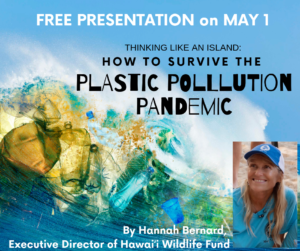
The public is invited to a free presentation titled, “Thinking Like an Island:  How to Survive the Plastic Pollution Pandemic,” that will be offered by guest presenter Hannah Bernard at the Wednesday, May 1 meeting of Maui Nui Marine Resource Council.

This free presentation will take place from 5:30 pm to 7:00 pm at The Sphere at Maui Ocean Center. Doors will open at 5 pm. Advance reservations are recommended, as seating is limited. To make a free reservation, visit https://bit.ly/MauiPlasticPollution

“While scientists and politicians may argue about climate change and its impact on our world ocean, the world is waking up to the devastating reality of the oceanic plastic plague,” says Bernard, the co-founder and Executive Director of Hawai’i Wildlife Fund.  “After several decades of local awareness-raising we are at a tipping point worldwide where plastic pollution of the ocean is widely recognized as one of the greatest threats of our time to the ocean ecosystem and even human health.”

Bernard’s talk will focus on ways individuals help turn the tide on the plastic plague and why there’s hope for the future.

“We are excited to have this opportunity to share Hannah Bernard’s extensive knowledge about plastic pollution with the community,” says Amy Hodges, Programs Manager at Maui Nui Marine Resource Council. “She’ll be sharing the latest findings about plastic pollution and offering commonsense ideas for ways to slow down and perhaps even stop the ‘plastic plague’ that is threatening our ocean and all marine wildlife.”

The meeting will also include updates on Maui Nui Marine Resource Council’s programs, including results from its ocean water quality monitoring program al

ong the shores of south and west Maui and its program to improve ocean water quality at Ma’alaea Bay.

The meeting and presentation will take place at Maui Ocean Center at The Sphere, a new high-tech dome-shaped presentation space, offering reclining movie-theater style seats and state-of-the-art visuals and acoustics. (Learn more about The Sphere at www.mauioceancenter.com.) Maui Ocean Center is donating use of this space to Maui Nui Marine Resource Council for this event.
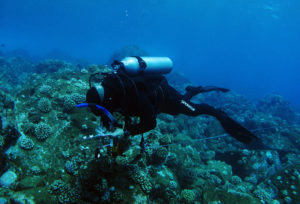
Doors open at 5 pm; please enter by the Administrative Office entrance at Maui Ocean Center. The presentation will take place from 5:30 pm to 7 pm. Admission is free and the public is invited. By order of the fire marshal, only 118 guests can be accommodated. Free reservations can be made by following this link: https://bit.ly/MauiPlasticPollution

SPECIAL THANKS TO MAUI OCEAN CENTER FOR HOSTING THIS EVENT.


About Hannah Bernard:
Co-Founder and Executive Director of Hawai’i Wildlife Fund, Hannah Bernard is an award-winning marine biologist with 37 years’ experience studying, teaching, leading expeditions and directing efforts to support research and conservation of Pacific Ocean marine life. In addition to co-founding the state’s Makai Watch program, she currently serves on the federally appointed False Killer Whale Take Reduction Team to address the incidental mortality and serious injury of false killer whales in Hawai`i’s longline fishery.

She has served on numerous Boards and committees, including the federally appointed Pacific Scientific Review Group, Sierra Club’s National Marine Wildlife and Habitat Committee, the ‘Ahini-Kina’u Advisory Group, the Hawai’i Ecotourism Association, the Humpback Whale National Marine Sanctuary Advisory Council, Save Honolua Coalition, Maui Surfrider Foundation, Maui Coral Reef Network, Maui Reef Fund and the ‘Ohana Coalition Steering Committee.

Hawai’i Wildlife Fund is a non-profit organization founded in 1996, and has initiated numerous community-based management projects and orchestrated the removal of more than 300 tons of marine debris from some of Hawai’i’s most impacted coastal habitats, protected more than 10,000 hawksbill sea turtle hatchlings and their mothers, and taught thousands of students and volunteers in the field and in the classroom through marine naturalist trainings, youth outreach programs and expeditions.

About Maui Nui.Marine Resource Council:

Maui Maui Nui Marine Resource Council is a Maui-based nonprofit organization celebrating 11 years of working for healthy coral reefs, clean ocean water and an abundance of native fish for the islands of Maui County. In addition to co-managing the Hui O Ka Wai Ola ocean water quality testing program, which tests ocean water quality at 39 locations along the south and west shores of Maui, the nonprofit is working to improve ocean water quality in Ma’alaea Harbor through the installation of caged oysters in the harbor. Maui Nui Marine Resource Council is also working in the Pohakea watershed above Ma’alaea Bay to prevent stormwater runoff to protect ocean water quality and the coral reefs located in the bay. To learn more, visit www.mauireefs.org

Free presentation about Kahoʻolawe –“Kūkulu Ke Ea A Kanaloa — The life and spirit of Kanaloa builds and takes form” at April 3 meeting

in /by

Missed this event? View it here:

https://vimeo.com/332580699


The public is invited to a free presentation focusing on Kahoʻolawe titled, “Kūkulu Ke Ea A Kanaloa — The life and spirit of Kanaloa builds and takes form.” The talk will be presented by Dean Tokishi, Ocean Resources Specialist III, Kaho’olawe Island Reserve Commission, at the Wednesday, April 3 meeting of Maui Nui Marine Resource Council.  This event will take place at a new venue: The Sphere at Maui Ocean Center. 

“Kanaloa Kaho‘olawe’s rich history, complex present and hopeful future can be seen and felt,” said Tokishi. “My talk will cover everything from the island’s use as a prison colony, a ranch, and military live fire training site to the extensive unexploded ordinance clean-up project and the efforts to restore an entire island ecosystem, mauka to makai.”

The meeting and presentation will take place at Maui Ocean Center at The Sphere, a new high-tech dome-shaped presentation space, offering reclining movie-theater style seats and state-of-the-art visuals and acoustics. (Learn more about The Sphere at www.mauioceancenter.com) Doors open at 5 pm; please enter by the Administrative Office entrance at Maui Ocean Center. The presentation will take place from 5:30 pm to 7 pm. Admission is free and the public is invited. By order of the fire marshal, only 118 guests can be accommodated, so admission is on a first-come, first-served basis.

“Many on Maui look across the channel to Kahoʻolawe and wonder about its history, and what the island is like now,” says Amy Hodges, Program Manager at Maui Nui Marine Resource Council. “Thereʻs also a lot of curiosity about the reefs and marine resources of Kahoʻolawe. How are they surviving after the years of extreme sediment runoff caused by the decades of military bombing of Kahoʻolawe? We are grateful that Dean Tokishi will be sharing his manaʻo and knowledge about Kahoʻolawe with us all.”

“Please join us for this free talk, which will include time for questions from the audience,” says Hodges. “Iʻm confident that weʻll all learn much and come away inspired by the work that KIRC is doing to restore and protect Kahoʻolawe and its marine resources.”

“We thank Dean Tokishi in advance for this presentation, and also thank Maui Ocean Center for hosting this event,” says Hodges.

About Dean Tokishi:
Growing up on Maui, Dean graduated from Maui High School and later received a Bachelorʻs Degree in Marine Science from the University of Hawaii at Hilo. For three years he was involved in the restoration of Kahoʻolawe during the ordnance removal project. In January of 2003 he obtained a position with the Kahoʻolawe Island Reserve Commission (KIRC) in monitoring, managing and protecting all of the Reserves marine resources. Currently Dean serves as KIRCʻs Ocean Resources Program Manager where he is given the opportunity to educate others on the importance of these marine resources.

About Kahoʻolawe Island Reserve Commission (KIRC)
From its inception by the State of Hawaiʻi in 1993, KIRC was funded through the Kahoʻolawe Island Rehabilitation Trust Fund – originating from a portion of the federal funding allocated to the Navy’s unexploded ordnance clearance project (ending in 2003). In 2014, KIRC partnered with PKO (Protect Kahoʻolawe ʻOhana) and OHA (Office of Hawaiian Affairs) to publish a collaborative plan for the Kahoʻolawe Island Reserve through 2026 (entitled I Ola Kanaloa!). With refined goals and objectives adopted by each organization, KIRC presented its self-sustainability financial plan to the Hawaiʻi State Legislature in 2016. Supported by an Aloha Kahoʻolawe campaign, which called for memberships, shared information and public testimony to affirm KIRC’s restoration and access programs, the State authorized permanent funding for KIRC staff and additional CIP funding for KIRC operations in 2018. Programs that bring community volunteers to the Reserve continue to rely on funds raised through donations, grants and memberships. Learn more at https://www.kahoolawe.hawaii.gov/home.php

About Maui Nui Marine Resource Council
Celebrating 11 years, Maui Nui Marine Resource Council is a Maui-based nonprofit organization working for healthy coral reefs, clean ocean water and the restoration of native fish for the islands of Maui County. To learn more, visit www.mauireefs.org.

Special thanks to Maui Ocean Center for donating use of The Sphere for this presentation.


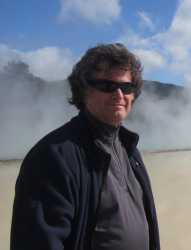
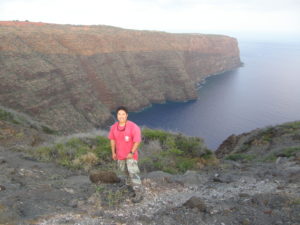
Dean Tokishi poses at the cliffs of Kamohio, located along the southern shore of Kahoʻolawe.

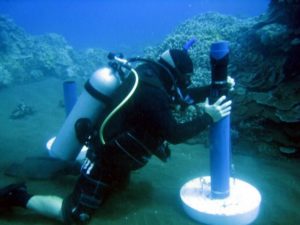
Dean Tokishi installs underwater sediment traps to monitor the rate of terrestrial run off that is
coming off of Kaho‘olawe and into the marine environment.

Dean Tokishi records data on coral and fish density and abundance along a line transect, as part
of his work to understand the condition of Kahaoʻolaweʻs nearshore reefs and to educate the public
about them.


Free Presentation on “The Other Side of Coral Restoration: Slow Growing Massive Coral Forms and Land-Based Coral Nurseries in Hawaii” 
to be Offered by David Gulko

in /by

A land-based coral nursery that quickly grows massive coral colonies for replenishing degraded reefs is the topic of a free presentation at Maui Nui Marine Resource Council’s March 6 meeting. David Gulko, Aquatic Biologist IV and Coral Ecologist for the State of Hawaii Division of Aquatic Resources and Director of the DLNR Division of Aquatic Resources (DAR) Coral Restoration Nursery will present on this innovative program.

David Gulko

The presentation is open to the public and takes place at Pacific Whale Foundation’s classrooms at the Maʻalaea Harbor Shops. Doors open at 5 pm with the hour long presentation beginning at 5:30 pm. Time will be provided to ask and answer questions and free refreshments will be served.

“Most coral nurseries elsewhere focus on in-water growing of fast-growing branching species to relatively small sizes for outplanting,” says Gulko. “Unfortunately, these branching species are more susceptible to stress caused by warming ocean temperatures.”

“While massive coral species are more resistant to bleaching, they are very slow growing in the wild,” notes Gulko.

The State of Hawaii has recently implemented an innovative program which allows for these massive coral species to be fast grown in the Stateʻs land-based Coral Restoration Nursery.

The program involves the collection of small (10 cm) live massive forms of coral colonies mostly from within public harbors. At the State’s land-based Coral Restoration Nursery, they are micro-fragged and then fast-grown into large-sized (42 cm and 84+ cm) massive colonies in a fraction of the time it would take to occur naturally.

“In the wild in Hawaii, these corals would typically grow only 1 -2 cm/year. To grow corals 42 cm would take 20+ years in the wild,” says Gulko. “In our nursery, we are growing massive colonies in a fraction of the time it would take to occur naturally.”

According to Gulko, the resulting large colony modules are then placed onto degraded natural Hawaiian coral reefs in an effort to restore these reefs back towards their earlier ecologically-complex state.

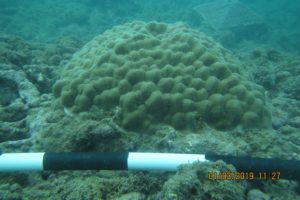
This photo from January 2019 shows an outplanted 42cm module of Porites evermanni on a reef area that the Hawaii Coral Restoration Nursery has been restoring. In the background you can see a Montipora module that was put out later. This coral was produced in 8 months from 10 cm of source tissue. Photo credit: C. Wolke, Hawaii Coral Restoration Nursery, DAR

The outplanted colonies are evaluated using the State’s Coral Ecological Services and Functions Tool. “We can calculate an offset that can be used by developers and responsible parties to pay for coral and habitat loss incurred elsewhere in Hawaii,” Gulko notes. “The result is a dynamic program to put out large, live coral colonies, paid for without large expenditures of public monies, and without the extremely long natural recovery rates. This program can replace large corals that are normally found in Hawaii in one year instead of decades.”

According to Gulko, the program is now expanding to focus on extremely rare coral species to re-introduce them back into the wild using similar techniques.

Gulko has served as the Director of the State of Hawaii Coral Reef Restoration Nursery for 6 years. He has also worked as a NRDA Aquatic Biologist/Coral Reef Ecologist for the State of Hawaii for 23 years.

Maui Nui Marine Resource Council is a nonprofit organization working for healthy coral reefs, clean ocean water and the restoration of native fish. To learn more, visit www.mauireefs.org.

Free Presentation on “Wildfire on Maui: the History, Threat, and Our Collective Responsibility”

in /by

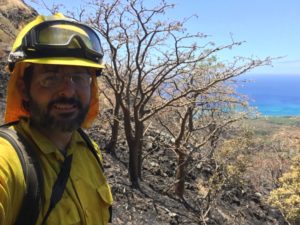
Did you know that the area burned each year by wildfire in Hawaii has increased by 400% over the past several decades? Wildfires have an impact on our nearshore ocean environment and coral reefs, which is why Maui Nui Marine Resource Council is hosting a free presentation on “Wildfire on Maui: the History, Threat, and Our Collective Responsibility” on Wednesday, February 6.

The presentation will be offered by Clay Trauernicht, PhD, Wildland Fire Specialist at University of Hawaiʻi Cooperative Extension. It will take place from 5:30 pm to 7:00 pm at Pacific Whale Foundation’s classrooms at the Ma’alaea Harbor Shops at 300 Ma’alaea Road, Ma’alaea (Wailuku). Doors open at 5:00 pm and complimentary refreshments will be served.

“Over the past decade, an average of more than 1,000 wildfires burned more than 17,000 acres each year in Hawai‘i, with the percentage of total land area burned comparable to and often exceeding figures for the fire-prone western United States,” reported Dr. Trauernicht.
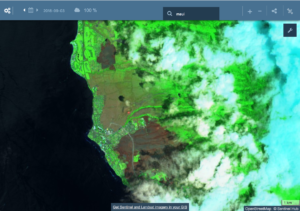
“During my presentation, we’ll use fire science and a bit of history to tackle the how and why of the 400% increase in areas burned by wildfires in Hawaii,” said Dr. Trauernicht. “We’ll also look at the consequences it has for our watersheds and nearshore ecosystems.”

“The short story is that fire on Maui and other islands is a problem we’ve largely created,” he noted.  “It is therefore one of the few ‘natural’ disasters we can actually avoid.”

“We’ll consider our options to reduce fire risk and impacts on Maui and how the urgency to take action is increasing under a changing climate,” Dr. Trauernicht reported.

Attendees will be invited to share their questions, experiences and ideas about wildland fires on Maui at the conclusion of Dr. Trauernicht’s presentation.

Dr. Trauernicht earned his PhD in Plant Science at the University of Tasmania and a MS in Botanical Sciences at the University of Hawaii at Manoa. He completed his BS in Biology at the University of Denver.  In addition to many years of botanical and ecological fieldwork, he has published and presented on plant community ecology and population modeling, geospatial analyses of fire and species occurrence, and the use of local knowledge to adapt management strategies and inform research needs.
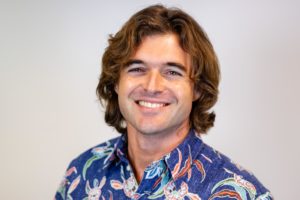
His current focus is on improving wildland fire management in Hawaii and the Pacific with a strong emphasis on science extension and communication.  Dr. Trauernicht is the project leader for the Pacific Fire Exchange, part of the Joint Fire Science Program’s nationwide Fire Science Exchange Network.  He is currently working with the Pacific Island Climate Change Cooperative to extend climate science resources to Cooperative Extension programs throughout the Pacific Island region.

Maui Nui Marine Resource Council is a Maui-based nonprofit organization celebrating 17 years of working for healthy coral reefs, clean ocean water and an abundance of native fish for the islands of Maui County. In addition to co-managing the Hui O Ka Wai Ola ocean water quality testing program, which tests ocean water quality at 39 locations along the south and west shores of Maui, the nonprofit is working to improve ocean water quality in Ma’alaea Harbor through the use of installed oysters in cages. Maui Nui Marine Resource Council is also working in the Pohakea watershed above Ma’alaea Bay to prevent fire and erosion to protect ocean water quality and the coral reefs located in the bay. To learn more, visit www.mauireefs.org.

Free Presentation on Using Artificial Reefs and Other Offshore Wave Dissipation Techniques to Protect Eroding Coastlines on Maui

in , /by

The public is invited to a free presentation on Wednesday, January 2 that will explore artificial reefs and other offshore wave dissipation techniques that could be used to reduce coastal erosion on Maui. The presentation is part of Maui Nui Marine Resource Council’s monthly meeting series, which is free and open to all.

The presentation will take place from 5:30 to 7:00 pm at Pacific Whale Foundation’s classrooms at the Ma’alaea Harbor Shops at 300 Ma’alaea Road, Wailuku. Doors open at 5:00 pm. Refreshments will be served.

The presentation will be offered by Dr. Michael Foley, a Professional Engineer and leader of the Resilient Sustainable Engineering (RiSE) team at Oceanit, a company with headquarters in Honolulu that employs more than 160 scientists and  engineers.
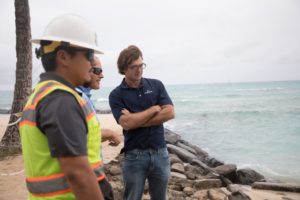

Considered one of the state’s leading experts on shoreline erosion, Foley has designed artificial reef systems to provide coastal protection and promote coral reef habitats. He has also been a key contributor to understanding issues and identifying solutions for beach erosion and sand depletion.

Dr. Foley grew up on Maui. He is an avid surfer, serves on the Board of Directors of the Hawaii Shore and Beach Preservation Association, and volunteers with the Surfrider Foundation.  He earned his Ph.D. from the University of Hawaiʻi at Mānoa, specializing in the application of submerged breakwaters (artificial reefs) that provide coastal and harbor protection while simultaneously providing ecological and recreational value as coral reef habitat and surf breaks.

“Many of us on Maui are wondering what can be done about shoreline erosion and the loss of beaches and coastal areas,” says Amy Hodges, Programs Manager at Maui Nui Marine Resource Council. “Dr. Foley’s talk will explore some innovative options that could be considered to help reduce shoreline loss.”

According to the company’s website, “Oceanit is committed to pursuing responsible solutions to the world’s most difficult problems, blending interdisciplinary science, technology, engineering, and innovative thinking to benefit our global community. Through spin-outs, co-development partnerships, licensing, and direct manufacturing, Oceanit is able to deliver solutions to market. Oceanit calls this practice ‘Mind-to-Market’; delivering deep science to disruptive, real-world breakthroughs.”

With headquarters in Honolulu, Oceanit employs over 160 scientists and engineers in Hawai’i, California, Texas, and Washington, D.C and has built its culture upon values of Ohana, Curiosity, and Community. To learn more, visit www.oceanit.com.

Maui Nui Marine Resource Council is a nonprofit organization celebrating 11 years of working for healthy coral reefs, clean ocean water and abundant native fish. To learn more, visit www.mauireefs.org