Blog Archives: News Releases

Community-Led Coral Restoration Effort Launches in South Maui

in , /by


KIHEI – Maui’s coral reefs are facing increasing threats from rising ocean temperatures, sediment pollution, and human impact. In a community-driven effort to combat these challenges, a new Community-Based Coral Restoration Area (CBCRA) has been established in South Maui, giving damaged corals a second chance at survival.

Over the course of 3 days in February, the Maui Nui Marine Resource Council (MNMRC) worked under the guidance of Kuleana Coral Restoration to find broken corals near large reef colonies and re-plant them on bare reef in the same area. Reattaching the broken coral can help to extend its lifespan and over time it will continue to grow, increasing coral cover and providing habitats for fish and other marine life.

“We are excited to support Maui’s community in creating this new CBCRA site,” said Kuleana Coral Restoration’s Manager, Blake Nowack. “We have spent over a year training and planning with the MNMRC team to pilot restoration techniques in Maui so that their local communities can foster resilient coastal ecosystems. Kuleana Coral primarily focuses on Oʻahu, but we want all of Hawaiʻi to have healthy reefs, so we support efforts on other islands whenever we are able to.”

The teams only sourced corals found already detached from the reef, focusing on collecting grapefruit-sized (or larger) Large Rescued Colony (LRCs) and smaller coral fragments. Large Rescued Colony corals were prepared with a metal pin for reattachment while smaller, baseball-sized fragments were reattached directly to the bare reef using an adhesive.

The project began with a collaboration between MNMRC and community members to identify potential areas for restoration work. “Kula Kai is facing many threats, so when this project came up, we thought, ‘Why not try? What do we have to lose?’” said Kanaka ʻŌiwi of Kula Moku, Vernon Kalanikau. “It is clear the reefs need help, and while we are also looking mauka for solutions to mitigate sediment run-off, the thought has always been, ‘What else can we do to help makai?’ We felt that if there is an opportunity to do something in the ocean, this is a good place to start. Considering the damage sediment run-off has caused to our reefs in Kula Kai for years, a project like this can only have positive outcomes and results.”

In addition to working with community members, MNMRC also worked with the State of Hawaii Division of Aquatic Resources (DAR) to evaluate site selections and hosted DAR staff of Day 2 of the project. “Protecting our local reefs is of critical importance,” said DAR Aquatic Biologist, Russell Sparks. “Being a part of this project was a great opportunity to support restoration work in South Maui and train our team in new coral restoration methods to build capacity for future work on Maui.”

MNMRC has a long history of launching projects and initiatives to address the many factors influencing reef health. Last year, they launched reef-friendly landscaping education and test plots, adding to previous erosion mitigation efforts like gulch sediment removal and deer fencing for upstream ranches. The organization also conducts water quality monitoring at 41 sites in Maui, scientific studies, and reef monitoring dives throughout the year.

By creating community-based coral restoration areas, MNMRC aims to enhance the impact of conservation work already taking place on land and in the water.

“Whenever possible, we try to connect different efforts, so that we can make an even greater impact in one area or create a network of related projects from mauka to makai,” said Executive Director, Amy Hodges. “When we connect projects or communities together, impact is multiplied and change can happen at a faster pace.”

While the process is still new to Maui, there is interest in creating CBCRAs from communities in West Maui that are already doing water quality monitoring or reef-friendly landscaping. “Our goal is to accelerate conservation efforts in Maui by helping communities who want to create their own CBCRAs and to provide training so they have the skills and knowledge needed to sustain long-term reef health,” said Hodges.

The team from Maui Nui Marine Resource Council will continue to maintain the two sites going forward and monitor restored corals for signs of growth.

Support for community-based coral restoration provided by the County of Maui Department of Environmental Protection and Sustainability.

For more information, please visit: mauireefs.org/cbcra

NOTE: Please do NOT touch any live coral without obtaining a permit. Special permits are required for handling coral in Hawai’i [SAP 2025-12].
New Reef-Friendly Landscaping Test Plots at Waiehu Golf Course and Ichiro “Iron” Maehara Stadium

in /by

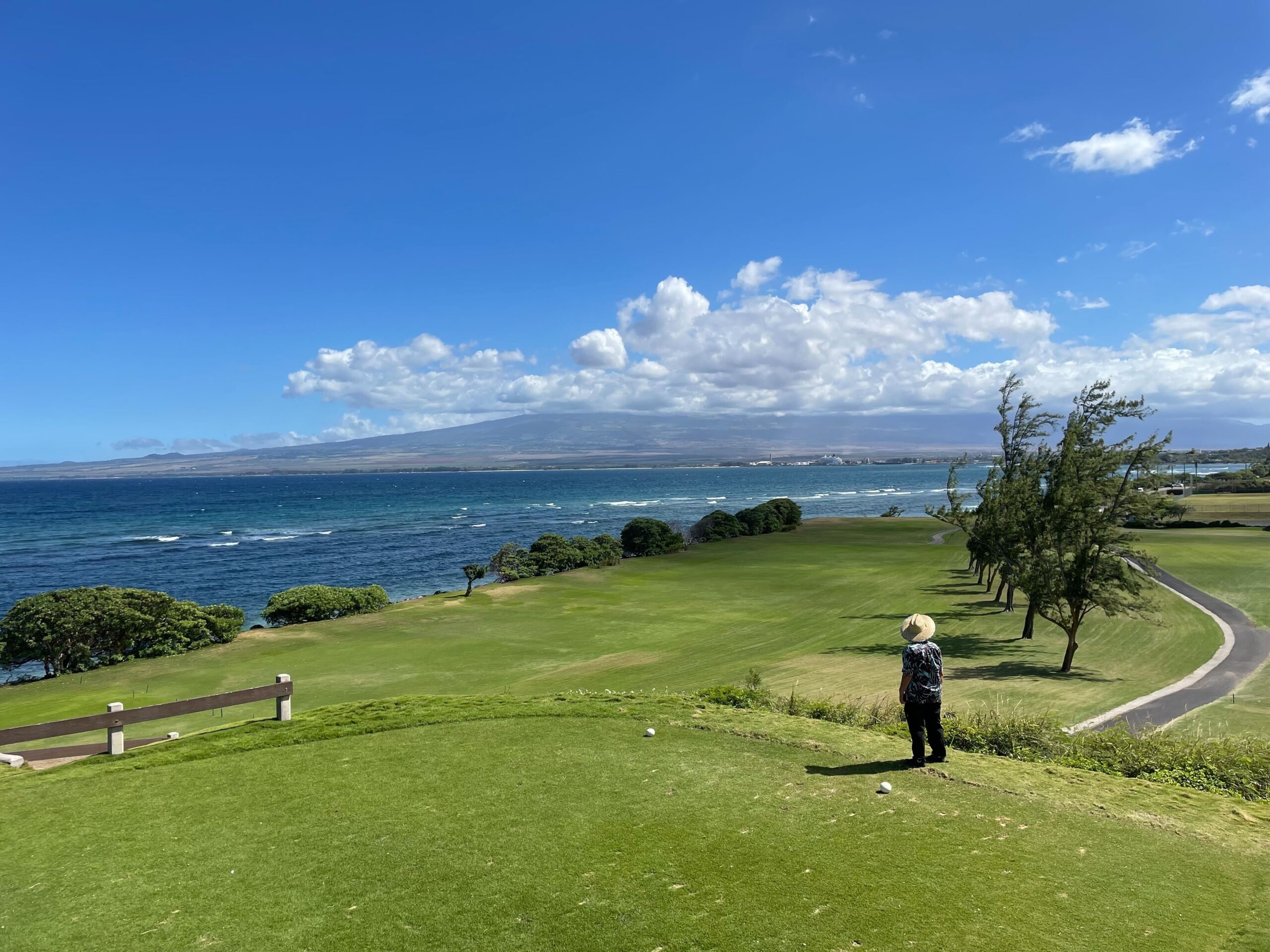
Charlotte O’Brien of SoilThrive Hawaii LLC surveys an area at the Waiehu Golf Course, where the County of Maui is launching a new, 3-month Reef-Friendly Landscaping test plot. (Photo Credit: SoilThrive Hawaii LLC)

WAILUKU, HI – The County of Maui is working with the Maui Nui Marine Resource Council (MNMRC) and SoilThrive Hawaii LLC to pilot reef-friendly landscaping (RFL) practices at Waiehu Golf Course and Ichiro “Iron” Maehara Stadium in Kahului. These pilot projects play an important role in assisting the County’s Parks and Recreation Department to find alternatives to synthetic landscaping inputs.

Building on the success of its first RFL test plot at Keōpūolani Park in 2022, the County of Maui Department of Parks and Recreation aims to achieve similar results including water savings and increased plant health at the two new sites.

“We were impressed with how the initial test plot turned out,” said Michael-James Mendiola, the County’s Parks Beautification Manager. “Even during a period with challenges in the park’s irrigation system, the RFL test plot thrived. It’s exciting to see that these sustainable practices have the potential to save water and still keep our public spaces healthy and beautiful. We look forward to seeing the results after applying RFL practices at different parks.”

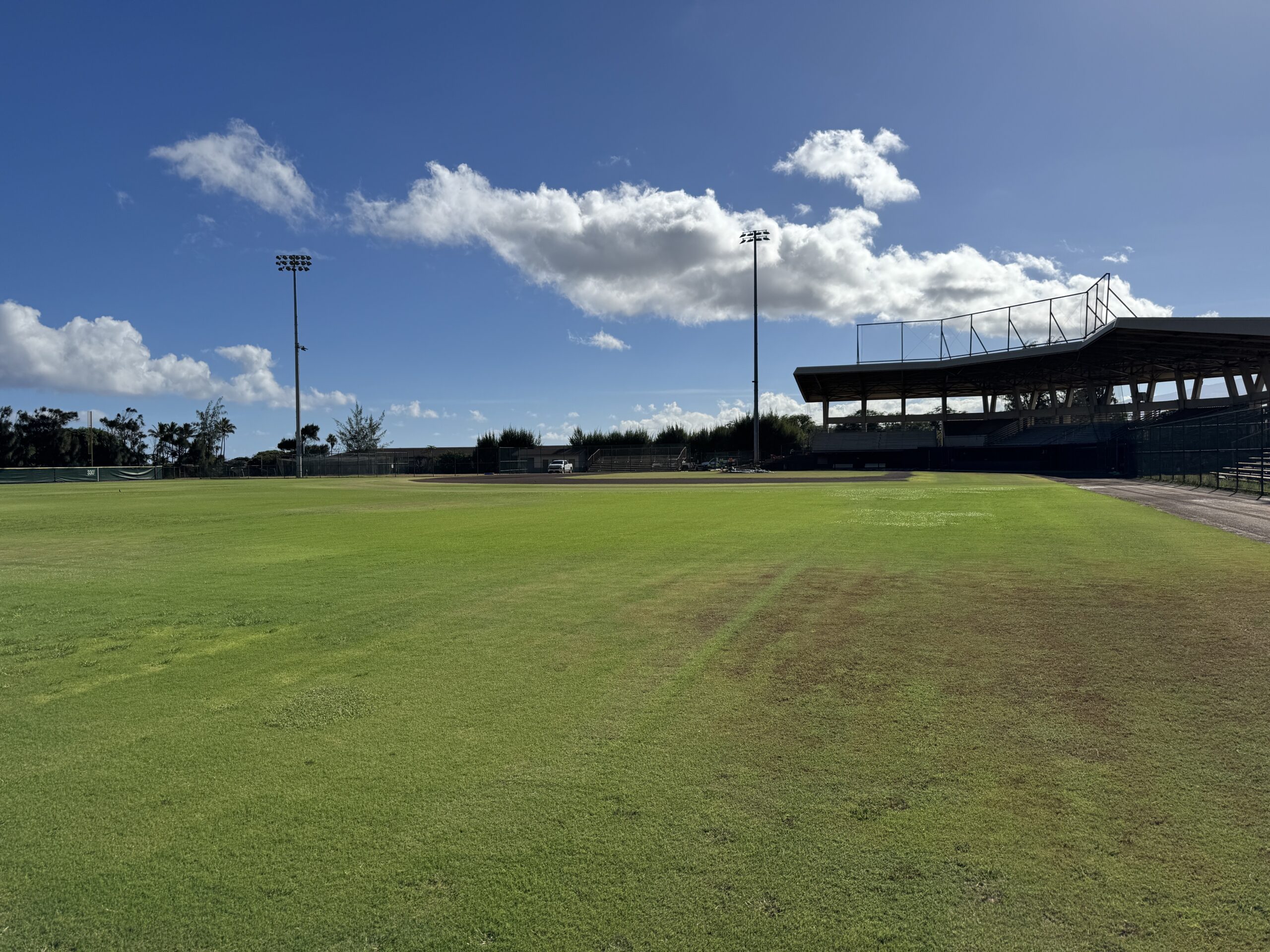
The County of Maui is in the preliminary stages of creating a 6-month RFL test plot at Ichiro “Iron” Maehara Stadium in Kahului. (Photo Credit: Jill Wirt, Maui Nui Marine Resource Council)

SoilThrive Hawaii LLC will provide the County with complimentary services for the 3-month test plot at Waiehu Golf Course, including applying its locally-made soil amendment, a liquid filled with nutrients and microbes to nourish plants and enrich the soil. The project will also implement and demonstrate reef-friendly weed control practices.

“We are thrilled to be partnering with the County of Maui Parks and Recreation Department again and can’t wait to see how these new test plots will do,” said Jill Wirt, Program Director at MNMRC. “It’s encouraging to see the County join the growing shift toward non-synthetic practices. Other industries, like resorts and commercial agriculture, are also starting to pilot RFL practices signaling an openness to change, and hopefully a commitment to creating a more sustainable future for our island.”

The County is also in the preliminary stages of creating a six-month test plot at the Ichiro “Iron” Maehara baseball field to test the reef-friendly landscaping process in different environments.

“Our company is dedicated to providing true pono landscape health solutions. By revitalizing soils naturally, we boost “ola” or vitality. We believe we will achieve the results desired by parks and recreation management,” said Robin Leimomi Proctor, of SoilThrive Hawaii LLC.

In addition to its new test plots, the County is working to find and incorporate other non-synthetic products for routine care and maintenance in the parks. These products will complement the soil amendment provided by SoilThrive Hawaii LLC, and help ensure that the County’s parks are healthy and maintained while minimizing its environmental impact.

“Providing the community with beautiful parks and outdoor spaces to enjoy is at the heart of what we do,” said Shane Dudoit, Deputy Director of Parks and Recreation. ”By working with MNMRC and SoilThrive Hawaii LLC to launch these test plots we are committing to minimizing our impact on the environment while enhancing the quality of our public spaces.”

MNMRC will host its 5-day Reef-Friendly Landscaping Certification Course in November, offering County Parks staff and all industry professionals an opportunity for professional development and support to learn and successfully implement RFL Practices.

Maui Gold Pineapple Partners with Maui Nui Marine Resource Council to Pilot Reef-Friendly Landscaping Program

in /by

Maui, Hawaii (May 9, 2024) – Maui Gold Pineapple is proud to announce the creation of a test plot to pilot Maui Nui Marine Resource Council’s (MNMRC) Reef-Friendly Landscaping program at their farm in Haliʻimaile. This collaboration aims to complement reef-friendly practices already in place at the farm and increase Maui Gold’s commitment to protect the island’s coral reefs and coastal ecosystems. On Wednesday, May 8, a test plot launch was hosted by Maui Gold and MNMRC at the farm, with County of Maui Mayor Richard Bissen and Hawaiʻi State Senator Lynn DeCoite among the guests supporting the initiative in attendance.

“We are thrilled to join forces with the Maui Nui Marine Resource Council to pioneer this Reef-Friendly Landscaping initiative on our farm,” said Darren Strand, director of agriculture at Maui Gold Pineapple. “As stewards of the land, we have always recognized the importance of protecting our coastal ecosystems. Continuing to implement more reef-friendly practices at Maui Gold is one way to show our commitment to sustainability and responsible land management.”

The Reef-Friendly Landscaping program focuses on minimizing chemical pollution and runoff from agricultural and residential areas that may harm marine life and coral reefs. The plot at Maui Gold will be treated with a biological soil amendment, which is a liquid filled with nutrients and microbes that will nourish crops while enriching the soil at the same time. Made locally by natural land-care company SoilThrive Hawaii, LLC, the amendment will be applied to the plot via a custom delivery system specifically designed for Maui Gold Pineapple. SoilThrive will also conduct 19 types of soil testing and crop monitoring in the test plot throughout the pilot period.

“We are excited to have Maui Gold Pineapple pilot our Reef-Friendly Landscaping program on their farm,” said Jill Wirt, program director at Maui Nui Marine Resource Council. “They are the first agricultural business to partner with us. We know the program’s success on their farm will demonstrate how agricultural businesses of all sizes can thrive while driving positive change for Maui’s land and reefs.”

About Maui Gold Pineapple

For over 50 years, Maui Gold has produced Hawaii’s famously sweet pineapple. Grown on the slopes of Maui’s Haleakala with fresh water and nutrient-rich volcanic soil, Maui Gold pineapples are hand-harvested to ensure they’re picked at their peak ripeness. Located upcountry in Hali’imaile, guests can experience the history and culture of Maui Gold and see first-hand how the iconic fruit is produced on the Maui Pineapple Tour. Throughout the guided tour of the working pineapple farm, guests can taste the sweetness and take home a complimentary pineapple. Tours are available daily. To subscribe and receive Hawaii’s sweetest pineapple shipped from the Maui Gold farm, or for more information, visit MauiGold.com.

Hawaiʻi’s first reef-friendly landscaping certification course to be hosted by Maui Nui Marine Resource Council

in , /by

KAHULUI, HI–The Maui Nui Marine Resource Council (MNMRC) will launch its inaugural Reef-Friendly Landscaping certification course on May 22, 2024. The hybrid online and in-person course will teach professional landscapers, property managers, and agricultural businesses how to move away from synthetic products and transition to reef-friendly land-care practices. 

Enrollment is open through May 15, 2024 and is available for 50% off the course price for the first 10 students. 

As a community, we know that implementing sustainable practices and reducing land-based sources of pollution is key to preserving the longevity of our island home,” said Program Director, Jill Wirt. “By creating this course, MNMRC aims to make it easier for industry professionals to adopt land-care practices that are better for both our land and our reefs.”

The 10-subject curriculum will be taught by local experts in reef-friendly landscaping, combined with expertise from the Northeast Organic Farming Association’s (NOFA) Organic Land Care (OLC) program. Subject topics will include site analysis, design, and management; native, exotic, and invasive plants; wetlands and Hawaiian land care; and energy, pollution, and climate change. 

Before launching its certification course, MNMRC partnered with 12 local properties to test reef-friendly landscaping practices over 3 months in 2023. Early results showed positive results at each property, with many seeing an increase in plant growth and a decrease in pests and diseases. “The results from our pilot program were exciting because they demonstrate how the landscaping industry could create a positive, lasting impact on our land and reefs if professionals adapt natural products and reef-friendly practices,” said Wirt. “It is encouraging to see that a thriving landscaping industry can also mean healthy land and reefs in Maui County.”

Click this link to enroll in the course or email [email protected] for more information

Know Your Ocean: Can a non-scientist do science? Global and local community science projects on Maui

in , /by

Can a non-scientist do science? Global and local community science projects on Maui

MA’ALAEA, MAUI — Increasingly, scientists are asking for the public’s help to understand a wide range of topics from earthquakes to water quality to where animals live and more. Learn more about community or “citizen” science and how you can contribute to aiding conservation work in particular, at a free Zoom presentation on Wednesday, April 6 at 5:30 pm. This free event is hosted by Maui Nui Marine Resource Council as part of its Know Your Ocean Speaker Series with support from the County of Maui Office of Sustainability and Climate Resilience.

Through presentations by guest speakers Dr. Mark Deakos, Cheryl King, John Starmer, and Jennifer Vander Veur, you’ll be introduced to some global citizen science projects that are relevant to Maui and hear about some long-running community science projects taking place in Maui County that are seeking volunteers.

“If you want to make a difference in understanding the effects of climate change, protect native habitats and the species they rely on, or simply become more aware of the world around you, citizen science is a great way to get involved and make a difference,” notes John Starmer, Chief Scientist at Maui Nui Marine Resource Council and Volunteer Coordinator at City Nature Challenge (CNC) on Maui.

Maui Nui Marine Resource Council is a Maui-based nonprofit that relies upon citizen volunteers for its Hui O Ka Wai Ola ocean water quality monitoring program at 29 locations along Maui’s shores.

John Starmer

Starmer is the Maui Coordinator for City Nature Challenge. Started in 2016 as a competition between San Francisco and Los Angeles, the City Nature Challenge (CNC) has grown into an international event, motivating people around the world to find and document wildlife in their cities. The challenge is organized by Community Science teams at the California Academy of Sciences and the Natural History Museum of Los Angeles County and occurs during a four-day period. From April 29 to May 2, participants take photos of wild plants and animals. From May 3 to May 8, participants identified what was found. During this friendly competition, the winner is the city that gathers the most observations of nature, finds the most species, and engages the most people in the event.


Mark Deakos

“Because our urban areas are a bit smaller than most cities (like San Francisco or Hong Kong), our Maui team decided to aggregate the whole island (plus Molokini Crater) for the purpose of the challenge,” says Starmer.


Dr. Mark Deakos is the Founder, President, and Chief Scientist of the Hawai‘i Association for Marine Education and Research (HAMER).  Mark will be focusing on his manta ray photo-identification catalog of over 600 individuals.

Cheryl King

Cheryl King will be summarizing information about two of her citizen scientist-related projects: SHARKastics (marine debris research and cleanups) and Hawaiian Hawksbill Conservation (the statewide in-water photo-identification catalog for critically endangered Hawaiian hawksbill sea turtles from 1998-present).  She’s also a Seabird Biology Technician with the Maui Nui Seabird Recovery Project, so will be presenting potential volunteer opportunities with seabirds and colony restoration.


“There are so many wonderful, diverse ways to get involved in helping our precious natural resources and habitats of Maui Nui, so we hope to inspire a new batch of volunteers to join the critical work that’s being done all around Maui every day,” says King.

Jennifer Vander Veur

Jennifer Vander Veur is the Senior Program Manager of the Coral Reef Alliance of Maui Nui. “We are proud to support a dedicated team of local volunteers in Maui, Hawai’i, as they work to protect the valuable coral reefs in their community,” says Vander Veur. Her program works with volunteers who grow and plant native vegetation at key locations near coastal streams, which act as natural barriers and trap sediment runoff before it reaches the ocean and coral reefs.


“Getting the public involved in science projects allows scientists to take on projects that they could not do on their own with the limited funding and time that are available to typical research projects,” says Starmer.

“Maui Nui Marine Resource Council is hosting this talk to help Maui residents and visitors learn about the opportunities to participate in citizen science projects and help our community better understand and protect our natural resources,” says Meredith Beeson, who organizes the Know Your Ocean Speaker Series at Maui Nui Marine Resource Council. “Please join this event to learn how you can get involved and make a difference.”

Hui O Ka Wai Ola Reports on Six Years of Monitoring Maui’s Coastal Water Quality 2016-2022

in , , /by

KIHEI, HI – How do you know the water off your favorite beach is clean enough to swim in? You have a group of volunteers to thank for that.  Prompted by caring for the health of our residents, visitors, and the culturally important and ecologically sensitive coral reefs off our shores,  Hui O Ka Wai Ola (the Hui) has been keeping track of changes in water quality on Maui since 2016. (https://www.huiokawaiola.com/findings.html
Their data supports the efforts of the Department of Health to maintain a long-term record of nearshore water quality to inform efforts by state agencies and local nonprofit groups, like MNMRC, to reduce pollution impacts around the island. 


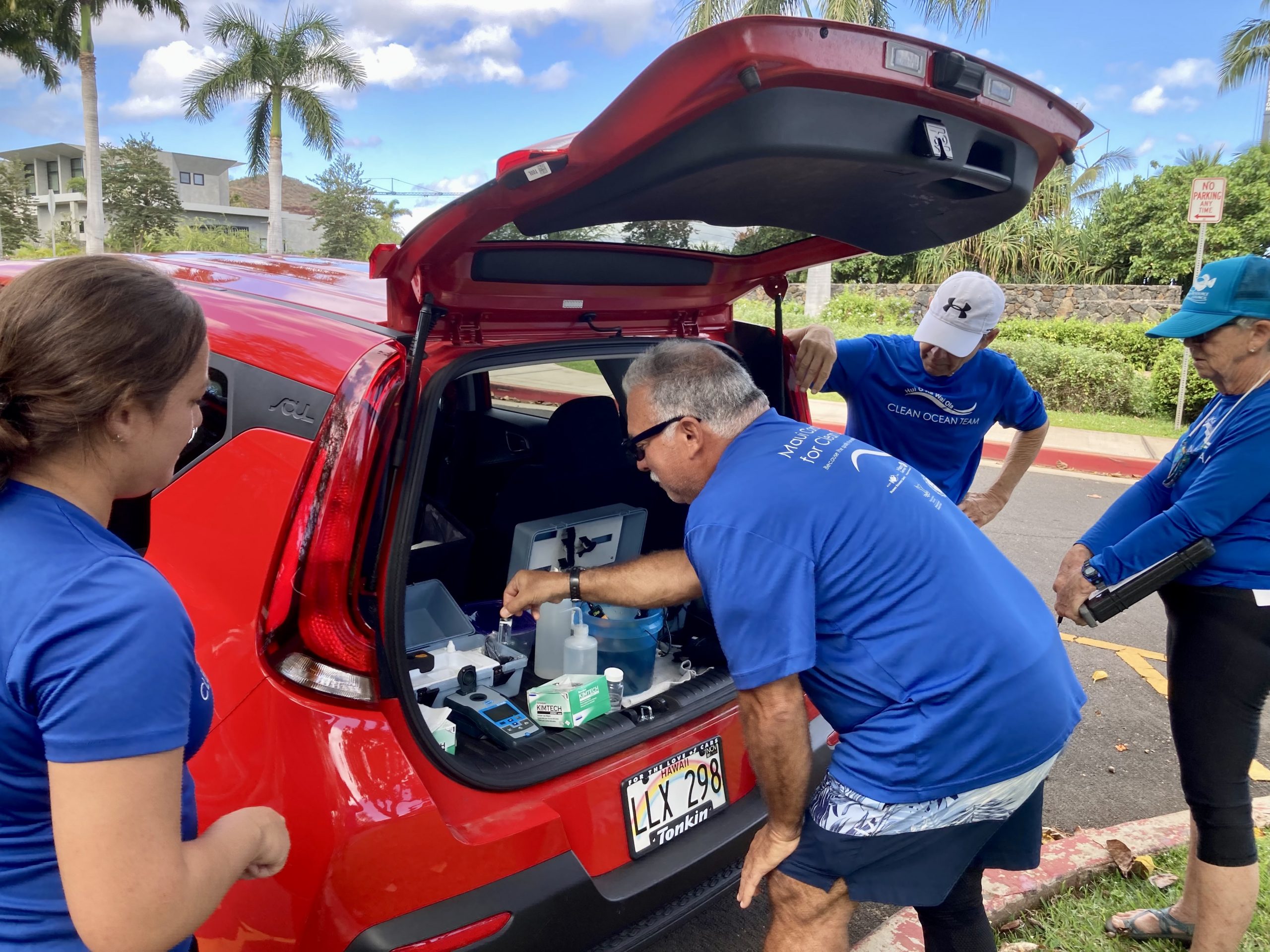
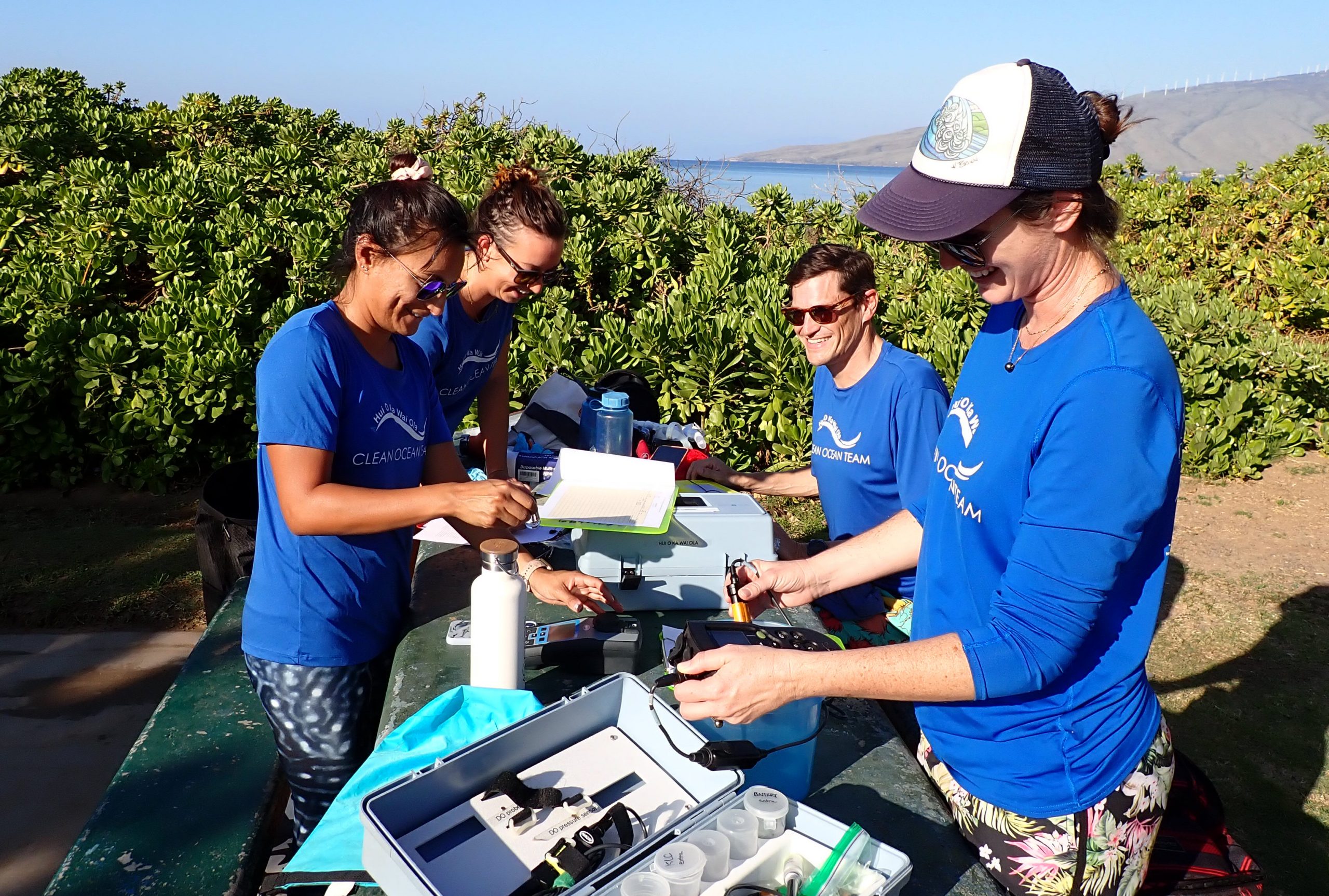
Water testing by HOKWO

The program, which follows strict quality control standards, measures physical qualities like water clarity, salinity, and temperature, as well as nutrient levels (which harm coral reefs if out of balance). A new collaborative project with the National Oceanographic and Atmospheric Administration (NOAA) is addressing a long-standing to-do from the Hawaii Coral Reef Initiative – evaluating pesticide contamination in the waters along our coast.

In he January 2023 MNMRC Know Your Ocean Speaker Series talk, Liz Yannell, the Hui’s Senior Team Lead, spoke about water quality observations taken over the last year and presented long-term trends from the past six years.  She also spoke about an ongoing collaborative project with the National Oceanographic and Atmospheric Administration (NOAA) to evaluate pesticide contamination in waters along our coast. View the talk here: https://www.youtube.com/watch?v=Ey3xHZ0u3Z4.

The Hui O Ka Wai Ola is a volunteer-based water quality monitoring organization that is a partnership between MNMRC, The Nature Conservancy, and the West Maui Ridge to Reef Initiative. The Hui’s members include volunteers from diverse backgrounds like scientists and community organizations. The Hawaii Department of Health is mandated to monitor coastal water quality around the islands and encourages partnerships with groups such as the Hui to improve data about pollutants threatening coral reefs and human health.

The Hui’s culture of collaboration and a deep interest in ocean health made for a natural partnership with  NOAA’s NCCOS (National Centers for Coastal Ocean Science) carrying out the fieldwork needed for a research study to address a long-standing gap in our understanding of Maui’s water quality, “current use” pesticides. Current use pesticides are still legally in use for pest control vs those, like DDT, that are no longer on the market in the US. Current use pesticides are one class of chemicals that has long been overlooked here in Maui.  Pollutants in the water are typically measured by collecting a one-time “grab sample” (i.e. a bottle of water). While these can provide good information, especially when repeated over time, the drawback to using grab samples is that low-level pollutants can be missed.  Passive samplers that absorb chemicals in the environment over time can be used to sample for a longer period of time. This minimizes the likelihood of missing the presence of a pollutant.  In the current project, silicone bands will be used to soak up any pesticides in the water at eighteen nearshore reefs along Leeward Maui. This work will provide a more comprehensive assessment of pesticide pollution in our coastal waters, and help guide pollution reduction actions if needed.

To view this talk, please visit https://www.youtube.com/watch?v=Ey3xHZ0u3Z4.

About Liz Yannell, Hui O Ka Wai Ola Senior Team Lead: 

Liz joined the Hui as Senior Team Leader in May 2022. She has a bachelor’s degree in environmental studies from Florida Gulf Coast University. In 2022, Liz graduated from the Marine Options Program at UH Maui and worked as an assistant in the marine lab on campus. She also often volunteered in the lab with Surfrider’s Blue Water Task Force.

Water quality monitoring with the HOKWO mobile water quality lab.

Hui O Ka Wai Ola volunteers and staff (left to right: Ylenia St. Louis, Kristina McHugh, Dan Crevier, and Liz Yannell) go beyond their regular ocean water testing duties in support of NOAA’s current-use pesticide study. Their data will help the science team understand ocean conditions where the pesticide sampling bands are deployed. Photo Credit: Tova Callender Location: North Kihei

Four Seasons Resort Lāna’i Goes for Gold, Becomes First Resort to be Reef Friendly Certified by Maui Nui Marine Resource Council

in , , /by

KIHEI — Maui Nui Marine Resource Council’s Reef Friendly Landscaping Certification Program is pleased to announce its first fully accredited resort partner, Four Seasons Resort Lānaʻi. The resort was awarded Gold Certification for its new efforts to manage the property grounds organically.

The Reef Friendly Landscaping (RFL) Program aims to prevent polluted runoff originating from the use of synthetic fertilizers, herbicides, and pesticides from resorts, golf courses, businesses, and residential areas. Research has shown that traditional pesticides, fungicides, and fertilizers can negatively impact marine ecosystems, through coral bleaching and developmental issues in juvenile corals and fish. Additionally, they can cause cancerous growths in sea turtles and other marine life.

Maui Nui Marine Resource Council (MNMRC), in partnership with Duane Sparkman, worked with Robert Woodman, Director of Landscaping at Four Seasons Resort Lānaʻi. Woodman has been leading the landscaping team for 7 years, managing 12 densely planted acres of gardens, incorporating a number of native Hawaiian plants. He focused on plants that were less water and labor intensive and those that can thrive in the specific microclimate on Lānaʻi at Hulopoʻe Bay.

MNMRC launched their RFL Certification program in early 2022, and have been assisting the resort with their transition since August of the same year. The program requires properties to stop the use of all pesticides, herbicides, and synthetic fertilizers that are harmful to aquatic and marine life, with the opportunity to go one step further and implement 100% organic landscaping.* The Gold Level requires properties to have at least one member of the landscaping team become an Accredited Organic Landcare Professional through the Northeast Organic Farming Association (NOFA), and document and report all “emergency use” chemicals in case of a pest infestation or outbreak.

Woodman and the landscaping team were close to achieving 100% organic landcare; the safe removal of select pesticides by Cameron Chemical Corp ensured full compliance for organic landscaping. In addition, the landscaping team has begun composting onsite using their own green waste.

Four Seasons Resort Lānaʻi is committed to preserving and regenerating the environment and leaving a positive, enduring impact on the local community. Some of their Environment, Social, and Governance (ESG) efforts on the property include: elimination of single-use plastic bathroom amenities, food waste diverted from landfill and donated to local farmers for agricultural use, water-efficient landscaping and golf course management, waters off the coast have been declared a Marine Reserve to promote resilience in the reef, complimentary reef-friendly sun care products available for guests, botanical preservation to reintroduce awikiwiki, a federally endangered perennial vine, to the area, and the resort has Arboretum Accreditation by the Morton Register of Arboreta, recognizing professional standards and capabilities in a shared purpose to plant and conserve trees and advance goals specific to tree-focused public gardens.

“We are committed to building upon Four Seasons’ strong history of supporting our communities and the environment, leaving a positive, long-lasting impact on the storied places where we operate and live,” said Alastair McAlpine, General Manager, Four Seasons Resorts Lāna‘i.  He continued, “Protecting Lāna‘i’s native ecosystem and championing ongoing sustainability efforts across our island is an honor as is becoming the first Resort to achieve this accreditation, a true testament to the hard work of our landscaping team.”

“We know that holistic land management isn’t a new idea. This program recognizes and supports properties who are genuinely trying to do the right thing with the resources they have, and we hope other properties will want to do the same; not only for the health of their guests, but the environment as well,” states Jill Wirt, project manager for the RFL program.

The certification program has taken some time to gain traction due to the lack of viable organic alternatives produced locally in Maui County; but with support of Duane Sparkman and other businesses like Environmental Solutions Maui who produce a liquid biological soil amendment that supports soil health, it is becoming easier and more accessible to transition from conventional landscaping to holistic land management.

“I am really excited to see Four Seasons Lānaʻi take on this endeavor to change their resort landscape maintenance practices,” states Duane Sparkman. “Robert Woodman and his team now lead the way in the organic landscape resort maintenance industry. Gold level certification that he and his team have achieved is not only the first one awarded but critical to all life in the Mānele-Hulopoʻe area of Lānaʻi.”

MNMRC looks forward to continuing this partnership and working with more shoreline properties to prevent harmful land-based sources of pollution from entering invaluable nearshore marine ecosystems.

If you would like a free property assessment and recommendations to pursue an RFL Certification, please contact [email protected] or visit www.mauireefs.org/what-we-do/reef-friendly-landscaping/.


*Emergency Non-Organic Rescue Treatment (from NOFA standards handbook)

As one moves forward in a transitional or organic program, it may become necessary to intervene with a product for control of a particular pest if all reasonable efforts within an Organic IPM program have failed. It is acknowledged that from time to time situations present themselves that call for intervening action that normally would not be incorporated into an organic program. It is far preferable to react to pest pressure than it is to preemptively apply even allowed pesticides. When a situation arises that could create economic or unreasonable aesthetic injury an application may be made during or after transition that would allow for the inclusion of a material within the framework of a sound organic program.


About Maui Nui Marine Resource Council:

Founded in 2007, Maui Nui Marine Resource Council (MNMRC) is a nonprofit organization working for healthy coral reefs, clean ocean water and abundant native fish for the islands of Maui County (Maui Nui). We’re recognized for working with our local community to create culturally appropriate, effective science-based solutions to serious local threats facing our reefs.

About Four Seasons Resort Lānaʻi:

The five-diamond, five star Resort features 213 guestrooms and suites in a series of low-rise buildings spread along the Pacific coastline and immersed in Hawaiian botanical gardens, providing a private residential experience. Additional facilities include the signature ONE FORTY restaurant, Malibu Farm, NOBU LANAI, a spa and wellness program, variety of complimentary activities, luxury retail boutiques, Tennis Gardens, an 18-hole ocean-view Jack Nicklaus Signature Manele Golf Course, the Lanai Observatory, as well as an array of land, ocean and air activities.


Sharks and Us: Free Webinar Presents Short Film about Humanity’s Relationship with Sharks through Unique Hawaiian Lense

in , /by

KIHEI – Google search news for tiger sharks, and you’re most likely to see the latest headlines about unfortunate run-ins between these animals and people – especially on Maui. The Hawaiian Islands are infamous for these toothy apex predators, and Maui is home to the most tiger sharks of all the islands.

But rewind about a thousand years, and you’d find a society with a different view of these animals. The ancient Hawaiians revered sharks, called manō, recognizing their potential danger but admiring their strength and role in marine ecosystems. In fact, many Hawaiian families denoted sharks as ‘aumakua, personal or family gods that originated as a deified ancestor, which takes on physical forms.

This evolving relationship is the focus of a new animated short film, Manō, which will be presented and discussed during Maui Nui Marine Resource Council’s next Know Your Ocean Speaker Series webinar, which is supported by the County of Maui. Brittany Biggs, director and producer of Manō, will lead the screening and discussion of the film, along with cultural advisors Mike and Kaikea Nakachi. 

“One of my primary goals with Manō is to present a cultural perspective to shark conservation by sharing the relationship between sharks and Native Hawaiians, in which these animals are revered and loved as family,” said Biggs. “My hope is that this film will illustrate how vulnerable sharks are and inspire people to protect them.”

The film, which is about 10 minutes long, follows humankind’s relationship with these animals through the eyes of a tiger shark in Hawaii’s ever-changing waters. From the ancient Hawaiians’ first settlement of the islands to the present day, viewers will get a specialized view of how these animals are both revered, feared, and even killed in a world of once-pristine seas to an ocean now desecrated with pollution and capitalized as an economic resource through activities such as shark finning.

“It’s no secret that sharks are vital for healthy oceans,” said Meredith Beeson, Project and Research Coordinator at Maui Nui Marine Resource Council. “And unfortunately it’s well known that these animals are declining rapidly. We hope this webinar and film spark more compassion and understanding for these important and misunderstood animals.”

About Brittany Biggs:
Brittany Biggs is an animation professional, filmmaker, artist, and educator. She is currently a Previz / Rough Layout Artist at DreamWorks Animation. Her animation feature film screen credits include DreamWorks’ Trolls, Kung Fu Panda 3, Kung Fu Panda 2, and Turbo. Prior to her recent return to DreamWorks, she was an Assistant Professor of 3D Animation at the Academy for Creative Media at the University of Hawaii at Mānoa. In August 2020, she was selected as one of 102 fellows for the Unreal Fellowship in Virtual Production.

About Mike and Kaikea Nakachi:
Mike and Kaikea Nakachi from the Big Island are cultural practitioners, and they are descendants of Hawaiian kahu manō, or “shark guardians.” They are devoted to the study and preservation of sharks. Mike and Kaikea have been providing feedback and guidance relating to the story, manō ‘aumakua, character designs, and visuals. They advocated for years for the state to pass a law protecting sharks, and on June 8, 2021, Hawaii House Bill 553 was passed, which establishes an offense for intentionally or knowingly capturing, entangling, or killing a shark in state marine waters.

Maui Nui Marine Resource Council 15th Anniversary and 2022 in Review to be Topic of Next Webinar

in /by

KIHEI – Marine biologist Robin Newbold and community visionary Uncle Ed Lindsey were alarmed at what they saw around Maui in 2007. Depleted fish stocks, damaged reefs, pollution, the effects of climate change. This sparked the idea for a group that would collectively address these issues.

They convened an all-volunteer “council” that included representatives from a wide sector of the community including fishers, scientists, educators, cultural practitioners, ocean tourism business representatives and representatives of federal, state and local management agencies. The council met regularly to discuss and act on issues relating to our nearshore ocean environment, and became Maui Nui Marine Resource Council (MNMRC). To specifically address issues threatening our reefs, MNMRC convened the Maui Coral Reef Recovery Team to create the Maui Coral Reef Recovery Plan, the first of its kind in the state. And the rest is history.

Now closing out its 15th year of working to protect the reefs of Maui Nui, MNMRC invites the public to learn more about its work, achievements over the past few years, and hopes for 2023 in a webinar on Dec. 7, 2022 at 5:30 pm HT. This presentation is part of MNMRC’s monthly Know Your Ocean Speaker Series, sponsored by the County of Maui. Admission is free but advanced registration is required. Register here.

MNMRC staff and board members will discuss recent grants and the projects they have helped the organization accomplish, achievements in 2022, and new projects that will begin in 2023.

“MNMRC has come a long way since its humble beginnings in 2007,” said Mike Fogarty, executive director of MNMRC. “Our presence on the island is expanding exponentially, leading to visible solutions to the threats the reefs face.”

Federal and County of Maui grants significantly increased the organization’s capacity to target land-based threats to Maui’s reefs in 2022. Working in Pohakea, staff and volunteers created fire break roads and planted drought-resistant vetiver grass to mitigate runoff and sedimentation that threatens Ma‘alaea Bay. Makai of the highway, the oyster bioremediation project in Ma‘alaea Harbor has steadily grown, adding more oysters and seeing rapid growth in existing individuals, showing promising progress in efforts to clean the harbor’s water. MNMRC’s Reef Friendly Landscaping Program (RFL) began encouraging commercial properties to transition to environmentally-friendly lawn care solutions.

The next year brings exciting growth for the RFL program. Two recently awarded grants will expand the Program’s presence in South Maui, encouraging properties such as golf courses and resorts to use Maui-created soil amendments to aid in the transition to organic land care. Additionally, a new federal grant from the National Fish and Wildlife Foundation sets MNMRC’s sights on gulches and wetlands in North Kihei to address flooding and sources of runoff and sedimentation that blankets the Kihei reef tract during heavy rain events. Funding from this grant will provide the means necessary to remove hundreds of tons of fine sediment from the gulch and restore the natural environment.

These future projects and more will be discussed during the webinar, giving attendees a chance to dive deeper into the work MNMRC undertakes to protect the island’s natural resources.

“We’re thrilled to present our accomplishments over the past few years,” said Amy Hodges, programs and operations manager at MNMRC, who has been with the organization over the past 10 years. “And the new year brings more exciting opportunities – both for MNMRC and the ecosystems we’re working to protect.”

To learn more about MNMRC’s history and mission, register for the free webinar here

Dive Into Efforts to Protect Olowalu Reef in Next Know Your Ocean Speaker Series Webinar

in /by

KIHEI – The 939-acre Olowalu reef has been identified as one of the most essential reefs to protect on the island of Maui. Olowalu was declared an official Mission Blue Hope Spot in 2017, and research has shown that this large reef is an important source of larvae for other reefs in Maui Nui. However, issues from both the land and sea threaten this vital reef system. But efforts are underway to restore the area, with The Nature Conservancy (TNC) and other local organizations heavily involved.

The public is invited to learn more about this ecosystem and the efforts to protect it in a free webinar, “The Vision for Olowalu-Ukumehame-Papalaua,” on Wednesday November 2 at 5:30 pm, led by environmental engineer Kim Falinski of TNC. This presentation is part of Maui Nui Marine Resource Council’s (MNMRC) monthly Know Your Ocean Speaker Series, sponsored by the County of Maui. Admission is free but advanced registration is required. Register here.

Falinski will describe the vision for Olowalu-Ukumehame-Papalaua, which incorporates the best mauka-to-makai practices. TNC, working with the National Oceanographic and Atmospheric Administration, the Division of Aquatic Resources, MNMRC, County, State and private landowners, and the broader community, is identifying restoration actions to implement to reduce land-based inputs to the coral reef ecosystems adjacent to Olowalu. Additionally, MNMRC, TNC, and West Maui Ridge to Reef Initiative’s Hui O Ka Wai Ola water testing program is contributing data to inform restoration practices.

TNC’s goal is to plan and implement restoration actions that will make a difference at scale in the watersheds along the Olowalu reef, informed by the best available science, with a coalition of partners who collectively support and prioritize this work. The desired long-term outcome is an engaged coalition of landowners, government partners, and local stakeholders invested in and committed to funding and implementing actions to protect and restore the Olowalu reef.

“The threats to the reef are many, but poor water quality is identified as an important stressor, with sediment as the major contributor,” said Falinski. “Directly above the Olowalu reef is a low-lying coastal area that includes degraded wetlands and sand dunes. Further upland, wildland fires and pressure from axis deer kill the grasses and shrubs that hold our soil.”

Falinski’s work in the area has identified major source points of sediment and soil erosion hotspots along the four-mile stretch of road that runs parallel to the reef system. TNC’s efforts in the area will help inform government actions to protect the reef. State and Maui County landowners have plans for the next 20 years to improve the coastal and coastal-adjacent resources. The State Department of Transportation plans to move the coastal highway inland. The State Division of Forestry and Wildlife is proposing to build fencing to revegetate this area.

“Not only is Olowalu a seed reef for other coral reefs around Maui Nui, it’s also home to the oldest coral in the main islands of Hawai’i,” said Amy Hodges, Programs and Operations Manager at Maui Nui Marine Resource Council. “Protecting this reef is vital, and we’re excited to hear what TNC and other stakeholders are doing to preserve this unique reef.”

Register for the webinar here.

More about Kim Falinski:

Kim Falinski is an environmental engineer advising ridge to reef conservation projects in Hawaii and Palmyra Atoll for The Nature Conservancy. She focuses on green infrastructure solutions to mitigating sediment, nutrients, and pollutants from watersheds that affect coastal water quality. Recent projects include monitoring the effects of native Hawaiian restoration for a 200-acre wetland in windward O’ahu, partnering with the USGS on erosion control management recommendations on Hawai’i island, and developing quality assurance documents for a large-scale citizen science water quality project in collaboration with the Department of Health. Falinski earned her BS at MIT in electrical science and engineering, and PhD in tropical plant and soil sciences from the University of Hawaii. She has lived in Nepal teaching environmental science and English, and the Bahamas as a researcher and instructor at The Island School, part of the Cape Eleuthera Institute.

In her spare time, she runs Nalo Meli Honey and keeps urban bee hives in Honolulu.