Blog Archives: News Releases

PacIOOS Water Quality Sensor Partnership Program Enhances Maui Nui Marine Resource Council’s Water Quality Monitoring in Māʻalaea Harbor

in /by


MĀʻALAEA, HI – Maui Nui Marine Resource Council’s ocean water quality monitoring efforts in Māʻalaea Harbor are being helped by a new underwater data sensor that the organization has borrowed through the Pacific Islands Ocean Observing System (PacIOOS) Water Quality Sensor Partnership Program. The new data sensor collects data every five minutes on water temperature, salinity, turbidity, chlorophyll and ocean depth.

The PacIOOS program supports scientists and natural resource managers to collect water quality data in order to inform research, conservation, planning, and resource management projects in the U.S. Pacific Islands region. The data sensor is owned and maintained by PacIOOS under the supervision of Dr. Margaret McManus, Chairwoman of the Department of Oceanography at the University of Hawai‘i at Mānoa.

“We are grateful to PacIOOS for the use of this data sensor that will help us learn more about the effects of tides, swell, rain events, and runoff on water quality within Māʻalaea Harbor and to monitor water quality variability over time,” reports Amy Hodges, Programs and Operations Manager at Maui Nui Marine Resource Council.

Mounted 1 or 2 meters below the ocean’s surface, the sensor package is relocated by divers from Maui Nui Marine Resource team to a new site within the harbor about once per month. The sensor package was installed in 2020 and is scheduled to be used in Māʻalaea Harbor through 2021.

The PacIOOS data sensor will help guide Maui Nui Marine Resource Council as it implements its watershed management plan, which aims to reduce sediment and pollutants in Māʻalaea Bay and its harbor. Professor Margaret McManus

“In recent decades, declining ocean water quality has led to significant deterioration of Māʻalaea Bay’s reefs,” says Hodges. “Monitoring by the community-based program Hui O Ka Wai Ola — which was co-founded and is co-managed by Maui Nui Marine Resource Council, The Nature Conservancy and West Maui Ridge to Reef Initiative —  using ocean water samples grabbed from the ocean edge has shown turbidity (sediment) and excessive nitrogen as primary causes of impaired water quality.”

Maui Nui Marine Resource Council’s staff also assist with gathering ocean water quality “grab samples” from the shore. All combined, the Hui O Ka Wai Ola sampling and the MNMRC staff grab sampling results in data from 5-10 sites every three weeks in Māʻalaea Harbor.

Maui Nui Marine Resource Council has also been using a Manta data sonde, purchased with a grant from LUSH cosmetics, to gather water quality data in the Harbor. The sonde is towed behind a kayak and records real time data as it is pulled through varying depths through the water.

The organization has also been testing the nitrogen isotope ratios (δ15N values) in macroalgae (limu) tissue to determine the possible sources of nitrogen pollution in the harbor and the bay. Other ongoing testing in Māʻalaea Bay conducted by MNMRC includes current drift analysis studies, underwater coral cover and fish transects, and stormwater sampling.

To address Māʻalaea’s sediment issues, MNMRC is working to improve stormwater management in the 4,000 acre Pohakea watershed adjoining Mā‘alaea Bay. In 2018, MNMRC commissioned Maui Environmental Consulting (MEC) to create the Pohakea Stormwater Management Plan following meetings with Hawai‘i Division of Forestry and Wildlife (DOFAW), Māʻalaea Village Association, Maui Ocean Center and other stakeholders.

MNMRC has been enacting the priorities in this plan. In 2020, MNMRC installed firebreaks in Pohakea watershed to suppress frequent wildfires that occur in this windy, dry region, causing loss of vegetative cover that helps hold soil in place and prevents erosion. Partners included DOFAW, Maui Electric Co. and Goodfellow Bros. Inc.

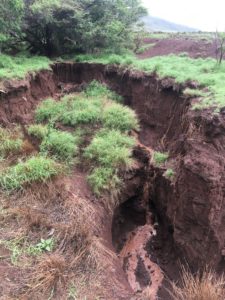
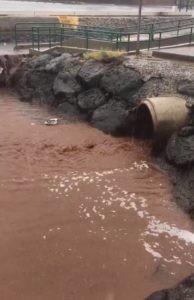
MNMRC and Maui Environmental Consulting began monitoring headcuts (erosional features) in 2020 to quantify soil loss at four of the most severely eroded sites in the Pohakea watershed nearest the harbor. Their monitoring showed a loss of an estimated 64,050 pounds, or 32 tons, of soil from just two head cut locations in a single moderate rainstorm in January 2021. The lost soil was likely transported via culverts directly into the ocean, contributing to a severe brown water event in Māʻalaea Bay.  MNMRC is now working to obtain funding to work with Maui Environmental Consulting and Goodfellow Bros. to repair two of the most severe head cut locations to reduce the sediment runoff.

Maui Nui Marine Resource Council launched an oyster bioremediation project in Māʻalaea Bay in 2020 to utilize caged oysters as a natural method of water filtration. A single oyster can filter up to 50 gallons of ocean water per day, removing sediment and pollutants. During 2020, MNMRC installed more than 10,000 oysters and conducts periodic monitoring to assess their growth rates and health. Data from the PacIOOS data sensor will help measure changing ocean water quality conditions in response to the oyster program.

“The progress of our projects to clean up Māʻalaea Bay’s water quality will be measured by resulting data from the PacIOOS data sensor and our other monitoring methods,” says Hodges. “We to see evidence of improved ocean water quality, through reductions in sediment and excess nitrogen, an essential step in restoring coral cover and reef health in Māʻalaea Harbor and in the bay.”

To learn more about the PacIOOS Water Quality Sensor Partnership Program and view data, visit https://www.pacioos.hawaii.edu/water/sensor-maalaea/#about.

Founded in 2007, Maui Nui Marine Resource Council is a nonprofit 501(c)(3) organization working for clean ocean water, healthy coral reefs and abundant native fish for the islands of Maui County. To learn more, visit www.mauireefs.org.
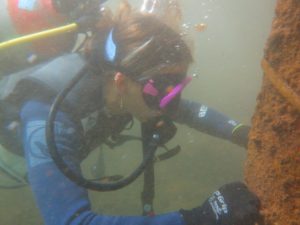
 

CAPTION: Maui Nui Marine Resource Council’s Grace Silver helps to prepare a site in Mā’alaea Harbor for the data sensor on loan from PacIOOS.

Public invited to free webinar on “Shark Research in Hawaii – With an Emphasis on Maui” by Dr. Kim Holland on Wednesday, March 3

in /by

KIHEI, HI – Recent shark attacks that occurred off the coast of Maui in November (2020), December (2020) and January (2021), as well as an incident in February (2021) which involved a large shark biting a kayak, have many ocean users concerned and curious about the sharks found in our nearshore waters. The public is invited to learn more about our local sharks at a free Zoom presentation titled “Shark Research in Hawaii – With an Emphasis on Maui’ by Dr. Kim Holland. Dr. Holland is the Research Professor at the Hawaii Institute of Marine Biology, (HIMB) at University of Hawaii at Manoa and the founder of the Shark Research Group at HIMB.

This free talk is hosted by Maui Nui Marine Resource Council’s “Know Your Ocean Speaker Series” and will take place on Wednesday, March 3 at 5:30 pm via Zoom. The presentation is free, but advance reservations are required. To reserve your spot, please visit https://bit.ly/SharkWebinar

For over 40 years Dr. Holland’s research has focused on the biology and movement patterns of large marine fishes such as tuna, billfishes and sharks. He has been a pioneer in helping to develop and deploy cutting edge tracking technologies that allow unprecedented insight into the movement patterns of marine fishes.
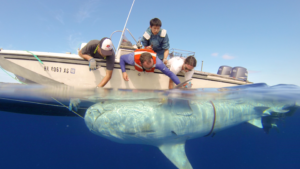
His presentation will include a brief overview of tracking technologies with an emphasis on what has been learned about the movements of sharks around Maui Nui.

“While many Maui residents and visitors are fearful about sharks, it’s important to remember that sharks play an important role in maintaining Hawaii’s ocean ecosystems,” said Anne Rillero, Communications, Community Outreach and Development Manager at Maui Nui Marine Resource Council. “We’re looking forward to learning more about Dr. Holland’s findings and insights about Hawaii’s sharks.”

Maui Nui Marine Resource Council’s “Know Your Ocean Speaker Series” events are held monthly via Zoom. Support for these events is provided by the County of Maui Mayor’s Office of Economic Development.

The emcee for this event is Darla Palmer-Ellingson, local radio show host of the public affairs program, Island Environment 360 Maui’s only commercially broadcast public affairs show on environmental and related Hawaiian cultural topics, aired on the stations of H-Hawaii Media.

To reserve your spot at this free Zoom webinar, please visit https://bit.ly/SharkWebinar


Experts tag a tiger shark with a tracking device in the waters off Maui. The satellite tag gets attached to the shark’s dorsal fin and sends a signal every time the fin surfaces the water. Photo Credit: HIMB

Maui Nui Marine Resource Council Launches Campaign to Encourage Chemical-Free Landscaping to Protect Coral Reefs and Marine Wildlife

in /by

MAUI, HI – As part of its work to protect and promote healthy coral reefs, clean ocean water and abundant native fish in Maui County, Maui Nui Marine Resource Council has launched an educational campaign to encourage private and public landowners, golf courses and landscapers to switch to organic land management. The organization launched this campaign after gathering research on the impacts that toxic pesticides, fungicides, herbicides and synthetic fertilizers have on coral reefs and marine wildlife.

“Many people want to help protect the ocean, but they aren’t aware that they can do that through organic land management,” says Grace Silver, Project and Research Coordinator at Maui Nui Marine Resource Council. “This campaign will educate and encourage private and public landowners to give up use of landscape chemicals to protect the ocean environment and create a healthier and thriving microclimate on their own land.”

Maui Nui Marine Resource Council is working with Beyond Pesticides, National Organic Farming Association and local organic land management experts to provide the community with helpful information for landowners and land management experts to make the switch to organic land management. Because cumulative impacts can be so detrimental, every single property that makes the switch will make a difference towards creating a cleaner and healthier environment around them.

“Numerous scientific studies have shown that the use of synthetic chemicals on land have significant and adverse impacts to coral reef ecosystems and aquatic species,” reports Silver. “Some of these negative impacts include coral reef bleaching, eutrophication, biomagnification, reproduction inhibition and increased disease in fish and marine wildlife.”

“Through our research, we’ve found that a majority of chemicals applied to our land for landscaping and pest control often end up in the ocean,”  explains Meredith Beeson, Project and Research Coordinator at Maui Nui Marine Resource Council. “Once these chemicals make their way into aquatic environments, they harm coral reefs by hindering their ability to feed and reproduce.”

“In order to protect our oceans, this chemical runoff needs to be reduced (or ideally stopped) from reaching the ocean,” says Beeson. “The solution is organic land management.”

According to a study published in the Journal of Agricultural and Environmental Ethics by David Pimentel, less than 0.1% of pesticides applied for pest control reach their target pests. Thus, more than 99.9% of pesticides used move into the environment where they adversely affect public health and beneficial biota, and contaminate soil, water, and atmosphere of the ecosystem.

Problems caused by landscaping chemicals and synthetic fertilizers entering the marine environment include:
• Tumor-causing diseases in turtles, as documented by the University of Hawaii, Manoa by Celia Smith and Walter Zimmermann.
• Creation of dead zones through the process of eutrophication, as documented by InTeGrate in “Managing Runoff to Reduce the Dead Zone.”
• Degradation of coral reefs, leading to economic impacts, as documented by University of Hawaii, Manoa in “Economic Value of Hawaii’s Nearshore Reefs.”
• Death of zooxanthelle (coral symbiont) which leads to coral bleaching, as documented by the Marine Pollution Bulletin by C.M. Shaw, J. Brodie, and J.F. Mueller.
• Potential human health impacts through chemical exposure, as documented by the Agency for Toxic Substances and Disease Registry.

“Whether you have a small yard or run a large-scale farm, organic land management can help protect Maui’s coral reefs and aquatic organisms” says Beeson. “Another benefit of organic landscaping is that it ultimately allows the land to sustain itself without large amounts of human intervention, saving time, energy and money in the long run.”

Maui Nui Marine Resource Council has created a webpage at https://www.mauireefs.org/what-we-do/pesticides/ with resources to help land managers, owners and landscapers obtain more information on organic land management. These resources focus on common issues found in Maui County.


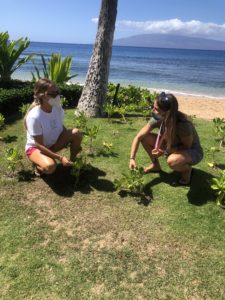
Maui Nui Marine Resource Council staff members Meredith Beeson and Grace Sliver examine landscaping plants and discuss organic land care methods as part of our new Pesticide Education Program. 

Monitoring study shows that 64,050 lbs. of soil likely washed into Māʻalaea Bay from just two “head cuts” during recent Jan. 18 rainstorm 

in /by

After a rainstorm on January 18, 2021, the State of Hawaii Department of Health Clean Water Branch issued a Brown Water Advisory for all of Maui.

Māʻalaea Bay was one of the areas that experienced a significant brown water event as a result of this rainstorm.

Curious about how so much sediment ended up in Māʻalaea Bay?

A monitoring project of head cuts (severe erosional features) launched in 2020 by Maui Nui Marine Resource Council on unused agricultural land in the Pohakea watershed measured the loss of an estimated 64,050 pounds (or 32 tons) of soil from just two head cut locations as a result of the January 18 rains. The two head cuts are located on the mauka (upslope) side of the Honoapi’ilani Highway across from Maui Ocean Center. The lost soil was likely carried via the stormwater through culverts and box culverts under the highway and into the bay.

What is a head cut? Head cuts occur when the flow of a stream is constricted (in this case by a culvert) and the water’s force is directed downward. This creates a sheer bluff or cliff in the stream known as the knickpoint. As the water erodes the soil, the knickpoint migrates further upstream each time the stream flows and a larger area is exposed to stormwater erosion.

The monitoring was conducted by Maui Environmental Consulting (MEC) who installed arrays of erosion pins in the ground around the extent of the head cuts. By measuring the amount of soil lost between pins and the depth of the head cut observed, MEC was able to quantify the approximate amount of soil loss during the January 18 storm.

Sediment pollution is believed to be a significant cause of the coral reef decline in Māʻalaea Bay. This sediment, coming from legacy agricultural land, may also be transmitting excess nitrogen and other pollutants into the ocean.

While the two head cuts described here aren’t responsible for all of the sediment entering Māʻalaea Bay, repairing these two erosional sites can keep tons of sediment out of the ocean each year. That’s why Maui Nui Marine Resource Council is working to obtain funding to plan, design and implement repairs to to pull back and stabilize the now vertical or undermined walls of these two significant head cuts.

Learn more about the work that Maui Nui Marine Resource Council is doing to improve ocean water quality in Ma’alaea Bay. 


Free Feb. 10 talk on “Using the distant past as a guide for future decision-making about restoring and managing coastal lands in Waiheʻe and other parts of Hawaiʻi” by Scott Fisher, PhD

in /by

WAIHE’E, HI — How can the distant past be used as a guide for future decision-making about restoring and managing coastal lands and helping these ecosystems survive future challenges from rising sea levels and climate change? Learn more at a free Zoom presentation that focuses on the science of paleoecology, which is the study of interactions between organisms and their environments across geologic timescales, by Scott Fisher, PhD, Chief Conservation Officer at Hawaiian Islands Land Trust (HILT). The talk will take place on Wednesday, February 10, and will be hosted by Maui Nui Marine Resource Council as part of its “Know Your Ocean Speaker Series.”

Dr. Fisher’s presentation will be shared via Zoom and is free of charge and open to all who wish to attend. Advance reservations are required and are free. To reserve your spot, visit https://bit.ly/HILTpast

Fisher and the Hawaiian Islands Land Trust staff are using sediment coring at locations such as Nu`u Pond to extract and examine micro-fossils embedded in the sediment. They are working to understand past ecosystems on HILT lands, particularly the function and composition of vegetation across landscapes. For example, what plants and organisms were most dominant approximately 2,000 years ago, long before the first humans arrived on Maui? How were they capable of withstanding substantial ecological disturbances, such as floods and tsunami? What can be learned from this natural history to better manage coastal lands in Waiheʻe and other parts of Hawaiʻi to make them more resilient to a changing global climate?

“As climate change brings about substantive changes to our islands, we need to discern ways of adapting to more intense storms, sea level rise and loss of coastal ecosystems,” said Dr. Fisher. “The past holds the key to the future, and by learning about the past, we can better understand how to restore, adapt and change in order to make our islands and nearshore coral reefs more resilient.”

Maui Nui Marine Resource Council’s “Know Your Ocean Speaker Series” events are held monthly via Zoom. Support for these events is provided by the County of Maui Mayor’s Office of Economic Development.

The emcee for this event is Darla Palmer-Ellingson, local radio show host of the public affairs program, Island Environment 360 Maui’s only commercially broadcast public affairs show on environmental and related Hawaiian cultural topics, aired on the stations of H-Hawaii Media.

For reservations, visit https://bit.ly/HILTpast

About Scott Fisher, PhD:

Scott grew up in Kula, and at age 17 enlisted in the United States Marine Corps. After his discharge, he studied at Colorado State University. Scott’s graduate work includes an M.A. in Peace Studies with a concentration in Native Hawaiian Strategies of Peacemaking and Reconciliation. His PhD. explored the dynamics of post-conflict recovery in a civil war on the island of Bougainville, Papua New Guinea, with a particular emphasis on how communities make wise decisions about conflicts over natural resources. Scott also holds a graduate certificate in ecological restoration from the University of Idaho.

Since 2003 Scott has worked for the Maui Coastal Land Trust, first as a project manager at the land trust’s 277-acre Waihe‘e Coastal Dunes and Wetlands Refuge and is now the Chief Conservation Officer for the Hawaiian Islands Land Trust.  In this capacity he has been involved in all aspects of ecological restoration work on land trust properties. In 2017 Scott began a three-year research fellowship in Paleoecology with the University of Leicester in England. With materials collected in Hawai`i, and with the assistance of the Quaternary Palaeoecology Working Group, his research was able to reconstruct the dominant floral species at Waihe`e over the past 12,000 years (since the beginning of the Holocene). More recently Scott has been consulting with the US Forest Service on a wetlands restoration project in western Madagascar.

About Hawaiian Islands Land Trust:
The Hawaiian Islands Land Trust (HILT) is a state-wide land conservation organization dedicated to protecting the lands that sustain Hawaiʻi, while teaching future generations to do the same. HILT’s mission is to protect and steward the lands that sustain Hawaiʻi, and to perpetuate Hawaiian values by connecting people with ʻāina. Throughout ka pae`āina (the Hawaiian archipelago) HILT has protected over 20,000 acres through both fee ownership and conservation easements.

About Maui Nui Marine Resource Council: 

Maui Nui Marine Resource Council is a community-based nonprofit organization celebrating 13 years of working for healthy coral reefs, clean ocean water and abundant native fish throughout Maui County. Our work includes co-managing the Hui O Ka Wai Ola Ocean Water Quality Monitoring Program in South and West Maui, efforts to reduce pollution in Mā‘alaea Bay (through erosion-control efforts in the Pohakea watershed and using oysters to filter sediment and pollutants from ocean water), coral reef research, visitor education programs and more. Learn more at www.mauireefs.org.

Public invited to free Zoom presentation about unique collaboration of 7 environmental projects funded by Maui CARES

in /by

Program provided employment for more than 70 Maui and Molokai residents

“It’s like Maui County’s own version of the Civilian Conservation Corps”

KIHEI, HI – During the Great Depression, the government-sponsored Civilian Conservation Corps (CCC) provided paychecks for 3 million unemployed young men and provided valuable labor for conservation projects across the country.

With unemployment at record levels due to COVID-19, a new program followed this historical CCC model and put more than 70 Maui and Molokai residents to work in November, providing seven local conservation nonprofits with needed labor to benefit coral reefs, cultural resources and the environment.

The public is invited to a free presentation on Weds. January 27 at 5:30 pm on Zoom to learn about this unique collaborative employment and workforce training program and the impact it had on our local environment. The presentation will include videos, photos and firsthand accounts of the projects and accomplishments, with information on how the projects incorporated traditional Hawaiian cultural practices and modern technology to prevent sediment pollution in the ocean and protect valuable cultural resources.

It’s free, but registration is required. To sign up, visit https://bit.ly/mauiCARES

This unique collaborative employment and workforce training program was made possible through the County of Maui Office of Economic Development’s Maui CARES program, which was funded by the Federal CARES Act. As the fiscal sponsor, Maui Nui Marine Resource Council oversaw the administration of the Maui CARES funding for the projects and managed the rapid employment of more than 70 new hires with the help of simplicityHR by ALTRES.

The workers participated in conservation and restoration projects in Olowalu, Waihe’e, Keanae, Kipahulu, Hana and Moloka’i. All of the projects were rooted in Hawaiian cultural practices and values which serve as the foundation of our community. Their work was filmed by Inflatable Film of Kula. The evening will include video premieres exclusively for webinar attendees.

“Through this presentation, attendees will be immersed in a virtual experience to feel the importance of Kuleana, ʻOhana, Kōkua, Aloha ʻAina, Mālama ʻAina, and Hānai ʻAina, said Ekolu Lindsey, President of Maui Cultural Lands and a principal organizer of this program. “Be inspired to follow in the footsteps of those who have come before us, as we share our legacies with you.”

The participating nonprofits include:

Ka Honua Momona on Molokai worked to restore two ancient fishponds, which will help trap sediment before it reaches the open ocean – with the benefit of also producing fish for local people.

Kipahulu ‘Ohana in East Maui improved a lo’i, or wetland taro farm. The taro plants will slow the flow of stormwater, allowing time for sediment in the water to settle, rather than flow out to sea.

Hawaiian Islands Land Trust in Waihe’e worked to remove invasive species along approximately 3,000 linear feet of Kalepa Stream to lower sediment loads in the nearshore waters off Waihe’e and protect offshore corals.

Ke Ao Hali‘i (KAH) in Hana worked on 27 acres of publicly owned land at Mokae/Kaholaiki and another ~2 acres of contiguous land, directly above Hamoa Beach. Their project included invasive plant removal and native habitat restoration for seabirds and insects, and a biological survey of ‘opihi as a baseline for a possible ‘opihi rest area in the future.

Kipuka Olowalu in West Maui reestablished washed out and damaged lo’i (taro fields), rebuilt vanished lo’i and prepared lo’i for planting in the Olowalu Cultural Reserve. Workers removed overgrowth, fire hazards and invasive plants; planted native plants and crops and repaired infrasturcture.

Na Moku ‘Aupuni O Ko‘olau Hui in East Maui worked on watershed management and stream maintenance, as well as stream and ditch monitoring in the East Maui Irrigation system to establish accurate data for stream and ditch flow and loss as a basis for making sound future management decisions related to this resource and delivery infrastructure.

Each of the nonprofits will be presenting their work and accomplishments through photos, video and stories from the field.

Na Mamo o Mu‘olea in East Maui focused on land and shoreline management on a county parcel (which Nā Mamo O Mū’olea has a 50 year lease). It included removal of invasive plants around a rock wall that is on the historic registry, and preparation for wall restorations, maintenance of two heiau on the property, installation of new fencing around an area designated for native trees and medicinal plants, and maintenance and repair of feral animal controls.

“This presentation is a celebration of all that was accomplished and learned,” said Lindsey. “We encourage the public to attend to connect with these organizations and the workers who put heart and soul into these challenging and impactful projects.“

The emcees for this event are Ekolu Lindsey and Darla Palmer-Ellingson, local radio show host of the public affairs program, Island Environment 360 Maui’s only commercially broadcast public affairs show on environmental and related Hawaiian cultural topics, aired on the stations of H-Hawaii Media.

About Maui Nui Marine Resource Council

Maui Nui Marine Resource Council is a community-based nonprofit organization celebrating 13 years of working for healthy coral reefs, clean ocean water and abundant native fish throughout Maui County. Our work includes co-managing the Hui O Ka Wai Ola Ocean Water Quality Monitoring Program in South and West Maui, efforts to reduce pollution in Mā‘alaea Bay (through erosion-control efforts in the Pohakea watershed and using oysters to filter sediment and pollutants from ocean water), coral reef research, visitor education programs and more. Learn more at www.mauireefs.org.

Free Materials Available to Help Educate Public About Sunscreen Choices

in /by

Starting on January 1, 2021, a new state law that prohibits the sale, offer of sale, and distribution of sunscreens that contain the chemicals oxybenzone and octinoxate in Hawai’I goes into effect. The purpose of this law is to preserve marine ecosystems, including coral reefs.

The nonprofit Maui Nui Marine Resource Council (MNMRC), with support from the County of Maui Mayor’s Office of Economic Development, is offering free materials to educate visitors and residents about this transition.

To provide information about the reasons for the new law and to encourage visitors and residents to curtail their use of sunscreens containing oxybenzone and octinoxate that they already own, MNMRC offers wallet-sized sunscreen information cards. The cards provide a friendly, simple explanation about avoiding sunscreens with reef-harming oxybenzone and octinoxate. MNMRC is offering the cards free to Maui businesses and concierge for distribution to the public.

“The cards require very little space on a counter or desk yet provide all of the information needed to help a guest or customer avoid reef-harming oxybenzone and octinoxate, two chemicals that have been proven to harm or kill corals,” says Anne Rillero, Communications, Community Outreach and Development Manager at Maui Nui Marine Resource Council.

For those with more space, Maui Nui Marine Resource Council is offering free 8 1/2” x 11” color posters, with the message “Get a Jump on Protecting Maui’s Coral Reefs: Make the Sunscreen Switch Today.”

Maui Nui Marine Resource Council has also produced a short video about sunscreen choices which can be viewed and shared at https://youtu.be/nz-XTbFYlBY

The organization provides a website page that offers details on safer-for-the-reef sunscreens at https://www.mauireefs.org/sunscreens/.

Maui Nui Marine Resource Council has also printed bumperstickers, with the message, “Show some love for Maui’s corals. Choose reef-safe sunscreen” that are offered free to the public.

To arrange for any of these free materials, please email [email protected]. Please include the name of your business, resort or vacation rental, along with your name and contact information, and the items requested.

Maui Nui Marine Resource Council has installed large scale window signage at Kahului Airport to educate arriving visitors about sunscreen choices that protect coral reefs. Earlier this year, MNMRC installed educational signage about coral reefs at 39 Maui beaches that includes information about sunscreens.

“Coral reefs in Hawaii and around the world are under stress due to warming ocean waters, sediment runoff, pollution and other human-related causes,” said Robin Newbold, co-founder and chair of Maui Nui Marine Resource Council. “While it’s important that we tackle those issues, switching to a more environmentally friendly sunscreen now is an easy way for individuals and families to help protect the reefs.”

Newbold noted that new sunscreen products made without oxybenzone and octinoxate are readily available and easy to use.

A Maui-based nonprofit organization founded in 2007, Maui Nui Marine Resource Council is working for healthy coral reefs, clean ocean water and abundant native fish for the islands of Maui County. Current projects include ocean water quality testing in South and West Maui, work to improve ocean water quality in Ma’alaea Bay, ongoing studies of corals in Olowalu and Ma’alaea, and outreach programs to educate visitors about protecting Maui’s coral reefs. Learn more at www.mauireefs.org.

Photo by Don Bloom


Maui Nui Marine Resource Council Helps Provide Jobs to 70 Maui and Moloka’i Residents Through Maui CARES Funding

in , /by

MAUI, HI – A unique collaboration of seven Maui and Moloka’i nonprofits working in partnership with Maui Nui Marine Resource Council and the County of Maui Mayor’s Office of Economic Development provided employment and workforce training for more than 70 unemployed or underemployed residents in November.

The program was made possible through the Maui CARES program, funded by the Federal CARES Act.

The workers participated in conservation and restoration projects in Olowalu, Waihe’e, Keanae, Kipahulu, Hana and Moloka’i. All of the projects were rooted in Hawaiian cultural practices and values which serve as the foundation of our community. Their efforts helped to protect nearshore coral reefs and important Hawaiian cultural sites.

A Zoom presentation about the projects, including sneak previews of video recorded for a film about the unique collaboration, will be offered on Wednesday, January 27 at 5:30 pm. The presentation is free. Reservations are required.

“Mahalo to Mayor Victorino and his staff at the County of Maui Office of Economic Development for directing federal CARES Act funding to this hui of seven nonprofit groups to do this very worthwhile, important work,” said Ekolu Lindsey, President of Maui Cultural Lands. “Covid’s economic devastation has been real for many on Maui and Moloka’i. This program provided the real benefit of wages at a time when families desperately needed income. It also offered the added benefits of skills development, cultural connection and the satisfaction of protecting coral reefs.”

As the fiscal sponsor, Maui Nui Marine Resource Council oversaw the administration of the Maui CARES funding for the projects and managed the rapid employment of nearly 70 Maui residents.

“Maui Nui Marine Resource Council was grateful for the opportunity to help provide employment, health insurance and career development to prepare Maui County residents for future opportunities in the growing fields of environmental protection, resource management and climate change adaptation,” says Mike Fogarty, Acting Director of Maui Nui Marine Resource Council. “

The seven nonprofit partners each tackled labor-intensive projects that helped to improve the health of the coral reefs offshore and improve nearshore ocean water quality. “Many people are surprised to learn that protecting coral reefs doesn’t begin in the ocean; it begins upslope,” comments Fogarty. “Upslope is where the problems begin with sediment washing off the land during rainstorms, and getting transported into the sea, where it creates problems for the corals, including blocking their ability to generate food for themselves or to reproduce.”

The group of seven nonprofits worked on ways, both traditional and new, to prevent sediment pollution in the ocean. On Moloka’i, Ka Honua Momona worked to restore two ancient fishponds, which will help trap sediment before it reaches the open ocean – with the benefit of also producing fish for local people.

In East Maui, Kipahulu ‘Ohana improved a lo’i, or wetland taro farm. The taro plants will slow the flow of stormwater, allowing time for sediment in the water to settle, rather than flow out to sea. The Kipahulu ‘Ohana team also worked on a 9-acre agricultural plot including orchard, field crop and pasture production supporting free food distributions to the communities of Kipahulu, Kaupo and Kahikinui and will conducted social monitoring at an ‘opihi rest area along the shore, to help ensure a sustainable supply of ʻopihi for the future.

The organizations and their projects are:

Hawaiian Islands Land Trust: Kalepa Stream Sediment Reduction Project
This project worked to lower sediment loads in the nearshore waters off Waihe’e by removing invasive species along approximately 3,900 linear feet of Kalepa Stream.

Kipahulu ‘Ohana
Taro fields serve to reduce the volume and velocity of flowing water, which in turn, reduces the size and volume of material transported to the coastal habitats. Sediment trapped in the protective canals and pits can be recovered for agricultural use. The taro cultivated adds to food security, strengthens cultural interactions and improves public health through dietary value and exercise. This project took place in the Kipahulu Moku, and included management of traditional wetland taro farm in Haleakala National Park (restoring, clearing, planting, weeding, harvesting, mowing, weedeating), plus irrigation system maintenance, invasive species removal and biological and social monitoring of shoreline areas including an ‘opihi rest area.

Kipuka Olowalu: Olowalu Cultural Reserve
This project reestablished washed out and damaged lo’i (taro fields), rebuilt vanished lo’i and prepared lo’i for planting. Workers removed overgrowth, fire hazards and invasive plants; planted native plants and crops and repaired the poi shed, washroom and bathrooms. The goal was to assist in the restoration and rejuvenation of the mauka to makai leased lands in the Olowalu Cultural Reserve to the traditional native practitioner uses.

Ke Ao Hali‘i KAH
This project implemented the Land Management Plan created for 27 acres of land at Mokae/Kaholaiki acquired by KAH through the county’s Open Space Fund and the state Legacy Land Conservation Program, and another ~2 acres of contiguous land, directly above Hamoa Beach. The project included invasive plant removal and native habitat restoration for seabirds and insects, and a biological survey of ‘opihi as a baseline for a possible ‘opihi rest area in the future.

Na Moku ‘Aupuni O Ko‘olau Hui
The primary purpose of the project was to develop a model of what needs to be known about every localized watershed unit, and to develop community-based technology infrastructure for collecting and synthesizing that information in a way that can be adapted by the other community organizations in other parts of the County for their ongoing monitoring needs. This project included watershed management and stream maintenance, as well as stream and ditch monitoring in the East Maui Irrigation system to establish accurate data for stream and ditch flow and loss as a basis for making sound future management decisions related to this resource and delivery infrastructure.

Na Mamo o Mu‘olea – Hana Moku, Mu‘olea ahupua‘a
This project focused on land and shoreline management on a county parcel (which Nā Mamo O Mū’olea has a 50 year lease). It included removal of invasive plants around a rock wall that is on the historical registry, and preparation for wall restorations, maintenance of two heiau on the property, installation of new fencing around an area designated for native trees and medicinal plants, and maintenance and repair of feral animal controls.

Ka Honua Momona (KHM)
Fishponds serve as effective buffers between land and sea. Due to permitting issues, selection of existing fishponds for restoration is the most practical approach. KHM worked on rehabilitating and managing production on two sacred ancient Hawaiian fishponds (each ~ 30 acres) on Molokaʻi. Through this project, KHM continued its work to restore the fishponds and ancient natural and cultural resources by removing invasive plants, planting food and native plants, caring for the ‘aina and doing community outreach where safe and appropriate.

About Maui Nui Marine Resource Council
Maui Nui Marine Resource Council is a nonprofit working for healthy coral reefs, clean ocean water and abundant native fish. To learn more, visit www.mauireefs.org.

Volunteers Needed to Assist with Pre-Rainy Season Mā’alaea Ditch Clean Up on Sunday, December 27

in /by

MA’ALAEA, HI — Looking for ways to give back this holiday season? Maui Nui Marine Resource Council invites the public to help protect marine life and water quality in Mā’alaea Bay by participating in a clean-up of trash that has been accumulating in the Mā’alaea ditch by the Honoapi‘ilani Highway. The clean-up will take place on Sunday, December 27, from 8 am – 11 am. Now is the time to remove trash from the ditch before heavy rains arrive and cause the debris to wash into the ocean.

“Unless we act now, the trash will flow into the ocean when winter storms arrive, putting marine life and water quality in Mā’alaea Bay at risk,” says Tiara Stark, clean-up coordinator. “We’ll meet at the EV charging stations at the parking lot along the highway between Maui Ocean Center and Carl’s Jr.”

Trash bags, gloves, and facemasks will be provided.

“To ensure a fun and safe event, safety precautions such as mask wearing, social distancing, and limitations on the number of volunteers will be enforced,” notes Stark. “Please wear closed toed shoes and long pants; don’t forget your hat, sunscreen and water bottle.”

“It feels good to make a difference,” says Stark.

To volunteer for one or more one-hour time slots, please sign up through this link:
https://bit.ly/MaalaeaCleanUp

Maui Nui Marine Resource Council is a nonprofit organization working for healthy coral reefs, clean ocean water and abundant native fish. The organization is working to improve ocean water quality in Mā’alaea Bay through an oyster bioremediation project and a program to reduce sediment runoff from the adjoining Pohakea watershed. To learn more and to Adopt an Oyster to support this work, please visit www.mauireefs.org.

Maui Nui Marine Resource Council’s work to prevent sediment runoff to begin in Pohakea watershed

in /by

MĀʻALAEA, HI – As part of  ongoing work to improve ocean water quality in Māʻalaea Bay, Nui Marine Resource Council is working in partnership with Goodfellow Bros. in the Pohakea watershed to do maintenance on a steep existing dirt road, to prevent it from eroding and sending sediment into the ocean — and to allow it to serve as a firebreak to suppress wildfires in this fire-prone region.

A firebreak is a gap in vegetation or other combustible material that acts as a barrier to slow or stop the progress of a wildfire. Firebreaks are strategically located to ultimately reduce the size, intensity, and impact of wildfires. In this case, the work focuses on restoring firebreak functionality to an existing access road,  including the reestablishment of waterbars and stormwater erosion control measures. The creation of firebreaks will help reduce the impact of wildfires which strip the vegetative cover from the land and lead to erosion during stormwater events.

Additional work planned by Maui Nui Marine Resource Council includes  routine vegetation maintenance along the edges of the dirt road to keep fire fuel load low, to improve its ability to serve as a firebreak.

The work will begin on Wednesday, Monday, December 14 and will continue through December. The Pohakea watershed is a 5,268 acre area with the majority located mauka of the Honoapiʻilani Highway across from the Mā‘alaea Triangle. The grant-funded firebreak installations will take place on both private and publicly owned land (State of Hawai‘i Land Division) with approval and cooperation from the landowners and the State. The planning for this work was done in collaboration with the State of Hawai‘i DLNR’s Division of Forestry and Wildlife (DOFAW) as part of a larger conservation management strategy for the watershed.

Wildfire suppression was listed as a high priority in the “Pohakea Watershed Stormwater Management Plan,” an action plan for reducing sediment runoff into Māʻalaea Bay authored by Maui Environmental Consulting and commissioned by Maui Nui Marine Resource Council. Past wildfires in the Pohakea watershed have been a health and safety issue for the community and have caused the loss of vegetative covering in the watershed, leading to soil erosion during heavy rains.

“We are very pleased to work with the professional team of Goodfellow Bros. of Maui to install these firebreaks,” said Mike Fogarty, Acting Executive Director at Maui Nui Marine Resource Council. “The Goodfellow Bros. team will be following established best management practices (BMPs) to install the firebreaks with the least impact to the surrounding area. And of course, all State and County COVID-19 guidelines for outdoor work of this type will be strictly adhered to by all who are working on this project.”

This project is supported by funding from the National Fish and Wildlife Foundation, Hawai‘i Tourism through the Aloha ‘Āina Program, and the County of Maui Office of Economic Development. Local funding from individuals, businesses, resorts and foundations have also helped to make this work possible.

After the firebreaks are installed, Maui Nui Marine Resource Council will be working with volunteers to plant vetiver, a non-invasive, deep rooted, clump grass used in tropical climates, along with native dry-land species, to stabilize hillsides and stop erosion.

“The work to reduce sediment runoff from the Pohakea watershed is tied to our vision of cleaner ocean water for Māʻalaea Bay,” says Amy Hodges, Programs and Operations Manager at Maui Nui Marine Resource Council. “It’s a multi-pronged approach that also includes installations of caged oysters in the bay to remove sediment and other pollutants from the water.”

“Our goal is to create an environment where the coral reefs of Māʻalaea Bay can thrive and thus help protect the shoreline of Māʻalaea from storm surge and big waves,” says Hodges. “We also want clean ocean water for the people who use this bay for recreation.”

Hodges notes that Māʻalaea Bay is home to two canoe clubs, several popular local beaches and a much-frequented fishing area. Māʻalaea Harbor is a launching place for private and commercial ocean tours, and is famous for its “Freight Trains” surf break. Sea turtles feed outside the harbor, and visiting Hawaiian monk seals, hammerhead sharks, sea turtles and a variety of fish are not uncommon.

To learn more about this project, please visit www.mauireefs.org.

Funding for our work in Pohakea is provided by:
National Fish and Wildlife Foundation
Hawaiʻi Tourism through the Aloha ʻĀina program
County of Maui Mayor’s Office of Economic Development

Please note: The views and conclusions contained in this document are those of the authors and should not be interpreted as representing the opinions or policies of the U.S. Government or the National Fish and Wildlife Foundation and its funding sources. Mention of trade names or commercial products does not constitute their endorsement by the U.S. Government, or the National Fish and Wildlife Foundation or its funding sources.


About Maui Nui Marine Resource Council:

Maui Nui Marine Resource Council is a community-based nonprofit organization celebrating 13 years of working for healthy coral reefs, clean ocean water and abundant native fish throughout Maui County. Our work includes co-managing the Hui O Ka Wai Ola Ocean Water Quality Monitoring Program in South and West Maui, efforts to reduce pollution in Mā‘alaea Bay (through erosion-control efforts in the Pohakea watershed and using oysters to filter sediment and pollutants from ocean water), coral reef research, visitor education programs and more. Learn more at www.mauireefs.org.

About Goodfellow Bros.:
Established in 1921, Goodfellow Bros. (GBI) is a fourth-generation family-owned heavy-civil contractor with headquarters in Hawaii and Washington and more than 99 years of experience in the construction industry. For nearly a century, GBI has transformed regions across North America and abroad. With 12 offices in Washington, Oregon, California and Hawaii, GBI’s range of projects include: airports, bridges, reservoirs and dams, golf courses, harbors, highways, housing developments, marinas, parks, underground utilities construction services, wastewater treatment facilities, wind and solar farms, fisheries, wildlife habitats and more. To learn more, visit: www.goodfellowbros.com