Posts


Free Talk on “The Coral Pledge” Initiative Created by Hawaii’s DLNR to Reduce Human Impacts on Hawaii’s Coral Reefs

in /by

Maui Nui Marine Resource Council invites the public to a free talk on Monday, December 9 at 5:30 pm at The Sphere at Maui Ocean Center to learn about the “The Coral Pledge,” a new initiative to reduce human impacts on Hawaiiʻs reefs year-round.

The presenter will be Dan Dennison, Senior Communications Manager for the Hawaii Dept. of Land and Natural Resources (DLNR). The Coral Pledge was created by the DLNR Division of Aquatic Resources and was introduced statewide earlier this month.

The eveningʻs presentation will include details about The Coral Pledge and will feature a showing of “Saving Coral,” a  half-hour television special created by DLNR to educate the public about threats to Hawaii’s coral reefs. Dennison will also provide updates on “30 x 30” which is a State of Hawaii commitment to effectively manage 30% of Hawaiiʻs nearshore ocean waters by 2030.

At the conclusion of the evening, Maui Ocean Center will also provide a special holiday treat for attendees: a viewing of the movie, “Humpbacks of Hawaii,” to be shown in 3D at The Sphere.

“The Coral Pledge provides a simple set of recommendations to help reduce human impacts to Hawai‘i reefs year-round, but particularly during bleaching events,” says Dennison. “While all ocean users can learn from the recommendations in The Coral Pledge, we especially encourage commercial tour operators and businesses who work in and around the ocean, and who regularly interact with visitors, to attend to learn about The Coral Pledge and hopefully to sign up to participate in this initiative.”

Admission to this event is free and the public is invited. Because seating is limited in The Sphere, the public is encouraged to make a free reservation by visiting https://bit.ly/coralpledge. 

Maui Ocean Center is donating the use of The Sphere to Maui Nui Marine Resource Council for this presentation. This new facility features comfortable movie-style seating, excellent acoustics and state-of-the-art video equipment with a large presentation screen.

Maui Nui Marine Resource Council holds free public presentations on the first Wednesday of each month, as part of its “Know Your Ocean Speaker Series.” However, this Monday, December 9 presentation on The Coral Pledge will replace Maui Nui Marine Resource Council’s regularly scheduled meeting for December.

About Dan Dennison


Dan Dennison currently serves as the Senior Communications Manager for the Hawaii Dept. of Land and Natural Resources. Dan brings more than four decades of broadcast journalism experience to his current position.

Prior to joining DLNR in 2014, Dan served as news director at six, top-rated television stations, in four states, including KHON2 and KHNL/K5 in Honolulu. He began his news management career in his native Colorado after being a television reporter and photographer for 25 years covering Western Colorado for Denver television stations. He has multiple Emmy awards, state broadcaster association awards, and Edward R. Murrow awards both as a reporter and news director.

At DLNR, Dan has been responsible for the production of more than 1.000 videos to date, including seven television specials. He supervises a team of communications specialists who handle all internal/external communications, media relations, and social media.

Dan has served on numerous state and national boards both as a broadcaster and now as a government communications professional. He is an avid hiker, bicyclist, snorkeler, skier, and loves to play tennis and Frisbee. He says he is both blessed and honored to document the work of DLNR staff and its many partners in the mountains, forests, and waters that comprise Hawaii Nei. “The best job in the world,” he says.


About Maui Nui Marine Resource Council

Maui Nui Marine Resource Council is a community-based nonprofit organization celebrating 11 years of working for healthy coral reefs, clean ocean water and abundant native fish throughout Maui County. Our work includes co-managing the Hui O Ka Wai Ola Ocean Water Quality Monitoring Program at 41 sites in South and West Maui, efforts to reduce pollution in Ma‘alaea Bay (through erosion-control efforts in the Pohakea watershed and using oysters to filter sediment and pollutants from ocean water), coral reef research, visitor education programs and more. Learn more at www.mauireefs.org.
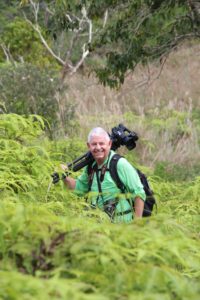
Photo caption:
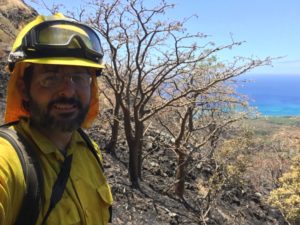
Dan spends a great deal of time shooting video and photographs in remote areas of Hawai’i to provide material for media coverage.


Dennison has been involved from the beginning in producing media materials to raise public awareness about Rapid Ohia Death.
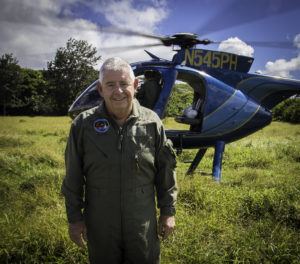
 

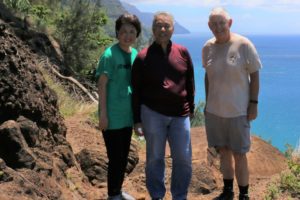
Dan Dennison with Governor and First Lady Ige, hiking the Kalalau Trail in conjunction with the reopening of the Napali Coast State Wilderness Park and Ha’ena State Park on Kaua’i.

Dr. Steven Businger to Speak on “Severe Weather in a Warming World”

in /by

MA’ALAEA, HI – A free presentation titled “Severe Weather in a Warming World” will be offered by Dr. Steven Businger on Wednesday, August 7 at The Sphere at Maui Ocean Center, as part of Maui Nui Marine Resource Council’s monthly meeting. The talk takes place from 5:30 pm to 7 pm. Doors open at 5 pm.

This presentation is open to the public and admission is free. Seating is limited so advance reservations are recommended. For reservations, visit https://bit.ly/hurricanetalk

Dr. Businger is the Professor and Chair of the Department of Atmospheric Sciences at the University of Hawaii and has devoted the past 30 years to researching the evolution and structure of destructive atmospheric storms.

“My talk will cover the evolution of recent hurricanes and other severe weather events that have threatened Hawaii, including how and why they form, how their structure affects the hazards they produce, and the role that a warming climate may play in these events,” said Dr. Businger. “I will also cover the similarities and differences between hurricanes and kona lows (a winter half year phenomenon).”

“We are offering this presentation because hurricanes have a profound impact on Maui’s coastal areas, causing erosion, storm surges and damage to homes and property – and possibly to coral reefs,” said Robin Newbold, co-founder and Chair of Maui Nui Marine Resource Council. “The weather and the future of our reefs are inextricably linked.”

“Right now, we are fortunate to have our local coral reefs providing an estimated $377.1 million worth of protection from storm surges and big waves to Maui’s coastlines every year, according to a recently released study from the U.S. Geological Survey, The Nature Conservancy and UC-Santa Cruz,” noted Newbold.

“However, coral bleaching caused by warming ocean temperatures can make corals weak and brittle, and more likely to be broken off in strong waves,” said Newbold. “If the height of our corals is reduced, we can expect more storm-related damage along our coasts. If sea level rises, it will also be harder for corals to break up big waves.”

“Please attend this talk to learn about hurricanes and severe weather events in Hawaii, so we can all be better prepared and safer,” says Newbold.

A nonprofit Maui-based organization working for healthy coral reefs and clean ocean water, Maui Nui Marine Resource Council hosts monthly meetings on the first Wednesday of each month featuring guest presenters speaking on issues, ideas and new advances relating to Maui County’s nearshore ocean environment. The meetings are free and open to all. Maui Ocean Center generously donates space for these monthly meetings at The Sphere, its new high-tech facility featuring advanced audio and visual projection and comfortable movie-style amphitheater seating.

About Dr. Steven Businger:
Dr. Steven Businger is Professor and Chair of the Department of Atmospheric Sciences at the University of Hawaii. He has made notable contributions to the atmospheric sciences in several important, yet diverse areas. For the past 30 years Professor Businger has been active in researching the evolution and structure of destructive atmospheric storms, resulting in fundamental contributions to our understanding of the formation of storm systems in cold air streams and in the tropics (e.g., Kona lows and tropical cyclones). To date he has over 80 peer-reviewed journal publications, published 2 academic textbooks, and seven book chapters.

Dr. Businger was elected Fellow of the American Meteorological Society (AMS) in 2010. He is an AMS Certified Consulting Meteorologist, and in 2011 Professor Businger received the UH Mānoa Chancellor’s Citation for Meritorious Teaching.

About Maui Nui Marine Resource Council:
An award-winning, community-based organization, Maui Nui Marine Resource Council is celebrating 11 years of working for healthy coral reefs, clean ocean water and abundant native fish. Maui Nui Marine Resource Council co-founded and co-manages Hui O Ka Wai Ola, a unique volunteer-based ocean water quality monitoring program that gathers data at 39 shoreline locations in South and West Maui. Maui Nui Marine Resource Council is working to restore clean ocean water at Ma’alaea Bay, through a pilot program to use oysters to improve ocean water quality in Ma’alaea Harbor and through upslope projects in the adjoining Pohakea Watershed. The organization also sponsors visitor education programs to encourage respect, protection and responsible use of our local coral reefs. To learn more visit www.mauireefs.org.

Public Invited to Free June 12 Presentation on South Maui Ocean Water Quality Monitoring Results

in /by

How clean is the ocean water at your favorite South Maui beach?

Get answers at a free presentation about ocean water quality along the coast of South Maui from ‘Āhihi-Kīnau (Makena) to Haycraft Park (Mā‘alaea) on Wednesday, June 12 at 6 pm. The talk will feature data collected at 20 South Maui sites by the community-based ocean water quality monitoring program Hui O Ka Wai Ola (Association of Living Waters). The presentation will take place at the Hawaiian Islands Humpback Whale National Marine Sanctuary at 726 South Kīhei Road in Kīhei. Admission is free and the public is invited.

“Sharing what we have observed in our first full year of data gathering in South Maui is a big milestone for our unique community-based program,” says James Strickland III, Project Manager. “We’ve learned some surprising things about our coastal water quality in South Maui, which we are looking forward to sharing with everyone at our presentation.”

The free presentation will also include information about why clean ocean water is so important to the future of Maui’s coral reefs.

The Hui O Ka Wai Ola program is co-managed by Maui Nui Marine Resource Council, The Nature Conservancy and West Maui Ridge to Reef Initiative, working in cooperation with the State of Hawai‘i Department of Health Clean Water Division. More than 40 Maui residents volunteer with Hui O Ka Wai Ola, covering 39 locations along Maui’s leeward shoreline.

“Clean ocean water is important for healthy coral reefs and for all ocean recreation,” says Tova Callender, Watershed Coordinator of West Maui Ridge to Reef Initiative. “To work towards clean ocean water along our shorelines, we need to understand where the water is impaired and what pollutants are to blame.”

“The Hui O Ka Wai Ola program follows a strict Department of Health approved Quality Assurance Project Plan (QAPP),” says Callender. “This allows the Hui to provide data the Department of Health can readily incorporate into its reports and databases, which are shared with County, State and Federal agencies, scientists, community groups and the public.”

Every three weeks the Hui team measures sediments, nutrients, and other pollutants from land-based sources that might be having a negative impact on water quality. They collect data for ocean salinity, pH, temperature, organic nutrients (nitrogen and phosphorous compounds), dissolved oxygen (DO), and turbidity). Nutrients, including nitrogen and phosphorus, can indicate agricultural runoff and sewage pollution. Sediments, which block sunlight and smother corals, can be carried from the land to the ocean by streams, flooding, and storm water runoff.

“We’ll be discussing all that we’ve found, the implications for the reef and marine wildlife, and the clues the data provides about the sources of any pollutants,” says Robin Newbold, Chair and co-founder of Maui Nui Marine Resource Council. “Ultimately, our goal is to use our data to bring about clean ocean water for Maui’s coastal areas, for all to enjoy.”

The Hui O Ka Wai Ola program is supported by Maui County Office of Economic Development (OED), Hawai‘i Tourism Aloha ‘Āina Program, North Beach West Maui Benefit Fund, Napili Bay and Beach Foundation, National Fish and Wildlife Foundation, Lush Cosmetics, The Makana Aloha Foundation, Honua Kai West Maui Community Fund, as well as individuals, families and local businesses. To learn more or to donate, please visit www.huiokawaiola.com or at www.mauireefs.org.

Free Presentation on “Wildfire on Maui: the History, Threat, and Our Collective Responsibility”

in /by

Did you know that the area burned each year by wildfire in Hawaii has increased by 400% over the past several decades? Wildfires have an impact on our nearshore ocean environment and coral reefs, which is why Maui Nui Marine Resource Council is hosting a free presentation on “Wildfire on Maui: the History, Threat, and Our Collective Responsibility” on Wednesday, February 6.

The presentation will be offered by Clay Trauernicht, PhD, Wildland Fire Specialist at University of Hawaiʻi Cooperative Extension. It will take place from 5:30 pm to 7:00 pm at Pacific Whale Foundation’s classrooms at the Ma’alaea Harbor Shops at 300 Ma’alaea Road, Ma’alaea (Wailuku). Doors open at 5:00 pm and complimentary refreshments will be served.

“Over the past decade, an average of more than 1,000 wildfires burned more than 17,000 acres each year in Hawai‘i, with the percentage of total land area burned comparable to and often exceeding figures for the fire-prone western United States,” reported Dr. Trauernicht.
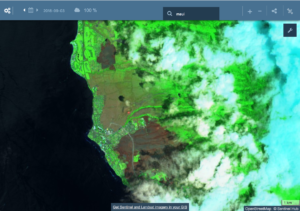
“During my presentation, we’ll use fire science and a bit of history to tackle the how and why of the 400% increase in areas burned by wildfires in Hawaii,” said Dr. Trauernicht. “We’ll also look at the consequences it has for our watersheds and nearshore ecosystems.”

“The short story is that fire on Maui and other islands is a problem we’ve largely created,” he noted.  “It is therefore one of the few ‘natural’ disasters we can actually avoid.”

“We’ll consider our options to reduce fire risk and impacts on Maui and how the urgency to take action is increasing under a changing climate,” Dr. Trauernicht reported.

Attendees will be invited to share their questions, experiences and ideas about wildland fires on Maui at the conclusion of Dr. Trauernicht’s presentation.

Dr. Trauernicht earned his PhD in Plant Science at the University of Tasmania and a MS in Botanical Sciences at the University of Hawaii at Manoa. He completed his BS in Biology at the University of Denver.  In addition to many years of botanical and ecological fieldwork, he has published and presented on plant community ecology and population modeling, geospatial analyses of fire and species occurrence, and the use of local knowledge to adapt management strategies and inform research needs.

His current focus is on improving wildland fire management in Hawaii and the Pacific with a strong emphasis on science extension and communication.  Dr. Trauernicht is the project leader for the Pacific Fire Exchange, part of the Joint Fire Science Program’s nationwide Fire Science Exchange Network.  He is currently working with the Pacific Island Climate Change Cooperative to extend climate science resources to Cooperative Extension programs throughout the Pacific Island region.

Maui Nui Marine Resource Council is a Maui-based nonprofit organization celebrating 17 years of working for healthy coral reefs, clean ocean water and an abundance of native fish for the islands of Maui County. In addition to co-managing the Hui O Ka Wai Ola ocean water quality testing program, which tests ocean water quality at 39 locations along the south and west shores of Maui, the nonprofit is working to improve ocean water quality in Ma’alaea Harbor through the use of installed oysters in cages. Maui Nui Marine Resource Council is also working in the Pohakea watershed above Ma’alaea Bay to prevent fire and erosion to protect ocean water quality and the coral reefs located in the bay. To learn more, visit www.mauireefs.org.

Free Presentation on “Proposed Use of Oysters for Water Quality Improvement in Ma’alaea Harbor”

1 Comment/in /by

The public is invited to a free presentation on a proposed plan to use oysters to improve ocean water quality in Ma’alaea Harbor during Maui Nui Marine Resource Council’s monthly meeting on Wednesday, December 5, from 5:30 pm to 7:30 pm.

The presentation will be offered by Rhiannon “Rae” Tereari‘i Chandler-‘Īao, Executive Director and O‘ahu Waterkeeper for Waiwai Ola Waterkeepers Hawaiian Islands. It will take place at Pacific Whale Foundation’s classrooms at the Ma’alaea Harbor Shops, 300 Ma’alaea Road. Admission is free and refreshments will be served.

Oysters are filter feeders that remove pollutants from the water column including sediment, bacteria, heavy metals, PCBs, oil, microplastics, oxybenzone, and other harmful sunscreen-related chemicals. Oysters also digest the type of bacteria that cause skin-borne illnesses such as Staph and MRSA. These oysters are for restoration, they cannot be consumed. Oysters for consumption are grown in clean water only.

Oysters are currently at work in harbor waters of New York and New Jersey, where Waterkeeper Alliance member projects have installed more than 42 million oysters to help clean the water and protect the coastline from wave action. Similar efforts are also being employed in Baltimore’s Chesapeake Bay to improve ocean water quality.

Pacific oysters, the type of oyster considered for the pilot project in Ma’alaea Harbor, were originally introduced by the State in the 1950’s and 1960’s and are found in locations throughout the Hawaiian Islands. Adult Pacific oysters can filter more than 50 gallons of water per day. The proposed pilot project would involve the installation of approximately 1,000 oysters in cages beneath the docks of Ma’alaea Harbor away from boat traffic. Trained staff and volunteers will monitor the oysters to evaluate survival rates and their success in improving water quality. At the end of one year, the pilot project will yield a report to help determine the feasibility of expanding the project within the harbor.

“In 2017, Hawai‘i’s Department of Land and Natural Resources (DLNR), Division of Aquatic Resources (DAR) conducted a successful grow trial using Pacific oysters,” says Chandler-‘Īao “This DAR study, conducted in West Loch, demonstrated the oysters’ ability to remove various pollutants water column. We’re excited to see what is possible to improve conditions in Ma‘alaea Harbor.”

Maui Nui Marine Resource Council (MNMRC) is partnering with Waiwai Ola Waterkeepers Hawaiian Islands to conduct the one-year pilot oyster project in Ma’alaea Harbor. The project is part of MNMRC’s overall plan to address land-based impacts to water quality in Ma’alaea Bay.

Recently, MNMRC commissioned and funded a study of the watershed that drains into Ma’alaea Harbor. With the study in hand, the nonprofit is now evaluating recommendations for action steps, and will be selecting those that can be implemented in 2019 and beyond. “We are looking at ways we can work upslope to improve water quality throughout Ma’alaea Bay,” notes Amy Hodges, Programs Manager at Maui Nui Marine Resource Council, who has been meeting with local landowners, MECO, Hawai‘i’s Division of Forestry and Wildlife, Ma’alaea Community Association, and others to talk about ocean water quality in Ma’alaea.

“Ma’alaea Bay is home to a popular surf break, beaches, a sea turtle feeding area, fishing areas, and coral reefs both inside and outside the harbor,” says Hodges. “Improving water quality in the harbor will benefit recreational users of the area and help marine wildlife.”

At the meeting, MNMRC will provide information on new volunteer opportunities associated with this project, including helping MNMRC regularly monitor the oysters and clean the cages to remove excess algae.

Doors will open at 5 pm, with complimentary holiday-themed refreshments. The presentation will begin at 5:30 pm and will include time for questions and comments from the public. To learn more, visit www.mauireefs.org.

About our presenter:
Rhiannon “Rae” Tereari‘i Chandler-‘Īao serves as the Executive Director and O‘ahu Waterkeeper for Waiwai Ola Waterkeepers Hawaiian Islands. She earned a B.A. in Ethnic Studies from the University of Hawai‘i at Mānoa in 2004. After graduating from William S. Richardson School of Law in 2016 with certificates in both Native Hawaiian Rights Law and Environmental Law, she worked as a Post J.D. Research & Teaching Fellow at Ka Huli Ao Center for Excellence in Native Hawaiian Law. Prior to attending law school, Rhiannon served as the Executive Director of the environmental non-profit organization Community Work Day Program, d.b.a. Mālama Maui Nui. While on Maui, she served as a member of the Maui County Cultural Resources Commission, the Maui Nui Marine Resource Council, and the Steering Committee of Ka Ipu Kukui Fellows Leadership Program.

About Maui Nui Marine Resource Council:
Maui Nui Marine Resource Council is a nonprofit organization based on Maui, dedicated to healthy coral reefs, clean ocean water and abundant native fish. Founded in 2007, Maui Nui Marine Resource Council is celebrating its 11th anniversary this year. Some of the organization’s accomplishments include:

• Formation of Maui Coral Reef Recovery Team and the Maui Coral Recovery Plan, the first of its kind in the state.

• Forming Community Managed Makai (CMMA) areas, in which local residents work together to manage their marine resources.

• Creating Hui O Ka Wai Ola in partnership with The Nature Conservancy and West Maui Ridge to Reef. This volunteer citizen-based ocean water quality testing program is now in its 2nd year of testing ocean water quality at 39 locations along Maui’s south and west shorelines every 3 weeks.

To learn more, visit www.mauireefs.org

Hui O Ka Wai Ola Ocean Water Quality Testing Program Expands Again – Now Testing 48 Maui Sites

1 Comment/in /by

The volunteer-based Hui O Ka Wai Ola ocean water quality testing program has expanded again, with the addition of 12 more testing sites in South Maui in early March 2018.  With this expansion, the program is now covering 48 shoreline locations where trained volunteers routinely test water quality on Maui every 2 to 3 weeks.

The Hui O Ka Wai Ola program, whose name means “Association of the Living Waters,” is the first community-based water quality monitoring to measure for nutrients (including nitrogen and phosphorus), along with turbidity, salinity, dissolved oxygen, pH and temperature in Maui’s coastal waters.

The program first launched in June 2016 in West Maui with 17 sites. One West Maui site was added in February 2017 (Napili Bay), and 6 additional West Maui sites were added in June 2017.

The program expanded to include a dozen new test sites in South Maui in November 2017. The latest expansion in 2018 added another 12 South Maui sites. In all, the group of volunteers are testing 48 sites on Maui.

A Partnership at Work
The program is made possible through the volunteers’ efforts and a joint partnership of Maui Nui Marine Resource Council, The Nature Conservancy, West Maui Ridge to Reef Initiative and the State of Hawaii Department of Health. Financial support for the program is provided by the partners, along with the County of Maui Office of Economic Development, National Fish and Wildlife Foundation, North Beach West Maui Benefit Fund, Napili Bay and Beach Foundation, Pride of Maui, Maui Ocean Center and individual donors and supporters

“Our goal is to support the State of Hawaii Department of Health and Maui County efforts to improve coastal water quality so that coral reefs and native fish populations thrive, and our residents and visitors are safe,” said Robin Newbold, co-founder and chairwoman of the Maui Nui Marine Resource Council. “We want to help identify problem areas, so remedial action may be taken as needed.”

Trained Volunteers and a Quality Assurance Plan
To prepare for the expansion in March, a group of ten new volunteers completed intensive training in the classroom, in the lab and in the field. The volunteers work under the guidance of experienced team leaders and regional coordinators. The sampling follows strict guidelines set under a Quality Assurance plan approved by the Department of Health. A QA officer reviews the data before it is submitted.

The volunteers bring equipment to the field for onsite testing; they also freeze and ship water samples to the SOEST (UH School of Ocean and Earth Science and Technology) laboratory on Oahu for additional analysis.

Poor Water Quality Undermines the Health of our Reefs
Hui O Ka Wai Ola’s program tests water samples for nutrients, such as nitrogen and phosphorous compounds, which can indicate pollution from wastewater and runoff from agriculture, landscaping and golf courses. High nutrient content in the water can cause an increase in growth of invasive algae, which could damage coral reefs.

In addition, research has shown that sustained, nutrient rich, lower pH submarine groundwater discharging onto nearshore coral reefs off West Maui lowers the pH of seawater and exposes corals to nitrate concentrations 50 times higher than normal. Rates of coral calcification — the rate at which coral polyps produce calcium carbonate which forms the hard structure of the reef — are substantially decreased. As a result, the reef degrades faster and the reef ecosystem is more likely to collapse.

“With many of Maui’s coral reefs in significant decline, it is critical that we reduce stressors to our reefs on a local scale as quickly as possible,” notes Tova Callender, coordinator supporting the West Maui Ridge to Reef Initiative. “Our water quality studies will help us understand the source of pollutants, which is the first step in addressing the stress to the reefs caused by impaired water quality and will hopefully make our reefs more resilient to climate change.“

Data provided by Hui O Ka Wai Ola will be used to supplement Health Department water quality monitoring on Maui and can be viewed on the group’s website, www.huiokawaiola.com.

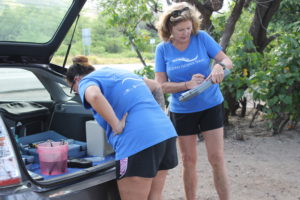
A State of Hawaii Department of Health employee tests water quality for enterococcus bacteria, a marker for potentially harmful bacteria in the water, The additional nutrient data provided by Hui O Ka Wai Ola provides an enhanced view of changing water quality conditions that can harm coral reefs and humans.

Community Support Sought
The cost of testing for each site is about $3,800 per year, which includes analysis and the shipping of samples to Oahu. Maui Nui Marine Resource Center is asking companies, canoe clubs, community organizations and individuals to each sponsor a site with a $3,800 donation. To donate, visit https://www.mauireefs.org/membership-and-giving/adopt-a-beach/

The goal of Hui O Ka Wai Ola is to bring more awareness to local coastal water quality issues and support better-informed decisions and policies regarding water quality.

To learn more, visit HuiOKaWaiOla.com.

Maui Nui Marine Resource Council May 2 Meeting to Feature Guest Presentation on “Updates on efforts to restore streamflow to Maui’s reefs and effects on fisheries”

in /by

Maui Nui Marine Resource Council invites the public to its next meeting on Wednesday, May 2, featuring guest presentations by Lucienne De Naie and Adriane Raff Corwin.

Lucienne De Naieʻs presentation will be on “Updates on efforts to restore streamflow to Maui’s reefs and effects on fisheries.” Adriane Raff Corwin will be speaking about the Hukilike No Maui Coalition and also efforts to keep harmful sunscreen chemicals out of our nearshore ocean ecoystems.

The meeting will take place from 5 pm to 6:30 pm at Pacific Whale Foundationʻs classrooms at the Maʻalaea Harbor Shops. Admission is free, everyone is invited and refreshments will be provided.

Lucienne De Naie lives in rural east Maui and is active with stream and watershed restoration projects. She is a a founding member and a director of Maui Nui Marine Resource Council, as well as a founding member of Maui Cultural Lands, Inc. and the Maui Coastal Land Trust (now Hawaiian Islands Land Trust). Lucienne has served on the Mayor’s Open Space Zoning Advisory Committee, the Maui General Plan Advisory Committee and serves as Conservation Chair and hike leader for the Maui Sierra Club. She also authored a report on the status of Mauiʻs freshwater resources.

Adriane Raff Corwin is the Sierra Club Group Coordinator. Adriane has been a community organizer for over ten years and received her Master’s Degree in Political Science and Futures Studies from the University of Hawaiʻi at Mānoa.

The meeting will include updates on Maui Nui Marine Resource Councilʻs work as a nonprofit community organization to restore clean ocean water, protect coral reefs and bring back abundant native fish to the nearshore areas of the islands of Maui County.

To learn more about Maui Nui Marine Resource Council, please visit www.mauireefs.org.

Lucienne De Naie

Adriane Raff Corwin


Herbivore management program at Kahekili shows encouraging results for the areaʻs coral reef

in /by

It’s often been said that “reef management” is a misleading term. After all, it’s not the reefs that need guidance; it’s human behavior that needs to be managed. One good example of the impact of humans working together as a community to protect reefs is the Herbivore Management Program at Maui’s Kahekili Beach Park. Three decades of detailed coral monitoring that has occurred there had led to informed and effective management actions.

A poster presentation by Darla White and Russell Sparks (Hawaii Department of Land and Natural Resources, Division of Aquatic Resources) and Ivor Williams (NOAA National Marine Fisheries Service, Coral Reef Ecosystem Division) showed the results of management of the herbivore fisheries at Kahekili and its impacts on the resilience of the reef.

You can view the poster at:
https://www.eposters.net/pdfs/the-kahekili-herbivore-fisheries-management-area-enhancing-resilience-of-a-reef-showing-signs-of.pdf

According to the poster, Dr. Eric Brown initiated monitoring at Kahekili Beach Park in the early 90s, In 1999, through the UH Coral Reef Assessment and Monitoring Program (CRAMP), the area was converted into one of a statewide network of intensively monitored reef sites. Hawaiiʻs Department of Aquatic Resources (DAR), part of the state Department of Land and Natural Resources (DLNR), has since worked to complete annual re-assessments of this site in collaboration with UH CRAMP.  It is through this intensive effort to measure change on the reefs in this area, that DAR developed clear concerns over rapid declines in coral cover, increases in algae growth, and reduced level of critically important herbivorous fishes.

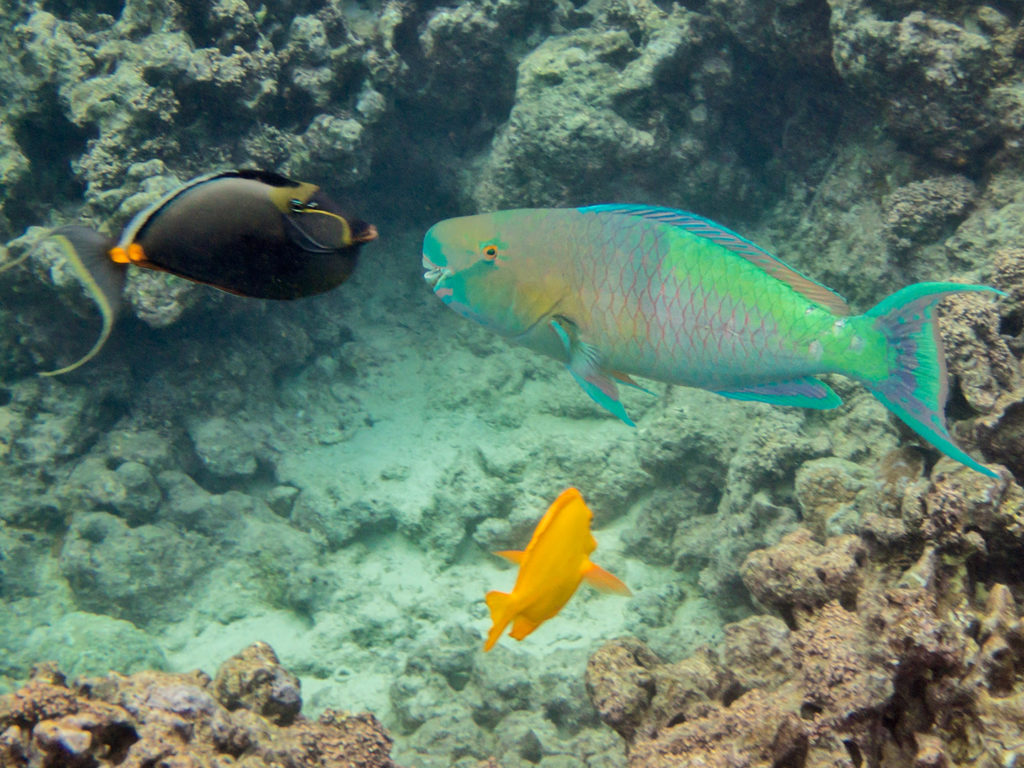
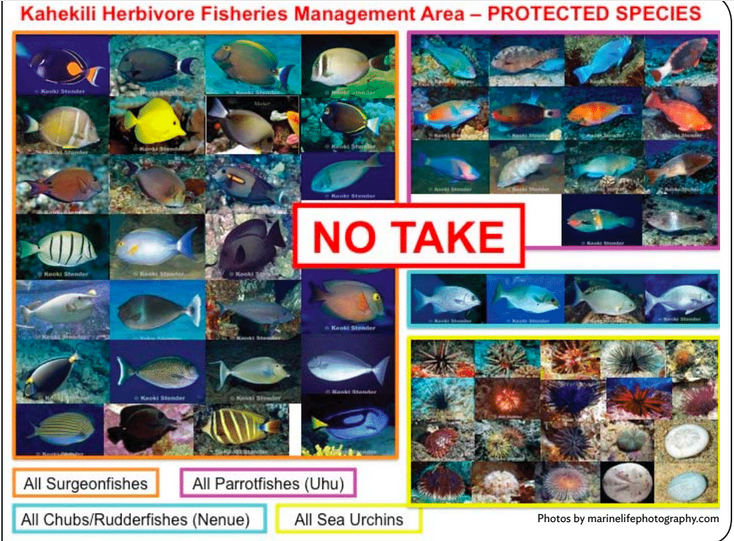
Herbivorous fish are fish that consume algae and seaweed. These fish include surgeonfish, parrotfish and chubs. The fish were being harvested for human food, leaving the reef defenseless against the onslaught of algae. The increase in algae resulted in the declining coral cover.

As a result, the DAR initiated discussions about the herbivore management area and got very good support from local long-time fishing families from the area, and from recreational fishing advocates such as Darrel Tanaka, Brain Yoshikawa and others. As a result, fishing for herbivores (such as parrotfish) was banned at Kahekiki, along with the taking of sea urchins. The program also prohibited the feeding of fish, because such activity decreases fishes’ natural appetite for seaweed.

Furthermore, marine biologist advocates such as Liz Foote and many others have helped move the effort forward and helped involve citizens and educate the public to improve compliance.

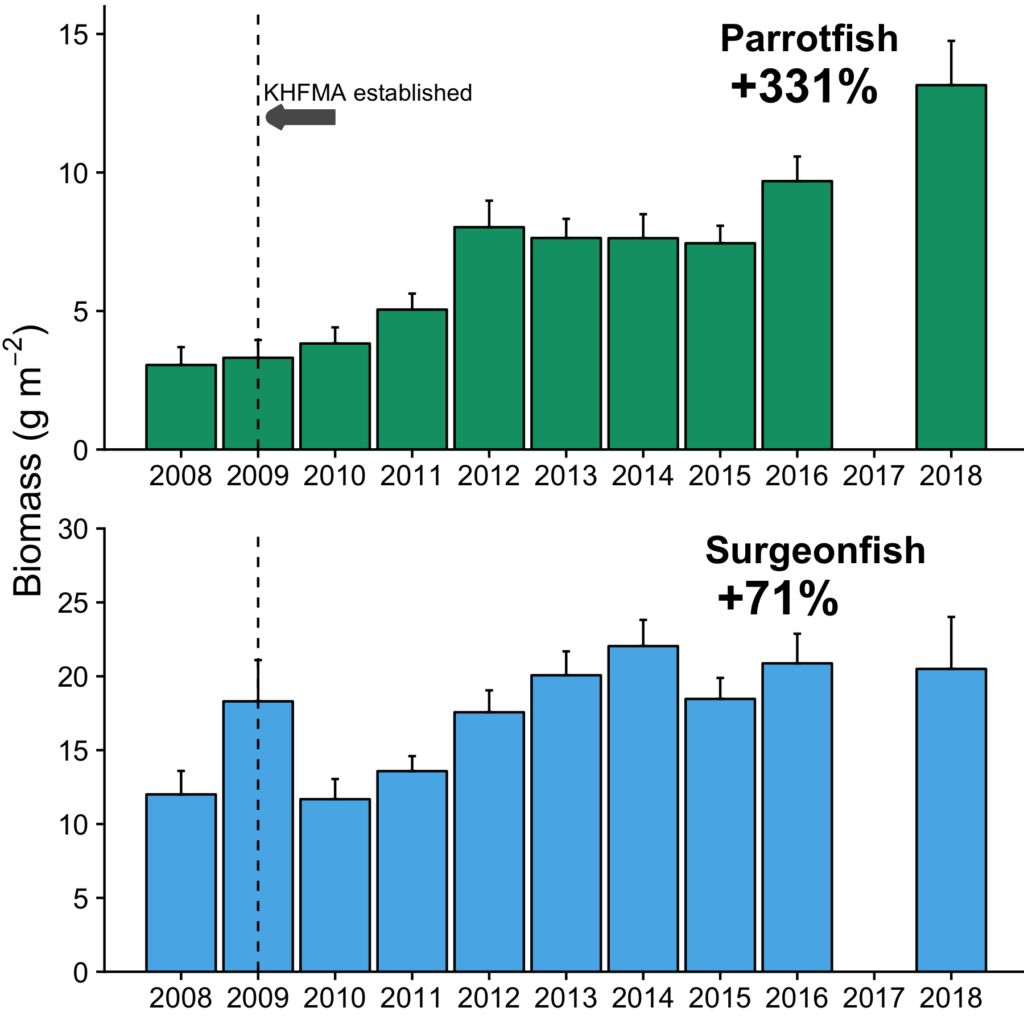
These new controls and outreach efforts have worked. Since the management area went into effect in 2009, there has been a 331% increase in parrotfish biomass at this reef, meaning that parrotfish have been growing to a larger size (which means they are better algae grazers) and are found in greater numbers. Surgeonfish increased 71% from 2008/09 to 2018 in this area. (See poster at https://www.eposters.net/pdfs/the-kahekili-herbivore-fisheries-management-area-enhancing-resilience-of-a-reef-showing-signs-of.pdf.)

Best of all, the seaweed and microalgae were reduced greatly, down to almost nothing. Success!

Current evaluation of the effectiveness of the area has been conducted with a partnership between DLNR/DAR and the NOAA science center (Dr. Ivor Williams).  This collaborative effort has allowed DAR  to conduct extensive yearly monitoring assessments and measure the response of the area to the management efforts.

Which takes us back to the question of managing reefs vs. managing humans. Human behavior can be managed, through education and effective management rules.  The results at Kahekili offer hope for what can be accomplished at other reefs throughout Maui Nui.


Aquatic Biologist Russell Sparks of Hawaii Department of Aquatic Resources to be Guest Speaker at March Meeting of Maui Nui Marine Resource Council

in , /by

A free presentation offering updates on the State of Hawaii’s management of Maui’s nearshore fisheries and coral reef resources will be featured at the Wednesday, March 7 meeting of the nonprofit Maui Nui Marine Resource Council. The talk will be presented by guest speaker Russell Sparks, Aquatic Biologist of State of Hawaii, Department of Land and Natural Resources, Division of Aquatic Resources. Sparksʻ presentation will also include an update on the status of Mauiʻs reefs following the bleaching event of 2015.

The meeting will take place from 5 to 7 pm at Pacific Whale Foundation’s Discovery Center Classrooms at Ma’alaea Harbor Shops at 300 Ma’alaea Rd, Wailuku (next to Maui Ocean Center). The talk is free and everyone is invited. Refreshments will be served. 

Maui Nui Marine Resource Council (MNMRC) is a Maui-based nonprofit working for healthy coral reefs, clean ocean water and the restoration of abundant native fish in the nearshore waters of the islands of Maui County. 

At the March 7 meeting, MNMRC staff will be offering updates on their recent and ongoing projects, including the expansion of a volunteer-based water quality monitoring program to include 48 sites in South and West Maui and a study of corals off Olowalu. 

Sparks received his B.S. in Biology from Oregon State University. He received his M.S. in Marine Biology from University of Hawaii at Manoa in 1996. Since 1998 Russell has worked for the State of Hawaii, Department of Land and Natural Resources, Division of Aquatic Resources as an education specialist and more recently as an aquatic biologist. He is currently responsible for leading the design, implementation, and overall management of the Maui marine monitoring program, and for working with stakeholders and communities to develop marine management programs aimed at adaptively managing nearshore fisheries and coral reef resources.

To learn more, visit www.mauireefs.org. 

Using Algal Turf Scrubbers  to Improve Wastewater Quality to be Subject of February 7 Meeting of Maui Nui Marine Resource Council

in /by

The public is invited to attend a free presentation on harnessing local algae and sunlight to improve the quality of treated municipal wastewater at the Wednesday, February 7 meeting of the nonprofit Maui Nui Marine Resource Council. 

The meeting will take place from 5 pm to 7 pm at Pacific Whale Foundation’s classrooms at the Harbor Shops at Maʻalaea at 300 Maʻalaea Road. Refreshments will be served. 

Guest presenter, Travis Liggett, will be speaking about Algal Turf Scrubbers, a cutting-edge technology which can improve wastewater quality by harnessing local algae and sunlight to lower nutrient levels, increase oxygen concentration, and reverse acidification in wastewater. 

“Algal Turf Scrubbers have a place on the island of Maui to provide an added stage of treatment to municipal wastewater before entering the marine environment via injection wells serving Kahului-Wailuku, Kihei-Wailea and Lahaina,” says Liggett. 

Liggett holds a MS in Aerospace Engineering from University of Colorado Boulder and a BS in Mechanical Engineering from University of California, Berkeley. He served as an Algae Manager at Maui Tropical Algae Farm and also worked as an Aerospace Research Engineer with NASA.  Mr. Liggett is working with Dr. Dean Calahan, a Smithsonian researcher focused on expanding the use of Algal Turf Scrubber technology.

Liggett holds a MS in Aerospace Engineering from University of Colorado Boulder and a BS in Mechanical Engineering from University of California, Berkeley. He served as an Algae Manager at Maui Tropical Algae Farm and also worked as an Aerospace Research Engineer with NASA.

The evening will also include a discussion about general wastewater issues on Maui, including the 12,000 cesspools located here, which handle 7.9 million gallons of untreated wastewater per day.

Dana Reed, West Maui Regional Coordinator of Hui O Ka Wai Ola, the ocean water quality testing program led by Maui Nui Marine Resource Council, The Nature Conservancy, West Maui Ridge 2 Reef and University of Hawaii Maui College, will be presenting some preliminary findings about ocean water quality at West Maui beaches and the Hui’s efforts to use algae (limu) to collect more information about Maui’s coastal water.