Posts

Drought Conditions Turn Kealia Pond Pink

in , /by

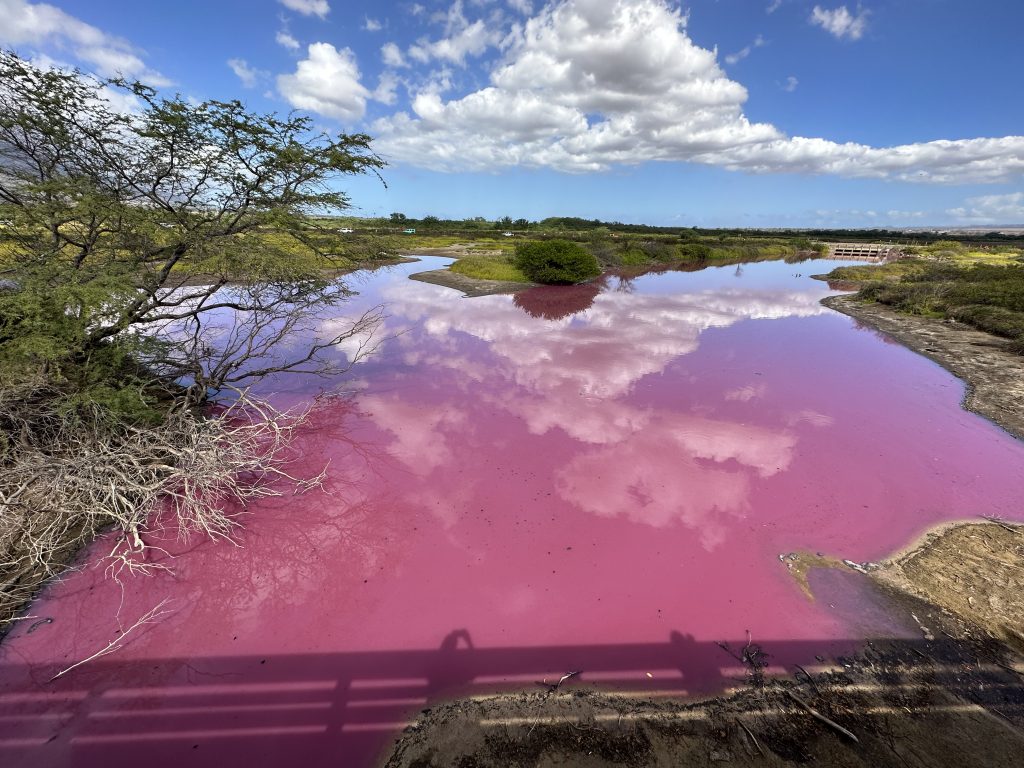
A pink pond doesn’t sound natural… but it is! … especially if that pond is salty… very salty.  A whole group of salt “loving” organisms (aka halophiles) ranging from bacteria and archaea to algae to shrimp to fish and birds have adapted to life in water that most other organisms would say “No thank you!” to living in. The recent pink makeover at Kealia Pond is an example of where water got too salty for some of the typical inhabitants and the halophiles got happy and took over.


Pink water at Kealia Pond in November 2023.

The water turned pink at Kealia Pond in November 2023. Early analysis suggests it could be due to Halobacterium salinarum or one of its close relatives. PC: John Starmer


Why did the Kealia Pond turn pink?

So what is turning the water pink at Kealia?  While a definitive ID is still not available, a good suspect is Halobacterium salinarum or one of its close relatives.  The red-to-pink color of Halobacterium comes from bacteriorhodopsin, which helps capture light energy for photosynthesis. This protein is unique to archaea and one of the things that separates them from true bacteria.

Halobacterium, despite the name, is a type of halophilic (salt-loving) archaea, not a bacterium. The archaea were only split out from bacteria about 50 years ago and now are recognized to comprise one of the three domains of life, alongside true bacteria and eukaryotes (everything from single-celled algae to sea turtles). Archaea were first discovered in ‘extreme environments’ like salt ponds and thermal hot springs. They are now recognized as abundant and common in most environments from seawater to soil to animal skin and digestive tracts.  Interestingly, none of the species found to date are considered to cause disease.

Is this natural?

Kealia Pond is a dynamic landscape that floods and dries as the seasons change and water becomes more or less abundant. The name Kealia means salt-encrusted place and reflects that during the dry season, patches of white salt remain behind as water evaporates from large areas of this shallow wetland.  The only surface drainage for the pond that remains connected to the sea passes under the National Wildlife Refuge boardwalk. This drainage channel gets scoured out when high water breaks through the sand plug that usually closes off the channel from the ocean in Ma’alaea Bay. Because the channel is deeper, it still holds water even as the shallower parts of the pond and nearby mudflats earn their name and show off white patches of salt crystals scattered across the surface.

The conditions that led to the Halobacterium bloom are considered a natural, though unexpected, result of a long dry summer evaporating the pond and raising its salinity – about twice that of seawater at the moment. Pink salt ponds are a common occurrence around the world thanks to Halobacterium and other halophilic organisms can turn these ponds a range of colors. A small pond along Hana Highway in Kahului has exhibited the same sorts of color changes over the years, but its less striking color changes and small size have kept it from getting much attention.

Is this a Red Tide? / Is this Dangerous?

Is there any need to be concerned about what’s going on at Kealia Pond? Red tides or harmful algal blooms (HABS) are known to affect wildlife and humans by producing toxins. HABS, however, are caused by different organisms – often dinoflagellates or cyanobacteria – and are frequently associated with high nutrient levels in the water. These organisms cannot survive in the high salinity in the pond and have been discounted as the source of the color change. Interestingly, the archaea as a whole, including Halobacterium, are not known to cause any human disease, despite being among the most common organisms on earth.

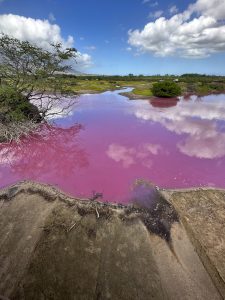
Vertical image of Pink water at Kealia Pond in November 2023.Will the pond stay pink forever?

The Halobacterium are thriving right now thanks to the current high salinity at in the pond. Because conditions are optimal for the growth of these halophiles, rather than typical green algae, the pond will likely stay pink as long as the salinity remains high. When rains come and drop the salinity, the pond will certainly return to a more sedate and typical color as algae take over as the dominant plankton in the pond.


Enjoy learning more about Maui Nui’s natural resources?

Consider making a donation to MNMRC to help us continue doing work like this and more!

Take a Virtual Dive with Hawaii’s Whale Sharks in Next Know Your Ocean Speaker Series Webinar

in /by

KIHEI, HI — Hawaiian waters are popular for ocean migrants, from humpback whales to green sea turtles to great white sharks, but did you know that the largest fish in the world visits the islands as well? Whale sharks, which can grow up to 60 feet, have eluded residents and scientists alike, but Kona-based Hawaii Uncharted Research Collective (HURC) is working to understand more about these gentle giants.

The public is invited to learn about HURC and these animals in a free presentation, “A look at whale sharks in Hawaii: A research effort for the conservation of an endangered species,” led by HURC founder Maria Harvey. The Zoom presentation will be held on Wednesday, Aug. 3 at 5:30 pm as part of Maui Nui Marine Resource Councilʻs monthly Know Your Ocean Speaker Series, sponsored by the County of Maui. Admission is free, but advanced registration is required. To register, visit https://bit.ly/ WhaleSharkWebinar.

Harvey founded HURC in 2017 with a mission to conduct research on whale sharks and other marine organisms in Hawaiian waters, focusing on population dynamics, ecology, animal behavior and human impacts. HURC merges community engagement with scientific research, relying on citizen science and field studies to better understand how and why these sharks use Hawaii’s offshore areas. Findings from this research will support local and global efforts to conserve whale sharks and their environment.

Her presentation will cover how and why Hawaii Uncharted Research Collective was formed and will give viewers a glance at the organization’s research projects. It will also provide information on localized and global threats to whale sharks, dive into some of HURC’s results so far, and discuss the future of the organization and other conservation efforts.

“Hawaii Uncharted Research Collective provides an avenue to couple my research and education background with my love for the Hawaiian Islands, ocean conservation, and the charismatic whale sharks that inhabit the deep blue waters of the Pacific,” said Harvey. “I’m excited to share the story of HURC and what we’ve accomplished since our founding.”

Whale sharks are found worldwide in tropical seas, preferring open waters where they can be found filter feeding with their large mouths on some of the smallest marine organisms, plankton. They are currently listed as “endangered,” mainly due to fishing pressure, accidental catch and vessel strikes. Capable of living upwards of 100 years, very little is known about these animals, especially those in Hawaiian waters. HURC’s research hopes to contribute to worldwide scientific investigations into these mysterious and threatened animals.

“Hawaii truly is a remarkable place for marine wildlife,” said Mike Fogarty, Executive Director of Maui Nui Marine Resource Council. “We’re excited to share Maria’s work with the larger public and hear ways that residents and visitors alike can contribute to local efforts to research and protect these charismatic sharks.”

To reserve your spot, visit https://bit.ly/WhaleSharkWebinar.

About Maria Harvey:
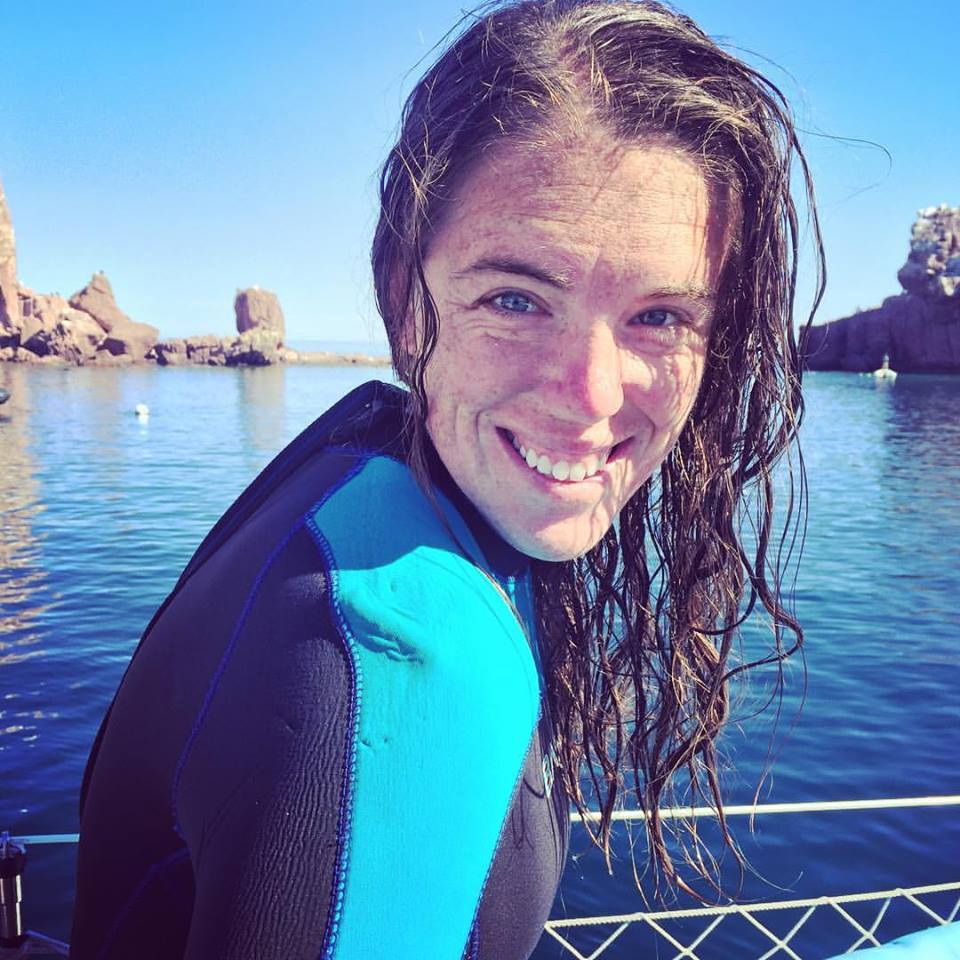
Maria Harvey graduated from the University of Hawaii in 2009 with a bachelor’s degree in Marine Science and is currently working on her graduate degree in Fish, Wildlife and Conservation Biology. Maria’s love for the ocean, education, wilderness and research has taken her all over the world in recent years. Notably, Maria has worked in Alaska, Hawaii, Canada, Mexico and Cape Cod. During her travels, she has worked as a Captain, naturalist, expedition guide and assistant researcher, and is currently a level-4 marine animal disentanglement specialist. Her work and studies have encompassed a variety of species, including spinner dolphins, humpback whales, right whales, bottlenose dolphins, leatherback turtles and whale sharks. In recent years, Maria has been a guest lecturer and distinguished speaker for private universities and cruise operations, including the University of Pennsylvania’s Veterinary School, Georgetown University and UnCruise Adventures.

In her free time, Maria loves to travel and backpack. Just last year, she completed the 211-mile John Muir Trail. When she isn’t on the water or hiking, she loves to spend time with her two beloved golden retrievers, Samantha and Palmer. One day, Maria would love to own an animal sanctuary in honor of her favorite four-legged critter, Melvin the pig (Instagram: @melvinpig).

Leeward Maui Coastal Water Quality Report Released

in /by

New 2016 – 2021 report released by Hui O Ka Wai Ola community-based water quality monitoring program

MĀ‘ALAEA, HI – A comprehensive report detailing findings about coastal ocean water quality at dozens of leeward Maui locations over a six-year period was released this week by Hui O Ka Wai Ola, a citizens’ ocean water quality monitoring program.

The 32-page Coastal Water Quality Report 2016-2021 focuses on data gathered by more than 60 volunteers and staff in coastal waters from Honolua Bay to Pāpalaua and from Mā’alaea to ‘Āhihi-Kīna’u Natural Area Reserve. The report reveals high levels of turbidity and nitrates in many areas along the coast and includes recommendations for reducing these pollutant levels.

Hui O Ka Wai Ola is a program conducted by scientists and highly trained community volunteers who monitor water quality every three weeks. The program is coordinated by Maui Nui Marine Resource Council (MNMRC), The Nature Conservancy (TNC), and West Maui Ridge to Reef Initiative (R2R). The group shares the data it collects with the Hawai’i Department of Health (DOH) to improve understanding of coastal waters.

“Since 2016, we have collected and analyzed over 3,200 water quality samples from 48 sites,” reports Tova Callender, R2R’s Watershed and Coastal Management Coordinator. “In a nutshell, what we’ve found is that these coastal waters are often degraded by land-based pollutants, including sediments, fertilizers, and wastewater. Sadly, these pollutants – which can cause brown water events and algae blooms – impact the quality of our lives and can smother, weaken and kill coral reefs.”

“The data in this report can help the community focus its efforts on reducing pollutant levels in areas that need it most,” says Amy Hodges, Programs and Operations Manager at MNMRC. “At Maui Nui Marine Resource Council, this data has led us to focus on efforts to reduce sediment and nitrate pollution in Māʻalaea Bay and sediment runoff along the North Kihei coast.”

“Though there are many areas of concern, there are also some bright spots,” notes Kim Falinski, TNC’s Coastal and Estuarine Scientist. “Most notably at Kapalua, nitrate levels have dropped in the last two years, and the turbidity levels have declined at Keālia Pond, likely due to the wetlands’ ability to filter and absorb pollutants before they reach the ocean.”

Hui O Ka Wai Ola testing protocols align with DOH standards so data collected can be combined with DOH data for an expanded understanding of coastal waters. The data is also available to researchers, advocacy groups, and the public at www.huiokawaiola.com (https://www.huiokawaiola.com/) , PacIOOS, and Zenodo.

To download a free copy of the Hui O Ka Wai Ola Coastal Water Quality Report 2016-2021, please visit https://www.huiokawaiola.com/findings.html

Some findings included in the Coastal Water Quality Report 2016-2021:

• The highest nitrate levels of all the monitored sites were found at Kīhei’s Cove Park, where levels are more than 2x higher than any other leeward Maui site. Studies show wastewater influence from the Kīhei Wastewater Reclamation Facility (WRF) is a likely driver of elevated nitrates near Cove Park [Dailer 2010, Hunt 2007]. Surprisingly, nitrate levels at Cove Park have been consistent from 2017 to 2021, including during the COVID-19 pandemic.

• Second to Cove Park are the nitrate levels from Mā‘alaea to North Kīhei.

• Nitrate levels at two sample sites within the ‘Āhihi-Kīna‘u Natural Area Reserve appear to be increasing, and there is evidence of pharmaceuticals at the south site, possibly from swimmers or from the large cesspool there.

• Nitrate levels far exceed DOH standards at Kapalua, Ka‘ōpala, Nāpili, Pōhaku, and Hanakaʻōʻō Canoe Beach. However, nitrate levels at Kapalua have dropped significantly in the last two years.

• Elevated nitrate levels at leeward Maui sites are associated with fertilizers and wastewater that seep into groundwater systems and emerge through springs on the ocean floor. Elevated nitrate levels can cause algae blooms and smother, weaken, and kill coral reefs.

• Turbidity and nitrate levels were consistently low in the coastal waters adjoining Keālia Pond, likely due to the wetlands’ ability to filter nitrates and sediment from freshwater flows including stormwater runoff.

• Ulua Beach in Wailea has turbidity levels that are so low that on average a snorkel partner 10 feet away will almost always be visible. Unfortunately, Ulua Beach also has elavated levels of nitrates. Contaminated groundwater is the likely source of the nitrates at Ulua Beach.

• Turbidity is a measure of water clarity. High turbidity diminishes water quality and threatens coral reefs. The report notes that high turbidity levels in leeward Maui are associated with coastal erosion, rains that carry sediments to coastal waters, and resuspension.

For additional information, download a free copy of the Hui O Ka Wai Ola Coastal Water Quality Report 2016-2021 at www.huiokawaiola.com.

Hui O Ka Wai Ola Sponsors and Funders

Hui O Ka Wai Ola (Association of Living Waters) is a Maui-based program, whose work is funded by generous individuals, businesses, and organizations.

Lab space provided by:
Lāhainaluna High School, Hawaiian Island Humpback Whale National Marine Sanctuary, Da Hawaiian Store and Pineapple Properties Maui, LLC.

Past and current sponsors and grant funders who made this report possible include:
Bayside Catering, County of Maui, Coastal Planners LLC, Duke’s Maui LLC, Flatbread Company, Hawaii Community Foundation, Hawaiian Paddle Sports, Hawaii Tourism, Host Hotels and Resorts, Jersey Mike’s Subs, Ka’anapali Ocean Resort Charitable Trust, Lilly Pulitzer, Lush Fresh Handmade Cosmetics – Charity Pot, Honua Kai – West Maui Community Fund, Inc, Marty Dread, Maui Sky Diving, Maui Brewing Company, Maui Classic Charters, Maui Ku’ia Estate Chocolate Inc., Maui Marathon & Maui Half Marathon, Maui Ocean Center, Napili Bay and Beach Foundation, National Fish and Wildlife Foundation, North Beach-West Maui Benefit Fund Inc., Pacific Whale Foundation, Plaza Home Mortgage, Pride of Maui, Robert F. Orr Foundation, The GoodCoin Foundation/Target, The Makana Aloha Foundation, The EACH Foundation, Media TheFoundation, Vitalitea Hawaii, and Westin Ka’anapali Ocean Resort Villas,

We thank the individuals and families whose contributions support our community-based ocean water quality monitoring program. Mahalo — we couldnʻt do it without you!

“Rally for the Reefs” webinar on Thursday, June 16 will focus on saving the reefs of Māʻalaea Bay

in /by

Speakers Stuart Coleman, Rep. Angus McKelvey and Maui County Councilmember Kelly King will provide updates on Māʻalaea wastewater treatment options

MĀʻALAEA, HI – Longtime Māʻalaea resident Peter Cannon remembers that during his childhood, “the coral reefs of Māʻalaea Bay were like the robust and healthy reefs that you see today at the ʻĀhihi-Kīnaʻu Natural Area Reserve.” He recalls that local families enjoyed harvests of ribbon limu from the bay, and there was an abundance of native fish and opae.

Since the 1970s, the coral reefs in Māʻalaea Bay have degraded so severely that Hawaii’s Division of Aquatic Resources (DAR) has described the situation as “a case study in total system collapse.” In their report, “Status and Trends of Maui’s Coral Reefs” DAR in partnership with the Coral Reef Assessment and Monitoring Program reported on their 1999 monitoring in Māʻalaea Bay and noted that the “end result of reef degradation is evident in Māʻalaea Bay.”

The report noted that in 1972, “Māʻalaea coral reefs were described as being ‘striking in their diversity and in the presence of rare corals species’. As late as 1993, estimated coral cover was 50- 75% close to the site where cover is now 8%. Therefore, in just a few decades, the Māʻalaea reef has transformed from a healthy and diverse ecosystem into a badly degraded habitat overgrown by algae and with little surviving coral.”

The report also noted that fish stocks in in Māʻalaea are now in very poor condition, and the reefs have been invaded by alien and invasive algae species.

Declining ocean water quality in Māʻalaea Bay is a major contributor of the decline. A new report for the years 2019 – 2022 by the Hui O Ka Wai Ola community-based ocean water quality monitoring program indicates that Māʻalaea Bay has excessive levels of nitrates, second only to the levels in Kihei Cove, of all the sites the program monitors along the leeward Maui coast.

What can Maui County residents and visitors do to improve the ocean water quality and save the reefs of Māʻalaea Bay? Learn about the steps that are proposed — and how individuals can help – at an online Rally for the Reefs webinar to be held on Thursday, June 16 at 5:30 pm via Zoom.

Admission is free, but reservations are required. To reserve your spot, visit https://bit.ly/Rally4Reefs.

The “Rally for the Reefs” webinar will feature presentations by:

Stuart Coleman
Founder and Executive Director of WAI (Wastewater Alternatives & Innovations)
Coleman will discuss modern wastewater alternatives and innovations that will make it possible to reduce the pollution that has been harming the corals in Māʻalaea Bay.

Maui County Councilmember Kelly Takaya King
(Holds the County Council seat for South Maui)
Councilmember King will discuss the funding for the improved wastewater treatment system for Māʻalaea in the County’s 2023 budget and the steps ahead to make this system a reality.

State Representative Angus L.K. McKelvey
(Representing West Maui – Māʻalaea – North Kihei)
Representative McKelvey will explain how the State can help establish improved wastewater treatment in Māʻalaea, and why the proposed wastewater treatment project in Māʻalaea could serve as a model for other small communities throughout Hawaii that are looking for replacements for cesspools, injection wells and septic systems.

“The community has been working hard to identify and address the problems that have undermined the ocean water quality of Māʻalaea Bay and harmed the coral reefs,” said Mike Fogarty, Executive Director of Maui Nui Marine Resource Council. “We’ve now reached critical junctures that will decide if and when some of the proposed solutions to the problems of water pollution and reef loss will be addressed. We need to act now to save Māʻalaea’s reefs before it’s too late. Please attend the Rally for the Reefs to learn what can and should be done.”

The Rally for the Reefs webinar is sponsored by WAI, Maui Ocean Center, Māʻalaea Village Association, Maui Nui Marine Resource Council, Maui Ocean Center Marine Institute and Sierra Club Maui Group.

To register to attend this free Zoom event, please visit https://bit.ly/Rally4Reefs.

New Sunblock Dispensers Urge South Maui Ocean-Goers to “Love the Ocean the Right Way” on Valentine’s Day

in /by

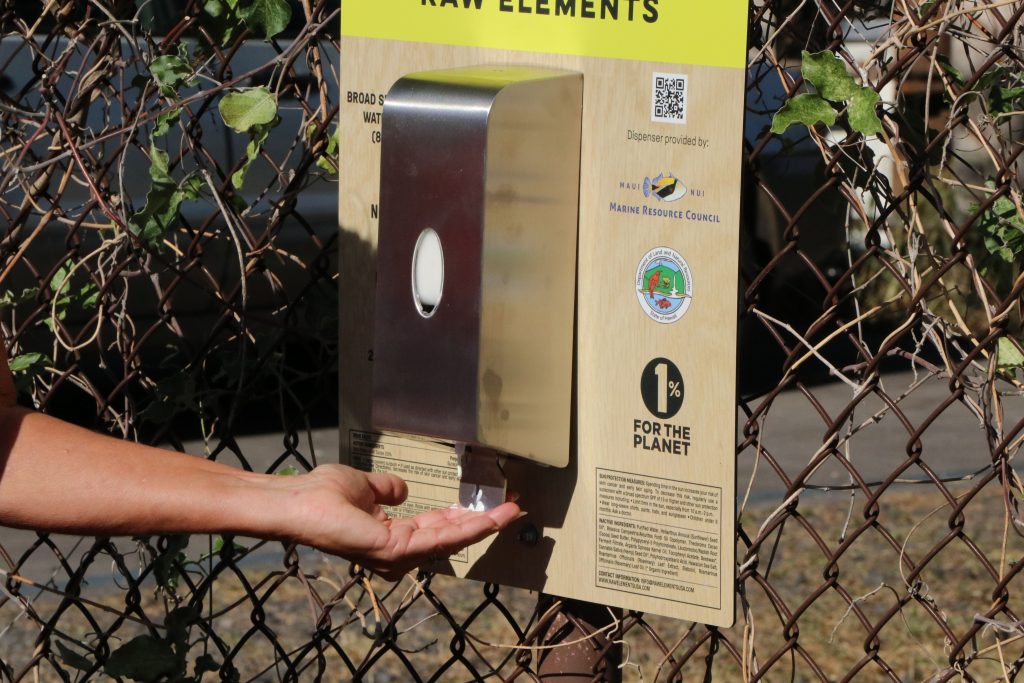
KIHEI – Four mineral sunblock dispensers are up on this Valentine’s Day on south Maui shores, encouraging all to “love the ocean the right way.” Two are at the ‘Āhihi-Kīna‘u  Natural Area Reserve and a pair are to be installed at Mākena State Park. Thousands of people enter the ocean at these locations every day.

The dispensers hold non-nano, zinc, mineral sunscreen. Products with these active ingredients are safe for people and marine life because those elements already exist in sea water. Dermatologists say mineral-based products are the most effective protection for people, as they block out both UVB and UVA rays from the sun.

The Maui installations were inspired by a sunblock dispenser at Waialea Bay at Hāpuna State Recreation Area on Hawai‘i Island. Kelli Lundgren, board member of the Robert F. Orr Charitable Foundation, decided Maui needed dispensers. “As a volunteer at ‘Āhihi-Kīna‘u I’ve communicated with hundreds of visitors about the effectiveness and protection of mineral sunscreens. As people understand the mineral alternative and discover that sprays and bottles labeled “reef safe” actually can be harmful, they wanted an alternative.”

The Robert F. Orr Charitable Foundation through the Maui Nui Marine Resource Council, and with support from the State of Hawai‘i and County of Maui, helped with the placement of dispensers at the Maui beaches. “I hope this will be the start of additional protection for Maui’s corals, fishes, and other abundant, beautiful, and essential sea life,” Lundgren added.

“Once people try mineral sunscreens, they see how easy they are to use,” said Mike Fogarty, Executive Director at Maui Nui Marine Resource Council. “We hope these dispensers give people an introduction to a better way of protecting themselves and marine life. Using mineral-based sunscreens also help protect the fish that many in our community rely on for food.”

Beginning on October 1, Maui County will be the first place in the country to ban the sale and use of sunscreen products with petrochemicals as active ingredients. Many of those products are labeled as “reef safe” with no scientific backing to the claims. The historic ordinance was passed unanimously by the Maui County Council and was signed into law by Mayor Michael Victorino last December.

It is intended to protect reefs and ocean food sources from continuous, daily chemical contamination. A 2018 state-wide law only banned the sale of two chemicals but allowed the continued sale of many other chemical ingredients.The Maui ordinance is stronger because it allows only the sale of mineral products. It prohibits the sale or use of any chemical compounds currently in use as well as any new compounds created in  the future.

Council member Kelly King introduced the bill and commented, “Non-mineral sunscreens are an aggressive pollutant. Our coral reefs are our first defense against climate change and sea level rise. This includes impacts such as erosion, runoff from storms and development, and seepage from wastewater injection wells. Our ordinance is one important step toward protecting the health and resilience of our reefs and marine life by removing a significant ecological stressor. Making a better choice in sun protection is one thing we can  all do immediately. What better day than Valentine’s to make a change and show your love for the kai?”

Peter Landon, of the DLNR Division of Forestry and Wildlife, manages ‘Āhihi-Kīna‘u Natural Area Reserve. Landon said, “Thanks for the generous donations and everyone’s work on this issue. The     installation of these dispensers is a welcome addition to our outreach efforts, giving us a way to help visitors who were unaware of the chemical sunscreen pollutants, or thought they bought something ‘reef safe’. We appreciate it when people hear our messageand want to do the right thing.”

Raw Elements USA supplied the dispensers and product. Chis Wagaman of the company remarked, “We’re honored and proud to be a part of this project with great people participating in positive change for Maui. It is incredible to see the steps taken to educate and provide an incredible experience for everyone who goes into the ocean.”
# # #

To view video please click on photo or view at this link: https://vimeo.com/677415105

More information about mineral sunscreens and reefs:  https://www.mauireefs.org/sunscreens

More information about Maui’s ordinance: https://www.mauicounty.gov/DocumentCenter/View/130826/Ord-5306

Media Contact:  Dan Dennison 
Senior Communications Manager 
Hawai’i Dept. of Land and Natural Resources 
[email protected] 
808-587-0396

New FlushAware App to Be Topic of March 2 Know Your Ocean Speaker Series

in /by

Meet the App’s Developer and Learn More About Where Wastewater Goes When You Flush Your Toilet on Maui

PAIA, MAUI, HI – The average person flushes their toilet five times per day. But when you flush, do you know where your wastewater goes and what impacts it has on the ocean where you surf or swim, the beaches where you play and the fish that you eat from our coastal waters? Maui Nui Marine Resource Council invites you to learn more about the path that wastewater follows once it leaves your toilet and how your wastewater is impacting our nearshore ocean water quality at a special Know Your Ocean Speaker Series presentation on Zoom on Wed. March 2 at 5:30 pm featuring Travis Liggett as the guest speaker. To reserve your spot, please visit https://bit.ly/FlushAwareWebinar

Liggett is the president of Reef Power LLC and the developer of the new FlushAware app with a demonstration website launch for Maui island users slated for March 2022.

“FlushAware is a new online education system that will inform users about the treatment level and destination of their Maui Island disposal method, while providing tools for activism and improving life downstream,” says Liggett.

During his presentation, Liggett will demonstrate how the new FlushAware app will work, and will discuss solutions to Maui’s wastewater challenges, which he says can be found in the living life support ʻĀina. “Native species such as stream limu, breadfruit and taro provide answers to our water waste woes. Instead of nearshore injection, municipal discharges in Maui can be polished with turf scrubbers to reduce nutrient pollution using local freshwater algae,” reports Liggett. “The wastewater can then be 100% reused as irrigation of native food agroforestry, pastureland, and vetiver slope stabilization plantings to reduce sediment transport potential from mauka lands.”

Travis Liggett graduated from University of California at Berkeley with a Bachelor of Science degree in Mechanical Engineering with a focus on design in 1998, and from the University of Colorado at Boulder with a Master of Science degree in Aerospace Engineering with a focus on life science in 2003.

In 2001 Mr. Liggett started work as a Research Assistant at  BioServe Space Technologies, a NASA Commercial Space Center locate

d at CU Boulder, and continued his tenure working for the Agency as a Flight Systems Engineer for the Space Station Biological Research Project starting in 2003, then as an Aerospace Research Engineer focusing on functional prototype development of new life science technologies from 2005 – 2010 at  NASA Ames Research Center in Moffett Field, located in California’s Silicon Valley.

On Maui, Travis has managed algae growth operations at Maui Tropical Algae Farm, and served as Principal Engineer for Water Quality Consulting, Inc., where he performed core duties including work on the Maui Ocean Center’s 2018 NPDES permit application.

Travis founded the small business Reef Power LLC in 2018 with the objective of bringing to Maui a natural regenerative reuse wastewater nutrient polishing system called a turf scrubber growing native Hawaiian stream limu (freshwater macroalgae), coupled with native food agroforest irrigation for disposal, instead of nearshore injection wells.

“Wastewater has a significant impact on Maui’s coral reefs and nearshore ocean water quality, whether you live in Kula or Kihei,” says Mike Fogarty, Executive Director of Maui Nui Marine Resource Council. “The FlushAware App will contribute to our community’s growing awareness of the impacts of each and every flush – the first step in finding an answer to the question of how to manage our wastewater to protect our reefs and the ocean waters that surround our shores.”

The Know Your Ocean Speaker Series is hosted on the first Wednesday of each month and is funded in part by the County of Maui Office of Climate Change, Resiliency and Sustainability and by donations from individuals and businesses in the community. To learn more, visit www.mauireefs.org.

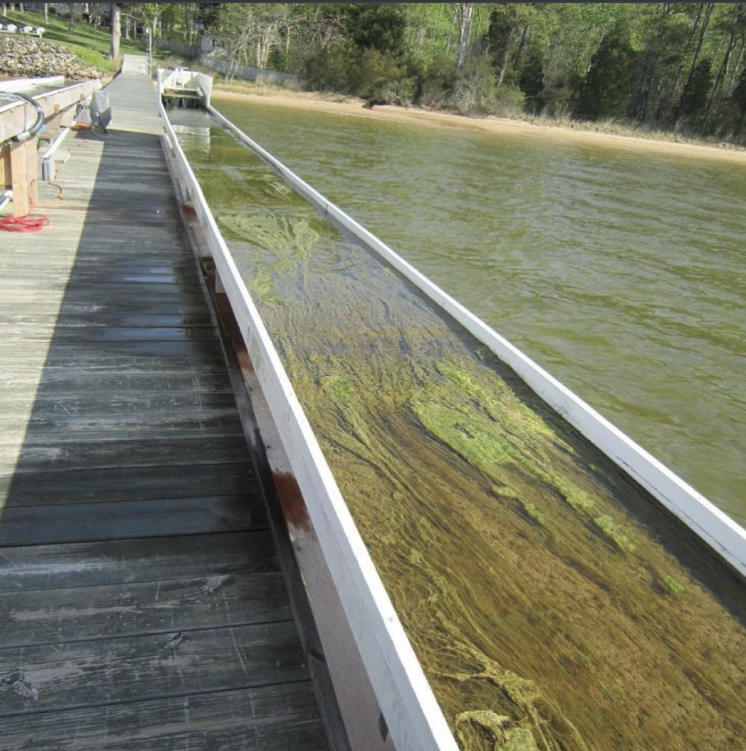
Photo at right: A turf scrubber reduces nutrient pollution using local freshwater algae.

Maui’s Community-Based Ocean Water Quality Monitoring Program Celebrates 100th Sampling Session

in /by

Maui’s volunteer-based ocean water quality monitoring program Hui O Ka Wai Ola celebrated a special milestone on February 8, 2022: its 100th sampling session since the program began on Maui in 2016.

A beachside ceremony held this morning at Hanakaʻōʻō Beach Park in Kāʻanapali was organized by Maui Nui Marine Resource Council, West Maui Ridge to Reef Initiative and The Nature Conservancy, the three organizations that co-founded and co-manage this unique community program. It was attended by about 40 Maui residents, program volunteers and local VIPs including State Representative Tina Wildberger, Maui County Councilmember Tamara Paltin, and Maui County Managing Director Sandy Baz, who each delivered remarks and congratulations to the volunteers and staff.

A sampling session occurs over a week’s time and typically involves about a dozen volunteers, who wake up before sunrise and fan out in groups of three or four with cars packed with water quality monitoring equipment to gather and test ocean water samples along Maui’s leeward coast.

Sampling sessions take place every three weeks. Each sampling session in West Maui covers 16 sites stretching from Pāpalaua Pali to Honolua. Each South Maui sampling session covers 13 sites from Mā’alaea to ‘Āhihi Kīna’u.

Todayʻs celebration included awarding of gift certificates donated by Duke’s Maui to the volunteers in the program, plus a ceremonial gathering of ocean water samples by long-time volunteers Kit Harris and George Burnette. It was followed by a demonstration of how the water samples are tested for sediment, temperature, pH and other factors conducted by Harris, Burnette, Representative Wildberger and Councilmember Paltin with narration by Hui O Ka Wai Ola Senior Team Lead Tiarra Stark.

Representative Wildberger had a special connection to today’s event: she had volunteered with the Hui O Ka Wai Ola monitoring program  to collect and test ocean water samples in South Maui before being elected as the District 11 Representative for Kihei, Wailea and Makena.

For Councilmember Paltin, the 100th sampling event also held special significance. She, along with then-West Maui resident Dana Reed, helped provide the spark that led to the creation of the community-based ocean water quality monitoring program after the pair observed an unusual increase in brown water events at DT Fleming Beach in 2013-2014.

“Large brown plumes started appearing at DT Fleming, even without much rainfall, which led to beach closures,” noted Reed, who is a retired electrical engineer and now lives in Pennsylvania. “One day I saw another brown plume and said, ‘That’s it! I have to investigate!’.”

Reed had learned how to test ocean water for turbidity at a UH Maui course taught by Donna Brown. She grabbed the sampling bottles she had received at the course and started gathering samples. It was then that she met Paltin, who was a lifeguard at the time. Paltin shared that she too was concerned about the brown water plumes and had photographed them and sent them to Watson Okubo, the Director of the Department of Health Clean Water Branch. Their sampling data wasn’t accepted because they did not have a Quality Assurance Project Plan (QAPP) in place to ensure the integrity of the data.

Undaunted, Reed and Paltin started documenting the water quality at DT Fleming on a regular basis, gathering data from water samples and photos, including aerial photos that Reed’s husband Bill Rathfon obtained with his drone.

Reed said that Paltin would sound the alert – “the stream is running brown!” – and Reed would rush over to grab water quality samples. Paltin also kept sampling bottles at her lifeguard station so she could gather samples during her breaks.

Paltin was a member of the Marine Nui Marine Resource Council Clean Water Committee and together with Reed and Rathfon presented data and pictures from DT Fleming to the group.

Someone who had hiked upslope to understand where the sediment runoff was originating reported that a site that was being prepared for the development of Mahana Estates appeared to be the cause of the runoff.

The project manager from Mahana Estates was invited to meet with Marine Resource Council’s clean water committee and visit the site. She reported that the developer had put up sediment fences and barriers to control the runoff but was having trouble keeping them in place because they kept breaking.

The Department of Public Works said that the developer was following the County’s Best Management Practices (BMPs) and asked for baseline data to compare the current water quality issues at DT Fleming to past years when the problem wasn’t occurring.

That data didn’t exist. But Paltin, Reed, Rathfon and Maui Nui Marine Resource Council persisted in spotlighting the problem  – and ultimately a County engineer, Department of Health representative and the developer visited the site and saw the source of the sediment.

The result was a County-mandated shutdown of the project for more than a year and improvement of the County’s BMPs.

“From that experience, I saw the importance of water quality data – including the need for baseline data – at all of our Maui beaches,” said Reed, who attended the ceremony remotely from her home in Pennsylvania. “At that time, the Department of Health Clean Water Branch had only one person sampling water quality for all of Maui. They suggested that we create a citizen’s monitoring group.”

Maui Nui Marine Resource Council and The Nature Conservancy joined together to host Carl Berg, a research scientist who has worked on water quality issues on Kauai, to learn how to create a community-based water quality monitoring program here.

He told the groups that they needed to create a Quality Assured Project Plan (QAPP) that would meet EPA requirements and State Department of Health standards for projects that involve the collection and analysis of water samples.

This led to a meeting with the Department of Health, Environmental Protection Agency, NOAA, Maui Nui Marine Resource Council, The Nature Conservancy, West Maui Ridge to Reef Initiative and other community environmental groups to discuss creating a water quality monitoring program for Maui.

The result was the launch of Hui O Ka Wai Ola (the “association of living waters”) to be managed through a partnership of Maui Nui Marine Resource Council, The Nature Conservancy and West Maui Ridge to Reef Initiative.

Maui Nui Marine Resource Council agreed to serve as the fiscal sponsor of the program and oversee its finances and payroll.  A grant from National Fish & Wildlife Foundation obtained by The Nature Conservancy helped fund paid positions for Reed and Kim Falinski to create the program in West Maui and purchase water sampling equipment. A second grant from National Fish & Wildlife Foundation later obtained by Maui Nui Marine Resource Council made it possible to expand the program to South Maui.

The QAPP was created over a two-year period by Reed, Falinski and Scott Lerner of The Nature Conservancy. The Department of Health Clean Water Branch signed off on the QAPP and the first official samples of the new Hui O Ka Wai Ola program were collected in June of 2016.

Volunteers signed on to receive the needed training and commit to the early morning sampling sessions. “People didn’t join for fun. They joined because they cared,” said Reed. “I am amazed at how many good quality people we got, who stuck with it. People are so dedicated. I am so impressed.”

At each sampling site, one of the volunteers wades into knee deep water and fills several containers with sea water. The citizen-scientists use portable lab equipment to analyze the samples for pH, dissolved oxygen concentration, salinity and turbidity. The water quality samples are transferred to indoor labs for additional testing. Further testing for nutrients is performed on samples that are frozen and shipped to the labs at the University of Hawaii at Manoa.

Today, the Hui O Ka Wai Ola program manages data collected at 40 leeward sites, which has been provided to the Department of Health Clean Water Branch, to be included in reports to the EPA and State and County agencies. New data is currently being gathered at 29 shoreline locations in West and South Maui.

Dozens of volunteers have worked with the program since its inception, including Hawaii State Representative Tina Wildberger and Maui resident Kit Harris. The program has four part time staff: Senior Team Lead Tiara Stark and Team Leads Meredith Beeson, Mitch Brown and Nalei Sampson. Retired biophysicist Cathy Maxwell is the organization’s Technical Advisor and Bill Rathfon is the Data Manager. Hui O Ka Wai Ola is led by a steering committee of representatives of the three partner organizations, along with Dana Reed and Kim Falinski, who are the Quality Assurance advisors.

The Hawaiian Islands Humpback Whale National Marine Sanctuary, Lahainaluna High School, Da Hawaiian Store and Pineapple Properties LLC have provided free space to the group for its indoor laboratories. The County of Maui has provided funding, along with local companies, foundations and groups including National Fish & Wildlife Foundation, Duke’s Maui, Makana Aloha Foundation, Napili Bay and Beach Foundation, MediaThe Foundation, EACH Foundation, North Beach West Maui Benefit Fund,  Maui Ocean Center, Hawaii Tourism, LUSH, Hawaii Community Foundation’s CHANGE grant and individual donors.
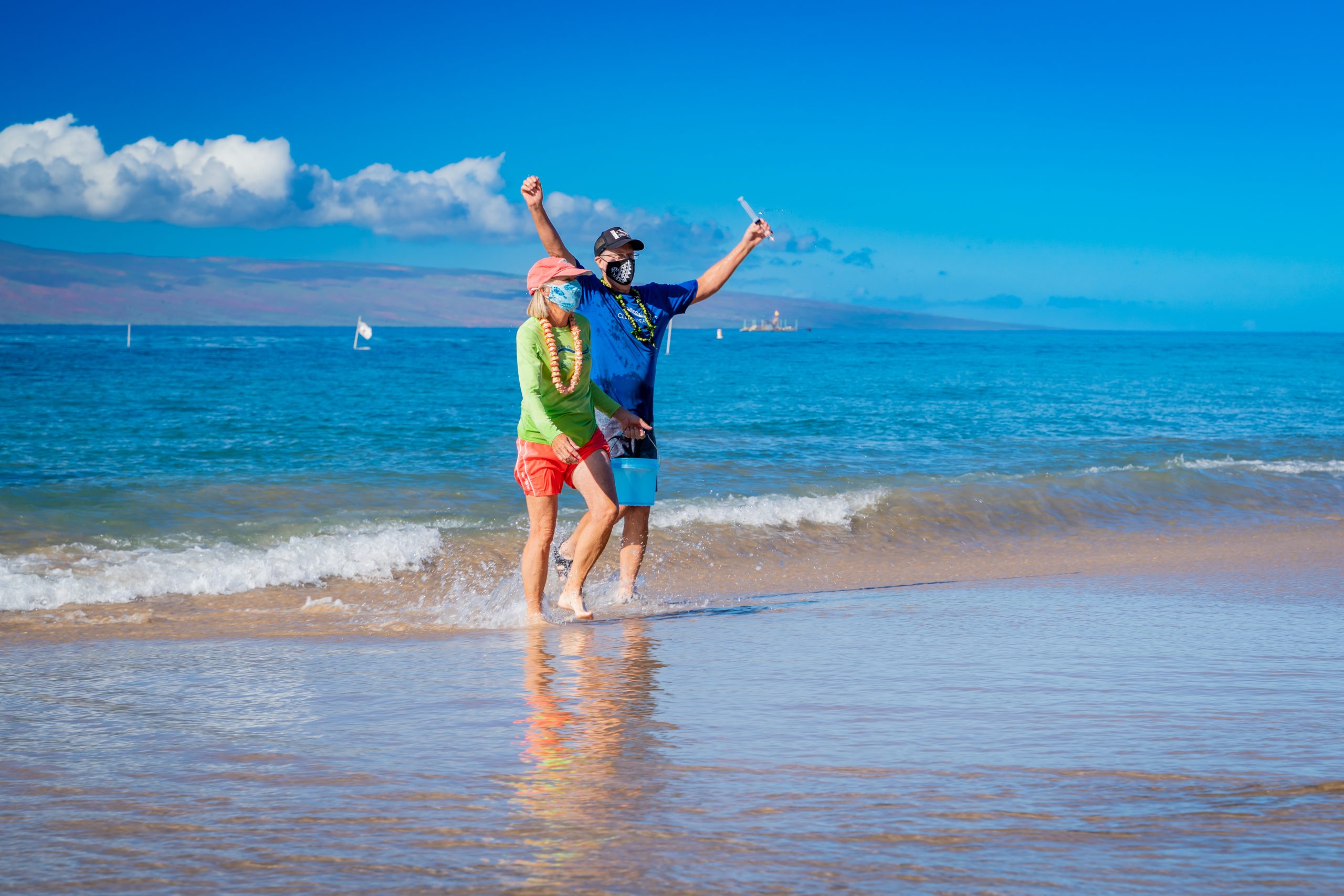
Longtime volunteers George Burnette and Kit Harris carry water samples for testing from the ocean at Hanakaʻōʻō Beach Park in Kāʻanapali.

Photo by Ty Freiberg
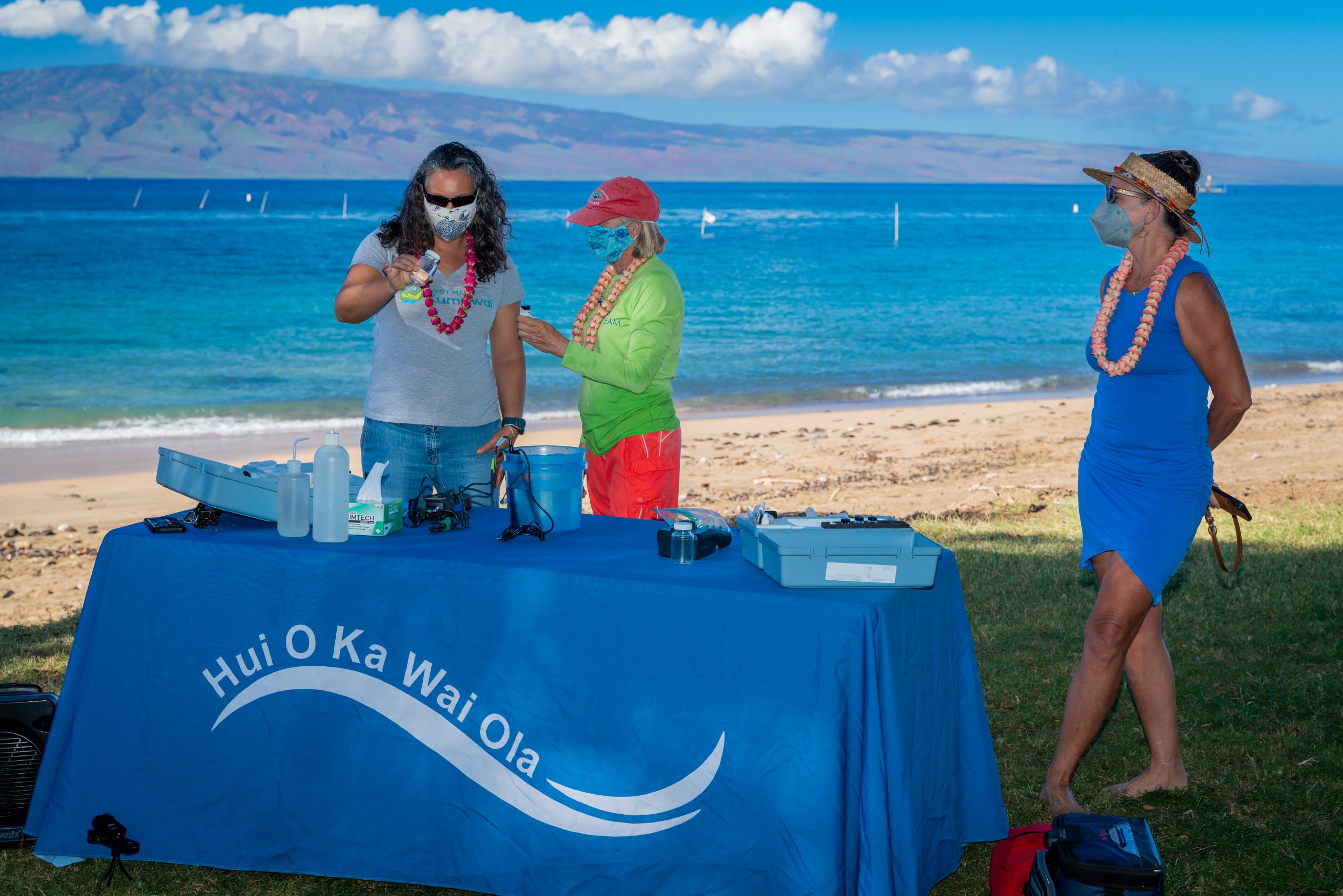
Maui County Councilmember Tamara Paltin and volunteer Kit Harris test a water sample while Hawaii Representative (and a former Hui O Ka Wai Ola volunteer) Tina Wildberger looks on.

Photo by Ty Freiberg
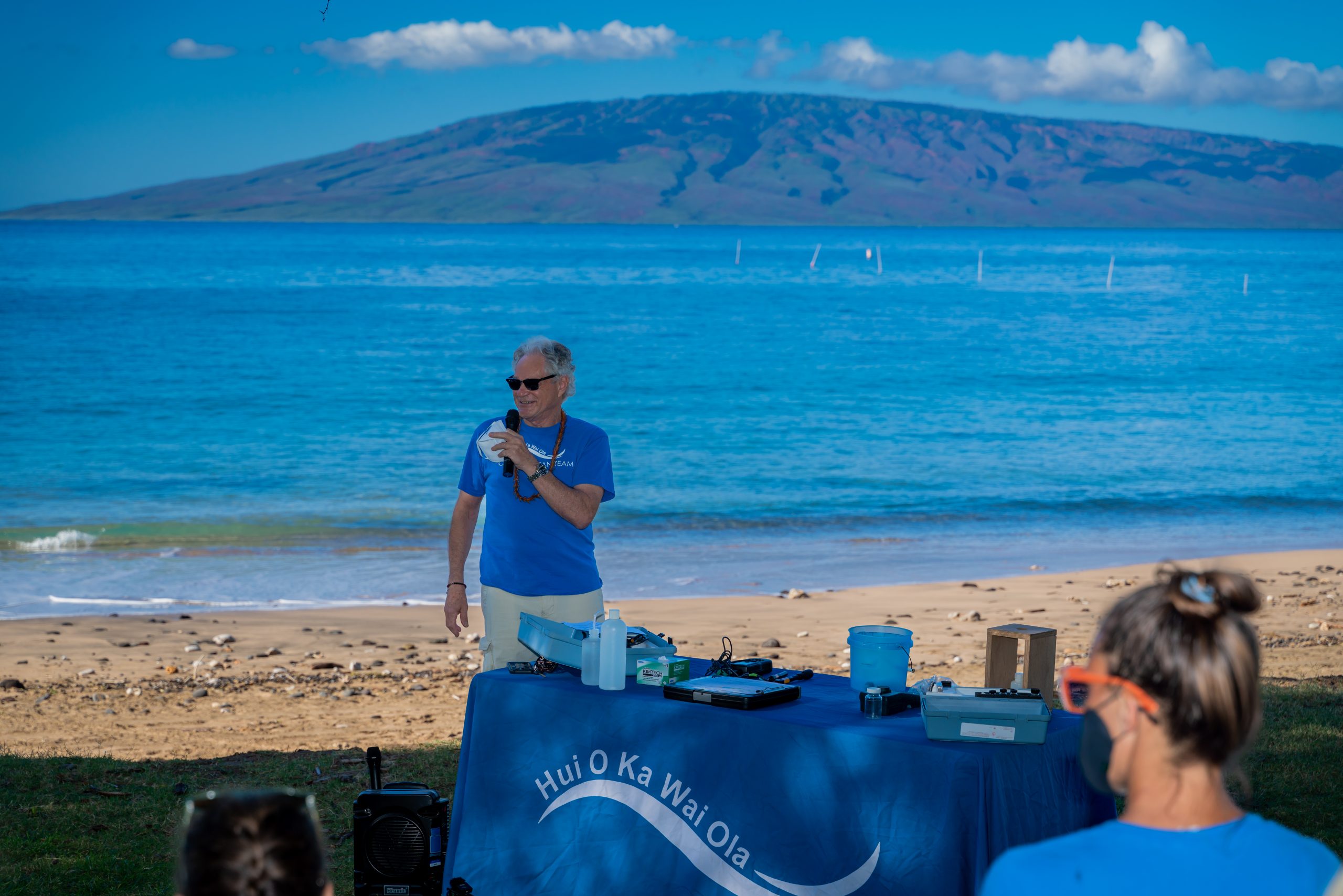
Maui Nui Marine Resource Council Executive Director Mike Fogarty thanks the volunteers and announces a special gift for each one donated from Duke’s Maui.

Photo by Ty Freiberg
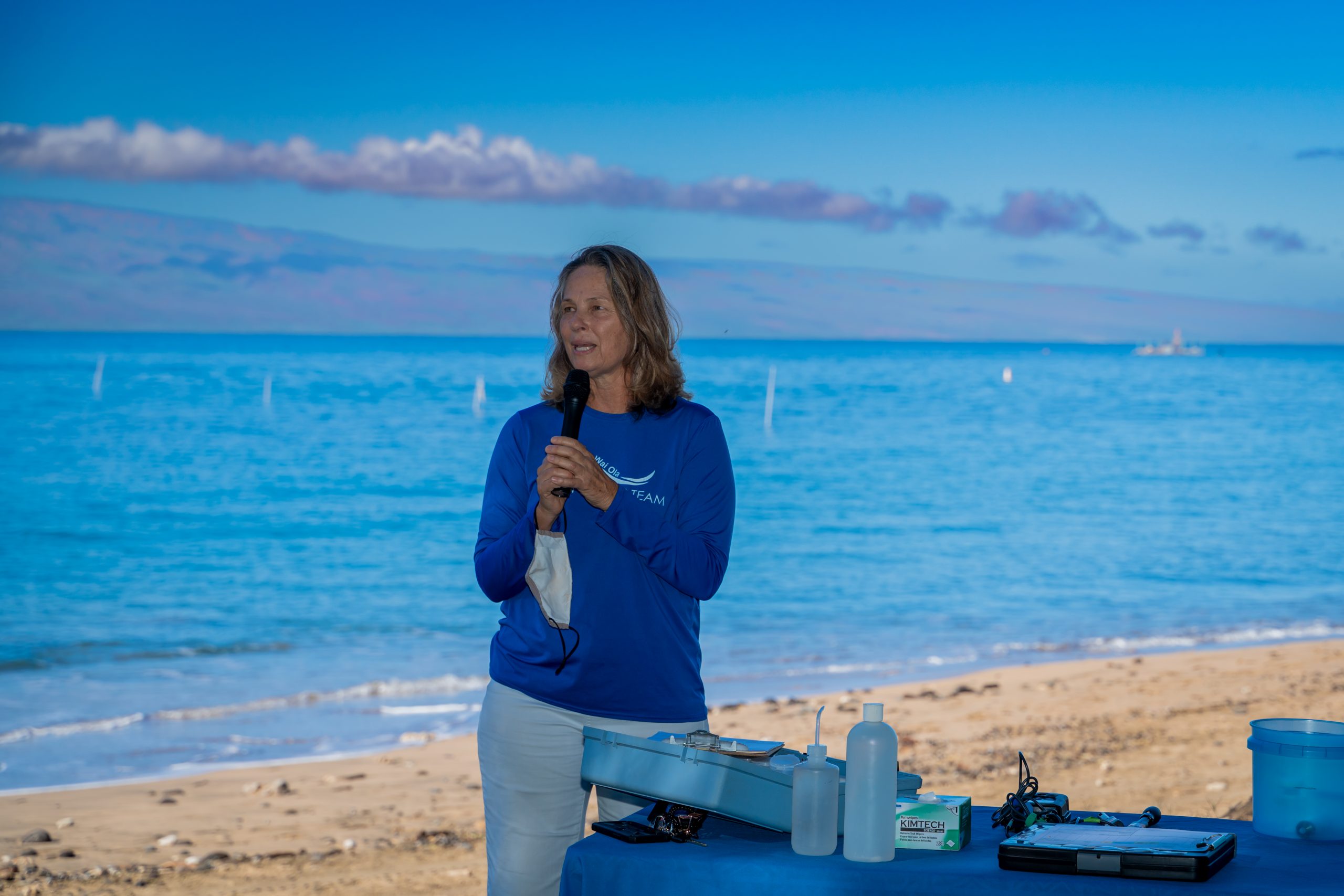
Emily Fielding, Maui Marine Program Manager at The Nature Conservancy, speaks about the partnership between The Nature Conservancy, Maui Nui Marine Resource Council and West Maui Ridge to Reef Initiative that co-founded and co-manages the Hui O Ka Wai Ola ocean water quality monitoring program.

Photo by Ty Freiberg

 

Free Zoom Presentation on Wed. Feb. 2 by Dr. Jennifer Lynch:
 “Did Maui’s expanded polystyrene ban improve the amounts or types of plastic on Maui beaches?”

in /by

KIHEI, HI – On December 31, 2018, Maui County banned the use, sale or provision of polystyrene food service containers as a step to protect marine wildlife and bird populations. The County took this step after learning about the lightweight nature of polystyrene and its ability to break down into smaller fragments that persist for decades, contributing to the potential illness and death of marine animals and birds that mistake the small fragments for food and ingest them.
Did this ban improve the amounts or types of plastic on Maui beaches? Learn what recent research has found at a free Zoom presentation by Dr. Jennifer M. Lynch, the co-director of the Hawaii Pacific University Center for Marine Debris Research. Her talk will take place on Wednesday, February 2 at 5:30 pm as part of Maui Nui Marine Resource Councilʻs Know Your Ocean Speaker Series, sponsored by the County of Maui Office of Economic Development.

Admission is free, but advance reservation is required. To register, visit https://bit.ly/MauiPlasticWebinar.

Dr. Lynch is one of eight co-authors on a study titled, “Did Maui’s expanded polystyrene ban (County Ord. No. 4457) improve the amounts or types of plastic pollution on Maui beaches?“
The study abstract states that “in order to protect native wildlife and Hawaii’s unique coastal environments, reduce plastic waste, and promote the health and welfare of the residents of Hawaii, bans on single-use plastic items have been implemented by some local municipalities. However, the impacts and effectiveness of these policies has been rarely studied.”

The study used polymer identification methods to determine if ordinance number 4457 had an effect on the amount and composition of plastic marine debris on five Maui beaches.
The authors of the study are Kerrianne O’Malley, Hawaii Pacific University Center for Marine Debris Research; Sheena Weller, Hawaii Pacific University Center for Marine Debris Research; Cheryl King, Sharkastics; Jens Currie, Pacific Whale Foundation; Kayla Brignac, Hawaii Pacific University Center for Marine Debris Research; Melissa Jung, Hawaii Pacific University Center for Marine Debris Research; Regina Ostergaard-Klem, Hawaii Pacific University and Jennifer M. Lynch, National Institute of Standards and Technology and Hawaii Pacific University Center for Marine Debris Research.

“We are excited to host Dr. Lynch and to learn about her findings about how Mauiʻs polystyrene ban has impacted the debris on our local beaches,” commented Michael Fogarty, Executive Director of Maui Nui Marine Resource Council. “Her findings are valuable for our nonprofit, especially now as we launch a National Geographic-funded study of the streams and gulches that are transporting plastic waste to Mauiʻs beaches and shorelines.”

“Polystyrene foam is lightweight, floats, and is more likely to be blown from landfills, even when disposed of properly,” reports the website Foam Free Maui County. Recent studies conducted by University of Hawaii at Manoa show that methane and ethylene (major contributors to global warming) are emitted as polystyrene breaks down (Royer et al 2018). Carbon dioxide is also emitted (Ward et al 2019).

“Join our presentation to learn what is being found here on Maui,” notes Meredith Beeson, Project and Research Coordinator at Maui Nui Marine Resource Council and the coordinator of the Know Your Ocean Speaker Series. “Sign up today at https://bit.ly/MauiPlasticWebinar.”

Jill Wirt, Project and Research Coodinator at Maui Nui Marine Research Council will emcee the free event.

About Dr. Jennifer M. (Keller) Lynch

Dr. Jennifer Lynch has worked for the National Institute of Standards and Technology since 2003, and became the Co-Director of the Hawaii Pacific University (HPU) Center for Marine Debris Research (CMDR) in 2019. The CMDR was purposefully established in Hawaii, one of the most plastic polluted marine environments. Dr. Lynch’s research focuses on developing optimal methods to quantify and chemically characterize plastic marine debris to answer questions about pollution quantities, sources, fate, transport, effects, and reuse.  She has authored 61 peer-reviewed publications and four book chapters, and mentored over 45 graduate students.

About Maui Nui Marine Resource Council
Maui Nui Marine Resource Council (MNMRC) is a Maui-based non-profit organization working for clean ocean water, healthy coral reefs and a restoration of abundant native fish for the islands of Maui County. MNMRC is recognized for its ability to work with the community to plan, fund, enact and manage culturally appropriate, science-based solutions to serious problems undermining nearshore ocean water quality and threatening local coral reefs. To learn more, visit www.mauireefs.org.

Free Presentation to Discuss Redefining the Definition of a Public Aquarium – and What it Means to Our Local Community

in /by

KIHEI— A free Zoom presentation on Wednesday, January 12 at 5:30 pm by Tapani Vuori, Maui Ocean Center’s General Manager and founder and president of the Maui Ocean Center Marine Institute (MOCMI) will discuss “Redefining the definition of a public aquarium and what it means to our local community.”

Vuoriʻs presentation is part of Maui Nui Marine Resource Council’s monthly “Know Your Ocean Speaker Series.” His talk will look at the history of Maui Ocean Center, its operational details and its journey of transformation over the past few years, driven by Maui Ocean Centerʻs vision and mission.

Reservations are required. To reserve, visit https://bit.ly/OceanCenterWebinar

Vuori will discuss Maui Ocean Centerʻs role in the community in Māʻalaea and its stated responsibility first and foremost to add value to the community every day.

“I will discuss topics such as aquarium and zoo industry in general, plastic marine debris, shark finning, climate change, tourism, and environmental threats to nearshore marine ecosystems,” says Vuori. “I’ll share with the audience what Maui Ocean Center is doing about all of these issues — and why our aquarium and others around the world need to take action on the problems impacting our planetʻs oceans.”

Vuori draws inspiration from world-renowned scientist and ocean protector Dr. Sylvia Earle, who said, “the oceans deserve our respect and care, but you have to know something before you can care about it.” Vuori notes that Earleʻs powerful message is the driving force behind the energy he brings to Maui Ocean Center each day, and his goal to educate people and get them to care about the creatures beneath the oceanʻs surface.

Vuori grew up in Finland, where he formed a powerful connection with nature and the ocean — a bond he has carried throughout his life. He got his diving license as a young child and as a boy experienced the wonder of diving in winter beneath an ice-covered surface. As a young adult, Vuori moved to the U.S. to attend college, starting at Brigham Young University in Utah and graduating from UCLA in 1987.

When Vuori accepted the position as Maui Ocean Center’s general manager, he had one request — to build an on-property nonprofit 501(c)(3) organization to support conservation efforts further. Through his efforts and vision, Vuori became the founder and president of the Maui Ocean Center Marine Institute (MOCMI), which serves to restore Hawaiʻiʻs coral reefs and rehabilitate injured Hawaiian green sea turtles.

Today, Vuori works from all angles to protect marine life and is deeply involved in Mauiʻs island community. In addition to his contribution at MOCMI, Vuori is an active board member of Māʻalaea Triangle Association, vice president of the Māʻalaea Village Community Association, and president of the advisory council for Maui County on Civil Rights. Vuori is also working to establish a regional wastewater treatment center for Māʻalaea Bay to replace the nutrient leaching injection wells that have caused widespread loss of coral reef and limu in the bay.

“My hope is that this talk will inspire our audience to become more active in their community, where ever it may be,” says Vuori.

Maui Nui Marine Resource Council’s monthly “Know Your Ocean Speaker Series” events are supported by the County of Maui Mayor’s Office of Economic Development.

To learn more about Maui Ocean Center, visit www.mauioceancenter.com.

To learn more about Maui Nui Marine Resource Council, visit www.mauireefs.org.

Reserve your spot for this presentation at https://bit.ly/OceanCenterWebinar.

Guided chocolate tasting at Maui Ku’ia Estate Chocolate to benefit Maui Nui Marine Resource Council 

in /by

Exciting news! This event will be led by Gunars Valkirs PhD, founder and CEO of Maui Ku’ia Estate Chocolate

Numerous scientific studies have identified the benefits of consuming chocolate, including providing health-boosting antioxidants and micronutrients.

This Sunday, December 5, you can add one more benefit to enjoying quality chocolate: it will help the nonprofit Maui Nui Marine Resource Council raise needed funds for projects to protect Mauiʻs nearshore coral reefs and the ocean water quality at island beaches. Thatʻs because Maui Kuʻia Estate Chocolate in Lahaina is holding a signature guided chocolate tasting this Sunday with 100% of the ticket sales to be donated to Maui Nui Marine Resource Council.

This special 60-minute guided chocolate tasting will be led by Gunars Valkirs, PhD, the founder and CEO of Maui Ku’ia Estate Chocolate. It will begin at 12:30 pm and will take place on the Maui Kuʻia rooftop pavilion at 78 Ulupono St, Suite 1, in Lahaina. During the tasting, guests will be introduced to Maui Ku’ia’s unique chocolate and its varieties. Guests will sample at least nine varieties of chocolate, including some featuring unique Maui flavors. Participants will discover how cacao is locally grown in Lahaina and why the chocolate produced at the Maui Kuʻia Estate Chocolate factory is of such high quality.

100% of the ticket sales from this tour will benefit Maui Nui Marine Resource Council. Tickets are $35 per person and can be purchased at https://www.mauichocolatetour.com/weekend-tastings-chocolate-laulima/

Maui Kuʻia Estate Chocolate established their guided chocolate tasting events to benefit local Maui nonprofits, finding inspiration in the Hawaiian concept of kuleana. “In the Hawaiian language, kuleana can be defined as accepting responsibility with understanding and intent,” notes the Maui Kuʻia Estate Chocolate website. “It is a value or a way of thinking that gives one a sense of ownership and accountability or carrying out certain responsibilities, and it becomes one’s privilege to do so.”

Through the Maui Kuʻia Estate Chocolate Laulima Program, participating nonprofits can sign up to benefit from the guided chocolate tastings. They can also earn 40% of the retail sales of chocolate products sold through the program. To learn more, visit https://mauichocolate.com/pages/chocolate-laulima.

“Give yourself a holiday treat by participating in Sundayʻs guided chocolate tasting event and be proud of yourself for making a difference,” says Anne Rillero, Communication, Community Outreach and Development Manager at Maui Nui Marine Resource Council. “Maui Nui Marine Resource Council is very grateful to Maui Kuʻia Estate Chocolate for their generosity in supporting our important work to save Mauiʻs coral reefs.”

“Itʻs a true gift to Maui that Maui Kuʻia Estate Chocolate is so committed to supporting our community nonprofits — while also producing such exquisite, high quality chocolates.”

To learn more about Maui Nui Marine Resource Council, please visit www.mauireefs.org.