Posts

Public Invited to “Talk Story with Maui Nui Marine Resource Council” on Wednesday, December 1 at 5:30 pm

in /by

KIHEI, HI — 10,000 oysters cleaning the water in Māʻalaea Harbor. Hundreds of ocean water quality samples gathered and analyzed. Three new solar-powered monitoring buoys providing data for scientists worldwide. A major new grant to help prevent coastal flooding in Kihei. Education programs to help visitors protect Mauiʻs reefs as they enjoy our island’s beaches. And much more. 

The public is invited to learn about the many projects underway at Maui Nui Marine Resource Council during a “Talk Story” evening with their staff on Wed. Dec. 1 from 5:30 to 6:30 pm on Zoom.

During the evening, attendees will learn about ways that this Maui-based nonprofit is working for healthy coral reefs, clean ocean water and a sustainable population of native fish for the islands of Maui County. Questions and suggestions will be welcomed, and door prizes will be awarded.

“We’re looking forward to sharing the latest news and developments at Maui Nui Marine Resource Council at this annual event,” said Mike Fogarty, Executive Director. “It’s been a very busy year for our staff, resulting in some exciting progress in our work to protect Maui’s reefs and nearshore waters.”

The evening will include details about an initiative to promote reef-friendly landscaping in South Maui, new technology that’s being used to identify ocean water quality issues along Maui’s coasts, and steps taken during 2021 to prevent ocean pollution caused by wildfires, feral axis deer, and marine debris transported into the ocean from Maui streams and gulches.

“We guarantee you’ll learn a lot about coral reef protection and why it is so important to the future of our island,” noted Amy Hodges, Programs and Operations Manager at Maui Nui Marine Resource Council. “And in turn, we want to hear from our community, to learn about your ideas and suggestions for protecting Maui’s coastal waters.”

Due to Covid-19, this annual event will once again be held by Zoom. Preregistration is required. To sign up, visit https://bit.ly/MNMRCUpdates.

Maui Nui Marine Resource Council Awarded $210,000 Grant to Help Address Recurring Coastal Flooding in Kihei, HI 

in /by

National Fish & Wildlife Foundation and NOAA announced 49 new grants from the National Coastal Resilience Fund. Maui Nui Marine Resource Council is proud to be named as one of the grant recipients, for our project titled “Conducting Site Assessments and Planning to Address Recurring Coastal Flooding (HI)”. This project was awarded $210,000, with $225,000 to be provided by Maui Nui Marine Resource Council in matching funds, for a total project cost of $435,000. 

This project will address recurring stormwater flooding in Hapapa watershed impacting the coastal community of Kīhei, Hawai‘i.

Through this project, Maui Nui Marine Resource Council will work with the community and stakeholders to conduct site assessments and planning of proposed nature-based solutions, including Regenerative Stormwater Conveyance methods, to address this flooding. Our project will create a workplan for site design, with the goal of preventing property and infrastructure damage due to stormwater flooding and protecting wetland bird habitat, native plant species, nearshore coral reef ecosystems and marine wildlife.

“Maui Nui Marine Resource Council is very grateful to be named as a recipient of this grant,” said Mike Fogarty, Executive Director of Maui Nui Marine Resource Council. “We have witnessed the flooding in Kihei for years and the subsequent sediment pollution on the adjacent coral reefs. We look forward to working with the community to create plans to help solve these issues, and benefit our wetlands, reefs, bird habitats and native plants, as well as the homes and infrastructure of our community.”

“Despite low average annual rainfall (10”), Kihei experiences recurring stormwater flooding,” reports Amy Hodges, Project and Operations Manager at MNMRC. “It originates at higher elevations on leeward Haleakeala and discharges via gulches to Kihei’s coastline. Our project focuses on Hapapa watershed’s three gulches (Kulanihakoi, Waipuilani and Keokea) which are responsible for most of Kihei’s stormwater flooding.”

To learn more about Maui Nui Marine Resource Council, please visit www.mauireefs.org.

Here is the official announcement from National Fish and Wildlife Foundation and NOAA:

WASHINGTON, D.C. (November 18, 2021) – The National Fish and Wildlife Foundation (NFWF) and NOAA today announced $39.5 million in new grants from the National Coastal Resilience Fund (NCRF) that will support coastal resilience projects in 28 states and U.S. territories. The 49 grants announced today will generate more than $58.3 million in matching contributions for a total conservation impact of nearly $97.8 million.

The NCRF increases and strengthens natural infrastructure to protect coastal communities while also enhancing habitats for fish and wildlife. Established in 2018, the NCRF invests in conservation projects that restore or expand natural features such as coastal marshes and wetlands, dune and beach systems, oyster and coral reefs, forests, coastal rivers and floodplains, and barrier islands that minimize the impacts of storms and other naturally occurring events on nearby communities. A complete list of the 2021 grants is available at https://www.nfwf.org/sites/default/files/2021-11/NFWFncrf20211117GSfinal.pdf.

NCRF is a partnership between NFWF, NOAA, Shell Oil Company, TransRe, the U.S. Environmental Protection Agency (EPA), AT&T and Occidental, with additional funding support from the U.S. Department of Defense (DoD). This year marks the first year of participation from Occidental. 

“NOAA is proud to support critical projects in coastal communities, helping them to adapt to coastal change and better prepare for climate-driven hazards,” said Rick Spinrad, Ph.D., NOAA administrator. “NOAA is committed to improving the resilience of our nation’s coastline to mitigate the effects of climate change, protecting people and improving the environment.”

“The grants announced today will help communities from Maine to Hawaii strengthen coastal landscapes, adapt to a changing climate, sustain local wildlife and harness the benefits of natural habitats to increase community resilience to future storms and floods,” said Jeff Trandahl, executive director and CEO of NFWF. “Grants awarded through the NCRF will help reduce flooding by increasing water retention capacity through restored floodplains, mangroves and wetlands. Restored beach dunes, barrier islands and oyster reefs will provide living barriers to storm surge and wave intensity, all while providing habitat for fish and wildlife.”

NFWF, in partnership with NOAA and joined initially by Shell and TransRe, launched the NCRF in 2018 to support on-the-ground projects that engage communities and reduce their vulnerability to growing risks from coastal storms, sea-level rise, flooding, erosion and extreme weather through strengthening natural ecosystems that also benefit fish and wildlife.

“In the wake of Hurricane Ida, investments like these underscore the importance of using nature’s ecosystems to improve the resilience of our working coast,” said Colette Hirstius, Shell’s senior vice president, Gulf of Mexico. “By working together, we can best preserve and protect our environment in a way that supports our local communities, businesses, and the place that we call home.”

“Since 2018 we have seen the positive results that are possible, and we believe that practical projects will continue to do good for the environment and for the communities they touch,” said Ken Brandt, TransRe’s president and CEO. “NFWF have shown effective leadership in the projects they select, fund and support, and we continue to support their efforts, and all the efforts of the communities involved.”

Increasingly severe hurricanes and erosion put coastal communities at far higher risk of flooding, storm damage, compromised infrastructure and loss of life. Coastal ecosystems and natural features that have historically provided a defense against the impacts of coastal storms and flooding are being lost to coastal development and sea-level rise.

 NCRF supports projects that restore or enhance natural infrastructure in ways that benefit both wildlife populations and coastal communities. By investing in these nature-based solutions to increasing environmental stressors, the NCRF seeks to increase the resilience of both human and wildlife communities to coastal flooding events.

“EPA is proud to support community-driven projects that strengthen resilience and climate adaptation strategies in the Gulf of Mexico region,” said EPA Assistant Administrator for Water Radhika Fox. “With this funding, we will advance efforts to identify hazards and better protect Gulf communities—especially low income neighborhoods and communities of color that are often hurt first and worst by the climate crisis.”

“The Department of Defense views climate as a real and existential national security threat and as such is developing new plans and strategies to combat the climate crisis and sustain military readiness” said Ron Tickle, deputy assistant secretary of defense (real property). “The recently released Climate Adaptation Plan, for example, lays out key activities and actions DoD will take to preserve operational capabilities and ensure the Military Services can operate under changing climate conditions. Through our partnership with NFWF and the NCRF, DoD advances multiple strategic priorities in the Plan, including enhancing adaptation and resilience through collaboration and creating resilient natural infrastructure. By promoting natural infrastructure solutions and leveraging our shared interests, DoD and NFWF will advance resilience projects at Tyndall Air Force Base, Florida, and Naval Weapons Station Earle, New Jersey. Together, these projects will restore coastal habitats near the installations to protect our training lands, critical infrastructure, and neighboring communities from climate change impacts.”

While the NCRF prioritizes direct restoration projects to increase natural infrastructure function, the projects supported by the 49 grants announced today span activities from community engagement in planning and prioritization to building capacity for coastal engineering and design development to help communities understand their best options. The NCRF employs a ‘pipeline’ approach to investments to meet communities where they are in the process of increasing their resilience and working with them through the implementation of high-impact projects to meet their goals.

“Network planning for extreme weather is critical for the millions of people who rely on the connectivity we provide,” said Shannon Carroll, director of global environmental sustainability at AT&T. “Contributing to the NCRF allows us to support resilience projects that will help protect our network, the communities we serve, and fish and wildlife habitats. This is important work, especially for underserved neighborhoods that are often most vulnerable to flooding and storms.”

A short video about the National Coastal Resilience Fund can be viewed at https://www.nfwf.org/media-center/videos/partnerships-conservation-video-series/national-coastal-resilience-fund

About the National Fish and Wildlife Foundation

Chartered by Congress in 1984, the National Fish and Wildlife Foundation (NFWF) protects and restores the nation’s fish, wildlife, plants and habitats. Working with federal, corporate and individual partners, NFWF has funded more than 5,000 organizations and generated a total conservation impact of $6.8 billion. Learn more at www.nfwf.org.

About NOAA

NOAA is celebrating 50 years of science, service, and stewardship in fulfilling a mission to understand and predict changes in the Earth’s environment, from the depths of the ocean to the surface of the sun, and to conserve and manage our coastal and marine resources. Join us on Twitter, Facebook, Instagram and our other social media channels. Visit our news and features page.

About the U.S. Environmental Protection Agency

The U.S. Environmental Protection Agency (EPA) leads the nation’s environmental science, research, education, and assessment efforts. The mission of the Environmental Protection Agency is to protect human health and the environment. Since 1970, EPA has been working for a cleaner, healthier environment for the American people. For more information, visit www.epa.gov.

About U.S. DoD REPI Program

The Department of Defense (DoD)’s Readiness and Environmental Protection Integration (REPI) Program fosters multi-agency initiatives and collaboration to preserve compatible land uses and promote resilience around military installations and ranges. These efforts preserve and enhance Department of Defense (DoD) assets and capabilities in support of military readiness through the creation of unique cost-sharing partnerships with state and local governments and private conservation organizations. The REPI Program is administered by the Office of the Secretary of Defense (OSD). Learn more at www.repi.mil.

About Shell Oil Company

Shell companies have operations in more than 70 countries and territories with businesses including oil and gas exploration and production; production and marketing of liquefied natural gas and gas to liquids; manufacturing, marketing and shipping of oil products and chemicals and renewable energy projects. Over the past 100 years, Shell has helped preserve and protect habitat and species through hundreds of conservation projects and initiatives. Collaborating with key organizations and environmental NGOs has enabled Shell to leverage its efforts to ensure the highest possible impact – including the protection of more than 13 million acres of wetlands.

About TransRe

TransRe is the brand name for Transatlantic Holdings, Inc. and its subsidiaries (including Transatlantic Reinsurance Company). TransRe, wholly owned by Alleghany Corporation (NYSE-Y), is a reinsurance organization headquartered in New York with operations worldwide. Since 1977, TransRe has offered its clients the capacity, expertise and creativity necessary to structure programs across the full spectrum of property and casualty risks. Visit www.transre.com for additional information.

About Occidental

Occidental is an international energy company with assets in the United States, Middle East, Africa and Latin America. We are one of the largest oil producers in the U.S., including a leading producer in the Permian and DJ basins, and offshore Gulf of Mexico. Our midstream and marketing segment provides flow assurance and maximizes the value of our oil and gas. Our chemical subsidiary OxyChem manufactures the building blocks for life-enhancing products. Our Oxy Low Carbon Ventures subsidiary is advancing leading-edge technologies and business solutions that economically grow our business while reducing emissions. We are committed to using our global leadership in carbon management to advance a lower-carbon world. Visit oxy.com for more information.

About AT&T

AT&T Inc. (NYSE:T) is a diversified, global leader in telecommunications, media and entertainment, and technology. AT&T Communications provides more than 100 million U.S. consumers with entertainment and communications experiences across mobile and broadband. Plus, it serves high-speed, highly secure connectivity and smart solutions to nearly 3 million business customers. WarnerMedia is a leading media and entertainment company that creates and distributes premium and popular content to global audiences through its consumer brands, including: HBO, HBO Max, Warner Bros., TNT, TBS, truTV, CNN, DC Entertainment, New Line, Cartoon Network, Adult Swim and Turner Classic Movies. Xandr, now part of WarnerMedia, provides marketers with innovative and relevant advertising solutions for consumers around premium video content and digital advertising through its platform. AT&T Latin America provides pay-TV services across 10 countries and territories in Latin America and the Caribbean and wireless services to consumers and businesses in Mexico.

Contact: 
Rob Blumenthal, 202-857-0166, NFWF, [email protected]
Jennie Lyons, 202-603-9372, NOAA, [email protected]

Help support clean ocean water and healthy coral reefs at benefit for Maui Nui Marine Resource Council at Flatbread Company on November 23

in /by

PAIA, HI — Enjoy some exceptionally delicious wood-fired pizza and support efforts to protect Maui’s coral reefs at a Benefit Night for the nonprofit Maui Nui Marine Resource Council at Flatbread Company in Paia on Tuesday, November 23.

All pizzas purchased between 5 pm and 9 pm that day will help raise needed funds for Maui Nui Marine Resource Council’s work to restore healthy coral reefs, clean ocean water and abundant native fish to the islands of Maui County. The Flatbread Company will donate $3.50 for each large flatbread and $1.75 for each small flatbread sold during the benefit, whether the pizza is for takeout or in-restaurant dining. The Flatbread Company is located at 89 Hana Highway in Paia.

Maui Nui Marine Resource Council is a nonprofit organization celebrating 14 years of working with the local community to create culturally appropriate, effective science-based solutions to serious local threats facing our reefs. Projects include:

• Ocean water quality monitoring at 29 Maui beaches through the community-based program Hui O Ka Wai Ola
• Improving ocean water quality in Māʻalaea Bay by using caged oysters to filter sediment and other pollutants from the ocean water
• Preventing sediment and pollution runoff from Pohakea watershed into Māʻalaea Bay
• Educating visitors about protecting coral reefs by using only mineral-based sunscreens, avoiding walking or standing on corals, and keeping snorkel fins up and away from the reef while snorkeling
• Promoting reef friendly landscaping that avoids the use of reef-harming herbicides and pesticides

“We recognize that Tuesday evening will be a time when folks are preparing for their Thanksgiving feasts, so why not take a break from cooking dinner by ordering a delicious wood-fired Flatbread pizza — and experience the added satisfaction of helping to raise funds to protect Mauiʻs coastal waters and coral reefs,”  said Anne Rillero, Communication, Community Outreach and Development Manager at Maui Nui Marine Resource Council. “Each pizza sold during this benefit night will make a difference — whether you choose to dine at the Flatbread Company restaurant or take the pizza home.”

To learn more about Maui Nui Marine Resource Council, visit www.mauireefs.org.

Free November 3 presentation will share ocean water quality data from
 29 Maui beaches and its impact on watershed management planning

in /by

KIHEI, HI — Every three weeks year-round, more than 20 Maui residents leave their homes in the early morning hours to help monitor the ocean water quality along the coasts of South and West Maui.

Carrying portable lab equipment in their cars, they work in small teams, wading knee deep into the ocean to gather water samples. Inital testing is completed in their cars, with additional testing taking place at indoor labs and at the University of Hawai‘i Manoa.

This unique volunteer-based program known as Hui O Ka Wai Ola (“Association Of The Living Waters”) has been gathering data in this way for five years, including through most of the Covid-19 pandemic.

What are they discovering about Mauiʻs coastal waters?

Learn more about this community-based effort and its findings at a free Zoom presentation on Wednesday, November 3 at 5:30 pm, hosted by Maui Nui Marine Resource Council as part of its “Know Your Ocean Speaker Series.”

The presentation will be conducted by Tiara Stark, Senior Team Lead of the Hui O Ka Wai Ola Program. Stark is responsible for overseeing all of the Hui O Ka Wai Ola water quality monitoring tasks and regularly accompanies the volunteers on their monitoring expeditions. She will describe the coastal water quality trends that Hui O Ka Wai Ola has identified, and explain how these findings are helping to drive watershed management actions in our community.

Starkʻs presentation will include a snapshot of the findings at each of the projects’ 29 monitoring locations, so that attendees will be able to learn the latest about ocean water quality at their favorite beaches.

Stark notes that almost all of the 29 locations where Hui O Ka Wai Ola monitors ocean water quality are failing to meet State of Hawai‘i Department of Health standards.

“This is frustrating to our community, because we all want clean ocean water for our shorelines,” says Stark. “But with all of the data weʻve been gathering, weʻve acquired important information about whatʻs likely happening upslope from the ocean in our watersheds thatʻs creating the problems that weʻre seeing.”

“The data weʻve gathered will help shape better management strategies for our watersheds with the aim of achieving cleaner ocean water to benefit our coral reefs, our nearshore fish populations and marine wildlife, and the people of Maui County who love being in and around the ocean,” says Stark.

Hui O Ka Wai Ola was co-founded in 2016 through a partnership of Maui Nui Marine Resource Council, The Nature Conservancy, and West Maui Ridge to Reef Initiative.

The three organizations worked closely with the State of Hawai‘i Department of Health Clean Water Branch to establish consistent protocols that would ensure that the Hui O Ka Wai Ola data would be readily accepted for reports by county, state and federal agencies, including the U.S. Department of Environmental Protection.

Maui Nui Marine Resource Council, The Nature Conservancy, and West Maui Ridge to Reef Initiative continue to manage the program together.

Learn more about Hui O Ka Wai Ola and how you can volunteer at www.huiokawaiola.com.


Presenter Tiara Stark


Free Talk “Spying on Spinners: What We Can Learn From Listening” Focuses on Study of Spinner Dolphins of Maui, Moloka‘i, Lāna‘i, and the ‘Au‘au channel

in /by

KIHEI—  A free presentation called “Spying on Spinners: What We Can Learn from Listening” on Wednesday, Oct. 13 at 5:30 p.m. via Zoom will take a look at research conducted in the Maui Nui region (Maui, Moloka‘i, Lāna‘i and the ‘Au‘au Channel) that listened to spinner dolphins to learn more about their behaviors.  Reserve your spot. 

The presentation is part of Maui Nui Marine Resource Council’s monthly Know Your Ocean Speaker Series.

Megan McElligott, a fourth-year doctoral candidate at the University of Hawaiʻi at Mānoa in the Marine Biology Graduate Program, will be the guest speaker. She will discuss her recent work for her master’s thesis, titled “Investigating Spinner Dolphin (Stenella longirostris) Occurrence and Acoustic Activity in the Maui Nui Region” which was recently published in Frontiers in Marine Science. 

She will discuss how the acoustic recordings in her study confirmed that spinner dolphins use Mānele Bay and Honolua Bay for their daily resting behavior, as well as their use of the ʻAuʻau channel for resting.

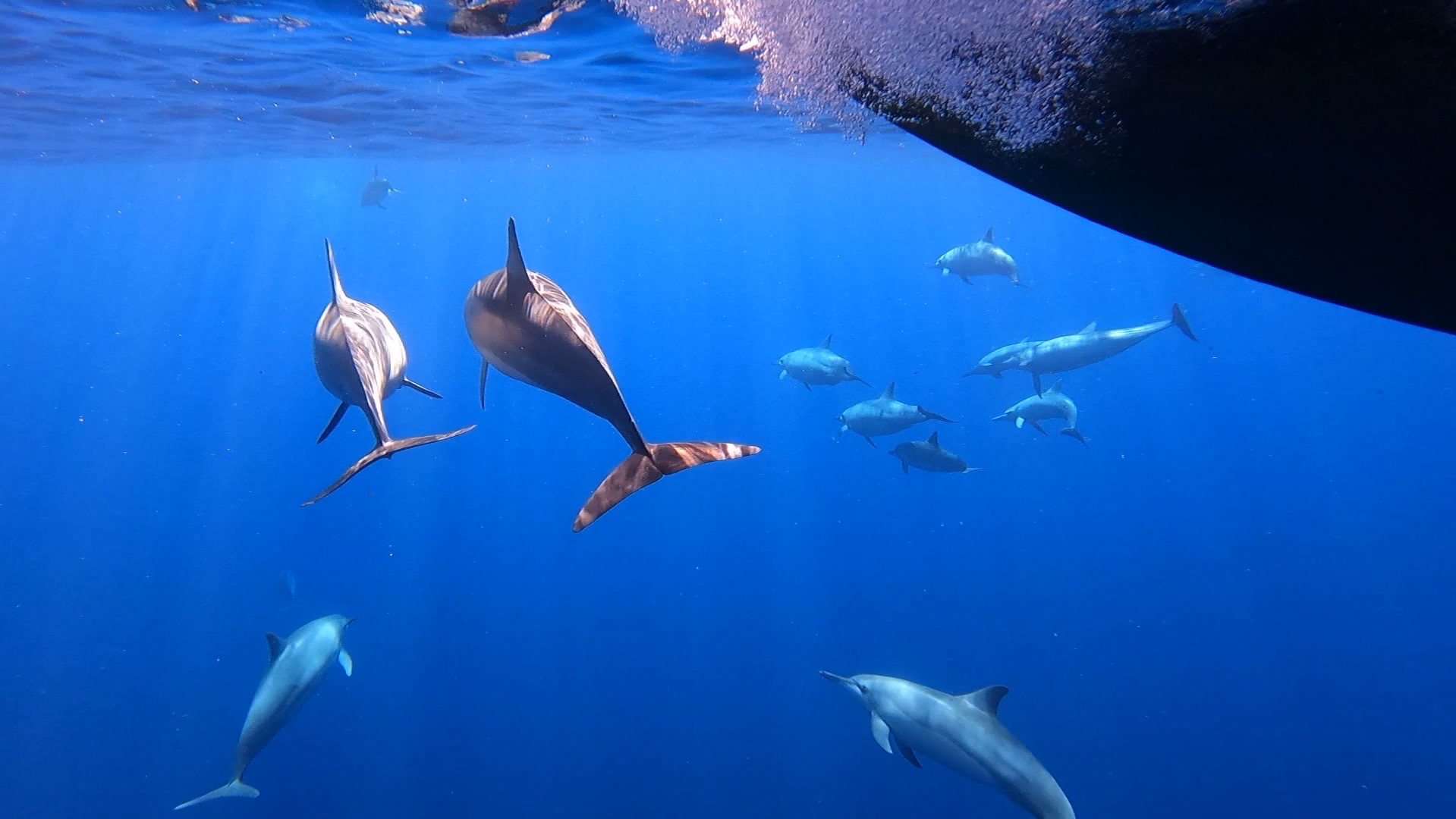
“Hawaiian spinner dolphins rest during the day in the islands’ coastal waters where they are susceptible to human disturbance,” reports McElligott. She notes that spinner dolphins are nocturnal and hunt in offshore waters at night. During the day, they use areas close to shore to socialize, nurture their young, shelter from predators, and rest in preparation for nightly hunting.

The goal of McElligott’s research is to help wildlife managers determine the best ways to protect spinner dolphins from human disturbance.

McElligott’s research was one of the studies examined by NOAA Fisheries leading up to their new rule finalized on September 28, 2021  that prohibits swimming with, approaching, or remaining within 50 yards of a Hawaiian spinner dolphin. The rule applies to any vessel, person, or object (including all boats, canoes, stand-up paddleboards, drones, or any other means) that is within 2 nautical miles from shore in the main Hawaiian Islands and in designated waters bounded by the islands of Lāna‘i, Maui, and Kahoʻolawe. This final rule will officially be in effect on October 28, 2021, 30 days after it was published in the Federal Register. Learn more about this new law and its exceptions at https://www.fisheries.noaa.gov/feature-story/new-regulation-protects-hawaiian-spinner-dolphins-against-disturbance.

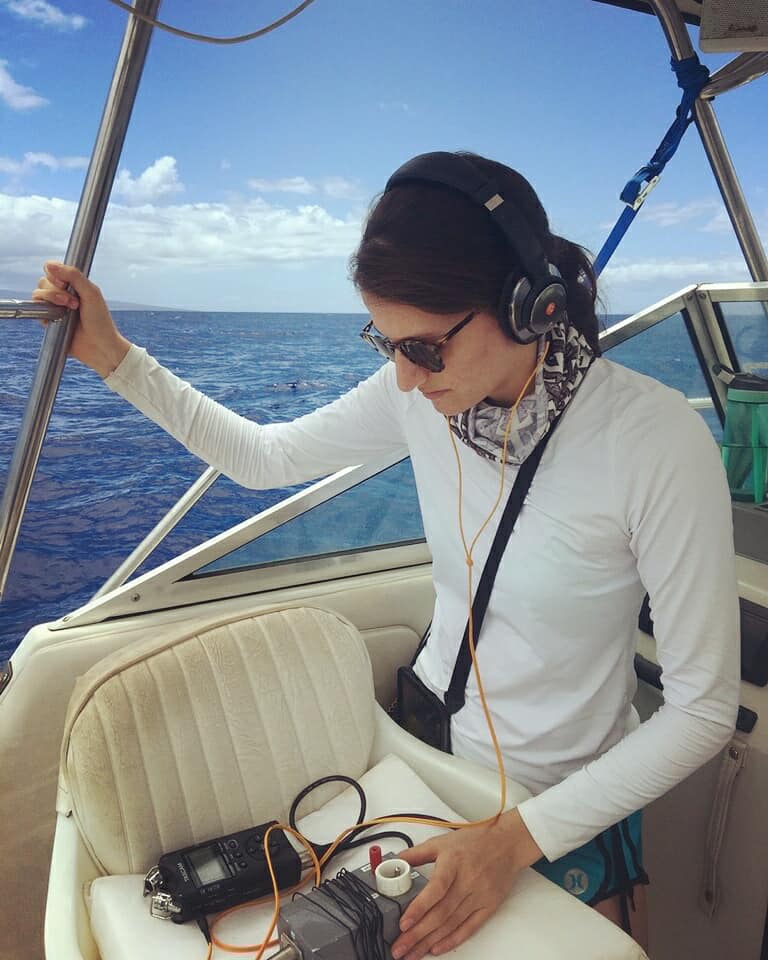
McElligott’s study was conducted using a combination of passive acoustic monitoring and vessel surveys to document spinner dolphin occurrence and movements. Bottom-moored acoustic recorders were deployed at eight locations in Maui Nui, and at one previously established resting bay off west O‘ahu for comparison. The amount of whistles, clicks, and burst pulses at each location was quantified and averaged by the hour of the day.

“What we observed in Maui Nui is different from what we see off Oʻahu and Hawaiʻi island,” says McElligott. “I will also talk about what we aim to investigate with our current data collection efforts in Mānele, Hulopoʻe, and Honolua.”

To learn more this species’ behavior and McElligott’s research, tune in to Maui Nui Marine Resource Council’s “Know Your Ocean Speaker Series” on Oct. 12 at 5:30 p.m. via Zoom.
These monthly virtual events are supported by the County of Maui Mayor’s Office of Economic Development.|

The event’s emcee will be Darla Palmer-Ellingson, local radio show host of the public affairs program, Island Environment 360 Maui’s only commercially broadcast public affairs show on environmental and related Hawaiian cultural topics, aired on the stations of H-Hawaii Media.

NOAA Fisheries is also proposing to establish time-area closures to reduce disturbance in five nearshore areas designated as essential daytime habitats for spinner dolphins. This regulation would prohibit entering restricted areas between 6 a.m. and 3 p.m. daily in parts of Kealakekua, Hōnaunau, Kauhakō (Ho‘okena), and Makako Bays on Hawai‘i Island, and La Perouse Bay on Maui.

Since this is a proposed rule, a decision on whether to finalize the rule will not happen until after the public has an opportunity to comment. The public comment period for the proposed time-area closures will be open until December 27, 2021, 90 days after publication in the Federal Register. To learn more, visit https://www.fisheries.noaa.gov/action/proposed-rule-establish-time-area-closures-hawaiian-spinner-dolphins-essential-habitats-main

Reserve your spot for this presentation.


Free Presentation “Saving a Species: “Rehabilitation as a Conservation Tool for Hawaiian Monk Seals” Offered on Weds., Aug. 4

in , /by

Hawaiian monk seals are endangered, with fewer than 1,400 animals left on earth — yet they have recently been in the news, as videos and photos have surfaced showing the seals falling victim to harassment by visitors who get too close or attempt to touch them, sometimes for social media content. Learn more about Hawaiian monk seals at a free presentation called “Saving a Species: Rehabilitation as a Conservation Tool for Hawaiian Monk Seals” on Wednesday, August 4 at 5:30 pm HST via Zoom where two special guests from The Marine Mammal Center’s dedicated hospital for monk seals, Ke Kai Ola, on Hawai’i Island will highlight their conservation and outreach work.

The Center’s Lauren Van Heukelem, Response and Operations Coordinator, and Dr. Sophie Whoriskey, Hawaiian Monk Seal Conservation Veterinarian, will speak at this event, part of the “Know Your Ocean Speaker Series” which is hosted every month by Maui Nui Marine Resource Council.

Researchers estimate that about 30 percent of Hawaiian monk seals are alive today due to conservation efforts led by the National Oceanic and Atmospheric Administration (NOAA) and partners like the Center. The mission of The Marine Mammal Center focuses on global ocean conservation through rescue and rehabilitation, scientific research, and education.

Reserve a spot at the free presentation by visiting https://www.bitly.com/monksealwebinar

“We are hosting this special presentation with the awareness that public education is needed to help protect our Hawaiian monk seals from harassment or injury,” says Anne Rillero, Communications Manager at Maui Nui Marine Resource Council. “These animals are among the most endangered seals on earth.”

Dr. Whoriskey received her bachelor’s degree from Dalhousie University in Nova Scotia, Canada, and her veterinary medical degree from the Atlantic Veterinary College. She first came to The Marine Mammal Center in 2015 as the intern veterinarian in marine mammal medicine and pathology where she spent two years training with marine mammal medicine experts.

In 2020, she returned to the Center as a full-time Hawaiian Monk Seal Conservation Veterinarian. She leads the Center’s Hawaiʻi animal care operations, dedicated to the rehabilitation, conservation and research of the endangered Hawaiian monk seal.

Whoriskey has extensive field experience in remote and harsh environments and has participated in research projects from Alaska to Antarctica, all with a mission of advancing the global body of knowledge on marine mammal health.

Born and raised in Hawaiʻi, Van Heukelem received both her bachelor’s and master’s degrees from the University of Hawaiʻi at Mānoa in Marine Biology. She has participated in many research studies both in Hawaiʻi and the Northern Mariana Islands on various topics.

As the Response and Operations Coordinator, Van Heukelem oversees the monitoring of the endangered Hawaiian monk seal population on Hawaiʻi Island. She runs the Center’s 24-hour hotline for reporting seal sightings around the island and coordinates outreach and population assessments on a daily basis.

“On Hawai’i Island, we operate Ke Kai Ola, the only hospital dedicated to Hawaiian monk seals, providing support for monk seals found throughout the Hawaii archipelago,” says Van Heukelem. “Utilizing a 24-hour response hotline and a variety of education and outreach programs, we aim to advance conservation practices that empower our local community to protect this rare species.”

This presentation will focus on the center’s mission and work over the past 45 years in California and Hawaiʻi. Since opening Ke Kai Ola in 2014, The Marine Mammal Center has treated 36 Hawaiian monk seals and supports the work of NOAA’s Hawaiian Monk Seal Research Program by providing the only long-term care facility for this endangered animal.

These monthly virtual events are supported by the County of Maui Mayor’s Office of Economic Development.

The event’s emcee will be Darla Palmer-Ellingson, local radio show host of the public affairs program, Island Environment 360 Maui’s only commercially broadcast public affairs show on environmental and related Hawaiian cultural topics, aired on the stations of H-Hawaii Media.

To reserve your spot at this free Zoom webinar, please visit https://www.bitly.com/monksealwebinar


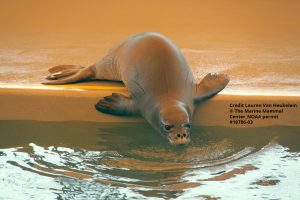
Eleu (PP08), a weaned female Hawaiian monk seal pup rescued from Papahānaumokuākea Marine National Monument Refuge, rests during rehabilitation at The Marine Mammal Center’s Ke Kai Ola hospital and visitor center in Kailua-Kona, HI. The young female seal’s name means one that is active, alert, energetic, lively and nimble. Credit Lauren Van Heukelem © The Marine Mammal Center, NOAA Permit #18786-03


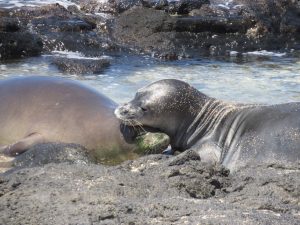
Hawaiian monk seals RK26 (on left) and RL50 (on right) rest on a beach. As the world’s largest marine mammal hospital, The Marine Mammal Center actively monitors endangered monk seals that frequent Big Island beaches to check on their condition, but its experts do not serve in a law enforcement capacity. Credit Sheila Latta © The Marine Mammal Center

The Maui News: Maui has the highest number of tiger sharks, attacks in state

in /by

Not only does Maui have the highest number of tiger sharks in the state, the area also sees the most shark attacks, according to local scientists who have tracked and studied Hawaii sharks for decades.

Shark bite frequency by island from 1995 to 2021 shows that Maui outpaces any other Hawaiian island with about 40 nonfatal bites and five fatal bites, research from the Hawaii Institute of Marine Biology shows. Oahu is second with slightly more than 20 nonfatal bites. Hawaii island is third with about 15 nonfatal bites.

Despite shark attacks off Maui in November, December and February, shark expert Kim Holland said he and colleagues are surprised that there aren’t more attacks, given how many tiger sharks are actually in the water.

“One of the things that has to come across in this conversation: The amazing thing to me and my colleagues is not how many shark attacks there are in Hawaii, it’s how few shark attacks there are in Hawaii,” he said. “If you think of how many tens of thousands of person hours of ocean users there are in the water and how common we know large sharks are, the fact that we have two (attacks per year) to five (attacks) to zero to eight to two to four to zero attacks per year is really astounding.”

Read more

Free July 7 Zoom Presentation by Dr. Craig Downs and Hawaii Senator Mike Gabbard: “Education vs. Enforcement: Next Steps Beyond the Enactment of Hawaii’s Sunscreen Law”

in /by

KIHEI, HI— Hawaii’s ban on sunscreens containing the reef-harming chemicals oxybenzone and octinoxate went into effect on January 1, but is the law effective in protecting our local coral reefs and marine animals as intended? Is the ban being enforced? What’s the latest scientific evidence about the chemicals that are replacing these two ingredients in some brands of sunscreen? Are new laws needed?

Get the answers to these important questions on Wednesday, July 7 at 5:30 p.m. via a free Zoom presentation featuring special guest speakers: Dr. Craig Downs, whose groundbreaking research educated the world about sunscreen chemicals and their role in coral reef decline; and Hawaii Senator Mike Gabbard, who authored the legislation that resulted in Hawaii’s ban on the sale of sunscreens that contain the chemicals oxybenzone and octinoxate.

The presentation titled “Education vs. Enforcement: Next Steps Beyond the Enactment of Hawaii’s Sunscreen Law” is sponsored by the County of Maui Mayor’s Office of Economic Development and hosted by Maui Nui Marine Resource Council as part of the organization’s “Know Your Ocean Speaker Series.”

This event is free, but advanced reservations are required. To reserve your spot, please visit https://bit.ly/SunscreenWebinar.

Downs graduated from Hiram College with a B.A. in philosophy and biology, received his M.Sc. from Syracuse University, and received his Ph.D. from the University of Hawaii in cell and molecular biology. He has published over 50 scientific papers and a number of book chapters in scientific textbooks, and is the co-editor of the CRC press veterinary book, Diseases of Corals, as well as founded a number of companies and nonprofits relating anywhere from animal welfare to environmental conservation and exploration.

Downs has held positions as research professor at University of Hawaii’s School of Medicine and Sweet Briar College. He is currently an invited professor at Sorbonne University (France) and is the Executive Director of Haereticus Environmental Laboratory, a non-profit scientific organization dedicated to increasing the scientific, social and economic knowledge of natural environmental habitats in order to better conserve and restore threatened environmental habitats and resources.

Gabbard, who has represented District 20 since 2006, which includes Kapolei, Makakilo, and portions of Kalaeloa, Waipahu, and Ewa, has authored 54 bills that became law relating to energy efficiency, renewable energy, endangered species protection, industrial hemp, the environment, public safety, and more.

One of those bills that became law in 2018, SB 2571, is the ban of sale or distribution in the state of any sunscreen that contains oxybenzone or octinoxate, or both. Last session, Gabbard introduced SB 366, which would ban the sale, offer of sale, or distribution in Hawaii of any sunscreen that contains two more chemicals, avobenzone or octocrylene.

The speakers plan to address whether or not sunscreen pollution is a symptom of unsustainable tourism and coastal development, how we get visitors and residents to comply with the new sunscreen law, and who is responsible for enforcing it.

This panel will also provide information and tips on how you can help to protect the marine environment.

Maui Nui Marine Resource Council’s “Know Your Ocean Speaker Series” events are held monthly via Zoom. Support for these events is provided by the County of Maui Mayor’s Office of Economic Development.

The virtual event’s emcee will be Darla Palmer-Ellingson, local radio show host of the public affairs program, Island Environment 360 Maui’s only commercially broadcast public affairs show on environmental and related Hawaiian cultural topics, aired on the stations of H-Hawaii Media.

To reserve your spot at this free Zoom webinar, please visit https://bit.ly/SunscreenWebinar.

Free Presentation on “Growing Up Fast: A Land-Based Coral Nursery for Restoring Hawaii’s Reefs” Offered During Earth Week

in /by


KIHEI, HI— In honor of Earth Day and Earth Week, the public is invited to a free presentation on “Growing Up Fast: A Land-Based Coral Nursery for Restoring Hawaii’s Reefs” on Zoom on Wednesday, April 21 at 5:30 pm.

The presenter will be coral specialist Christina Jayne of the Dept. of Land and Natural Resources Division of Aquatic Resources Hawaii Coral Restoration Nursery. The talk is hosted by Maui Nui Marine Resource Council, as part of its monthly “Know Your Ocean Speaker Series.”

Coral reef restoration is the process of raising new corals — often from fragments of coral salvaged from the wild — in a protected, nurturing environment, then transplanting them out into the ocean to grow and form new reefs. When combined with efforts to improve coral reef habitat, it is viewed as a way to help coral reefs survive the stresses of climate change and warming ocean waters.

For the past two years, Jayne has worked for the Dept. of Land and Natural Resources Division of Aquatic Resources as a coral restoration specialist at the Hawaii Coral Restoration Nursery on Oahu with director David Gulko. Before moving to Honolulu, she earned her bachelor’s in Marine Biology from the University of California San Diego and her masters from Scripps Institution of Oceanography at UC San Diego.“Hawaii’s reefs are extremely unique and Hawaiian corals have some of the slowest growth rates in the world, which is why the State has taken an innovative, land-based approach to coral restoration,” notes Jayne.
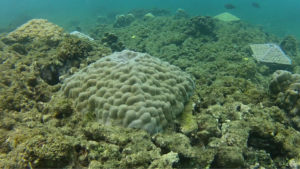
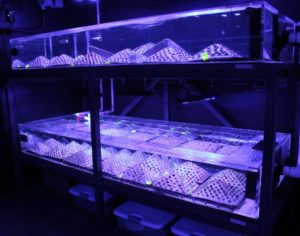
Hawaii’s first state coral nursery, which is managed by DAR, opened in 2016 at the Anuenue Fisheries Research Center on Oahu.

Corals are brought to the Coral Restoration Nursery and are rapidly grown using a series of aquarium-based techniques that help them to generate large coral colony modules in a fraction of the time it would take naturally, which can be out-planted back on the reef.

The nursery typically uses corals for out-planting from harbors because of their lower ecological value compared to corals from natural areas, says DAR, and they may also be more resilient to any challenges and environmental changes.

University of Hawaii Sea Grant researchers are also conducting experiments at the Anuenue facility to understand different environmental conditions, like light and water movement, that are useful for growing corals quickly. Creating the best environment for the corals to grow rapidly will help to restore local reefs after disturbance events such as bleaching or physical damage.

Maui Nui Marine Resource Council’s “Know Your Ocean Speaker Series” events are held monthly via Zoom. Support for these events is provided by the County of Maui Mayor’s Office of Economic Development.

The virtual event’s emcee will be Darla Palmer-Ellingson, local radio show host of the public affairs program, Island Environment 360 Maui’s only commercially broadcast public affairs show on environmental and related Hawaiian cultural topics, aired on the stations of H-Hawaii Media.

To reserve your spot at this free Zoom webinar, please visit https://bit.ly/coralnurserywebinar


PacIOOS Water Quality Sensor Partnership Program Enhances Maui Nui Marine Resource Council’s Water Quality Monitoring in Māʻalaea Harbor

in /by


MĀʻALAEA, HI – Maui Nui Marine Resource Council’s ocean water quality monitoring efforts in Māʻalaea Harbor are being helped by a new underwater data sensor that the organization has borrowed through the Pacific Islands Ocean Observing System (PacIOOS) Water Quality Sensor Partnership Program. The new data sensor collects data every five minutes on water temperature, salinity, turbidity, chlorophyll and ocean depth.

The PacIOOS program supports scientists and natural resource managers to collect water quality data in order to inform research, conservation, planning, and resource management projects in the U.S. Pacific Islands region. The data sensor is owned and maintained by PacIOOS under the supervision of Dr. Margaret McManus, Chairwoman of the Department of Oceanography at the University of Hawai‘i at Mānoa.

“We are grateful to PacIOOS for the use of this data sensor that will help us learn more about the effects of tides, swell, rain events, and runoff on water quality within Māʻalaea Harbor and to monitor water quality variability over time,” reports Amy Hodges, Programs and Operations Manager at Maui Nui Marine Resource Council.

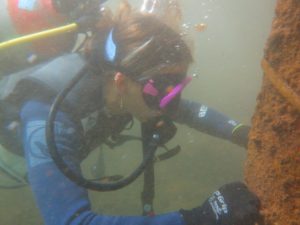
Mounted 1 or 2 meters below the ocean’s surface, the sensor package is relocated by divers from Maui Nui Marine Resource team to a new site within the harbor about once per month. The sensor package was installed in 2020 and is scheduled to be used in Māʻalaea Harbor through 2021.

The PacIOOS data sensor will help guide Maui Nui Marine Resource Council as it implements its watershed management plan, which aims to reduce sediment and pollutants in Māʻalaea Bay and its harbor. Professor Margaret McManus

“In recent decades, declining ocean water quality has led to significant deterioration of Māʻalaea Bay’s reefs,” says Hodges. “Monitoring by the community-based program Hui O Ka Wai Ola — which was co-founded and is co-managed by Maui Nui Marine Resource Council, The Nature Conservancy and West Maui Ridge to Reef Initiative —  using ocean water samples grabbed from the ocean edge has shown turbidity (sediment) and excessive nitrogen as primary causes of impaired water quality.”

Maui Nui Marine Resource Council’s staff also assist with gathering ocean water quality “grab samples” from the shore. All combined, the Hui O Ka Wai Ola sampling and the MNMRC staff grab sampling results in data from 5-10 sites every three weeks in Māʻalaea Harbor.

Maui Nui Marine Resource Council has also been using a Manta data sonde, purchased with a grant from LUSH cosmetics, to gather water quality data in the Harbor. The sonde is towed behind a kayak and records real time data as it is pulled through varying depths through the water.

The organization has also been testing the nitrogen isotope ratios (δ15N values) in macroalgae (limu) tissue to determine the possible sources of nitrogen pollution in the harbor and the bay. Other ongoing testing in Māʻalaea Bay conducted by MNMRC includes current drift analysis studies, underwater coral cover and fish transects, and stormwater sampling.

To address Māʻalaea’s sediment issues, MNMRC is working to improve stormwater management in the 4,000 acre Pohakea watershed adjoining Mā‘alaea Bay. In 2018, MNMRC commissioned Maui Environmental Consulting (MEC) to create the Pohakea Stormwater Management Plan following meetings with Hawai‘i Division of Forestry and Wildlife (DOFAW), Māʻalaea Village Association, Maui Ocean Center and other stakeholders.

MNMRC has been enacting the priorities in this plan. In 2020, MNMRC installed firebreaks in Pohakea watershed to suppress frequent wildfires that occur in this windy, dry region, causing loss of vegetative cover that helps hold soil in place and prevents erosion. Partners included DOFAW, Maui Electric Co. and Goodfellow Bros. Inc.

MNMRC and Maui Environmental Consulting began monitoring headcuts (erosional features) in 2020 to quantify soil loss at four of the most severely eroded sites in the Pohakea watershed nearest the harbor. Their monitoring showed a loss of an estimated 64,050 pounds, or 32 tons, of soil from just two head cut locations in a single moderate rainstorm in January 2021. The lost soil was likely transported via culverts directly into the ocean, contributing to a severe brown water event in Māʻalaea Bay.  MNMRC is now working to obtain funding to work with Maui Environmental Consulting and Goodfellow Bros. to repair two of the most severe head cut locations to reduce the sediment runoff.

Maui Nui Marine Resource Council launched an oyster bioremediation project in Māʻalaea Bay in 2020 to utilize caged oysters as a natural method of water filtration. A single oyster can filter up to 50 gallons of ocean water per day, removing sediment and pollutants. During 2020, MNMRC installed more than 10,000 oysters and conducts periodic monitoring to assess their growth rates and health. Data from the PacIOOS data sensor will help measure changing ocean water quality conditions in response to the oyster program.

“The progress of our projects to clean up Māʻalaea Bay’s water quality will be measured by resulting data from the PacIOOS data sensor and our other monitoring methods,” says Hodges. “We to see evidence of improved ocean water quality, through reductions in sediment and excess nitrogen, an essential step in restoring coral cover and reef health in Māʻalaea Harbor and in the bay.”

To learn more about the PacIOOS Water Quality Sensor Partnership Program and view data, visit https://www.pacioos.hawaii.edu/water/sensor-maalaea/#about.

Founded in 2007, Maui Nui Marine Resource Council is a nonprofit 501(c)(3) organization working for clean ocean water, healthy coral reefs and abundant native fish for the islands of Maui County. To learn more, visit www.mauireefs.org.


CAPTION: Maui Nui Marine Resource Council’s Grace Silver helps to prepare a site in Mā’alaea Harbor for the data sensor on loan from PacIOOS.