Posts

Maui Now: Ocean water testing begins off Lahaina

in /by

Preliminary water testing in the nearshore waters off Lahaina is showing that physical parameters, like temperature, PH, salinity, and dissolved oxygen, are currently in normal ranges.

Russell Sparks, an aquatic biologist with the DLNR Division of Aquatic Resources, said, “We have ongoing concerns that pollutants from the fire will make their way into the ocean at some of the drainage outfalls or from storm drains. For years we’ve done regular monitoring, but now we’re including testing from the fire zone. We’ll be sending samples off to… (Read More).

West Maui Water Quality Lab Destroyed in Lahaina Wildfire

in /by

This past week’s events have left us all reeling as our community suffered an entirely unexpected and devastating blow after wildfires swept through and destroyed the West Maui town of Lahaina.  As we come up for air and try to assess the next steps, we are grateful that, while none of our West Maui volunteers or employees lost their lives in this tragedy, no one in this close-knit community is unaffected by the effects of the Lahaina Wildfire.  Among the structural losses from these fires was our water quality lab, used by the Hui O Ka Wai Ola to analyze coastal water quality samples from West Maui.

As we look to the future, our volunteers are determined to continue their water quality testing. We’ve transferred spare equipment from our South Maui lab and one of our volunteers is temporarily housing a makeshift lab in their home. While we have always appreciated the dedication of our Hui members to their mission, we are looking for permanent housing for the lab and working to raise the ~$20,000 that will be needed to replace the equipment and supplies that were destroyed.

We are coordinating with our partner organizations in the non-profit and local government sectors to see how we should extend our water quality sampling to understand how the new pollutants of concern will affect our nearshore waters. While new tests will be useful, the importance of the Hui’s six-year baseline cannot be understated. The Hui’s data provides a multi-year baseline that will allow us to understand how and where water quality changes as a result of the Lahaina Wildfire.

If you are moved and able to support our efforts to, please consider donating to help us rebuild the Hui’s water quality lab with a tax-deductible donation:  https://www.mauireefs.org/lahaina-wqlab/

Maui’s Community-Based Ocean Water Quality Monitoring Program Celebrates 100th Sampling Session

in /by

Maui’s volunteer-based ocean water quality monitoring program Hui O Ka Wai Ola celebrated a special milestone on February 8, 2022: its 100th sampling session since the program began on Maui in 2016.

A beachside ceremony held this morning at Hanakaʻōʻō Beach Park in Kāʻanapali was organized by Maui Nui Marine Resource Council, West Maui Ridge to Reef Initiative and The Nature Conservancy, the three organizations that co-founded and co-manage this unique community program. It was attended by about 40 Maui residents, program volunteers and local VIPs including State Representative Tina Wildberger, Maui County Councilmember Tamara Paltin, and Maui County Managing Director Sandy Baz, who each delivered remarks and congratulations to the volunteers and staff.

A sampling session occurs over a week’s time and typically involves about a dozen volunteers, who wake up before sunrise and fan out in groups of three or four with cars packed with water quality monitoring equipment to gather and test ocean water samples along Maui’s leeward coast.

Sampling sessions take place every three weeks. Each sampling session in West Maui covers 16 sites stretching from Pāpalaua Pali to Honolua. Each South Maui sampling session covers 13 sites from Mā’alaea to ‘Āhihi Kīna’u.

Todayʻs celebration included awarding of gift certificates donated by Duke’s Maui to the volunteers in the program, plus a ceremonial gathering of ocean water samples by long-time volunteers Kit Harris and George Burnette. It was followed by a demonstration of how the water samples are tested for sediment, temperature, pH and other factors conducted by Harris, Burnette, Representative Wildberger and Councilmember Paltin with narration by Hui O Ka Wai Ola Senior Team Lead Tiarra Stark.

Representative Wildberger had a special connection to today’s event: she had volunteered with the Hui O Ka Wai Ola monitoring program  to collect and test ocean water samples in South Maui before being elected as the District 11 Representative for Kihei, Wailea and Makena.

For Councilmember Paltin, the 100th sampling event also held special significance. She, along with then-West Maui resident Dana Reed, helped provide the spark that led to the creation of the community-based ocean water quality monitoring program after the pair observed an unusual increase in brown water events at DT Fleming Beach in 2013-2014.

“Large brown plumes started appearing at DT Fleming, even without much rainfall, which led to beach closures,” noted Reed, who is a retired electrical engineer and now lives in Pennsylvania. “One day I saw another brown plume and said, ‘That’s it! I have to investigate!’.”

Reed had learned how to test ocean water for turbidity at a UH Maui course taught by Donna Brown. She grabbed the sampling bottles she had received at the course and started gathering samples. It was then that she met Paltin, who was a lifeguard at the time. Paltin shared that she too was concerned about the brown water plumes and had photographed them and sent them to Watson Okubo, the Director of the Department of Health Clean Water Branch. Their sampling data wasn’t accepted because they did not have a Quality Assurance Project Plan (QAPP) in place to ensure the integrity of the data.

Undaunted, Reed and Paltin started documenting the water quality at DT Fleming on a regular basis, gathering data from water samples and photos, including aerial photos that Reed’s husband Bill Rathfon obtained with his drone.

Reed said that Paltin would sound the alert – “the stream is running brown!” – and Reed would rush over to grab water quality samples. Paltin also kept sampling bottles at her lifeguard station so she could gather samples during her breaks.

Paltin was a member of the Marine Nui Marine Resource Council Clean Water Committee and together with Reed and Rathfon presented data and pictures from DT Fleming to the group.

Someone who had hiked upslope to understand where the sediment runoff was originating reported that a site that was being prepared for the development of Mahana Estates appeared to be the cause of the runoff.

The project manager from Mahana Estates was invited to meet with Marine Resource Council’s clean water committee and visit the site. She reported that the developer had put up sediment fences and barriers to control the runoff but was having trouble keeping them in place because they kept breaking.

The Department of Public Works said that the developer was following the County’s Best Management Practices (BMPs) and asked for baseline data to compare the current water quality issues at DT Fleming to past years when the problem wasn’t occurring.

That data didn’t exist. But Paltin, Reed, Rathfon and Maui Nui Marine Resource Council persisted in spotlighting the problem  – and ultimately a County engineer, Department of Health representative and the developer visited the site and saw the source of the sediment.

The result was a County-mandated shutdown of the project for more than a year and improvement of the County’s BMPs.

“From that experience, I saw the importance of water quality data – including the need for baseline data – at all of our Maui beaches,” said Reed, who attended the ceremony remotely from her home in Pennsylvania. “At that time, the Department of Health Clean Water Branch had only one person sampling water quality for all of Maui. They suggested that we create a citizen’s monitoring group.”

Maui Nui Marine Resource Council and The Nature Conservancy joined together to host Carl Berg, a research scientist who has worked on water quality issues on Kauai, to learn how to create a community-based water quality monitoring program here.

He told the groups that they needed to create a Quality Assured Project Plan (QAPP) that would meet EPA requirements and State Department of Health standards for projects that involve the collection and analysis of water samples.

This led to a meeting with the Department of Health, Environmental Protection Agency, NOAA, Maui Nui Marine Resource Council, The Nature Conservancy, West Maui Ridge to Reef Initiative and other community environmental groups to discuss creating a water quality monitoring program for Maui.

The result was the launch of Hui O Ka Wai Ola (the “association of living waters”) to be managed through a partnership of Maui Nui Marine Resource Council, The Nature Conservancy and West Maui Ridge to Reef Initiative.

Maui Nui Marine Resource Council agreed to serve as the fiscal sponsor of the program and oversee its finances and payroll.  A grant from National Fish & Wildlife Foundation obtained by The Nature Conservancy helped fund paid positions for Reed and Kim Falinski to create the program in West Maui and purchase water sampling equipment. A second grant from National Fish & Wildlife Foundation later obtained by Maui Nui Marine Resource Council made it possible to expand the program to South Maui.

The QAPP was created over a two-year period by Reed, Falinski and Scott Lerner of The Nature Conservancy. The Department of Health Clean Water Branch signed off on the QAPP and the first official samples of the new Hui O Ka Wai Ola program were collected in June of 2016.

Volunteers signed on to receive the needed training and commit to the early morning sampling sessions. “People didn’t join for fun. They joined because they cared,” said Reed. “I am amazed at how many good quality people we got, who stuck with it. People are so dedicated. I am so impressed.”

At each sampling site, one of the volunteers wades into knee deep water and fills several containers with sea water. The citizen-scientists use portable lab equipment to analyze the samples for pH, dissolved oxygen concentration, salinity and turbidity. The water quality samples are transferred to indoor labs for additional testing. Further testing for nutrients is performed on samples that are frozen and shipped to the labs at the University of Hawaii at Manoa.

Today, the Hui O Ka Wai Ola program manages data collected at 40 leeward sites, which has been provided to the Department of Health Clean Water Branch, to be included in reports to the EPA and State and County agencies. New data is currently being gathered at 29 shoreline locations in West and South Maui.

Dozens of volunteers have worked with the program since its inception, including Hawaii State Representative Tina Wildberger and Maui resident Kit Harris. The program has four part time staff: Senior Team Lead Tiara Stark and Team Leads Meredith Beeson, Mitch Brown and Nalei Sampson. Retired biophysicist Cathy Maxwell is the organization’s Technical Advisor and Bill Rathfon is the Data Manager. Hui O Ka Wai Ola is led by a steering committee of representatives of the three partner organizations, along with Dana Reed and Kim Falinski, who are the Quality Assurance advisors.

The Hawaiian Islands Humpback Whale National Marine Sanctuary, Lahainaluna High School, Da Hawaiian Store and Pineapple Properties LLC have provided free space to the group for its indoor laboratories. The County of Maui has provided funding, along with local companies, foundations and groups including National Fish & Wildlife Foundation, Duke’s Maui, Makana Aloha Foundation, Napili Bay and Beach Foundation, MediaThe Foundation, EACH Foundation, North Beach West Maui Benefit Fund,  Maui Ocean Center, Hawaii Tourism, LUSH, Hawaii Community Foundation’s CHANGE grant and individual donors.
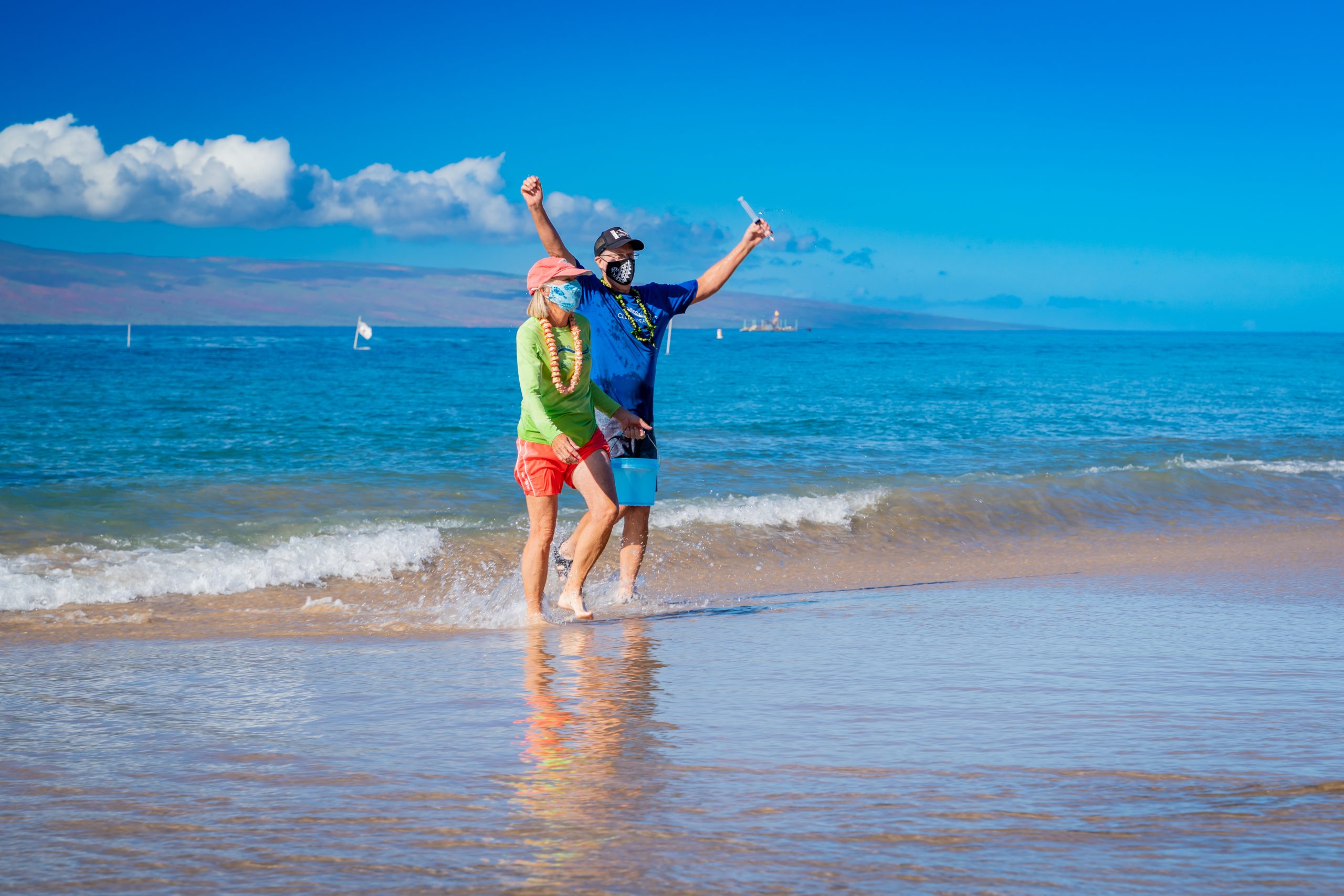
Longtime volunteers George Burnette and Kit Harris carry water samples for testing from the ocean at Hanakaʻōʻō Beach Park in Kāʻanapali.

Photo by Ty Freiberg
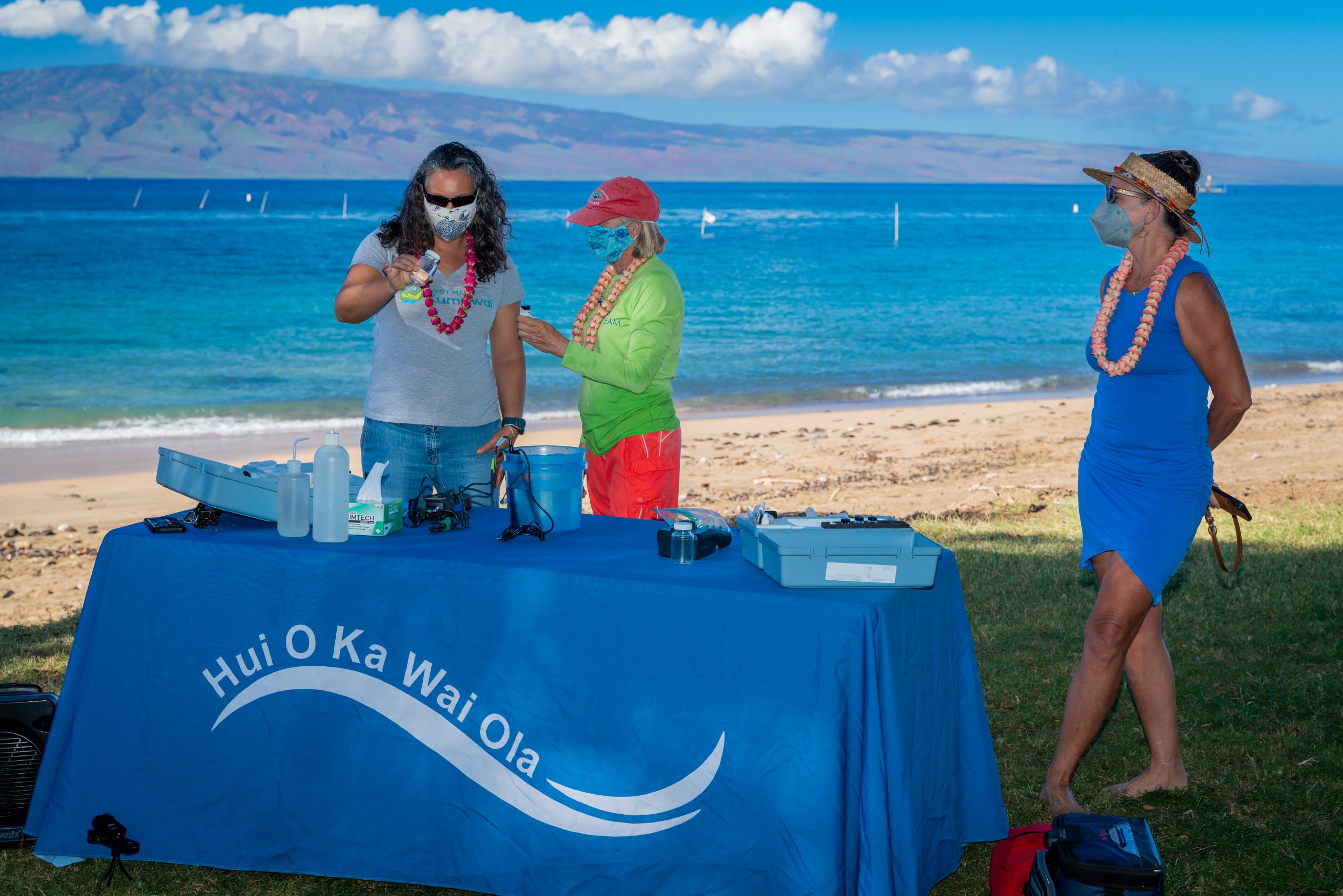
Maui County Councilmember Tamara Paltin and volunteer Kit Harris test a water sample while Hawaii Representative (and a former Hui O Ka Wai Ola volunteer) Tina Wildberger looks on.

Photo by Ty Freiberg
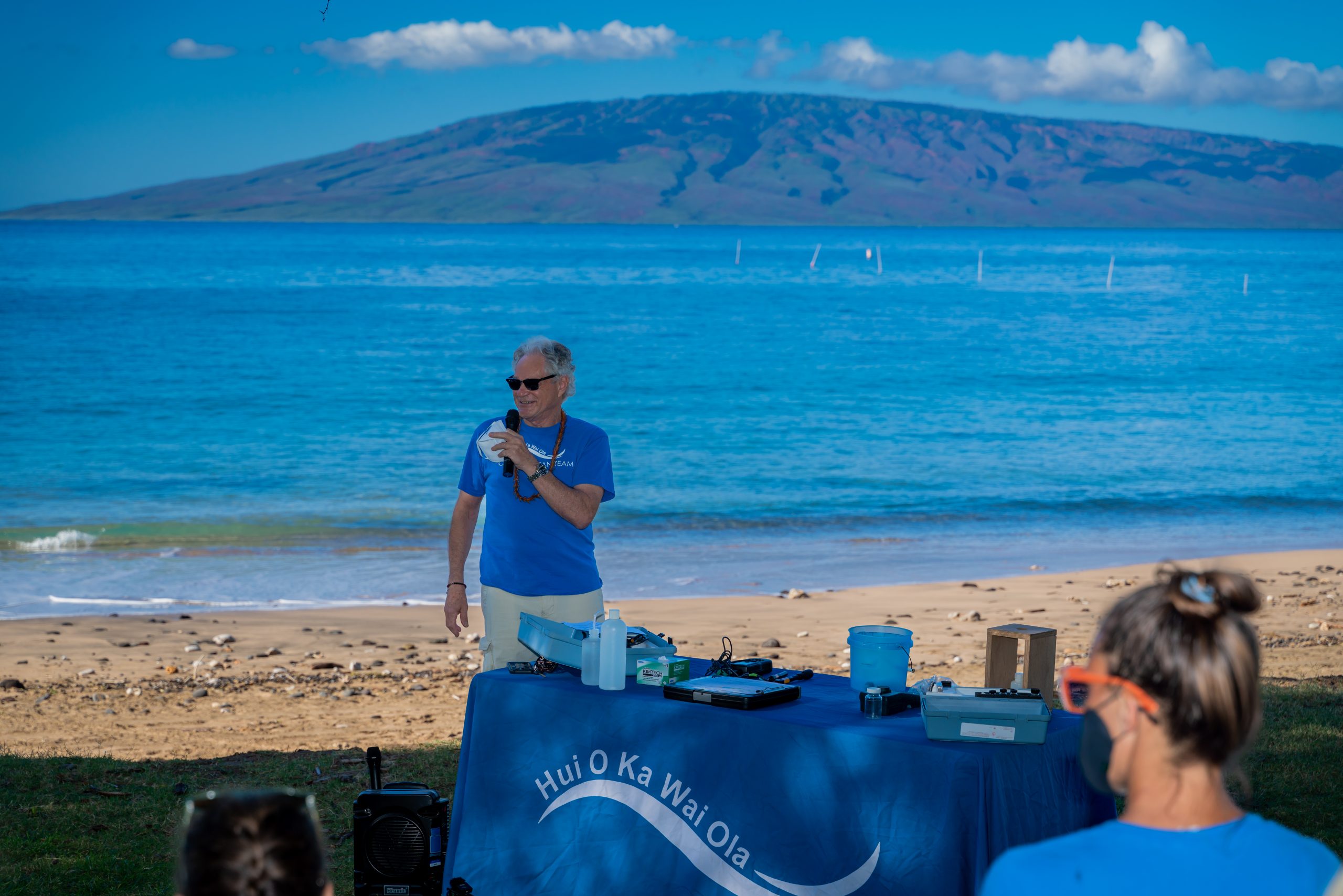
Maui Nui Marine Resource Council Executive Director Mike Fogarty thanks the volunteers and announces a special gift for each one donated from Duke’s Maui.

Photo by Ty Freiberg
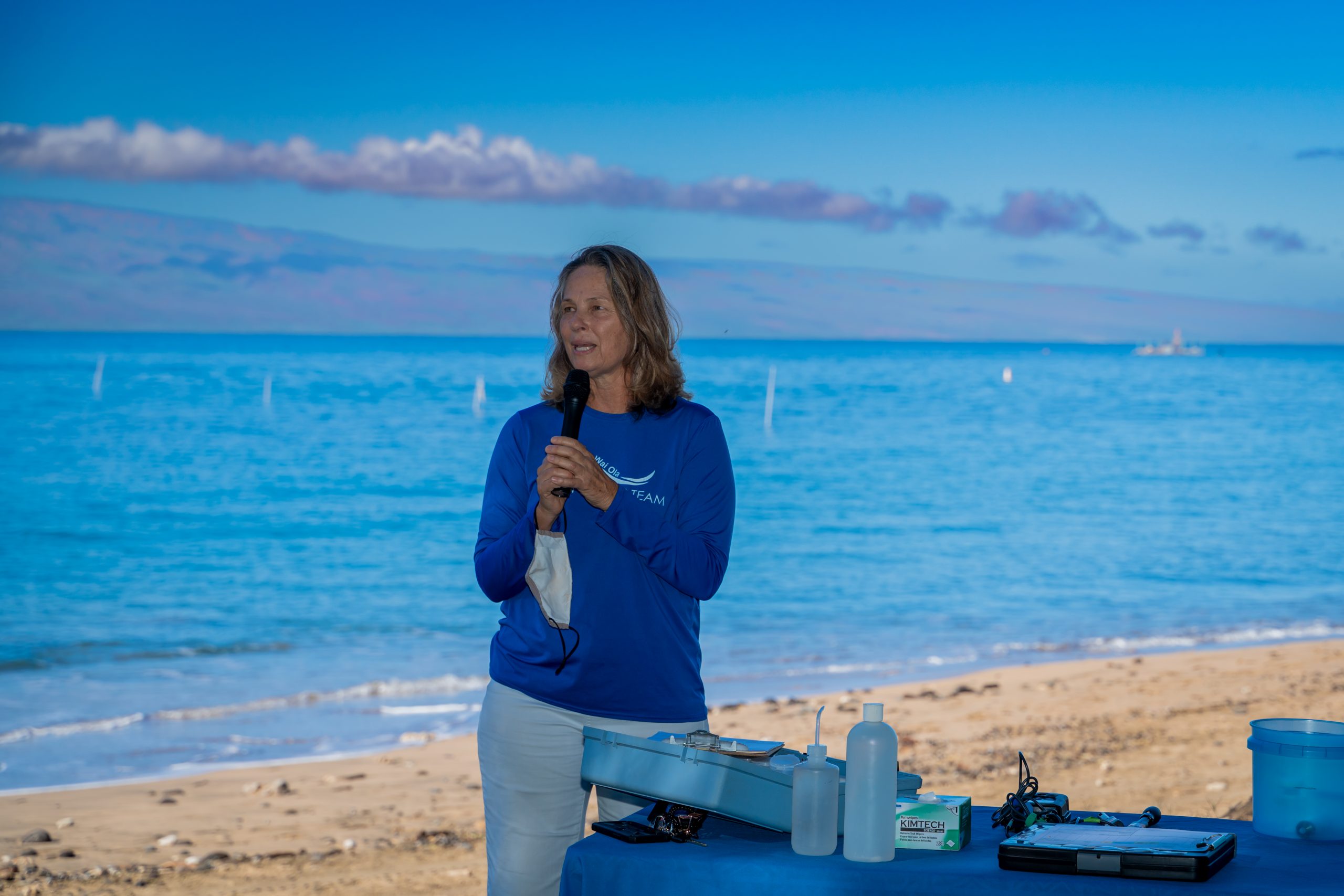
Emily Fielding, Maui Marine Program Manager at The Nature Conservancy, speaks about the partnership between The Nature Conservancy, Maui Nui Marine Resource Council and West Maui Ridge to Reef Initiative that co-founded and co-manages the Hui O Ka Wai Ola ocean water quality monitoring program.

Photo by Ty Freiberg

 

Hui O Ka Wai Ola Ocean Water Quality Testing Program Expands Again – Now Testing 48 Maui Sites

1 Comment/in /by

The volunteer-based Hui O Ka Wai Ola ocean water quality testing program has expanded again, with the addition of 12 more testing sites in South Maui in early March 2018.  With this expansion, the program is now covering 48 shoreline locations where trained volunteers routinely test water quality on Maui every 2 to 3 weeks.

The Hui O Ka Wai Ola program, whose name means “Association of the Living Waters,” is the first community-based water quality monitoring to measure for nutrients (including nitrogen and phosphorus), along with turbidity, salinity, dissolved oxygen, pH and temperature in Maui’s coastal waters.

The program first launched in June 2016 in West Maui with 17 sites. One West Maui site was added in February 2017 (Napili Bay), and 6 additional West Maui sites were added in June 2017.

The program expanded to include a dozen new test sites in South Maui in November 2017. The latest expansion in 2018 added another 12 South Maui sites. In all, the group of volunteers are testing 48 sites on Maui.

A Partnership at Work
The program is made possible through the volunteers’ efforts and a joint partnership of Maui Nui Marine Resource Council, The Nature Conservancy, West Maui Ridge to Reef Initiative and the State of Hawaii Department of Health. Financial support for the program is provided by the partners, along with the County of Maui Office of Economic Development, National Fish and Wildlife Foundation, North Beach West Maui Benefit Fund, Napili Bay and Beach Foundation, Pride of Maui, Maui Ocean Center and individual donors and supporters

“Our goal is to support the State of Hawaii Department of Health and Maui County efforts to improve coastal water quality so that coral reefs and native fish populations thrive, and our residents and visitors are safe,” said Robin Newbold, co-founder and chairwoman of the Maui Nui Marine Resource Council. “We want to help identify problem areas, so remedial action may be taken as needed.”

Trained Volunteers and a Quality Assurance Plan
To prepare for the expansion in March, a group of ten new volunteers completed intensive training in the classroom, in the lab and in the field. The volunteers work under the guidance of experienced team leaders and regional coordinators. The sampling follows strict guidelines set under a Quality Assurance plan approved by the Department of Health. A QA officer reviews the data before it is submitted.

The volunteers bring equipment to the field for onsite testing; they also freeze and ship water samples to the SOEST (UH School of Ocean and Earth Science and Technology) laboratory on Oahu for additional analysis.

Poor Water Quality Undermines the Health of our Reefs
Hui O Ka Wai Ola’s program tests water samples for nutrients, such as nitrogen and phosphorous compounds, which can indicate pollution from wastewater and runoff from agriculture, landscaping and golf courses. High nutrient content in the water can cause an increase in growth of invasive algae, which could damage coral reefs.

In addition, research has shown that sustained, nutrient rich, lower pH submarine groundwater discharging onto nearshore coral reefs off West Maui lowers the pH of seawater and exposes corals to nitrate concentrations 50 times higher than normal. Rates of coral calcification — the rate at which coral polyps produce calcium carbonate which forms the hard structure of the reef — are substantially decreased. As a result, the reef degrades faster and the reef ecosystem is more likely to collapse.

“With many of Maui’s coral reefs in significant decline, it is critical that we reduce stressors to our reefs on a local scale as quickly as possible,” notes Tova Callender, coordinator supporting the West Maui Ridge to Reef Initiative. “Our water quality studies will help us understand the source of pollutants, which is the first step in addressing the stress to the reefs caused by impaired water quality and will hopefully make our reefs more resilient to climate change.“

Data provided by Hui O Ka Wai Ola will be used to supplement Health Department water quality monitoring on Maui and can be viewed on the group’s website, www.huiokawaiola.com.

A State of Hawaii Department of Health employee tests water quality for enterococcus bacteria, a marker for potentially harmful bacteria in the water, The additional nutrient data provided by Hui O Ka Wai Ola provides an enhanced view of changing water quality conditions that can harm coral reefs and humans.

Community Support Sought
The cost of testing for each site is about $3,800 per year, which includes analysis and the shipping of samples to Oahu. Maui Nui Marine Resource Center is asking companies, canoe clubs, community organizations and individuals to each sponsor a site with a $3,800 donation. To donate, visit https://www.mauireefs.org/membership-and-giving/adopt-a-beach/

The goal of Hui O Ka Wai Ola is to bring more awareness to local coastal water quality issues and support better-informed decisions and policies regarding water quality.

To learn more, visit HuiOKaWaiOla.com.

Unique Community Based Water Quality Testing Program Expands to South Maui

in /by

KIHEI, HI – November 2, 2017 — How clean is the water at your favorite South Maui beach? Starting November 7, a volunteer-based water quality testing program known as Hui O Ka Wai Ola (Association of the Living Waters), will be expanding to test 12 South Maui shoreline locations every two weeks for six months, then every three weeks thereafter. The project will eventually be expanded to test a total of 24 South Maui locations.

The Hui O Ka Wai Ola water quality-testing project is the result of a partnership with Maui Nui Marine Resource Council (MNMRC), The Nature Conservancy, West Maui Ridge to Reef (R2R) Initiative, and University of Hawaii Maui College, working with the State of Hawaii Department of Health (DOH).

“Hui O Ka Wai Ola is the first community-based water quality monitoring program in the state that periodically measures turbidity (a measure of water clarity), and nutrients (such as nitrogen and phosphorous) in near shore ocean waters and makes their data available to the public,” said Dr. Kim Falinski, Marine Science Advisor at The Nature Conservancy.

“Our goal is to support the Department of Health and Maui County efforts to improve coastal water quality so that coral reefs and native fish populations thrive, and our residents and visitors are safe,” said Robin Newbold, Co-founder and Chair of Maui Nui Marine Resource Council.“We want to help identify problem areas, so remedial action may be taken as needed.”

An expansion of Hui O Ka Wai Ola’s West Maui testing
The Hui O Ka Wai Ola water quality testing program began in West Maui in June of 2016, and has been operating and expanding ever since.

“Volunteers and their team leaders currently test a total of 24 West Maui shoreline locations from the Pali to Honolua Bay,” reported Newbold.

“Starting November 7, Hui O Ka Wai Ola water quality testing will be expanded to include 12 sites in South Maui,” said Emily Fielding, The Nature Conservancy’s Maui Marine Program Manager. “Eventually, this will be expanded to 24 South Maui sites.”

The locations of the new South Maui testing sites will be finalized in the next few weeks after they are evaluated for accessibility by the volunteers and other factors. Sites under consideration include ‘Ahihi Kina’u Nature Reserve, Makena Beach State Park, Maluaka Beach, Oneuli (Black Sand Beach), Makena Landing, Kamaole Beach I and III, Kalama Park Beach, Cove Park and Waipuilani Beach.

Powered by volunteers
“A citizen science program like ours would not be possible without an amazing team of volunteers. They are the backbone of Hui O Ka Wai Ola,” noted Sofia de la Sota, South Maui Regional Coordinator and Team Leader.

“More than 20 volunteers have signed up to work at the 12 new South Maui sites. They have completed intensive training and are ready to start water quality testing,” reported de la Sota.

“The volunteers will collect water quality samples according to strict Department of Health (DOH) standards set forth in the Hui’s Quality Assured Program Plan every two weeks for the first six months, then every three weeks after that,” said de la Sota. “They will be testing several water quality parameters in the field: turbidity, salinity, dissolved oxygen, pH and temperature. During every collection period, the volunteers will also collect samples which will be frozen and shipped to the SOEST laboratory on Oahu for nutrient analysis.”

The program will test for nutrients such as nitrogen and phosphorous compounds, which can indicate pollution from wastewater, run-off from agriculture, landscaping and/or golf courses. Too many nutrients in the water can cause an increase in invasive algae (limu), which is damaging to coral reefs. The resulting data will be used to supplement DOH water quality monitoring on Maui and can be viewed at the Hui O Ka Wai Ola website.

“The data resulting from the Hui O Ka Wai Ola program will support the work of Department of Health employee Meghan Dailer, who tests for Enterococcus bacteria,” said de la Sota.

“Due to budget constraints, Dailer is the only Department of Health employee testing water quality for all of Maui,” said Dana Reed, West Maui Regional Coordinator for the Hui O Ka Wai Ola program. “By supplementing her bacteria testing efforts with our nutrient testing, we can better keep a close eye on changing water quality conditions that can harm our coral reefs and human health. We are happy to support DOH and Maui County with this added testing.”

Monitoring the impacts of development and wastewater
“Some of our possible testing sites in South Maui are slated for expanded shoreline development, such as at Maluaka Beach in Makena,” reported de la Sota. “Cove Park, at the center of the wastewater plume coming from the Kihei Wastewater Reclamation Facility, has been flagged for high nutrient levels and turbidity.”

“If we see an issue with increased turbidity or pollution at these sites, we can sound an early warning to initiate measures to address the run-off and pollution as quickly as possible,” noted de la Sota.

In addition to following a regular testing schedule for each of the sites, the program will eventually allow for additional testing during brown water events.

“It is our hope that frequently collecting water quality data will allow for more effective management practices.” said Emily Fielding.

Future funding sought
 
Testing at 18 of the West Maui sites of the Hui O Ka Wai Ola program is currently funded by North Beach West Maui Benefit Fund; testing at the remaining six West Maui sites is currently funded by Napili Bay and Beach Foundation, as well as National Fish and Wildlife Foundation.

“This expansion to South Maui is made possible with generous support from the National Fish and Wildlife Foundation, Maui County Office of Economic Development and community donors,” said Amy Hodges, Programs and Operations Coordinator at MNMRC. “Funding for the laboratory and field equipment and initial start-up costs were provided by National Fish and Wildlife Foundation. The Hawaiian Island Humpback Whale National Marine Sanctuary (NMS) is providing space for storing the water testing equipment.”

The cost of testing at each location is about $3,600 per site per year, which includes analysis and shipping of nutrient samples to the lab on Oahu. Currently, there is funding to continue testing at the South Maui sites for 15 months.

The three nonprofits that lead the project — Maui Nui Marine Resource Council (MNMRC), The Nature Conservancy and West Maui Ridge to Reef Initiative — rely upon public donations and local grants to finance their work.

“We hope that the public will support this valuable effort with donations on behalf of their favorite beaches in South and West Maui,” said Newbold. “We all want clean ocean water, healthy reefs and thriving local fish populations. This project is one way to help achieve these goals.”

“In addition to the millions of dollars in revenue directly and indirectly coming from coral reefs in Hawaii, we have to think of their ecological, cultural and recreational value. If we want future generations to benefit from Hawaii’s marine resources, we must act now to protect this valuable ecosystem,” said Newbold.

To learn more about Hui O Ka Wai Ola and ways you can donate or volunteer, visit www.huiokawaiola.com. You can also look at data that the Hui has collected on this website, and even download the data for yourself.

About Maui Nui Marine Resource Council
A local community-based nonprofit 501(c)(3) organization now celebrating our 10th anniversary, Maui Nui Marine Resource Council is dedicated to restoring clean ocean water, healthy coral reefs and native fish to near shore waters throughout Maui County. We bring the community together to collaborate, learn, work and advocate on behalf of Maui’s coral reef ecosystems. To learn more, visit mauireefs.org.


About West Maui Ridge to Reef (R2R) Initiative

West Maui Ridge to Reef (R2R) Initiative is an all-encompassing approach across multiple agencies and organizations to address adverse impacts to coral reefs in West Maui. The goal of the R2R Initiative is to restore and enhance the health and resiliency of West Maui coral reefs and near-shore waters through the reduction of land-based pollution threats from the summit of Pu`u Kukui to the outer reef.

About The Nature Conservancy

The Nature Conservancy is a global conservation organization dedicated to conserving the lands and waters on which all life depends. Guided by science, we create innovative, on-the-ground solutions to our world’s toughest challenges so that nature and people can thrive together. We are tackling climate change, conserving lands, waters and oceans at an unprecedented scale, providing food and water sustainably and helping make cities more sustainable. Working in 72 countries, we use a collaborative approach that engages local communities, governments, the private sector, and other partners. To learn more, visit www.nature.org or follow @nature_press on Twitter.

###