Posts

Public Invited to “Talk Story with Maui Nui Marine Resource Council” on Wednesday, December 1 at 5:30 pm

in /by

KIHEI, HI — 10,000 oysters cleaning the water in Māʻalaea Harbor. Hundreds of ocean water quality samples gathered and analyzed. Three new solar-powered monitoring buoys providing data for scientists worldwide. A major new grant to help prevent coastal flooding in Kihei. Education programs to help visitors protect Mauiʻs reefs as they enjoy our island’s beaches. And much more. 

The public is invited to learn about the many projects underway at Maui Nui Marine Resource Council during a “Talk Story” evening with their staff on Wed. Dec. 1 from 5:30 to 6:30 pm on Zoom.

During the evening, attendees will learn about ways that this Maui-based nonprofit is working for healthy coral reefs, clean ocean water and a sustainable population of native fish for the islands of Maui County. Questions and suggestions will be welcomed, and door prizes will be awarded.

“We’re looking forward to sharing the latest news and developments at Maui Nui Marine Resource Council at this annual event,” said Mike Fogarty, Executive Director. “It’s been a very busy year for our staff, resulting in some exciting progress in our work to protect Maui’s reefs and nearshore waters.”

The evening will include details about an initiative to promote reef-friendly landscaping in South Maui, new technology that’s being used to identify ocean water quality issues along Maui’s coasts, and steps taken during 2021 to prevent ocean pollution caused by wildfires, feral axis deer, and marine debris transported into the ocean from Maui streams and gulches.

“We guarantee you’ll learn a lot about coral reef protection and why it is so important to the future of our island,” noted Amy Hodges, Programs and Operations Manager at Maui Nui Marine Resource Council. “And in turn, we want to hear from our community, to learn about your ideas and suggestions for protecting Maui’s coastal waters.”

Due to Covid-19, this annual event will once again be held by Zoom. Preregistration is required. To sign up, visit https://bit.ly/MNMRCUpdates.

Public invited to free Zoom presentation about unique collaboration of 7 environmental projects funded by Maui CARES

in /by

Program provided employment for more than 70 Maui and Molokai residents

“It’s like Maui County’s own version of the Civilian Conservation Corps”

KIHEI, HI – During the Great Depression, the government-sponsored Civilian Conservation Corps (CCC) provided paychecks for 3 million unemployed young men and provided valuable labor for conservation projects across the country.

With unemployment at record levels due to COVID-19, a new program followed this historical CCC model and put more than 70 Maui and Molokai residents to work in November, providing seven local conservation nonprofits with needed labor to benefit coral reefs, cultural resources and the environment.

The public is invited to a free presentation on Weds. January 27 at 5:30 pm on Zoom to learn about this unique collaborative employment and workforce training program and the impact it had on our local environment. The presentation will include videos, photos and firsthand accounts of the projects and accomplishments, with information on how the projects incorporated traditional Hawaiian cultural practices and modern technology to prevent sediment pollution in the ocean and protect valuable cultural resources.

It’s free, but registration is required. To sign up, visit https://bit.ly/mauiCARES

This unique collaborative employment and workforce training program was made possible through the County of Maui Office of Economic Development’s Maui CARES program, which was funded by the Federal CARES Act. As the fiscal sponsor, Maui Nui Marine Resource Council oversaw the administration of the Maui CARES funding for the projects and managed the rapid employment of more than 70 new hires with the help of simplicityHR by ALTRES.

The workers participated in conservation and restoration projects in Olowalu, Waihe’e, Keanae, Kipahulu, Hana and Moloka’i. All of the projects were rooted in Hawaiian cultural practices and values which serve as the foundation of our community. Their work was filmed by Inflatable Film of Kula. The evening will include video premieres exclusively for webinar attendees.

“Through this presentation, attendees will be immersed in a virtual experience to feel the importance of Kuleana, ʻOhana, Kōkua, Aloha ʻAina, Mālama ʻAina, and Hānai ʻAina, said Ekolu Lindsey, President of Maui Cultural Lands and a principal organizer of this program. “Be inspired to follow in the footsteps of those who have come before us, as we share our legacies with you.”

The participating nonprofits include:

Ka Honua Momona on Molokai worked to restore two ancient fishponds, which will help trap sediment before it reaches the open ocean – with the benefit of also producing fish for local people.

Kipahulu ‘Ohana in East Maui improved a lo’i, or wetland taro farm. The taro plants will slow the flow of stormwater, allowing time for sediment in the water to settle, rather than flow out to sea.

Hawaiian Islands Land Trust in Waihe’e worked to remove invasive species along approximately 3,000 linear feet of Kalepa Stream to lower sediment loads in the nearshore waters off Waihe’e and protect offshore corals.

Ke Ao Hali‘i (KAH) in Hana worked on 27 acres of publicly owned land at Mokae/Kaholaiki and another ~2 acres of contiguous land, directly above Hamoa Beach. Their project included invasive plant removal and native habitat restoration for seabirds and insects, and a biological survey of ‘opihi as a baseline for a possible ‘opihi rest area in the future.

Kipuka Olowalu in West Maui reestablished washed out and damaged lo’i (taro fields), rebuilt vanished lo’i and prepared lo’i for planting in the Olowalu Cultural Reserve. Workers removed overgrowth, fire hazards and invasive plants; planted native plants and crops and repaired infrasturcture.

Na Moku ‘Aupuni O Ko‘olau Hui in East Maui worked on watershed management and stream maintenance, as well as stream and ditch monitoring in the East Maui Irrigation system to establish accurate data for stream and ditch flow and loss as a basis for making sound future management decisions related to this resource and delivery infrastructure.

Each of the nonprofits will be presenting their work and accomplishments through photos, video and stories from the field.

Na Mamo o Mu‘olea in East Maui focused on land and shoreline management on a county parcel (which Nā Mamo O Mū’olea has a 50 year lease). It included removal of invasive plants around a rock wall that is on the historic registry, and preparation for wall restorations, maintenance of two heiau on the property, installation of new fencing around an area designated for native trees and medicinal plants, and maintenance and repair of feral animal controls.

“This presentation is a celebration of all that was accomplished and learned,” said Lindsey. “We encourage the public to attend to connect with these organizations and the workers who put heart and soul into these challenging and impactful projects.“

The emcees for this event are Ekolu Lindsey and Darla Palmer-Ellingson, local radio show host of the public affairs program, Island Environment 360 Maui’s only commercially broadcast public affairs show on environmental and related Hawaiian cultural topics, aired on the stations of H-Hawaii Media.

About Maui Nui Marine Resource Council

Maui Nui Marine Resource Council is a community-based nonprofit organization celebrating 13 years of working for healthy coral reefs, clean ocean water and abundant native fish throughout Maui County. Our work includes co-managing the Hui O Ka Wai Ola Ocean Water Quality Monitoring Program in South and West Maui, efforts to reduce pollution in Mā‘alaea Bay (through erosion-control efforts in the Pohakea watershed and using oysters to filter sediment and pollutants from ocean water), coral reef research, visitor education programs and more. Learn more at www.mauireefs.org.

How the 2015 bleaching event impacted Maui’s corals

in /by

Maui Nui Marine Resource Council was honored to host a presentation by Russell Sparks, Aquatic Biologist, State of Hawaii’s Department of Aquatic Resources ( Department of Land and Natural Resources) at our March 2018 meeting.

Sparks presented reports on the toll of the 2015 coral bleaching event that occurred in Hawai’i and worldwide due to El Nino conditions.

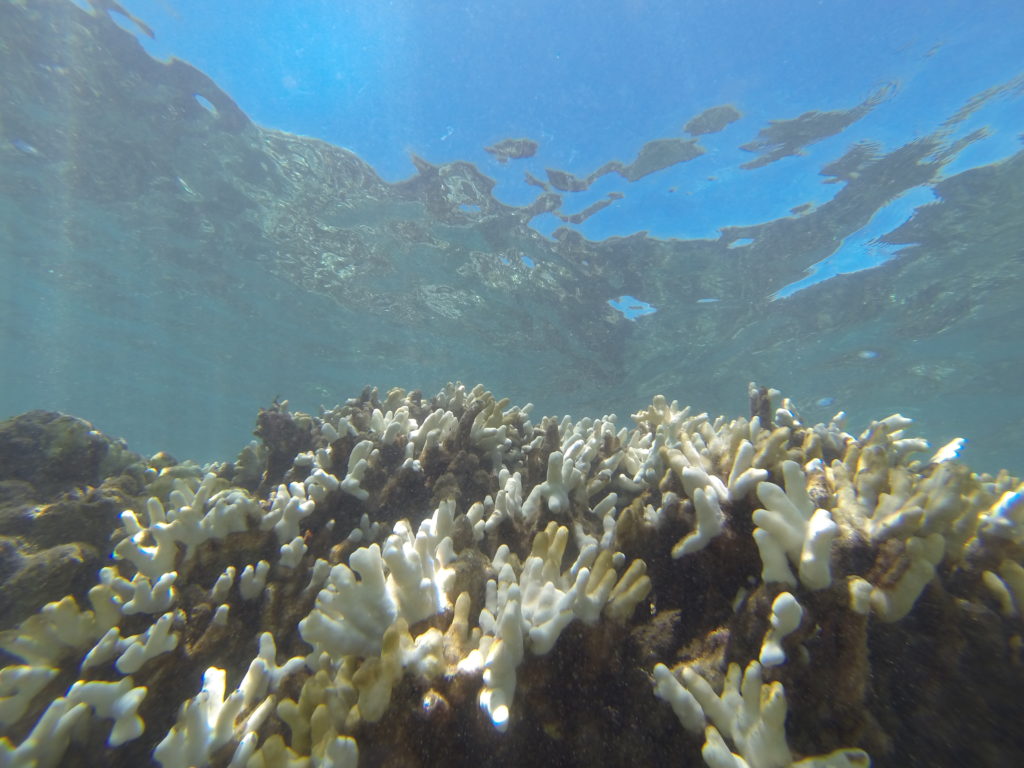
Sheltered from cooling breezes and waves, Maui’s leeward shores saw especially warm ocean conditions in 2015 and bleaching events were widespread. That summer, biologists watched in horror as a massive 400 year old coral nicknamed “Big Mama” succumbed to bleaching and perished in November of 2015.

DCIM100GOPRO

Sparks noted that almost all of the cauliflower coral off Maui’s coasts bleached. Lobe coral suffered the most impacts of bleaching and bleaching-related deaths. Smaller colonies of corals had higher rates of mortality, while bigger colonies showed more fragmentation during the bleaching event.

Biologists noted that some reefs did not die, and are striving to learn why they showed greater resistance.

Following this event, marine biologists have noted that there’s been a shift toward smaller sized coral colonies across the leeward nearshore areas of Maui.

In order for corals to adapt and survive into the future with the ongoing global warming concerns, we all need to do more to help reefs develop resiliency to these changes.  Corals can survive and adapt if we reduce local threats such as overfishing, sedimentation and nutrient pollution.  Support local efforts to address these man made local threats and coral reefs should better adjust to the warming world oceans.

Learn more about why corals bleach. 

Please follow this link to learn more about MNMRC’s work for clean ocean water to give our corals the best environment possible for survival.

Aquatic Biologist Russell Sparks of Hawaii Department of Aquatic Resources to be Guest Speaker at March Meeting of Maui Nui Marine Resource Council

in , /by

A free presentation offering updates on the State of Hawaii’s management of Maui’s nearshore fisheries and coral reef resources will be featured at the Wednesday, March 7 meeting of the nonprofit Maui Nui Marine Resource Council. The talk will be presented by guest speaker Russell Sparks, Aquatic Biologist of State of Hawaii, Department of Land and Natural Resources, Division of Aquatic Resources. Sparksʻ presentation will also include an update on the status of Mauiʻs reefs following the bleaching event of 2015.

The meeting will take place from 5 to 7 pm at Pacific Whale Foundation’s Discovery Center Classrooms at Ma’alaea Harbor Shops at 300 Ma’alaea Rd, Wailuku (next to Maui Ocean Center). The talk is free and everyone is invited. Refreshments will be served. 

Maui Nui Marine Resource Council (MNMRC) is a Maui-based nonprofit working for healthy coral reefs, clean ocean water and the restoration of abundant native fish in the nearshore waters of the islands of Maui County. 

At the March 7 meeting, MNMRC staff will be offering updates on their recent and ongoing projects, including the expansion of a volunteer-based water quality monitoring program to include 48 sites in South and West Maui and a study of corals off Olowalu. 

Sparks received his B.S. in Biology from Oregon State University. He received his M.S. in Marine Biology from University of Hawaii at Manoa in 1996. Since 1998 Russell has worked for the State of Hawaii, Department of Land and Natural Resources, Division of Aquatic Resources as an education specialist and more recently as an aquatic biologist. He is currently responsible for leading the design, implementation, and overall management of the Maui marine monitoring program, and for working with stakeholders and communities to develop marine management programs aimed at adaptively managing nearshore fisheries and coral reef resources.

To learn more, visit www.mauireefs.org.