Posts

Maui Nui Marine Resource Council’s work to prevent sediment runoff to begin in Pohakea watershed

in /by

MĀʻALAEA, HI – As part of  ongoing work to improve ocean water quality in Māʻalaea Bay, Nui Marine Resource Council is working in partnership with Goodfellow Bros. in the Pohakea watershed to do maintenance on a steep existing dirt road, to prevent it from eroding and sending sediment into the ocean — and to allow it to serve as a firebreak to suppress wildfires in this fire-prone region.

A firebreak is a gap in vegetation or other combustible material that acts as a barrier to slow or stop the progress of a wildfire. Firebreaks are strategically located to ultimately reduce the size, intensity, and impact of wildfires. In this case, the work focuses on restoring firebreak functionality to an existing access road,  including the reestablishment of waterbars and stormwater erosion control measures. The creation of firebreaks will help reduce the impact of wildfires which strip the vegetative cover from the land and lead to erosion during stormwater events.

Additional work planned by Maui Nui Marine Resource Council includes  routine vegetation maintenance along the edges of the dirt road to keep fire fuel load low, to improve its ability to serve as a firebreak.

The work will begin on Wednesday, Monday, December 14 and will continue through December. The Pohakea watershed is a 5,268 acre area with the majority located mauka of the Honoapiʻilani Highway across from the Mā‘alaea Triangle. The grant-funded firebreak installations will take place on both private and publicly owned land (State of Hawai‘i Land Division) with approval and cooperation from the landowners and the State. The planning for this work was done in collaboration with the State of Hawai‘i DLNR’s Division of Forestry and Wildlife (DOFAW) as part of a larger conservation management strategy for the watershed.

Wildfire suppression was listed as a high priority in the “Pohakea Watershed Stormwater Management Plan,” an action plan for reducing sediment runoff into Māʻalaea Bay authored by Maui Environmental Consulting and commissioned by Maui Nui Marine Resource Council. Past wildfires in the Pohakea watershed have been a health and safety issue for the community and have caused the loss of vegetative covering in the watershed, leading to soil erosion during heavy rains.

“We are very pleased to work with the professional team of Goodfellow Bros. of Maui to install these firebreaks,” said Mike Fogarty, Acting Executive Director at Maui Nui Marine Resource Council. “The Goodfellow Bros. team will be following established best management practices (BMPs) to install the firebreaks with the least impact to the surrounding area. And of course, all State and County COVID-19 guidelines for outdoor work of this type will be strictly adhered to by all who are working on this project.”

This project is supported by funding from the National Fish and Wildlife Foundation, Hawai‘i Tourism through the Aloha ‘Āina Program, and the County of Maui Office of Economic Development. Local funding from individuals, businesses, resorts and foundations have also helped to make this work possible.

After the firebreaks are installed, Maui Nui Marine Resource Council will be working with volunteers to plant vetiver, a non-invasive, deep rooted, clump grass used in tropical climates, along with native dry-land species, to stabilize hillsides and stop erosion.

“The work to reduce sediment runoff from the Pohakea watershed is tied to our vision of cleaner ocean water for Māʻalaea Bay,” says Amy Hodges, Programs and Operations Manager at Maui Nui Marine Resource Council. “It’s a multi-pronged approach that also includes installations of caged oysters in the bay to remove sediment and other pollutants from the water.”

“Our goal is to create an environment where the coral reefs of Māʻalaea Bay can thrive and thus help protect the shoreline of Māʻalaea from storm surge and big waves,” says Hodges. “We also want clean ocean water for the people who use this bay for recreation.”

Hodges notes that Māʻalaea Bay is home to two canoe clubs, several popular local beaches and a much-frequented fishing area. Māʻalaea Harbor is a launching place for private and commercial ocean tours, and is famous for its “Freight Trains” surf break. Sea turtles feed outside the harbor, and visiting Hawaiian monk seals, hammerhead sharks, sea turtles and a variety of fish are not uncommon.

To learn more about this project, please visit www.mauireefs.org.

Funding for our work in Pohakea is provided by:
National Fish and Wildlife Foundation
Hawaiʻi Tourism through the Aloha ʻĀina program
County of Maui Mayor’s Office of Economic Development

Please note: The views and conclusions contained in this document are those of the authors and should not be interpreted as representing the opinions or policies of the U.S. Government or the National Fish and Wildlife Foundation and its funding sources. Mention of trade names or commercial products does not constitute their endorsement by the U.S. Government, or the National Fish and Wildlife Foundation or its funding sources.


About Maui Nui Marine Resource Council:

Maui Nui Marine Resource Council is a community-based nonprofit organization celebrating 13 years of working for healthy coral reefs, clean ocean water and abundant native fish throughout Maui County. Our work includes co-managing the Hui O Ka Wai Ola Ocean Water Quality Monitoring Program in South and West Maui, efforts to reduce pollution in Mā‘alaea Bay (through erosion-control efforts in the Pohakea watershed and using oysters to filter sediment and pollutants from ocean water), coral reef research, visitor education programs and more. Learn more at www.mauireefs.org.

About Goodfellow Bros.:
Established in 1921, Goodfellow Bros. (GBI) is a fourth-generation family-owned heavy-civil contractor with headquarters in Hawaii and Washington and more than 99 years of experience in the construction industry. For nearly a century, GBI has transformed regions across North America and abroad. With 12 offices in Washington, Oregon, California and Hawaii, GBI’s range of projects include: airports, bridges, reservoirs and dams, golf courses, harbors, highways, housing developments, marinas, parks, underground utilities construction services, wastewater treatment facilities, wind and solar farms, fisheries, wildlife habitats and more. To learn more, visit: www.goodfellowbros.com

Maui Nui Marine Resource Council Wins $3,000 Award in Hogan/American Savings Bank Nonprofit Business Plan Competition

in /by

MĀ‘ALAEA, HI – The nonprofit Maui Nui Marine Resource Council (MNMRC) was awarded a $3,000 prize in the 2020 Hogan/American Savings Bank Nonprofit Business Plan Competition for a business plan titled, “Vision for Pohakea.”

“The goal of our Vision for Pohakea plan is to reduce sediment and pollutants in Māʻalaea Bay and Māʻalaea Harbor,” explains Amy Hodges, Programs and Operations Manager at Maui Nui Marine Resource Council. “Pohakea is the name of the 4,000+ acre watershed upslope from Māʻalaea Bay. Pohakea watershed has several gulches that all discharge into Māʻalaea Bay and the harbor. “

MNMRC’s business plan was one of only 8 plans selected as finalists from more than 40 other Hawai‘i nonprofit business plans submitted. Finalists were invited to present their plans to a panel of judges via Zoom, at a Chamindade University event held on October 14. MNMRC’s plan was presented by Amy Hodges, MNMRC’s Programs and Operations Manager, and Ekolu Lindsey, MNMRC Board Member.

MNMRC was awarded 4th place overall and a $3,000 prize, which it will use to help fund the “Vision for Pohakea” plan.

The plan explains that Māʻalaea Bay is a community resource — a place where people surf, fish, swim, paddle, whalewatch and embark on ocean adventures. “Unfortunately, the water quality in Mā‘alaea Bay is compromised by storm water and sediment run-off, as well as other pollution originating from land,” notes the plan. “This nearshore ocean pollution adversely impacts areas in Māʻalaea Bay that are important for recreation, and also undermines the health of coral reefs and sea turtle feeding areas just outside the harbor.”

To improve Māʻalaea Bay’s deteriorating ocean water quality, MNMRC is installing caged oysters in the bay. Oysters are natural filter feeders, with a single oyster capable of filtering 40 to 60 gallons of water per day, removing sediment and other pollutants. The first oysters were installed in early 2020, with new oysters added throughout the year. They are monitored every two weeks and are found to be thriving.

The second part of the project takes place in the Pohakea Watershed, implementing projects outlined in the Pohakea Stormwater Management Plan, which MNMRC commissioned Maui Environmental Consulting to produce in 2018.

MNMRC has been writing grants and raising funds to enact this plan over a multi-year period. Maui Nui Marine Resource Council applied for and received a $300,000 Resilient Communities Grant in 2019, made possible by the National Fish and Wildlife Foundation (NFWF) and the Wells Fargo Foundation, to enhance forest reserve resiliency through fuels management in the Pohakea watershed.

With funds from this grant, Maui Nui Marine Resource Council will establish and improve fuel breaks in strategically placed corridors to mitigate the pervasive cycle of wildfire and protect 3,414 acres of Forest Reserve in Māʻalaea,  part of the Pohakea watershed. That work is slated to begin later this year.

Additional funding for this project is provided by Hawaiʻi Tourism through the Aloha ʻĀina program and the County of Maui Mayor’s Office of Economic Development.


Ocean water quality is measured at several shoreline sites along Mā‘alaea Bay through the Hui O Ka Wai Ola citizen-based water quality monitoring program, co-founded and co-managed by Maui Nui Marine Resource Council, The Nature Conservancy and West Maui Ridge to Reef Initiative, working closely with the State of Hawai‘i Department of Health Clean Water Branch.

To gather baseline data about current ocean water quality throughout Māʻalaea Bay, MNMRC is also conducting regular kayak-based ocean water monitoring throughout the bay, using an electronic monitoring probe that provides a stream of data in real-time. The probe was purchased thanks to a generous grant from Lush Cosmetics Charity Pot.

Other support for implementing the “Vision for Pohakea” plan comes from a grant from the County of Maui Mayor’s Office of Economic Development.

To learn more about the Vision for Pohakea plan and how you can support it, please visit www.mauireefs.org.


Caption:
Maui Nui Marine Resource Council’s team takes a break from their work with the oysters at Māʻalaea Bay to display their award from the 2020 Hogan/American Savings Bank Nonprofit Business Plan Competition. From left to right: Grace Silver, Amy Hodges and Meredith Beeson.


Please note: The views and conclusions contained in this document are those of the authors and should not be interpreted as representing the opinions or policies of the U.S. Government or the National Fish and Wildlife Foundation and its funding sources. Mention of trade names or commercial products does not constitute their endorsement by the U.S. Government, or the National Fish and Wildlife Foundation or its funding sources.

New Coral Reef Signs Installed at 39 Maui Beaches

in /by

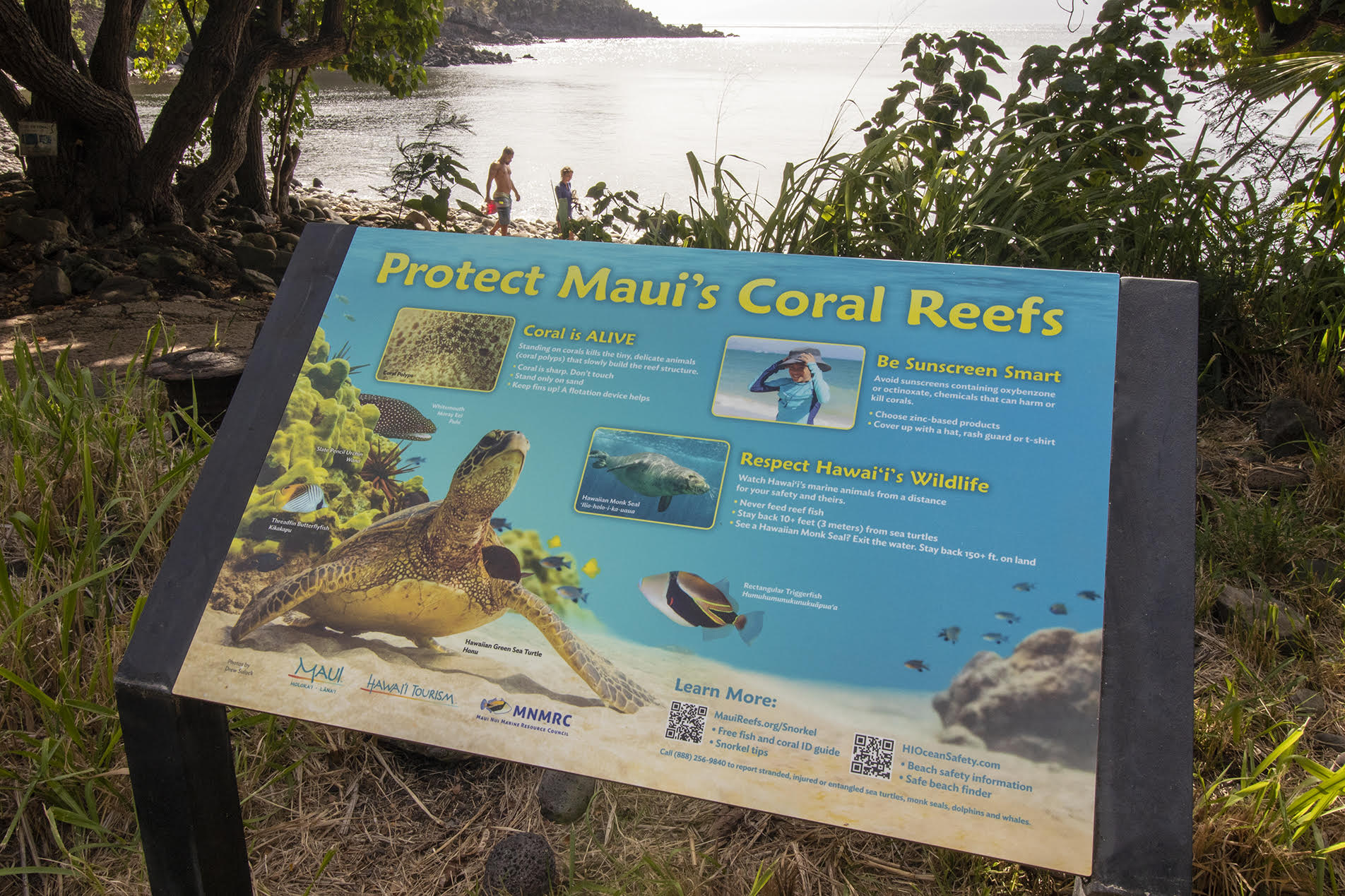
To help visitors and residents protect Maui’s coral reefs, the nonprofit Maui Nui Marine Resource Council has installed new coral reef information signs at 39 Maui beaches.

The signs feature large colorful photos of sea turtles, corals and marine life, and the headline, “Protect Maui’s Coral Reefs.” The signs instruct beachgoers to avoid walking or standing on coral because coral is alive and easily damaged by such actions. Other advice includes choosing sunscreen that’s free of reef-harming oxybenzone and octinoxate, and protecting sea turtles and other wildlife by giving them their space.

“Our goal was to use colorful eye-catching photography to attract people to the signs and then to provide friendly and compelling information about the basics of protecting the reefs while they snorkel, swim, dive, paddle or surf,” said Mike Fogarty, Acting Director of Maui Nui Marine Resource Council. “We’re very pleased with the result and the positive reaction from the public.”

Maui Nui Marine Resource Council was able to create and produce these signs with support provided by Hawaiʻi Tourism plus assistance from Maui Visitors Bureau.

The signs were designed by Geoff Moore, owner of Silver Moon Art and Design in Pāʻia. Photographs for the sign were donated by Drew Sulock, a local nature/adventure photographer and owner of Drew Sulock Creations.

Thorne Abbott of Coastal Planners, LLC donated time to help Maui Nui Marine Resource Council with permitting requirements. The County of Maui Department of Parks and Recreation also provided assistance in planning the installation of the signs at County parks.

The signs were installed by two local companies: Maui Rebuilders LLC and Maui Neon & Signs.

Twenty-nine of the signs are replacements for coral reef information signs created and installed about ten years ago by Project S.E.A.-Link. The signs had since become faded and weather-worn. An additional ten signs were installed at new locations, including Hoʻokipa, Launiupoko and Polo Beach.

“I’m really proud to have been an ongoing part of this public awareness campaign, and to have the opportunity to update the graphics and messaging to be fresh and relevant,” said Geoff Moore, who had designed both the original signs and the newly installed signs. “It’s important to me to inform Maui’s ocean users about protecting our coral reefs. I believe this will give the animals there the best opportunity to survive amongst so many environmental challenges.”

The coral reef information signs include a link to a snorkeling information page at www.mauireefs.org/snorkel which was created by Maui Nui Marine Resource Council and includes free downloadable fish cards, instructional videos and other information about snorkeling on Maui.

“The coral reef signs help to reinforce messages that visitors will see on the window displays that Maui Nui Marine Resource Council installed at the Kahului Airport,” says Fogarty. “We’re now planning public service announcements and social media advertising to provide additional reinforcement of these important reef conservation points.”

Maui Nui Marine Resource Council is a community-based nonprofit celebrating 12 years of working for healthy coral reefs and clean ocean water for the islands of Maui County. To learn more, please visit www.mauireefs.org.


Free webinar: home gardening without toxic chemicals

in /by

Part of Maui Nui Marine Resource Council’s Know Your Ocean Speaker Series

Americans are taking up gardening in record numbers during the COVID-19 pandemic, and Maui residents are joining the trend.

Growing your own produce, as well as doing your own landscaping and yard care, are great ways to save money, get exercise, be outdoors and engage your keiki in hands-on science learning.

Unfortunately, many people turn to toxic herbicides and chemicals when weeds and pests appear. In fact, the average yard contains 10 times more chemicals per acre than a typical commercial farm, says Consumer Reports.

Learn tips for skipping those toxic herbicides and pesticides and growing a productive garden and a beautiful yard at a free Zoom presentation by landscape and gardening expert Duane Sparkman on Thursday, June 4 at 3:30 pm. Sparkman is the Assistant Chief Engineer and Landscaping Manager at The Westin Maui Resort & Spa.

Our guest emcee is Darla Palmer-Ellingson, local radio show host and owner of 360 Social Business.

Sparkman will take you into his own yard via Zoom to demonstrate non-toxic gardening and landscaping practices in action. You’ll discover how you can achieve great results in your yard, save money and keep family and pets safer. Because chemicals travel through Maui’s porous soil into the ocean, switching to organic methods will also help protect our local coral reefs and nearshore fish populations.

This free Zoom presentation is part of Maui Nui Marine Resource Council’s “Know Your Ocean Speaker Series” now being held via Zoom due to COVID-19. To make a free reservation, please go to https://bit.ly/MauiGardeningWebinar.

Sparkman offers a wealth of practical firsthand experience about what works to control pests and weeds based on his years of experience as a professional landscaper, designing and maintaining luxury resort properties and private residences, his work at Haleakala National Park’s Vegetation Management Division and recently, as the Assistant Engineer and Landscaping Manager at The Westin Maui.

At The Westin Maui, Sparkman has successfully implemented measures to reduce the resort’s use of herbicides and pesticides, showcasing alternatives that are safer and more environmentally friendly.

“We are offering this presentation with the hope that more people will resolve to find ways to protect our coral reefs and marine environment by reducing or avoiding the use of herbicides and pesticides in their home gardens and yards,” says Robin Newbold, Chair of Maui Nui Marine Resource Council.

Newbold points out that most people don’t realize how porous our soil is on Maui and how readily chemicals from pesticides and herbicides find their way into the ocean, causing harm to fish, birds and corals.

According to the NOAA Ocean Service Education website, pesticides are designed to be toxic to a target organism, but they often kill other organisms as well: “The insecticide azinphos-methyl, for example, which is used to control insects such as biting mites and aphids, is also very toxic to fish and birds.”

The website notes that many of the compounds used today are toxic at very low concentrations.

Herbicides also penetrate coral tissues and rapidly, within minutes, can reduce the efficiency of the beneficial algae (zooxanthellae ) that live within the corals, reports the book, Chemical Pollution on Coral Reefs: Exposure and Ecological Effects. The zooxantellae convert the energy from the sun into food for the corals through photosynthesis, providing corals with about 90% of their food. When herbicides enter the ocean, they can cause the corals to suffer due to reduced food availability.

“We owe it to our coral reefs and ocean water to find better ways to manage pests and weeds without adding harmful chemicals to our land- and marine-ecosystems,” says Newbold. “We’re grateful that Duane Sparkman is willing to share his practical, hands-on knowledge and experience with us all.”

Special thanks to the County of Maui Mayor’s Office of Economic Development for supporting Maui Nui Marine Resource Council’s “Know Your Ocean” Speaker Series.


About Duane Sparkman:
A resident of Maui since 1995 arriving here from Texas, Duane is an avid photographer who aspires to capture “rare moments”. His life’s passion is to preserve intact Hawaiian forests and the perpetuation of Hawaiian Culture. Duane is a professional landscaper by trade, designing and maintaining luxury resort properties, private residences, and working on projects within the Haleakala National Park, Vegetation Management Division. When he is not working or volunteering his time with various Hawaiian reforestation projects “putting back what belongs” he enjoys spending time with his wife, Erin and 2 children, Evan and Isabella cultivating his back yard native forest.

About The Westin Maui Resort & Spa:
Centrally located on pristine Ka’anapali Beach, the spectacular transformations within this resort will completely reimagine many areas of the 12-acre tropical paradise. Surrounded by lush gardens with cascading waterfalls, the 770-room beachfront resort abounds with ways to rejuvenate. Guests can indulge in six outdoor pools that include a brand new family pool and dedicated adults-only pool, spa rejuvenation, unique dining experiences and cultural activities. It is mere steps away from snorkel and sunset cruises, neighboring Whalers Village and championship golfing. Visit www.westinmaui.com.

About Maui Nui Marine Resource Council:
Maui Nui Marine Resource Council is a community-based nonprofit organization celebrating 11 years of working for healthy coral reefs, clean ocean water and abundant native fish throughout Maui County. Our work includes co-managing the Hui O Ka Wai Ola Ocean Water Quality Monitoring Program at 41 sites in South and West Maui, efforts to reduce pollution in Ma‘alaea Bay (through erosion-control efforts in the Pohakea watershed and using oysters to filter sediment and pollutants from ocean water), coral reef research, visitor education programs and more. Learn more at www.mauireefs.org.

About Darla Palmer-Ellingson:
With a strong passion for volunteerism on environmental issues, Darla produces and hosts Maui’s only commercially broadcast public affairs show on environmental and related Hawaiian cultural topics. Darla is a member of the County of Maui Citizens Advisory Committee on the Climate Crisis and a member of Vice President Al Gore’s Reality Project, Hawaii chapter. Her company, 360 Social Business, LLC provides website design, content, social media management, general business and marketing consulting.

Scientists to Study “Molokini Without Tourists”

in /by

Maui Nui Marine Resource Council Helping to Raise Funds
 to Support This Once-in-a-Lifetime Research Opportunity

According to a 2007 report published in the scientific journal Ecological Applications, Molokini Marine Life Conservation District was considered the most effective marine protected area in Hawaiʻi1,2. However, during the past decade, Molokini’s ecosystem health has declined, likely related to pressures from intensive tourism at this mid-ocean reef system3,4.

During this time of COVI D-19, when tourism is switched off and there are no tour boats or snorkelers at Molokini, there is a once-in-a-lifetime opportunity to study how human activity impacts marine life in the Molokini Marine Life Conservation District.

The question: now that there is no tourism, is the wildlife changing how it uses the reserve?

“Molokini Crater is one of the most dramatic natural areas in the main Hawaiian Islands, and harbors coral reefs as well as fishes, sharks, manta rays and other wildlife,” says Maui resident Russell Sparks, Aquatic Biologist, Department of Land and Natural Resources, Division of Aquatic Resources on Maui. “Under normal conditions, tourism activity is very high at Molokini, with diving and snorkeling boats visiting continually. Now, there is no tourism.”

“How have important species changed their use of Molokini’s reef habitats in the absence of tourism?” asks Sparks. “We now have the opportunity to find out.”

Led by Sparks, a small team of scientists with expertise in animal tracking, underwater survey methods, wildlife ecology and past Molokini research experience is hoping to answer this question.

The team of Hawaiʻi-based scientists has extensive experience with coral reef ecology and animal movement studies in the Hawaiian Islands: Kevin Weng, Associate Professor at the Virginia Institute of Marine Science; Alan Friedlander, Chief Scientist, Pristine Seas, National Geographic Society, and director of the Fisheries Ecology Research Lab at the University of Hawaiʻi; and Whitney Goodell, National Geographic Fellow and marine ecologist with the Fisheries Ecology Research Lab, University of Hawaiʻi.

Friedlander has studied Molokini extensively and is the co-author of five research publications on Molokini conducted in collaboration with the Maui Division of Aquatic Resources.

The scientists plan to work at Molokini this summer (May and June) to conduct diver surveys of fishes and other wildlife. They will install a network of tracking receivers and tag animals with telemetry devices. Vessel activity will be counted using a time-lapse camera. This builds on previous work conducted by Friedlander’s lab in collaboration with the Maui Division of Aquatic Resources1,2,3,4 and offers a unique opportunity to compare current conditions with a robust, existing baseline.

The local nonprofit Maui Nui Marine Resource Council is raising funds for the team of scientists to conduct this study. The organization has set up a GoFundMe page for this project at gofundme.com/f/molokini-during-covid-19-research-study.

“Molokini is normally visited by 1,000 tourists every day and is one of the most visited marine protected areas in the world,” reports Robin Newbold, Co-founder and Chair of Maui Nui Marine Resource Council. “Many Maui residents are wondering what’s happening there now that the tourists are gone. We’re excited that these scientists have stepped forward to collect data relating to this important question.”

Newbold explains that the scientists are donating their time and resources for this study and have organized some parts of the expedition. However, they require support in a number of areas, since the urgent nature of the project has prevented the normal routes of science funding and planning.

The scientists have permits to travel and go to work at Molokini. They have a boat and captain, science equipment and telemetry tags ready to go.

As of July 15, they are seeking the use of a car or rental car, and a place to park an 18 foot boat overnight and when not in use. If you can help, please email [email protected].

“On behalf of the scientists, we are asking for help from the community for this project,” says Newbold. “Perhaps you have a car that’s not being used that you could share with the researchers.”

“We also welcome cash donations,” says Newbold. “100% of the donations collected by Maui Nui Marine Resource Council for this project will go directly to this research.” To donate, visit GoFundMe at gofundme.com/f/molokini-during-covid-19-research-study.

Maui Nui Marine Resource Council is a nonprofit 501 (c)(3) organization working for healthy coral reefs and clean ocean water for Maui’s nearshore areas. To learn more, visit www.mauireefs.org.
———————-
1 Friedlander AM, Brown EK, Monaco ME. 2007. Coupling ecology and GIS to evaluate efficacy of marine protected areas in Hawaii. Ecological Applications 17:715-730.

2 Friedlander AM, Donovan MK, Koike H, Murakawa P, Goodell W. 2019. Characteristics of effective Marine Protected Areas in Hawai‘i. Aquatic Conservation: Marine and Freshwater Ecosystems. Aquatic Conservation, 29(S2):103-117. DOI: 10.1002/aqc.3043

3 Filous, A., Friedlander, A.M., Koike, H., Lammers, M., Wong, A., Stone, K. and Sparks, R.T., 2017. Displacement effects of heavy human use on coral reef predators within the Molokini Marine Life Conservation District. Marine Pollution Bulletin 121:274-281.

4 Filous A, Friedlander A, Wolfe B, Sparks R. 2017. Movement patterns of reef predators in a small isolated Marine Protected Area with implications for resource management. Marine Biology, 164(1). DOI: 10.1007/s00227-016-3043-3

Photo credit:
 Molokini photographed by Bossfrog, 4 December 2015, under Creative Commons, via Wikipedia.

50th Anniversary of Earth Day

in /by

Due to COVID-19, big gatherings are not part of Earth Day 2020, the 50th Anniversary of Earth Day. But there’s so much you can do at home in honor of Earth Day to help shape a better future for our planet and our island home.

Check out these ideas:

1. Get informed. Learn what sea level rise caused by climate change will do to the shorelines, reefs and your favorite beaches in Maui County. Visit the Hawaii Sea Level Rise Viewer at https://www.pacioos.hawaii.edu/shoreline/slr-hawaii/.

2. Share what you’re observing here in Hawaii — beach loss, shoreline erosion, declining coral reefs, fewer reef fish — with friends and family worldwide. We need an informed public to understand what’s at stake and to vote for candidates who will actively work to fight climate change.

3. Help keep Maui County’s corals as resilient and as healthy as possible by keeping reef-harming chemicals out of the ocean. Choose sunscreens that don’t contain reef-harming oxybenzone and octinoxate. Learn more at https://www.mauireefs.org/sunscreens/

4. Remember, whatever you use in your home or yard will eventually find its way into the ocean. Pledge to stop using pesticides and herbicides in your landscaping, home and place of business. If you live in a condo, talk with your property manager about choosing non-toxic alternatives.

5. Dispose of unwanted or expired prescription medicines properly — never flush them down your toilet. When medications are flushed down a toilet or drain, they enter our wastewater treatment systems, which are not designed to remove medications. Some medications such as hormones and antidepressants include endocrine disrupting compounds (EDCs), which interfere with the reproduction and normal growth of many aquatic species, including fish.

Visit https://www.cvs.com/content/safer-communities-locate to find the CVS location nearest you that will accept unwanted medications.

6. Join the movement to prevent plastic pollution. Carry a set of lightweight cutlery in your purse or car so you can skip single use plastic utensils. Consider packaging as well as price when you shop. Learn more about the bill passed recently by the Maui County Council that bans nearly all sales and use of plastic disposable food ware in Maui County. Encourage Maui County Mayor Michael Victorino’s to approve it.

https://www.mauinews.com/news/local-news/2020/04/near-ban-on-plastic-disposable-utensils-okd/

7. Help prevent sediment-laden stormwater runoff; it is harmful to Maui’s nearshore reefs. In your yard, cover bare soil with mulch or plants to prevent runoff. Create a small soil berm in a ring around new plants to contain water. Incorporate permeable materials (like permeable pavers) into your patios, driveway, and walkways.

8. Educate the next generation. Check out the American Museum of Natural History’s curated list of Earth Day videos and plan an Earth Day watch party with your family. https://www.youtube.com/playlist?list=PLrfcruGtplwH76Sryqpk7nXf0YIEM0piZ

Humanity is working together in amazing ways to fight the coronavirus pandemic. The impossible is possible if we all work together for our planet. Happy Earth Day!

Free Oct. 7 Webinar by Daniel Amato, Ph.D. on “Sewage Impacts on Hawaiʻi’s Coastlines: Past, Present and Future”

in /by

What will determine the future impacts of sewage on Hawai’i’s nearshore ecosystems and public health? Learn more at a free Zoom webinar titled “Sewage Impacts on Hawaiʻi’s Coastlines: Past, Present and Future” by Daniel Amato, Ph.D., which will include recent research and latest information on Hawaiʻi’s wastewater saga. The webinar will take place on Wednesday October 7 at 5:30 pm and is free and open to the public. It is presented by Maui Nui Marine Resource Council as part of their monthly “Know Your Ocean Speaker Series.” Advance reservations are recommended as the Zoom webinar is limited to 100 attendees. Make your free reservation at https://bit.ly/MauiSewage

“My talk will share reports on how injection wells and cesspools continue to pollute Hawaiʻi’s waters, with an emphasis on recent Maui studies,” says Dr. Amato. ”I will also present recent decisions from the Hawaiʻi State Legislature and the current status of their effort to phase out cesspools.”

Dr. Amato will also discuss the current situation with sewage pollution in Hawai’i, and will present community efforts and new technological developments in sewage detection that show promise for the future.

A water quality specialist, Dr. Amato’s professional work focuses on the detection and impacts of land-based pollution in the Pacific Ocean and the development of new technology to assist in detecting the DNA of fecal indicator bacteria (FIB) in the water.Dr. Amato is a Marine Research Specialist at the University of Hawaiʻi at Manoa, an Environmental Scientist at Element Environmental LLC, and serves as the coordinator for Surfrider-Oahu’s Blue Water Task Force.

“We are offering this webinar by Dr. Amato to share important information about sewage and its impact on Maui’s coastlines, including ocean water quality and our nearshore coral reefs,” says Amy Hodges, Programs and Operations Manager at Maui Nui Marine Resource Council. “It’s a critically important topic, at a time when our coral reefs need the benefit of clean ocean water, to survive the impacts of climate change and warming water.”

“We thank the County of Maui Mayorʻs Office of Economic Development for supporting our Know Your Ocean Speaker Series,” says Hodges.

For reservations for this talk, visit https://bit.ly/MauiSewage.

About Maui Nui Marine Resource Council:
Maui Nui Marine Resource Council is a community-based nonprofit organization celebrating 12 years of working for healthy coral reefs, clean ocean water and abundant native fish throughout Maui County. Our work includes co-managing the Hui O Ka Wai Ola Ocean Water Quality Monitoring Program in South and West Maui, efforts to reduce pollution in Mā‘alaea Bay (through erosion-control efforts in the Pohakea watershed and using oysters to filter sediment and pollutants from ocean water), coral reef research, visitor education programs and more. Learn more at www.mauireefs.org.


Free Presentation on “Wildfire on Maui: the History, Threat, and Our Collective Responsibility”

in /by

Did you know that the area burned each year by wildfire in Hawaii has increased by 400% over the past several decades? Wildfires have an impact on our nearshore ocean environment and coral reefs, which is why Maui Nui Marine Resource Council is hosting a free presentation on “Wildfire on Maui: the History, Threat, and Our Collective Responsibility” on Wednesday, February 6.

The presentation will be offered by Clay Trauernicht, PhD, Wildland Fire Specialist at University of Hawaiʻi Cooperative Extension. It will take place from 5:30 pm to 7:00 pm at Pacific Whale Foundation’s classrooms at the Ma’alaea Harbor Shops at 300 Ma’alaea Road, Ma’alaea (Wailuku). Doors open at 5:00 pm and complimentary refreshments will be served.

“Over the past decade, an average of more than 1,000 wildfires burned more than 17,000 acres each year in Hawai‘i, with the percentage of total land area burned comparable to and often exceeding figures for the fire-prone western United States,” reported Dr. Trauernicht.
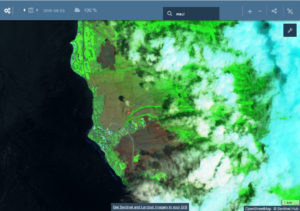
“During my presentation, we’ll use fire science and a bit of history to tackle the how and why of the 400% increase in areas burned by wildfires in Hawaii,” said Dr. Trauernicht. “We’ll also look at the consequences it has for our watersheds and nearshore ecosystems.”

“The short story is that fire on Maui and other islands is a problem we’ve largely created,” he noted.  “It is therefore one of the few ‘natural’ disasters we can actually avoid.”

“We’ll consider our options to reduce fire risk and impacts on Maui and how the urgency to take action is increasing under a changing climate,” Dr. Trauernicht reported.

Attendees will be invited to share their questions, experiences and ideas about wildland fires on Maui at the conclusion of Dr. Trauernicht’s presentation.

Dr. Trauernicht earned his PhD in Plant Science at the University of Tasmania and a MS in Botanical Sciences at the University of Hawaii at Manoa. He completed his BS in Biology at the University of Denver.  In addition to many years of botanical and ecological fieldwork, he has published and presented on plant community ecology and population modeling, geospatial analyses of fire and species occurrence, and the use of local knowledge to adapt management strategies and inform research needs.

His current focus is on improving wildland fire management in Hawaii and the Pacific with a strong emphasis on science extension and communication.  Dr. Trauernicht is the project leader for the Pacific Fire Exchange, part of the Joint Fire Science Program’s nationwide Fire Science Exchange Network.  He is currently working with the Pacific Island Climate Change Cooperative to extend climate science resources to Cooperative Extension programs throughout the Pacific Island region.

Maui Nui Marine Resource Council is a Maui-based nonprofit organization celebrating 17 years of working for healthy coral reefs, clean ocean water and an abundance of native fish for the islands of Maui County. In addition to co-managing the Hui O Ka Wai Ola ocean water quality testing program, which tests ocean water quality at 39 locations along the south and west shores of Maui, the nonprofit is working to improve ocean water quality in Ma’alaea Harbor through the use of installed oysters in cages. Maui Nui Marine Resource Council is also working in the Pohakea watershed above Ma’alaea Bay to prevent fire and erosion to protect ocean water quality and the coral reefs located in the bay. To learn more, visit www.mauireefs.org.

Maui Nui Marine Resource Council May 2 Meeting to Feature Guest Presentation on “Updates on efforts to restore streamflow to Maui’s reefs and effects on fisheries”

in /by

Maui Nui Marine Resource Council invites the public to its next meeting on Wednesday, May 2, featuring guest presentations by Lucienne De Naie and Adriane Raff Corwin.

Lucienne De Naieʻs presentation will be on “Updates on efforts to restore streamflow to Maui’s reefs and effects on fisheries.” Adriane Raff Corwin will be speaking about the Hukilike No Maui Coalition and also efforts to keep harmful sunscreen chemicals out of our nearshore ocean ecoystems.

The meeting will take place from 5 pm to 6:30 pm at Pacific Whale Foundationʻs classrooms at the Maʻalaea Harbor Shops. Admission is free, everyone is invited and refreshments will be provided.

Lucienne De Naie lives in rural east Maui and is active with stream and watershed restoration projects. She is a a founding member and a director of Maui Nui Marine Resource Council, as well as a founding member of Maui Cultural Lands, Inc. and the Maui Coastal Land Trust (now Hawaiian Islands Land Trust). Lucienne has served on the Mayor’s Open Space Zoning Advisory Committee, the Maui General Plan Advisory Committee and serves as Conservation Chair and hike leader for the Maui Sierra Club. She also authored a report on the status of Mauiʻs freshwater resources.

Adriane Raff Corwin is the Sierra Club Group Coordinator. Adriane has been a community organizer for over ten years and received her Master’s Degree in Political Science and Futures Studies from the University of Hawaiʻi at Mānoa.

The meeting will include updates on Maui Nui Marine Resource Councilʻs work as a nonprofit community organization to restore clean ocean water, protect coral reefs and bring back abundant native fish to the nearshore areas of the islands of Maui County.

To learn more about Maui Nui Marine Resource Council, please visit www.mauireefs.org.

Lucienne De Naie

Adriane Raff Corwin


Herbivore management program at Kahekili shows encouraging results for the areaʻs coral reef

in /by

It’s often been said that “reef management” is a misleading term. After all, it’s not the reefs that need guidance; it’s human behavior that needs to be managed. One good example of the impact of humans working together as a community to protect reefs is the Herbivore Management Program at Maui’s Kahekili Beach Park. Three decades of detailed coral monitoring that has occurred there had led to informed and effective management actions.

A poster presentation by Darla White and Russell Sparks (Hawaii Department of Land and Natural Resources, Division of Aquatic Resources) and Ivor Williams (NOAA National Marine Fisheries Service, Coral Reef Ecosystem Division) showed the results of management of the herbivore fisheries at Kahekili and its impacts on the resilience of the reef.

You can view the poster at:
https://www.eposters.net/pdfs/the-kahekili-herbivore-fisheries-management-area-enhancing-resilience-of-a-reef-showing-signs-of.pdf

According to the poster, Dr. Eric Brown initiated monitoring at Kahekili Beach Park in the early 90s, In 1999, through the UH Coral Reef Assessment and Monitoring Program (CRAMP), the area was converted into one of a statewide network of intensively monitored reef sites. Hawaiiʻs Department of Aquatic Resources (DAR), part of the state Department of Land and Natural Resources (DLNR), has since worked to complete annual re-assessments of this site in collaboration with UH CRAMP.  It is through this intensive effort to measure change on the reefs in this area, that DAR developed clear concerns over rapid declines in coral cover, increases in algae growth, and reduced level of critically important herbivorous fishes.

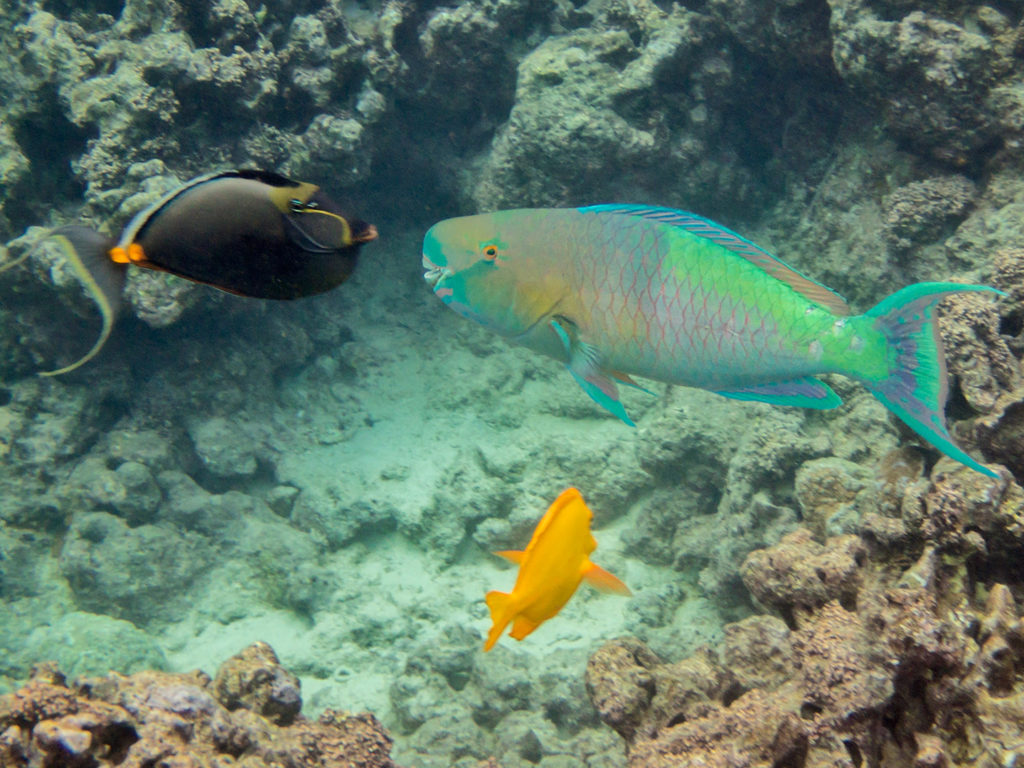
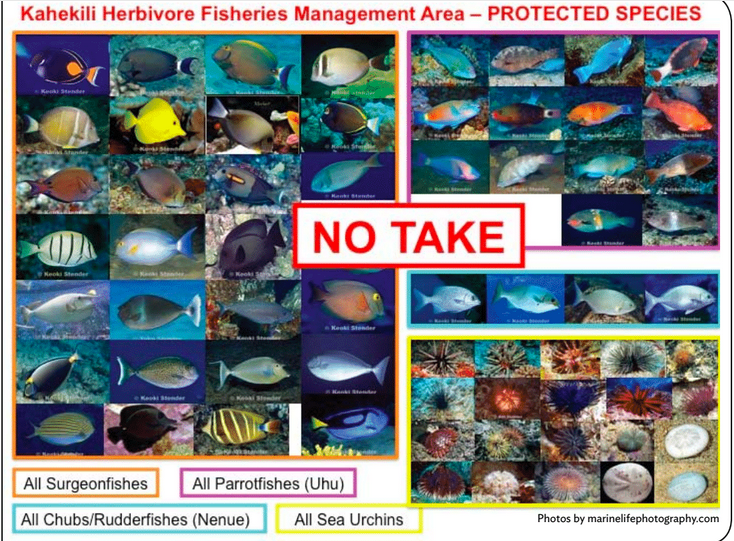
Herbivorous fish are fish that consume algae and seaweed. These fish include surgeonfish, parrotfish and chubs. The fish were being harvested for human food, leaving the reef defenseless against the onslaught of algae. The increase in algae resulted in the declining coral cover.

As a result, the DAR initiated discussions about the herbivore management area and got very good support from local long-time fishing families from the area, and from recreational fishing advocates such as Darrel Tanaka, Brain Yoshikawa and others. As a result, fishing for herbivores (such as parrotfish) was banned at Kahekiki, along with the taking of sea urchins. The program also prohibited the feeding of fish, because such activity decreases fishes’ natural appetite for seaweed.

Furthermore, marine biologist advocates such as Liz Foote and many others have helped move the effort forward and helped involve citizens and educate the public to improve compliance.

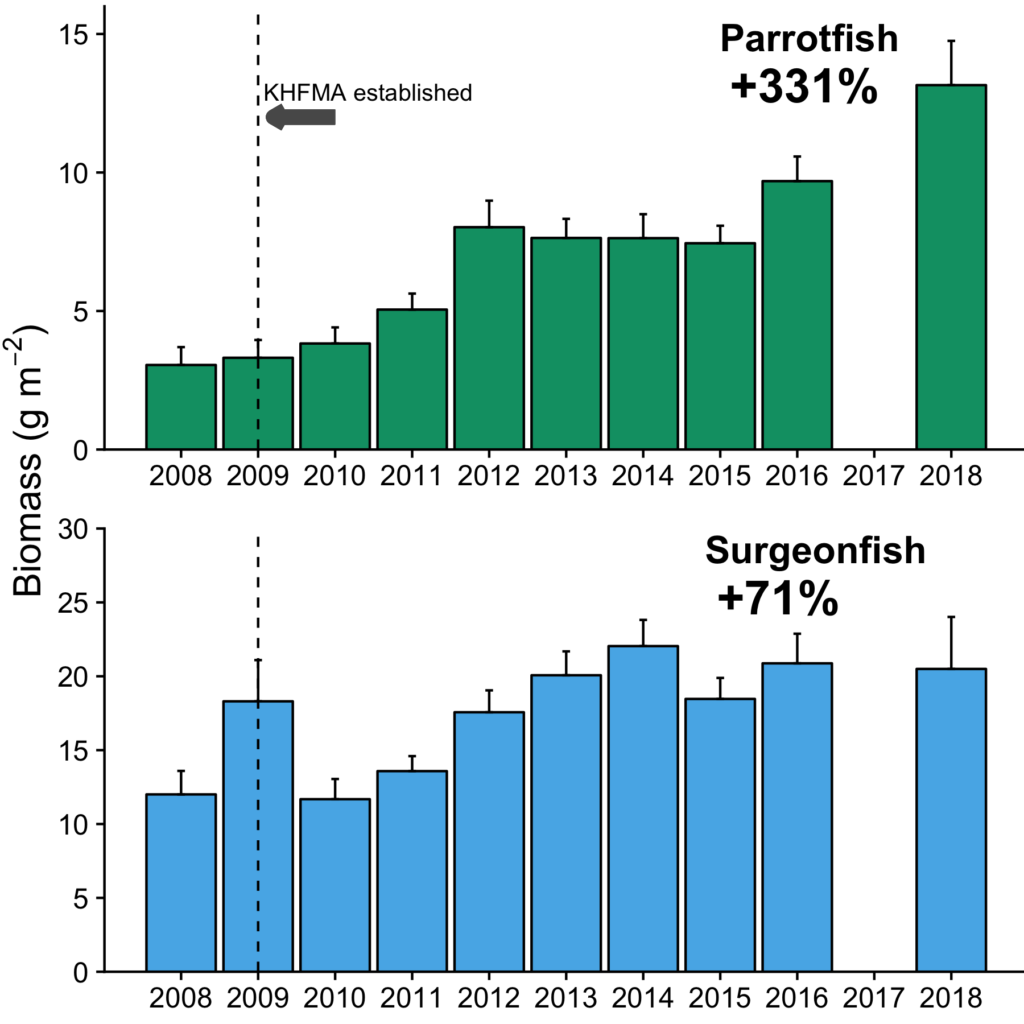
These new controls and outreach efforts have worked. Since the management area went into effect in 2009, there has been a 331% increase in parrotfish biomass at this reef, meaning that parrotfish have been growing to a larger size (which means they are better algae grazers) and are found in greater numbers. Surgeonfish increased 71% from 2008/09 to 2018 in this area. (See poster at https://www.eposters.net/pdfs/the-kahekili-herbivore-fisheries-management-area-enhancing-resilience-of-a-reef-showing-signs-of.pdf.)

Best of all, the seaweed and microalgae were reduced greatly, down to almost nothing. Success!

Current evaluation of the effectiveness of the area has been conducted with a partnership between DLNR/DAR and the NOAA science center (Dr. Ivor Williams).  This collaborative effort has allowed DAR  to conduct extensive yearly monitoring assessments and measure the response of the area to the management efforts.

Which takes us back to the question of managing reefs vs. managing humans. Human behavior can be managed, through education and effective management rules.  The results at Kahekili offer hope for what can be accomplished at other reefs throughout Maui Nui.