Posts

Maui Now: Ocean water testing begins off Lahaina

in /by

Preliminary water testing in the nearshore waters off Lahaina is showing that physical parameters, like temperature, PH, salinity, and dissolved oxygen, are currently in normal ranges.

Russell Sparks, an aquatic biologist with the DLNR Division of Aquatic Resources, said, “We have ongoing concerns that pollutants from the fire will make their way into the ocean at some of the drainage outfalls or from storm drains. For years we’ve done regular monitoring, but now we’re including testing from the fire zone. We’ll be sending samples off to… (Read More).

New FlushAware App to Be Topic of March 2 Know Your Ocean Speaker Series

in /by

Meet the App’s Developer and Learn More About Where Wastewater Goes When You Flush Your Toilet on Maui

PAIA, MAUI, HI – The average person flushes their toilet five times per day. But when you flush, do you know where your wastewater goes and what impacts it has on the ocean where you surf or swim, the beaches where you play and the fish that you eat from our coastal waters? Maui Nui Marine Resource Council invites you to learn more about the path that wastewater follows once it leaves your toilet and how your wastewater is impacting our nearshore ocean water quality at a special Know Your Ocean Speaker Series presentation on Zoom on Wed. March 2 at 5:30 pm featuring Travis Liggett as the guest speaker. To reserve your spot, please visit https://bit.ly/FlushAwareWebinar

Liggett is the president of Reef Power LLC and the developer of the new FlushAware app with a demonstration website launch for Maui island users slated for March 2022.

“FlushAware is a new online education system that will inform users about the treatment level and destination of their Maui Island disposal method, while providing tools for activism and improving life downstream,” says Liggett.

During his presentation, Liggett will demonstrate how the new FlushAware app will work, and will discuss solutions to Maui’s wastewater challenges, which he says can be found in the living life support ʻĀina. “Native species such as stream limu, breadfruit and taro provide answers to our water waste woes. Instead of nearshore injection, municipal discharges in Maui can be polished with turf scrubbers to reduce nutrient pollution using local freshwater algae,” reports Liggett. “The wastewater can then be 100% reused as irrigation of native food agroforestry, pastureland, and vetiver slope stabilization plantings to reduce sediment transport potential from mauka lands.”

Travis Liggett graduated from University of California at Berkeley with a Bachelor of Science degree in Mechanical Engineering with a focus on design in 1998, and from the University of Colorado at Boulder with a Master of Science degree in Aerospace Engineering with a focus on life science in 2003.

In 2001 Mr. Liggett started work as a Research Assistant at  BioServe Space Technologies, a NASA Commercial Space Center locate

d at CU Boulder, and continued his tenure working for the Agency as a Flight Systems Engineer for the Space Station Biological Research Project starting in 2003, then as an Aerospace Research Engineer focusing on functional prototype development of new life science technologies from 2005 – 2010 at  NASA Ames Research Center in Moffett Field, located in California’s Silicon Valley.

On Maui, Travis has managed algae growth operations at Maui Tropical Algae Farm, and served as Principal Engineer for Water Quality Consulting, Inc., where he performed core duties including work on the Maui Ocean Center’s 2018 NPDES permit application.

Travis founded the small business Reef Power LLC in 2018 with the objective of bringing to Maui a natural regenerative reuse wastewater nutrient polishing system called a turf scrubber growing native Hawaiian stream limu (freshwater macroalgae), coupled with native food agroforest irrigation for disposal, instead of nearshore injection wells.

“Wastewater has a significant impact on Maui’s coral reefs and nearshore ocean water quality, whether you live in Kula or Kihei,” says Mike Fogarty, Executive Director of Maui Nui Marine Resource Council. “The FlushAware App will contribute to our community’s growing awareness of the impacts of each and every flush – the first step in finding an answer to the question of how to manage our wastewater to protect our reefs and the ocean waters that surround our shores.”

The Know Your Ocean Speaker Series is hosted on the first Wednesday of each month and is funded in part by the County of Maui Office of Climate Change, Resiliency and Sustainability and by donations from individuals and businesses in the community. To learn more, visit www.mauireefs.org.

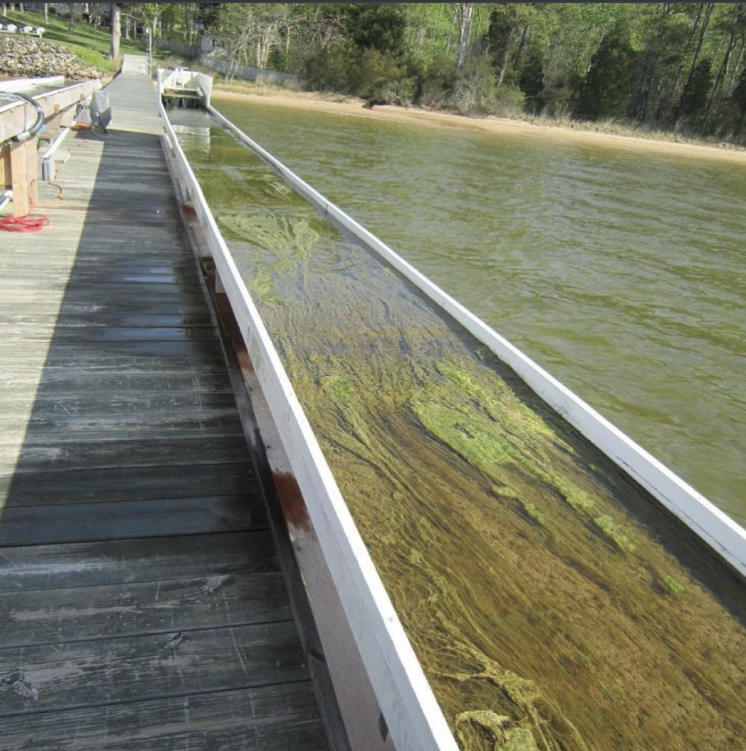
Photo at right: A turf scrubber reduces nutrient pollution using local freshwater algae.

Maui’s Community-Based Ocean Water Quality Monitoring Program Celebrates 100th Sampling Session

in /by

Maui’s volunteer-based ocean water quality monitoring program Hui O Ka Wai Ola celebrated a special milestone on February 8, 2022: its 100th sampling session since the program began on Maui in 2016.

A beachside ceremony held this morning at Hanakaʻōʻō Beach Park in Kāʻanapali was organized by Maui Nui Marine Resource Council, West Maui Ridge to Reef Initiative and The Nature Conservancy, the three organizations that co-founded and co-manage this unique community program. It was attended by about 40 Maui residents, program volunteers and local VIPs including State Representative Tina Wildberger, Maui County Councilmember Tamara Paltin, and Maui County Managing Director Sandy Baz, who each delivered remarks and congratulations to the volunteers and staff.

A sampling session occurs over a week’s time and typically involves about a dozen volunteers, who wake up before sunrise and fan out in groups of three or four with cars packed with water quality monitoring equipment to gather and test ocean water samples along Maui’s leeward coast.

Sampling sessions take place every three weeks. Each sampling session in West Maui covers 16 sites stretching from Pāpalaua Pali to Honolua. Each South Maui sampling session covers 13 sites from Mā’alaea to ‘Āhihi Kīna’u.

Todayʻs celebration included awarding of gift certificates donated by Duke’s Maui to the volunteers in the program, plus a ceremonial gathering of ocean water samples by long-time volunteers Kit Harris and George Burnette. It was followed by a demonstration of how the water samples are tested for sediment, temperature, pH and other factors conducted by Harris, Burnette, Representative Wildberger and Councilmember Paltin with narration by Hui O Ka Wai Ola Senior Team Lead Tiarra Stark.

Representative Wildberger had a special connection to today’s event: she had volunteered with the Hui O Ka Wai Ola monitoring program  to collect and test ocean water samples in South Maui before being elected as the District 11 Representative for Kihei, Wailea and Makena.

For Councilmember Paltin, the 100th sampling event also held special significance. She, along with then-West Maui resident Dana Reed, helped provide the spark that led to the creation of the community-based ocean water quality monitoring program after the pair observed an unusual increase in brown water events at DT Fleming Beach in 2013-2014.

“Large brown plumes started appearing at DT Fleming, even without much rainfall, which led to beach closures,” noted Reed, who is a retired electrical engineer and now lives in Pennsylvania. “One day I saw another brown plume and said, ‘That’s it! I have to investigate!’.”

Reed had learned how to test ocean water for turbidity at a UH Maui course taught by Donna Brown. She grabbed the sampling bottles she had received at the course and started gathering samples. It was then that she met Paltin, who was a lifeguard at the time. Paltin shared that she too was concerned about the brown water plumes and had photographed them and sent them to Watson Okubo, the Director of the Department of Health Clean Water Branch. Their sampling data wasn’t accepted because they did not have a Quality Assurance Project Plan (QAPP) in place to ensure the integrity of the data.

Undaunted, Reed and Paltin started documenting the water quality at DT Fleming on a regular basis, gathering data from water samples and photos, including aerial photos that Reed’s husband Bill Rathfon obtained with his drone.

Reed said that Paltin would sound the alert – “the stream is running brown!” – and Reed would rush over to grab water quality samples. Paltin also kept sampling bottles at her lifeguard station so she could gather samples during her breaks.

Paltin was a member of the Marine Nui Marine Resource Council Clean Water Committee and together with Reed and Rathfon presented data and pictures from DT Fleming to the group.

Someone who had hiked upslope to understand where the sediment runoff was originating reported that a site that was being prepared for the development of Mahana Estates appeared to be the cause of the runoff.

The project manager from Mahana Estates was invited to meet with Marine Resource Council’s clean water committee and visit the site. She reported that the developer had put up sediment fences and barriers to control the runoff but was having trouble keeping them in place because they kept breaking.

The Department of Public Works said that the developer was following the County’s Best Management Practices (BMPs) and asked for baseline data to compare the current water quality issues at DT Fleming to past years when the problem wasn’t occurring.

That data didn’t exist. But Paltin, Reed, Rathfon and Maui Nui Marine Resource Council persisted in spotlighting the problem  – and ultimately a County engineer, Department of Health representative and the developer visited the site and saw the source of the sediment.

The result was a County-mandated shutdown of the project for more than a year and improvement of the County’s BMPs.

“From that experience, I saw the importance of water quality data – including the need for baseline data – at all of our Maui beaches,” said Reed, who attended the ceremony remotely from her home in Pennsylvania. “At that time, the Department of Health Clean Water Branch had only one person sampling water quality for all of Maui. They suggested that we create a citizen’s monitoring group.”

Maui Nui Marine Resource Council and The Nature Conservancy joined together to host Carl Berg, a research scientist who has worked on water quality issues on Kauai, to learn how to create a community-based water quality monitoring program here.

He told the groups that they needed to create a Quality Assured Project Plan (QAPP) that would meet EPA requirements and State Department of Health standards for projects that involve the collection and analysis of water samples.

This led to a meeting with the Department of Health, Environmental Protection Agency, NOAA, Maui Nui Marine Resource Council, The Nature Conservancy, West Maui Ridge to Reef Initiative and other community environmental groups to discuss creating a water quality monitoring program for Maui.

The result was the launch of Hui O Ka Wai Ola (the “association of living waters”) to be managed through a partnership of Maui Nui Marine Resource Council, The Nature Conservancy and West Maui Ridge to Reef Initiative.

Maui Nui Marine Resource Council agreed to serve as the fiscal sponsor of the program and oversee its finances and payroll.  A grant from National Fish & Wildlife Foundation obtained by The Nature Conservancy helped fund paid positions for Reed and Kim Falinski to create the program in West Maui and purchase water sampling equipment. A second grant from National Fish & Wildlife Foundation later obtained by Maui Nui Marine Resource Council made it possible to expand the program to South Maui.

The QAPP was created over a two-year period by Reed, Falinski and Scott Lerner of The Nature Conservancy. The Department of Health Clean Water Branch signed off on the QAPP and the first official samples of the new Hui O Ka Wai Ola program were collected in June of 2016.

Volunteers signed on to receive the needed training and commit to the early morning sampling sessions. “People didn’t join for fun. They joined because they cared,” said Reed. “I am amazed at how many good quality people we got, who stuck with it. People are so dedicated. I am so impressed.”

At each sampling site, one of the volunteers wades into knee deep water and fills several containers with sea water. The citizen-scientists use portable lab equipment to analyze the samples for pH, dissolved oxygen concentration, salinity and turbidity. The water quality samples are transferred to indoor labs for additional testing. Further testing for nutrients is performed on samples that are frozen and shipped to the labs at the University of Hawaii at Manoa.

Today, the Hui O Ka Wai Ola program manages data collected at 40 leeward sites, which has been provided to the Department of Health Clean Water Branch, to be included in reports to the EPA and State and County agencies. New data is currently being gathered at 29 shoreline locations in West and South Maui.

Dozens of volunteers have worked with the program since its inception, including Hawaii State Representative Tina Wildberger and Maui resident Kit Harris. The program has four part time staff: Senior Team Lead Tiara Stark and Team Leads Meredith Beeson, Mitch Brown and Nalei Sampson. Retired biophysicist Cathy Maxwell is the organization’s Technical Advisor and Bill Rathfon is the Data Manager. Hui O Ka Wai Ola is led by a steering committee of representatives of the three partner organizations, along with Dana Reed and Kim Falinski, who are the Quality Assurance advisors.

The Hawaiian Islands Humpback Whale National Marine Sanctuary, Lahainaluna High School, Da Hawaiian Store and Pineapple Properties LLC have provided free space to the group for its indoor laboratories. The County of Maui has provided funding, along with local companies, foundations and groups including National Fish & Wildlife Foundation, Duke’s Maui, Makana Aloha Foundation, Napili Bay and Beach Foundation, MediaThe Foundation, EACH Foundation, North Beach West Maui Benefit Fund,  Maui Ocean Center, Hawaii Tourism, LUSH, Hawaii Community Foundation’s CHANGE grant and individual donors.
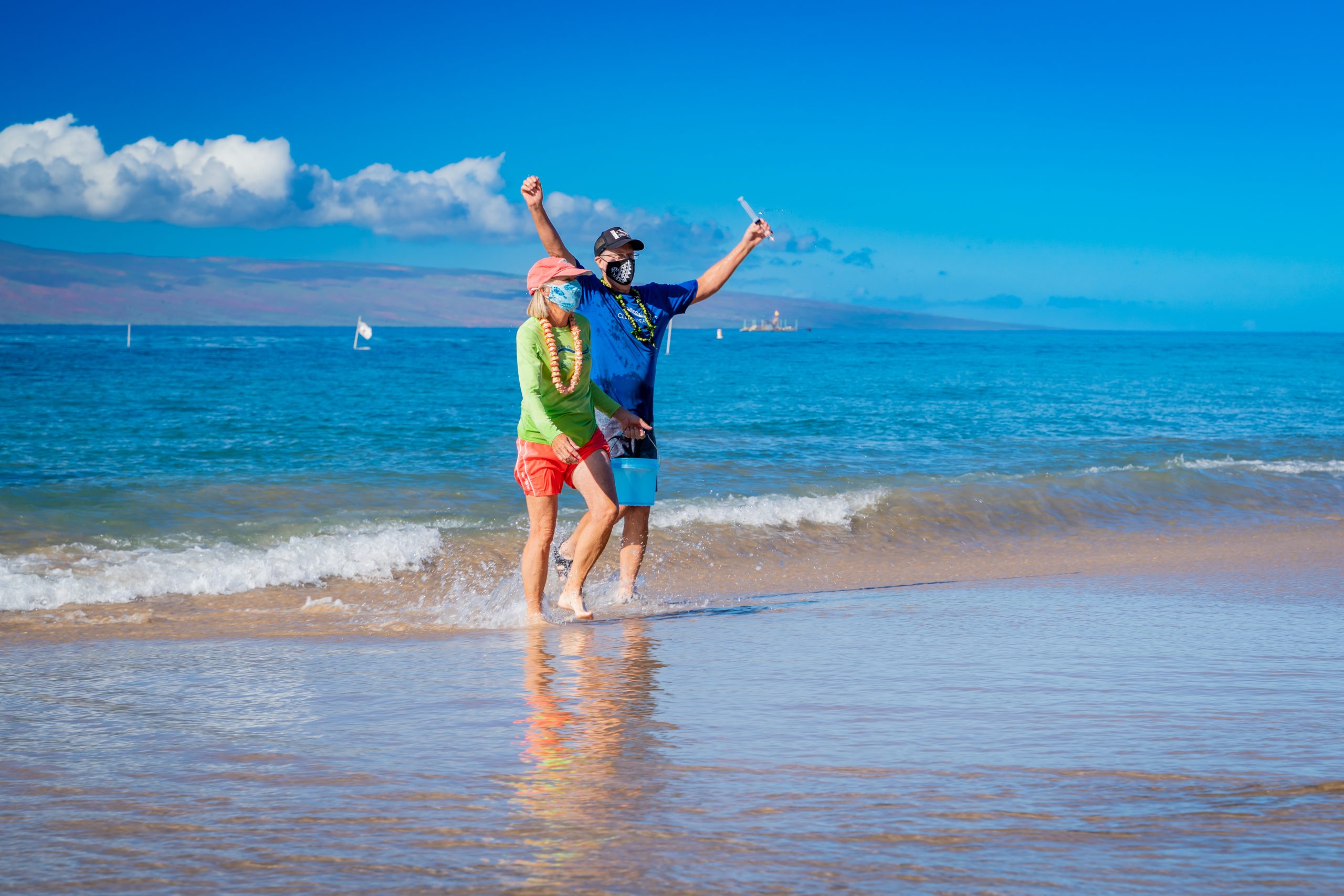
Longtime volunteers George Burnette and Kit Harris carry water samples for testing from the ocean at Hanakaʻōʻō Beach Park in Kāʻanapali.

Photo by Ty Freiberg
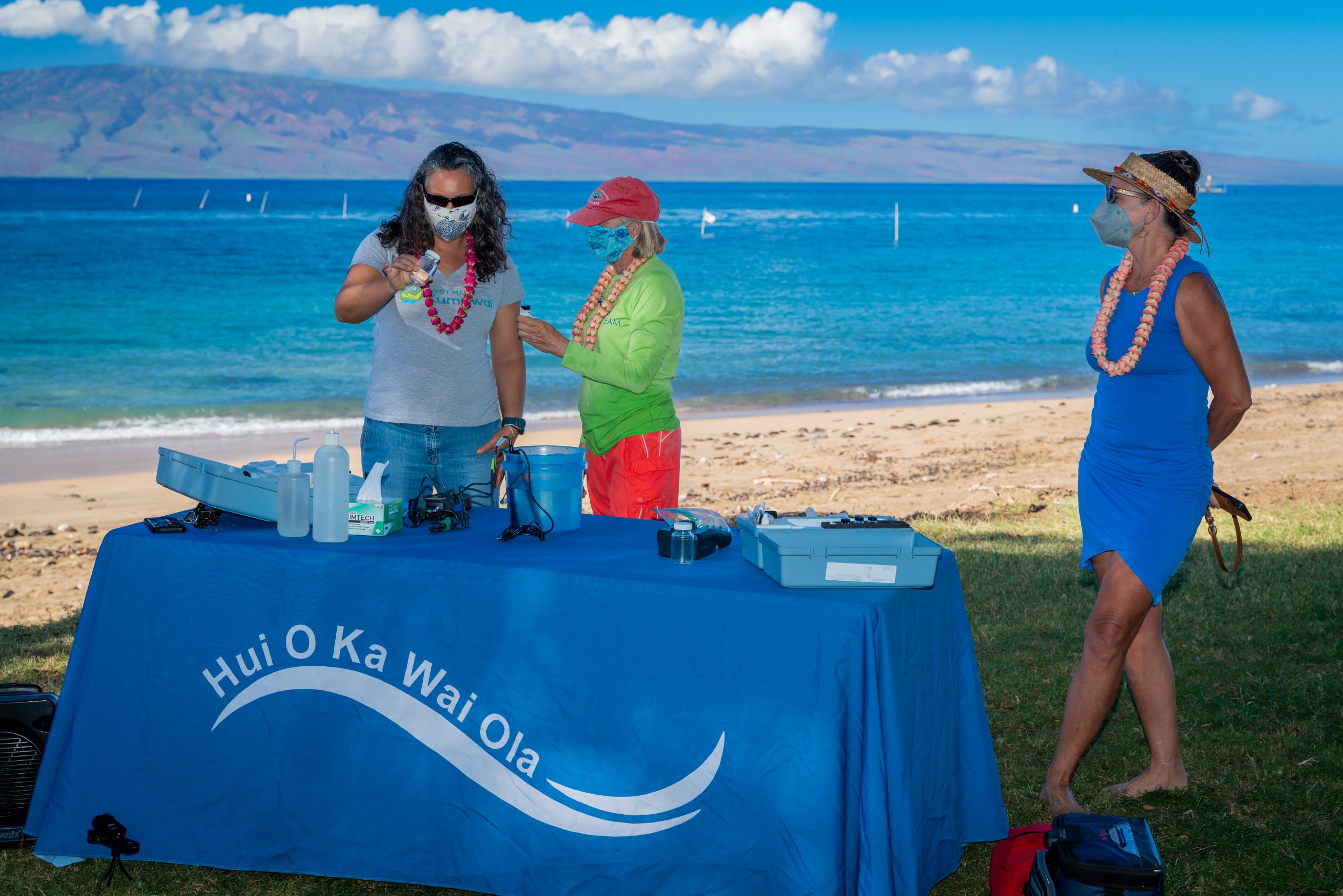
Maui County Councilmember Tamara Paltin and volunteer Kit Harris test a water sample while Hawaii Representative (and a former Hui O Ka Wai Ola volunteer) Tina Wildberger looks on.

Photo by Ty Freiberg
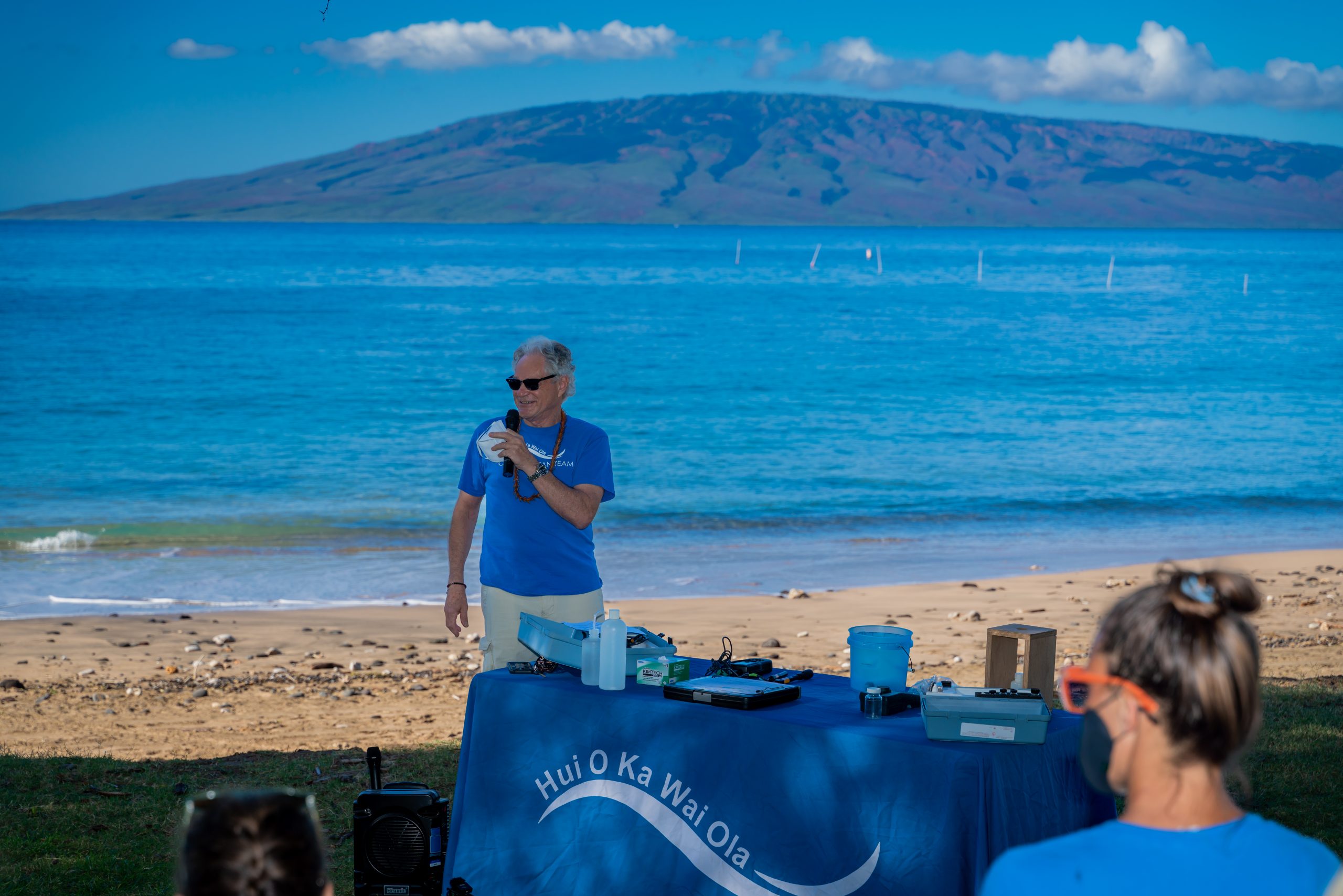
Maui Nui Marine Resource Council Executive Director Mike Fogarty thanks the volunteers and announces a special gift for each one donated from Duke’s Maui.

Photo by Ty Freiberg
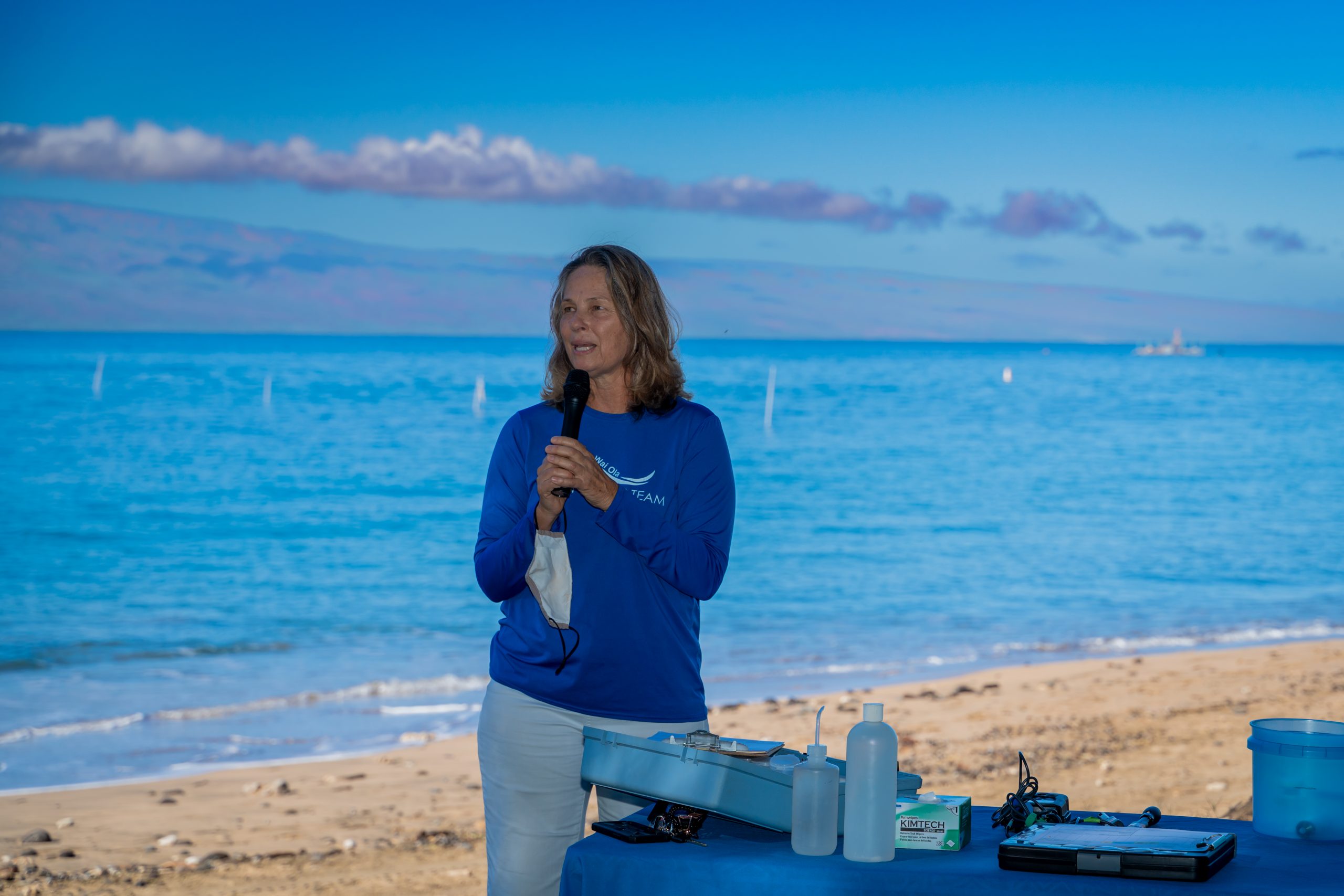
Emily Fielding, Maui Marine Program Manager at The Nature Conservancy, speaks about the partnership between The Nature Conservancy, Maui Nui Marine Resource Council and West Maui Ridge to Reef Initiative that co-founded and co-manages the Hui O Ka Wai Ola ocean water quality monitoring program.

Photo by Ty Freiberg

 

PacIOOS Water Quality Sensor Partnership Program Enhances Maui Nui Marine Resource Council’s Water Quality Monitoring in Māʻalaea Harbor

in /by


MĀʻALAEA, HI – Maui Nui Marine Resource Council’s ocean water quality monitoring efforts in Māʻalaea Harbor are being helped by a new underwater data sensor that the organization has borrowed through the Pacific Islands Ocean Observing System (PacIOOS) Water Quality Sensor Partnership Program. The new data sensor collects data every five minutes on water temperature, salinity, turbidity, chlorophyll and ocean depth.

The PacIOOS program supports scientists and natural resource managers to collect water quality data in order to inform research, conservation, planning, and resource management projects in the U.S. Pacific Islands region. The data sensor is owned and maintained by PacIOOS under the supervision of Dr. Margaret McManus, Chairwoman of the Department of Oceanography at the University of Hawai‘i at Mānoa.

“We are grateful to PacIOOS for the use of this data sensor that will help us learn more about the effects of tides, swell, rain events, and runoff on water quality within Māʻalaea Harbor and to monitor water quality variability over time,” reports Amy Hodges, Programs and Operations Manager at Maui Nui Marine Resource Council.

Mounted 1 or 2 meters below the ocean’s surface, the sensor package is relocated by divers from Maui Nui Marine Resource team to a new site within the harbor about once per month. The sensor package was installed in 2020 and is scheduled to be used in Māʻalaea Harbor through 2021.

The PacIOOS data sensor will help guide Maui Nui Marine Resource Council as it implements its watershed management plan, which aims to reduce sediment and pollutants in Māʻalaea Bay and its harbor. Professor Margaret McManus

“In recent decades, declining ocean water quality has led to significant deterioration of Māʻalaea Bay’s reefs,” says Hodges. “Monitoring by the community-based program Hui O Ka Wai Ola — which was co-founded and is co-managed by Maui Nui Marine Resource Council, The Nature Conservancy and West Maui Ridge to Reef Initiative —  using ocean water samples grabbed from the ocean edge has shown turbidity (sediment) and excessive nitrogen as primary causes of impaired water quality.”

Maui Nui Marine Resource Council’s staff also assist with gathering ocean water quality “grab samples” from the shore. All combined, the Hui O Ka Wai Ola sampling and the MNMRC staff grab sampling results in data from 5-10 sites every three weeks in Māʻalaea Harbor.

Maui Nui Marine Resource Council has also been using a Manta data sonde, purchased with a grant from LUSH cosmetics, to gather water quality data in the Harbor. The sonde is towed behind a kayak and records real time data as it is pulled through varying depths through the water.

The organization has also been testing the nitrogen isotope ratios (δ15N values) in macroalgae (limu) tissue to determine the possible sources of nitrogen pollution in the harbor and the bay. Other ongoing testing in Māʻalaea Bay conducted by MNMRC includes current drift analysis studies, underwater coral cover and fish transects, and stormwater sampling.

To address Māʻalaea’s sediment issues, MNMRC is working to improve stormwater management in the 4,000 acre Pohakea watershed adjoining Mā‘alaea Bay. In 2018, MNMRC commissioned Maui Environmental Consulting (MEC) to create the Pohakea Stormwater Management Plan following meetings with Hawai‘i Division of Forestry and Wildlife (DOFAW), Māʻalaea Village Association, Maui Ocean Center and other stakeholders.

MNMRC has been enacting the priorities in this plan. In 2020, MNMRC installed firebreaks in Pohakea watershed to suppress frequent wildfires that occur in this windy, dry region, causing loss of vegetative cover that helps hold soil in place and prevents erosion. Partners included DOFAW, Maui Electric Co. and Goodfellow Bros. Inc.

MNMRC and Maui Environmental Consulting began monitoring headcuts (erosional features) in 2020 to quantify soil loss at four of the most severely eroded sites in the Pohakea watershed nearest the harbor. Their monitoring showed a loss of an estimated 64,050 pounds, or 32 tons, of soil from just two head cut locations in a single moderate rainstorm in January 2021. The lost soil was likely transported via culverts directly into the ocean, contributing to a severe brown water event in Māʻalaea Bay.  MNMRC is now working to obtain funding to work with Maui Environmental Consulting and Goodfellow Bros. to repair two of the most severe head cut locations to reduce the sediment runoff.

Maui Nui Marine Resource Council launched an oyster bioremediation project in Māʻalaea Bay in 2020 to utilize caged oysters as a natural method of water filtration. A single oyster can filter up to 50 gallons of ocean water per day, removing sediment and pollutants. During 2020, MNMRC installed more than 10,000 oysters and conducts periodic monitoring to assess their growth rates and health. Data from the PacIOOS data sensor will help measure changing ocean water quality conditions in response to the oyster program.

“The progress of our projects to clean up Māʻalaea Bay’s water quality will be measured by resulting data from the PacIOOS data sensor and our other monitoring methods,” says Hodges. “We to see evidence of improved ocean water quality, through reductions in sediment and excess nitrogen, an essential step in restoring coral cover and reef health in Māʻalaea Harbor and in the bay.”

To learn more about the PacIOOS Water Quality Sensor Partnership Program and view data, visit https://www.pacioos.hawaii.edu/water/sensor-maalaea/#about.

Founded in 2007, Maui Nui Marine Resource Council is a nonprofit 501(c)(3) organization working for clean ocean water, healthy coral reefs and abundant native fish for the islands of Maui County. To learn more, visit www.mauireefs.org.


CAPTION: Maui Nui Marine Resource Council’s Grace Silver helps to prepare a site in Mā’alaea Harbor for the data sensor on loan from PacIOOS.

Hui O Ka Wai Ola Research Report

in /by

Research Report:
Changes in Water Quality During a 12-Hour Period at Two Maui Beaches

This research report was prepared by the Hui O Ka Wai Ola ocean water quality monitoring team. To learn more about this program, please visit huiokawaiola.com.

To better understand how tide change influences water quality, a group of Hui O Ka Wai Ola Team Leaders spent a full day in December 2019 (approximately 12 hours) measuring water quality parameters hourly at Cove Park in South Maui and Hanaka‘ō‘ō Park in West Maui – a deviation from the Hui’s usual practice of monitoring 41 sites once every three weeks only in the morning.

During this one-day study, we measured nutrient levels. We also measure nutrient levels as part of our regular ocean water quality monitoring year-round. Nutrients, including nitrogen and phosphorus, can indicate pollution from wastewater, run-off from agriculture, landscaping and/or golf courses. Once in the ocean, these nutrients can lead to an overgrowth of algae. Algae, particularly invasive species, quickly out-compete corals for sunlight and overrun large tracts of living reef.

Nutrient values can vary a lot over the course of a tide cycle — low nutrient levels at high tide and higher nutrient levels at low tide. Sites with higher nutrient levels acquire these nutrients via ground water that comes into the ocean as underground “springs.”

The fact that there is fresh water coming in from underground springs over the course of a day is shown by the change in salinity readings. This explains the ever-shifting levels that we see from the data we collect once every three weeks at each site.

During our one day experiment we took 4 nutrient samples, with the first sample at high tide and the last sample near low tide. The accompanying chart shows how salinity decreases as the tide goes out and the fresh water from underground springs comes in, while the nitrate levels increase as the amount of fresh water increases.

Our ongoing Hui O Ka Wai Ola water quality sampling program was designed to catch a variety of tide states so that we can understand not only the average level of nutrients but also the range of nutrient levels each site exhibits.


Another interesting observation is that other parameters vary during the day as well — temperature rises as the sun comes up and heats the top layer of water and then starts to decrease as the sun goes down or if clouds come over. During our one-day experiment, temperatures varied over 2 degrees centigrade during the course of the day.

With our ongoing water quality monitoring, we are careful that we measure this parameter at each site at approximately the same time of day every time we sample so that seasonal temperature variations can be distinguished from diurnal variations.

Finally, dissolved oxygen (DO) and pH levels also vary across the course of a day. Dissolved oxygen is needed for aquatic plants and animals to survive. Corals are very sensitive to changes in ocean chemistry, including increased ocean water acidity (which results in a drop in pH levels).

During our 12-hour study, we found that in Cove Park and Hanaka‘ō‘ō Park these diurnal variations are not as obvious because of the influx of fresh ground water as the tide is going out which also affects levels of pH and DO. In general, pH and DO are at their lowest levels just as the sun rises due to the fact that photosynthesis has not been taking place overnight. CO2 levels rise at night as marine organisms respire, taking in oxygen and producing CO2. There is no photosynthesis at night so as CO2 levels rise, the water becomes more acidic and pH levels drop. Dissolved oxygen also drops because of a lack of photosynthesis that generates oxygen as a bi-product. Once the sun begins to rise, photosynthesis begins again, and the pH and DO levels rise.

Please visit again for more reports from the field. Learn more about Hui O Ka Wai Ola at www.huiokawaiola.com.


Hui O Ka Wai Ola Ocean Water Quality Testing Program Expands Again – Now Testing 48 Maui Sites

1 Comment/in /by

The volunteer-based Hui O Ka Wai Ola ocean water quality testing program has expanded again, with the addition of 12 more testing sites in South Maui in early March 2018.  With this expansion, the program is now covering 48 shoreline locations where trained volunteers routinely test water quality on Maui every 2 to 3 weeks.

The Hui O Ka Wai Ola program, whose name means “Association of the Living Waters,” is the first community-based water quality monitoring to measure for nutrients (including nitrogen and phosphorus), along with turbidity, salinity, dissolved oxygen, pH and temperature in Maui’s coastal waters.

The program first launched in June 2016 in West Maui with 17 sites. One West Maui site was added in February 2017 (Napili Bay), and 6 additional West Maui sites were added in June 2017.

The program expanded to include a dozen new test sites in South Maui in November 2017. The latest expansion in 2018 added another 12 South Maui sites. In all, the group of volunteers are testing 48 sites on Maui.

A Partnership at Work
The program is made possible through the volunteers’ efforts and a joint partnership of Maui Nui Marine Resource Council, The Nature Conservancy, West Maui Ridge to Reef Initiative and the State of Hawaii Department of Health. Financial support for the program is provided by the partners, along with the County of Maui Office of Economic Development, National Fish and Wildlife Foundation, North Beach West Maui Benefit Fund, Napili Bay and Beach Foundation, Pride of Maui, Maui Ocean Center and individual donors and supporters

“Our goal is to support the State of Hawaii Department of Health and Maui County efforts to improve coastal water quality so that coral reefs and native fish populations thrive, and our residents and visitors are safe,” said Robin Newbold, co-founder and chairwoman of the Maui Nui Marine Resource Council. “We want to help identify problem areas, so remedial action may be taken as needed.”

Trained Volunteers and a Quality Assurance Plan
To prepare for the expansion in March, a group of ten new volunteers completed intensive training in the classroom, in the lab and in the field. The volunteers work under the guidance of experienced team leaders and regional coordinators. The sampling follows strict guidelines set under a Quality Assurance plan approved by the Department of Health. A QA officer reviews the data before it is submitted.

The volunteers bring equipment to the field for onsite testing; they also freeze and ship water samples to the SOEST (UH School of Ocean and Earth Science and Technology) laboratory on Oahu for additional analysis.

Poor Water Quality Undermines the Health of our Reefs
Hui O Ka Wai Ola’s program tests water samples for nutrients, such as nitrogen and phosphorous compounds, which can indicate pollution from wastewater and runoff from agriculture, landscaping and golf courses. High nutrient content in the water can cause an increase in growth of invasive algae, which could damage coral reefs.

In addition, research has shown that sustained, nutrient rich, lower pH submarine groundwater discharging onto nearshore coral reefs off West Maui lowers the pH of seawater and exposes corals to nitrate concentrations 50 times higher than normal. Rates of coral calcification — the rate at which coral polyps produce calcium carbonate which forms the hard structure of the reef — are substantially decreased. As a result, the reef degrades faster and the reef ecosystem is more likely to collapse.

“With many of Maui’s coral reefs in significant decline, it is critical that we reduce stressors to our reefs on a local scale as quickly as possible,” notes Tova Callender, coordinator supporting the West Maui Ridge to Reef Initiative. “Our water quality studies will help us understand the source of pollutants, which is the first step in addressing the stress to the reefs caused by impaired water quality and will hopefully make our reefs more resilient to climate change.“

Data provided by Hui O Ka Wai Ola will be used to supplement Health Department water quality monitoring on Maui and can be viewed on the group’s website, www.huiokawaiola.com.

A State of Hawaii Department of Health employee tests water quality for enterococcus bacteria, a marker for potentially harmful bacteria in the water, The additional nutrient data provided by Hui O Ka Wai Ola provides an enhanced view of changing water quality conditions that can harm coral reefs and humans.

Community Support Sought
The cost of testing for each site is about $3,800 per year, which includes analysis and the shipping of samples to Oahu. Maui Nui Marine Resource Center is asking companies, canoe clubs, community organizations and individuals to each sponsor a site with a $3,800 donation. To donate, visit https://www.mauireefs.org/membership-and-giving/adopt-a-beach/

The goal of Hui O Ka Wai Ola is to bring more awareness to local coastal water quality issues and support better-informed decisions and policies regarding water quality.

To learn more, visit HuiOKaWaiOla.com.