Posts

Free Talk: “Dr. Dolittle Meets CSI on the Coral Reefs of Maui” on September 5, 2018

in , /by

Forensics and diagnostics are all part of the scientific study of coral reefs, which is why Bob Richmond Ph.D., Research Professor and Director of Kewalo Marine Laboratory at the University of Hawaii at Manoa, will be presenting a free talk titled, “Dr. Dolittle Meets CSI on the Coral Reefs of Maui” at the upcoming September 5 meeting of the Maui Nui Marine Resource Council. This event will take place from 5:30 to 7:30 pm at Pacific Whale Foundation’s classrooms at the ocean-facing lower level of the Ma’alaea Harbor Shops, 300 Ma’alaea Road, Ma’alaea (next to Maui Ocean Center).
Dr. Richmond’s talk will explain how his team is using diagnostics and forensics to identify causes of stress to Maui’s reefs at Olowalu, Waihikuli, amd Honokowai, along with ways to enhance the reef’s resistance to these stressors.

Dr. Richmond’s childhood fascination with Dr. Dolittle helped inspire his approach to studying reefs by “listening” to coral reefs and other reef creatures through the use of ecological indicators and molecular biomarkers.

“Maui has some of the most well developed coral reefs in the Main Hawaiian Islands, but these have been negatively affected by local and global stressors including land-based sources of pollution and sedimentation from watershed discharges, overfishing, and bleaching due to climate change,” said Dr. Richmond.

“Our research blends traditional ecological knowledge with ecology and molecular biology to both diagnose and treat the causes of coral reef decline,” he noted. “Our approach can best be described as Dr. Dolittle meets CSI (crime scene investigations) on coral reefs and uses a combination of diagnostics and forensics.”

“The results of our reef studies on reefs at Waihikuli, Honokowai and Olowalu will be presented and ideas for helping these reefs recover will be discussed,” he said.
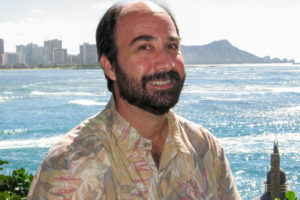
Dr. Richmond is the Chair of the Maui Coral Reef Recovery Team, a group of Hawaii’s most recognized coral reef scientists, resource managers, fishers, cultural advisors and communitymembers, first convened by Maui Nui Marine Resource Council in 2010. The group wrote the Maui Coral Reef Recovery Plan, a 101-page science-based plan that outlines specific goals and steps to protect Maui’s coral reefs. Team members continue to meet regularly to provide guidance and monitor progress toward implementing the plan.

Dr. Richmond has spent the majority of his professional career studying coral reefs in Micronesia, Hawaii, Japan, Central America, the Galapagos Islands and the Caribbean. His research interests are in the area of marine conservation biology, with a focus on coral reefs. His research programs include studies of coral reproductive biology, ecotoxicology, coral reef ecology, the impacts of climate change and bridging sound science to policy development and implementation.

Dr. Richmond received a Ph.D. in Biological Sciences from the Dept. of Ecology and Evolution, SUNY at Stony Brook, and subsequently spent two years as a postdoctoral fellow at the Smithsonian Tropical Research Institute in Panama, 18 years on the faculty of the University of Guam Marine Laboratory, and has been a Research Professor at the Pacific Biosciences Research Center, University of Hawaii at Manoa, since 2004.

Maui Nui Marine Resource Council is funding Dr. Richmond’s studies of corals in Olowalu and Ma’alaea. A nonprofit organization founded in 2007, Maui Nui Marine Resource Council is working for clean ocean water, healthy coral reefs and an abundance of native fish for the islands of Maui County. To learn more, visit www.mauireefs.org.
View movie about this talk.

How the 2015 bleaching event impacted Maui’s corals

in /by

Maui Nui Marine Resource Council was honored to host a presentation by Russell Sparks, Aquatic Biologist, State of Hawaii’s Department of Aquatic Resources ( Department of Land and Natural Resources) at our March 2018 meeting.

Sparks presented reports on the toll of the 2015 coral bleaching event that occurred in Hawai’i and worldwide due to El Nino conditions.

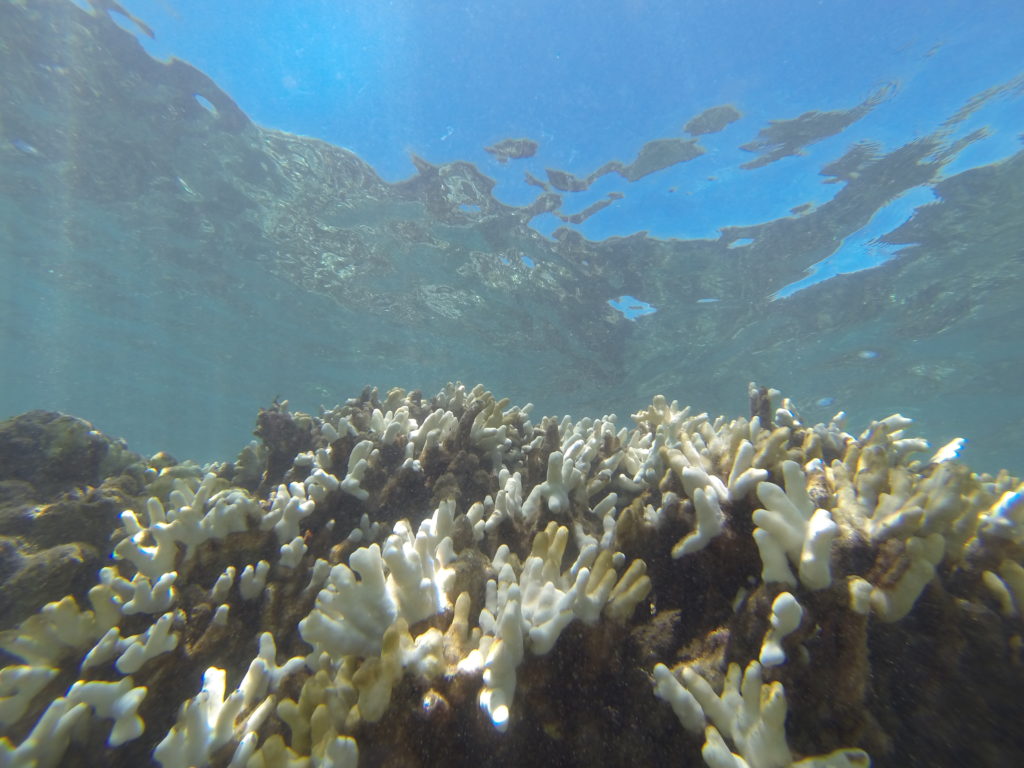
Sheltered from cooling breezes and waves, Maui’s leeward shores saw especially warm ocean conditions in 2015 and bleaching events were widespread. That summer, biologists watched in horror as a massive 400 year old coral nicknamed “Big Mama” succumbed to bleaching and perished in November of 2015.

DCIM100GOPRO

Sparks noted that almost all of the cauliflower coral off Maui’s coasts bleached. Lobe coral suffered the most impacts of bleaching and bleaching-related deaths. Smaller colonies of corals had higher rates of mortality, while bigger colonies showed more fragmentation during the bleaching event.

Biologists noted that some reefs did not die, and are striving to learn why they showed greater resistance.

Following this event, marine biologists have noted that there’s been a shift toward smaller sized coral colonies across the leeward nearshore areas of Maui.

In order for corals to adapt and survive into the future with the ongoing global warming concerns, we all need to do more to help reefs develop resiliency to these changes.  Corals can survive and adapt if we reduce local threats such as overfishing, sedimentation and nutrient pollution.  Support local efforts to address these man made local threats and coral reefs should better adjust to the warming world oceans.

Learn more about why corals bleach. 

Please follow this link to learn more about MNMRC’s work for clean ocean water to give our corals the best environment possible for survival.

Why do corals bleach?

in /by


There are many news stories about coral bleaching that’s occurring around the world. But what exactly is coral bleaching — and what can you do about it?

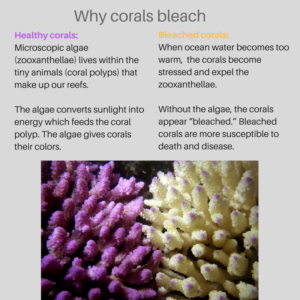
To understand, we need to look at the mutually beneficial (symbiotic) relationship that corals have with a type of microscopic one-celled algae known as zooxanthellae.

The algae lives right within the tiny living animals known as coral polyps that make up our reefs. The corals provide a home for the algae. In turn, the algae converts sunlight into energy and provides that nourishment to the coral polyp. The algae also gives corals their colors. It’s a win-win for both the coral polyp and the algae.

DCIM100GOPRO


Corals do best when ocean water is between 73 degrees F and 84 degrees  F. If the water becomes too warm or if it contains toxic chemicals, the corals expel their symbiotic algae. Without the algae, the corals appear white or “bleached.”

Unfortunately, bleached corals are more susceptible to death and disease.

Severe bleaching events occurred in Hawaii in 2014 and 2015, when ocean temperatures reached 88 degrees F.

In August 2014, warm weather in the North Pacific Ocean caused bleaching throughout the Hawaiian islands. More severe bleaching occurred in the summer of 2015.

Official reports state that 20 to 40% of Maui’s corals were lost following the 2015 bleaching event.

What can you do to prevent coral bleaching?

First, become an advocate in the fight to stop climate change. Do all you can to reduce your carbon footprint. Install a solar PV system at your home. Switch to LED lights. Buy a fuel-efficient hybrid or an electric car fueled with solar power. Drive less, and bike or walk more. Choose foods from local farms or local sources. Eat one or more vegetarian meals per week.

Second, help address other serious causes of stress to our coral reefs. For example, sediment run-off and near shore ocean water pollution are not international problems. These problems begin right here on the islands of Maui County and can be solved right here by people working together.

Last, avoid sunscreens with oxybenzone and octinoxate, two chemicals known to damage or kill corals. For more info visit here.

Learn more! Read the State of Hawaii Coral Bleaching Recovery Plan.