Posts

Free Presentation to Discuss Redefining the Definition of a Public Aquarium – and What it Means to Our Local Community

in /by

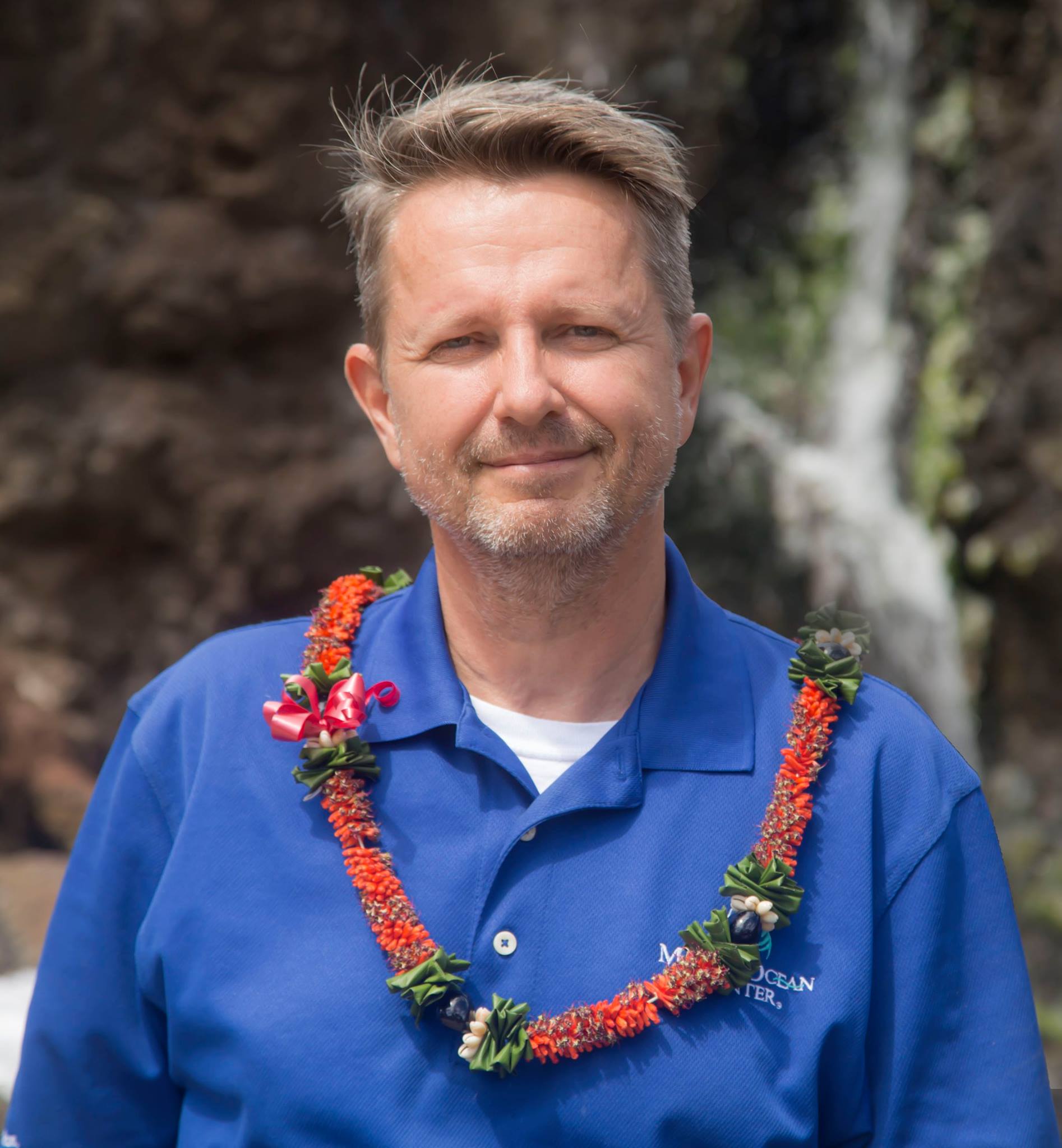
KIHEI— A free Zoom presentation on Wednesday, January 12 at 5:30 pm by Tapani Vuori, Maui Ocean Center’s General Manager and founder and president of the Maui Ocean Center Marine Institute (MOCMI) will discuss “Redefining the definition of a public aquarium and what it means to our local community.”

Vuoriʻs presentation is part of Maui Nui Marine Resource Council’s monthly “Know Your Ocean Speaker Series.” His talk will look at the history of Maui Ocean Center, its operational details and its journey of transformation over the past few years, driven by Maui Ocean Centerʻs vision and mission.
Reservations are required. To reserve, visit https://bit.ly/OceanCenterWebinar

Vuori will discuss Maui Ocean Centerʻs role in the community in Māʻalaea and its stated responsibility first and foremost to add value to the community every day.

“I will discuss topics such as aquarium and zoo industry in general, plastic marine debris, shark finning, climate change, tourism, and environmental threats to nearshore marine ecosystems,” says Vuori. “I’ll share with the audience what Maui Ocean Center is doing about all of these issues — and why our aquarium and others around the world need to take action on the problems impacting our planetʻs oceans.”

Vuori draws inspiration from world-renowned scientist and ocean protector Dr. Sylvia Earle, who said, “the oceans deserve our respect and care, but you have to know something before you can care about it.” Vuori notes that Earleʻs powerful message is the driving force behind the energy he brings to Maui Ocean Center each day, and his goal to educate people and get them to care about the creatures beneath the oceanʻs surface.

Vuori grew up in Finland, where he formed a powerful connection with nature and the ocean — a bond he has carried throughout his life. He got his diving license as a young child and as a boy experienced the wonder of diving in winter beneath an ice-covered surface. As a young adult, Vuori moved to the U.S. to attend college, starting at Brigham Young University in Utah and graduating from UCLA in 1987.

When Vuori accepted the position as Maui Ocean Center’s general manager, he had one request — to build an on-property nonprofit 501(c)(3) organization to support conservation efforts further. Through his efforts and vision, Vuori became the founder and president of the Maui Ocean Center Marine Institute (MOCMI), which serves to restore Hawaiʻiʻs coral reefs and rehabilitate injured Hawaiian green sea turtles.

Today, Vuori works from all angles to protect marine life and is deeply involved in Mauiʻs island community. In addition to his contribution at MOCMI, Vuori is an active board member of Māʻalaea Triangle Association, vice president of the Māʻalaea Village Community Association, and president of the advisory council for Maui County on Civil Rights. Vuori is also working to establish a regional wastewater treatment center for Māʻalaea Bay to replace the nutrient leaching injection wells that have caused widespread loss of coral reef and limu in the bay.

“My hope is that this talk will inspire our audience to become more active in their community, where ever it may be,” says Vuori.

Maui Nui Marine Resource Council’s monthly “Know Your Ocean Speaker Series” events are supported by the County of Maui Mayor’s Office of Economic Development.

To learn more about Maui Ocean Center, visit www.mauioceancenter.com.

To learn more about Maui Nui Marine Resource Council, visit www.mauireefs.org.

Reserve your spot for this presentation at https://bit.ly/OceanCenterWebinar.
Free Talk “Spying on Spinners: What We Can Learn From Listening” Focuses on Study of Spinner Dolphins of Maui, Moloka‘i, Lāna‘i, and the ‘Au‘au channel

in /by

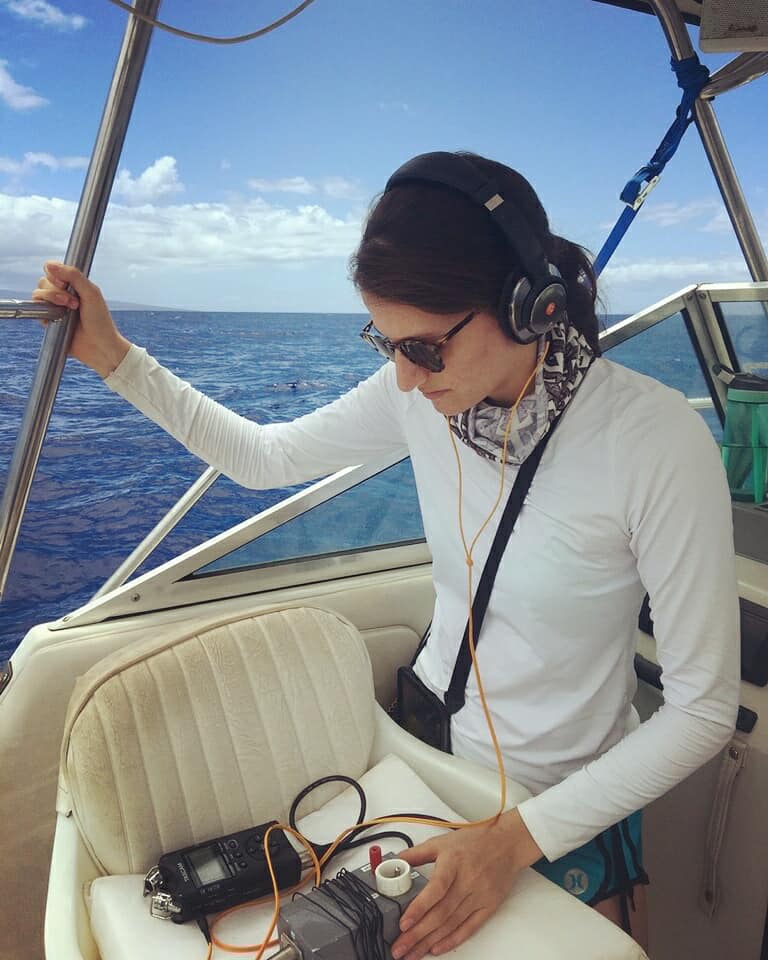
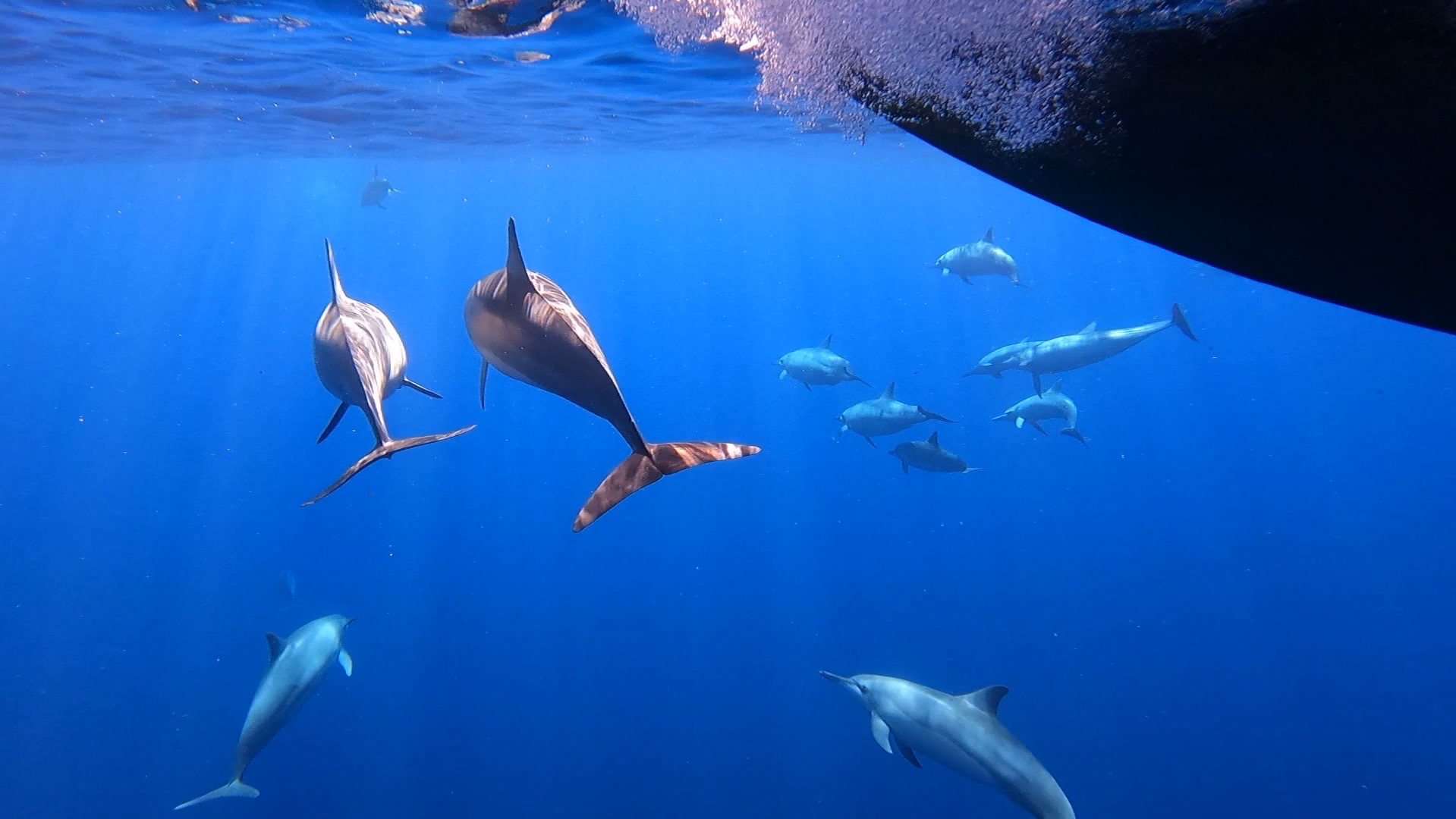
KIHEI—  A free presentation called “Spying on Spinners: What We Can Learn from Listening” on Wednesday, Oct. 13 at 5:30 p.m. via Zoom will take a look at research conducted in the Maui Nui region (Maui, Moloka‘i, Lāna‘i and the ‘Au‘au Channel) that listened to spinner dolphins to learn more about their behaviors.  Reserve your spot. 

The presentation is part of Maui Nui Marine Resource Council’s monthly Know Your Ocean Speaker Series.

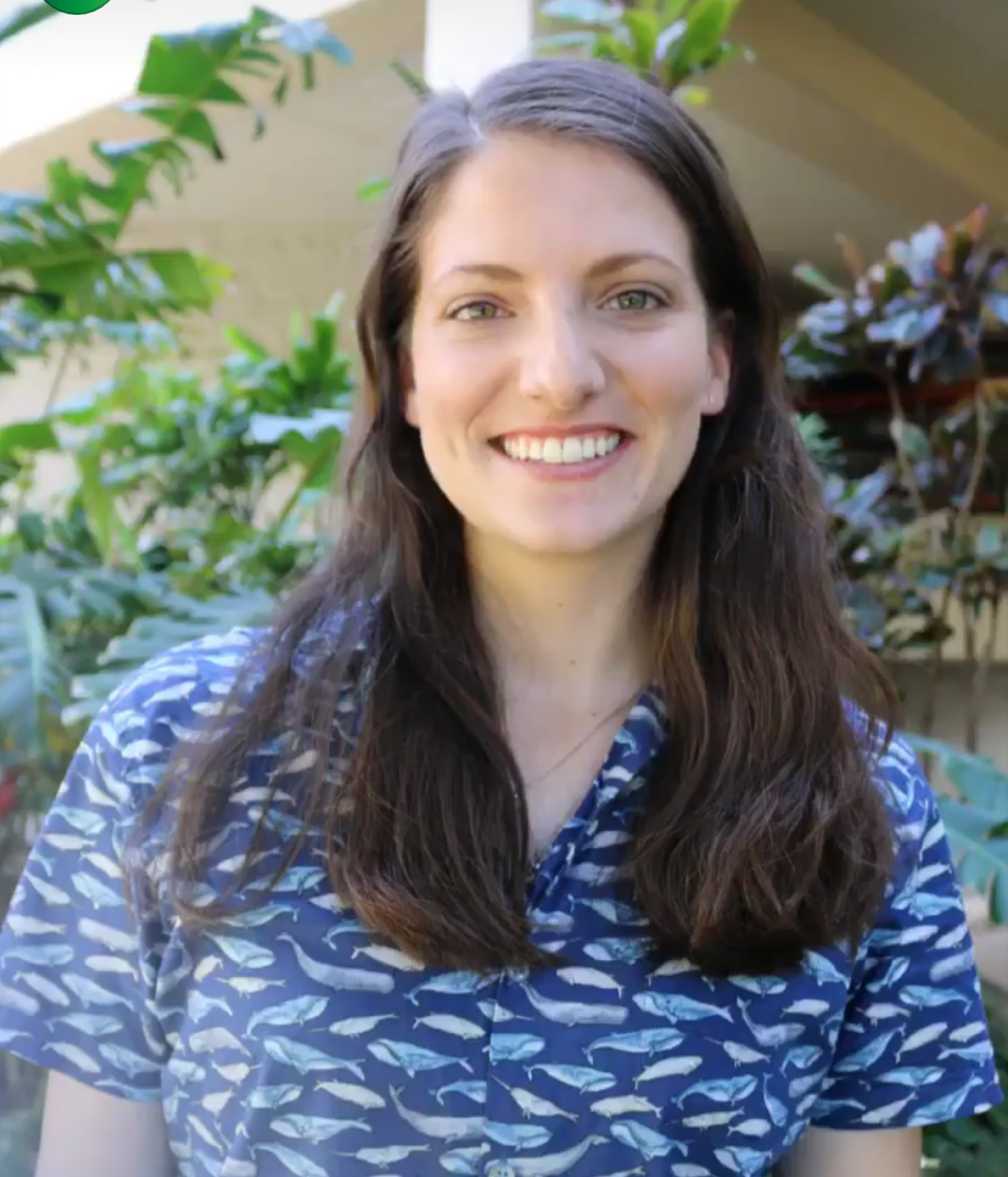
Megan McElligott, a fourth-year doctoral candidate at the University of Hawaiʻi at Mānoa in the Marine Biology Graduate Program, will be the guest speaker. She will discuss her recent work for her master’s thesis, titled “Investigating Spinner Dolphin (Stenella longirostris) Occurrence and Acoustic Activity in the Maui Nui Region” which was recently published in Frontiers in Marine Science. 

She will discuss how the acoustic recordings in her study confirmed that spinner dolphins use Mānele Bay and Honolua Bay for their daily resting behavior, as well as their use of the ʻAuʻau channel for resting.

“Hawaiian spinner dolphins rest during the day in the islands’ coastal waters where they are susceptible to human disturbance,” reports McElligott. She notes that spinner dolphins are nocturnal and hunt in offshore waters at night. During the day, they use areas close to shore to socialize, nurture their young, shelter from predators, and rest in preparation for nightly hunting.

The goal of McElligott’s research is to help wildlife managers determine the best ways to protect spinner dolphins from human disturbance.

McElligott’s research was one of the studies examined by NOAA Fisheries leading up to their new rule finalized on September 28, 2021  that prohibits swimming with, approaching, or remaining within 50 yards of a Hawaiian spinner dolphin. The rule applies to any vessel, person, or object (including all boats, canoes, stand-up paddleboards, drones, or any other means) that is within 2 nautical miles from shore in the main Hawaiian Islands and in designated waters bounded by the islands of Lāna‘i, Maui, and Kahoʻolawe. This final rule will officially be in effect on October 28, 2021, 30 days after it was published in the Federal Register. Learn more about this new law and its exceptions at https://www.fisheries.noaa.gov/feature-story/new-regulation-protects-hawaiian-spinner-dolphins-against-disturbance.

McElligott’s study was conducted using a combination of passive acoustic monitoring and vessel surveys to document spinner dolphin occurrence and movements. Bottom-moored acoustic recorders were deployed at eight locations in Maui Nui, and at one previously established resting bay off west O‘ahu for comparison. The amount of whistles, clicks, and burst pulses at each location was quantified and averaged by the hour of the day.

“What we observed in Maui Nui is different from what we see off Oʻahu and Hawaiʻi island,” says McElligott. “I will also talk about what we aim to investigate with our current data collection efforts in Mānele, Hulopoʻe, and Honolua.”

To learn more this species’ behavior and McElligott’s research, tune in to Maui Nui Marine Resource Council’s “Know Your Ocean Speaker Series” on Oct. 12 at 5:30 p.m. via Zoom.
These monthly virtual events are supported by the County of Maui Mayor’s Office of Economic Development.|

The event’s emcee will be Darla Palmer-Ellingson, local radio show host of the public affairs program, Island Environment 360 Maui’s only commercially broadcast public affairs show on environmental and related Hawaiian cultural topics, aired on the stations of H-Hawaii Media.

NOAA Fisheries is also proposing to establish time-area closures to reduce disturbance in five nearshore areas designated as essential daytime habitats for spinner dolphins. This regulation would prohibit entering restricted areas between 6 a.m. and 3 p.m. daily in parts of Kealakekua, Hōnaunau, Kauhakō (Ho‘okena), and Makako Bays on Hawai‘i Island, and La Perouse Bay on Maui.

Since this is a proposed rule, a decision on whether to finalize the rule will not happen until after the public has an opportunity to comment. The public comment period for the proposed time-area closures will be open until December 27, 2021, 90 days after publication in the Federal Register. To learn more, visit https://www.fisheries.noaa.gov/action/proposed-rule-establish-time-area-closures-hawaiian-spinner-dolphins-essential-habitats-main

Reserve your spot for this presentation.


“A Closer Look at Hawaiʻi’s Sea Turtles” is Topic of Sept. 9 “Know Your Ocean Speaker Series” Webinar

in , /by

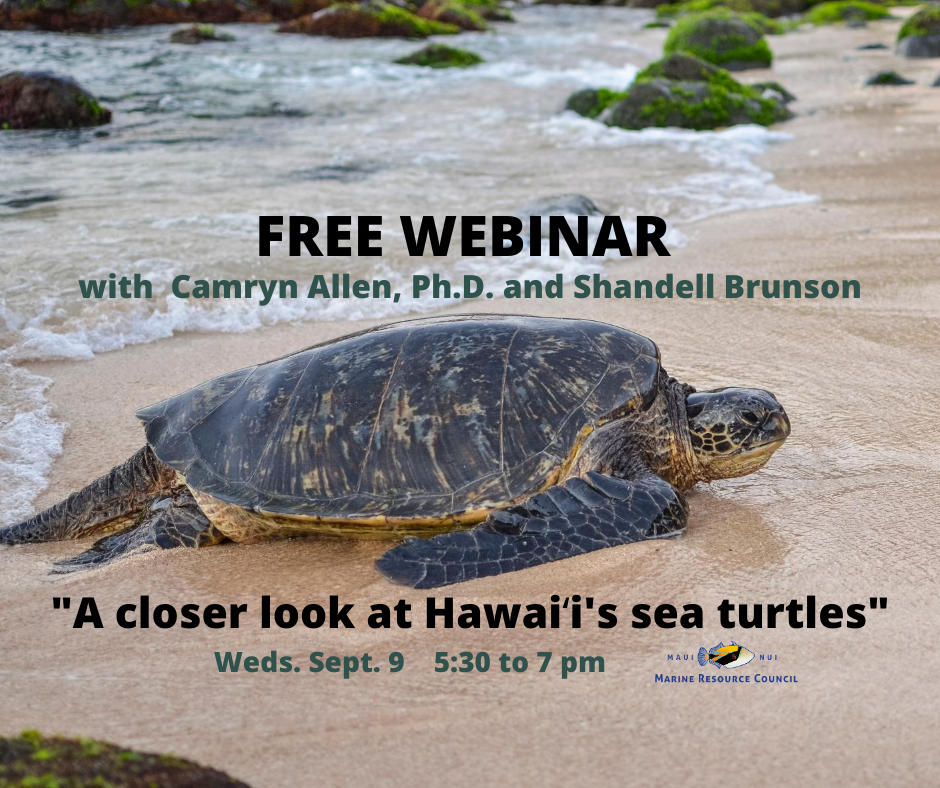
A free Zoom webinar offering “A Closer Look at Hawaiʻiʻs Sea Turtles” will be presented on Wednesday, September 9 from 5:30 to 7 pm Hawaii Standard Time as part of Maui Nui Marine Resource Councilʻs  monthly “Know Your Ocean Speaker Series.” It will also air via Facebook Live at facebook.com/mnmrc, the Facebook page of Maui Nui Marine Resource Council.

The talk will feature presentations by Dr. Camryn Allen, a NOAA wildlife endocrinologist,  and Shandell Brunson, NOAA’s sea turtle stranding coordinator for Hawaiʻi and the Pacific Islands region.

Dr. Allen is the Supervisory Marine Biological Researcher (JIMAR) at the Joint Institute for Marine and Atmospheric Research at NOAA Fisheries Pacific Island Fisheries Science Center in the Protected Species Division. She created a sea turtle endocrinology laboratory to examine sex ratios of sea turtles in the wild.  Her talk will present findings on the ratio of male vs. female turtles at foraging grounds — and what that means for the potential impacts of climate change on our sea turtle populations.

Shandell Brunson is a biological sciences technician with the Marine Turtle Biology and Assessment Program and is NOAA’s sea turtle stranding coordinator for Hawaiʻi and the Pacific Islands region. She will share findings from sea turtle strandings in Hawai’i, including what’s being learned about threats from strandings, rehabilitations and deaths.

Our guest emcee is Darla Palmer-Ellingson, local radio show host of the public affairs program, Island Environment 360 Maui’s only commercially broadcast public affairs show on environmental and related Hawaiian cultural topics. The program is made possible by H-Hawaii Media.

This free online event is part of Maui Nui Marine Resource Councilʻs “Know Your Ocean Speaker Series” and is made possible with support from the County of Maui Mayorʻs Office of Economic Development.

Advance reservations are for the Zoom webinar.  To make your free reservation, please visit https://bit.ly/HawaiiSeaTurtles.

The talk will also be presented on Maui Nui Marine Resource Councilʻs Facebook Live page at https://www.facebook.com/MNMRC.

Questions will be accepted from the audience on both Zoom and Facebook.


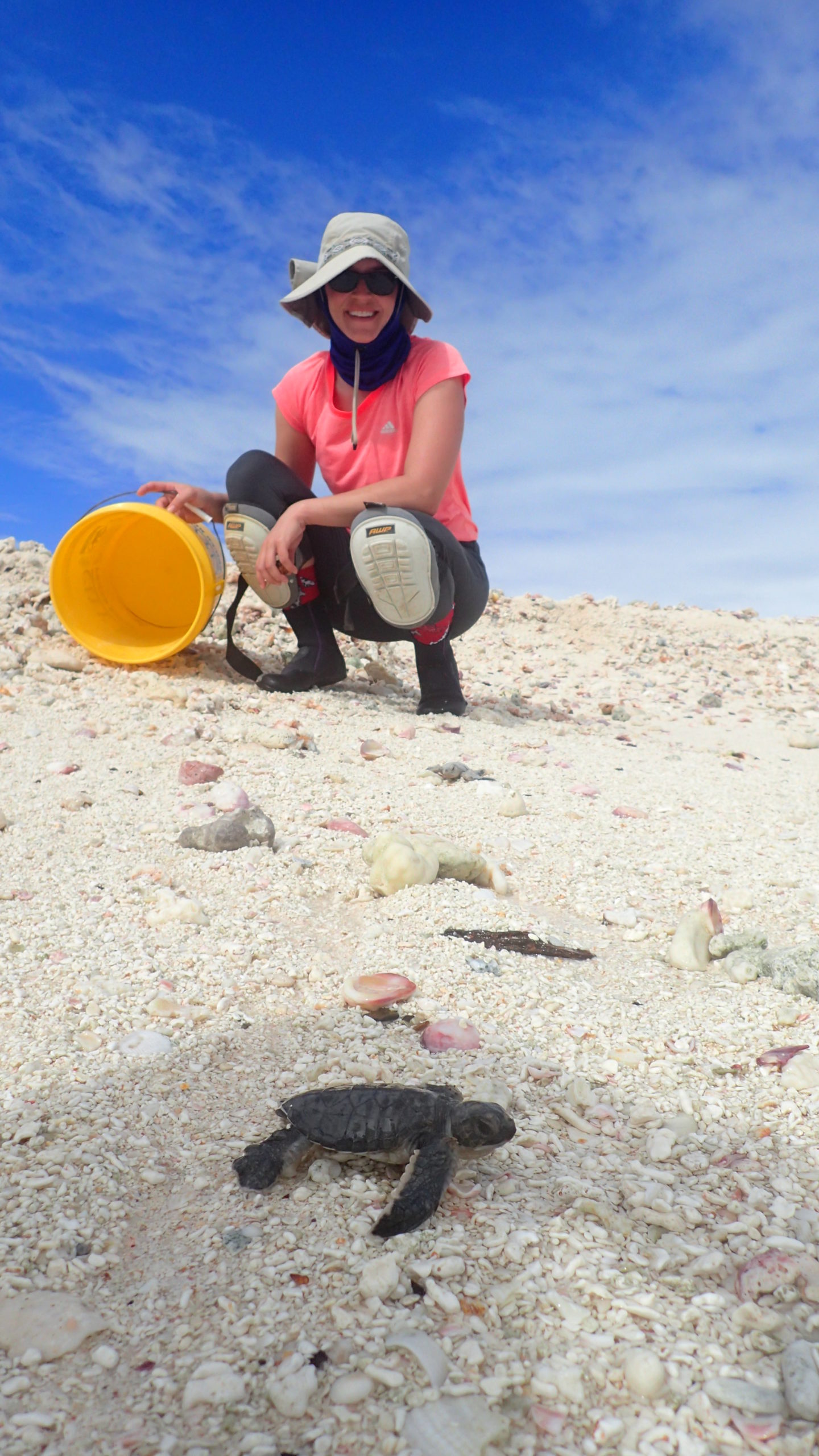
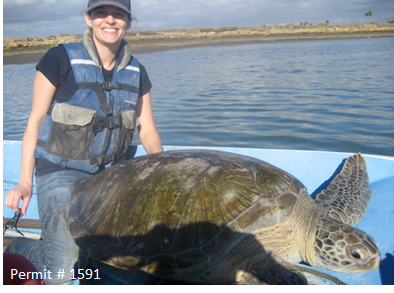
Photos at left: Dr. Camryn Allen at work in the field.


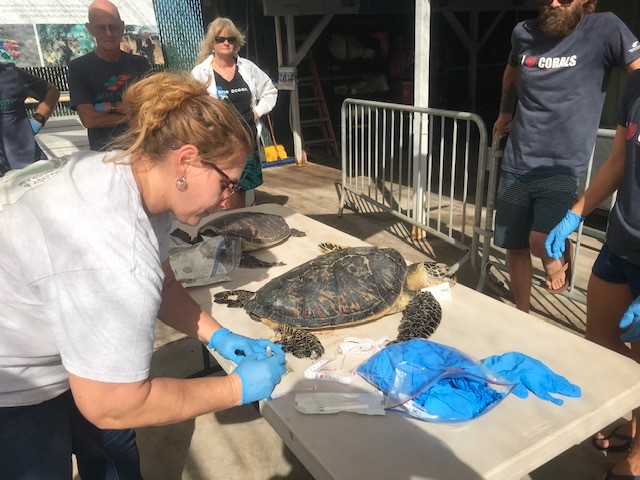
Photo below: Shandell Brunson at a training with Maui Ocean Center Marine Institute (MOCMI) last November.

June 5 Meeting of Maui Nui Marine Resource Council 
to Feature Free Presentation on Carrying Capacity Study of Popular Oahu Snorkeling Site

in /by

When considering Maui’s most popular reefs, how many snorkelers are too many? What’s the impact of hundreds or possibly thousands of snorkelers per day at our reefs? How do we determine the right amount of snorkelers at our local reefs?

If you’ve wondered about the answers to these questions, Maui Nui Marine Resource Council invites you to a free talk that will share methodology and findings from a carrying capacity study of O‘ahu’s heavily visited Hanauma Bay by researchers from The Coral Reef Ecology Lab (CREL). The free presentation will take place at the Wednesday, June 5 meeting of Maui Nui Marine Resource Council from 5:30 pm to 7:30 pm at The Sphere at Maui Ocean Center. Doors open at 5 pm. Seating is limited so advance reservations are strongly recommended. To reserve, visit https://bit.ly/snorkelers

The featured guest presenters will be Sarah Jane Leicht Severino, Research Associate, and Ku‘ulei Rodgers, PhD, Principal Investigator of The Coral Reef Ecology Lab (CREL) at the University of Hawai‘i, Hawai‘i Institute of Marine Biology campus. They will speak about CREL’s Hanauma Bay Biological Carrying Capacity study, which quantifies the extent of human influence and determines the acceptable limits of disturbance to the marine resources of Hanauma Bay. For the past year, CREL has performed observational and manipulative experimentation within the Bay documenting the interactions between visitors and the marine environment as they relate to human use, coral tramping, sedimentation, and visual water clarity.
“The findings of the Hanauma Bay research should prove valuable in helping communities throughout Maui County evaluate the impacts of snorkelers at our popular reefs,” says Amy Hodges. “This talk is an excellent opportunity to explore how Maui County might most effectively answer the question of how many snorkelers — and under what circumstances — are too many snorkelers  at our local reefs?” 

About Dr. Ku’ulei Rodgers:

Dr. Ku‘ulei Rodgers has been working at the Hawai‘i Institute of Marine Biology’s (HIMB) Coral Reef Ecology Lab since 1992 under the direction of Drs. Paul Jokiel and Fenny Cox, as an HIMB faculty member since 2005 and as the Principal Investigator of the Coral Reef Ecology Lab since 2016. Over 100 of her articles have been published in peer-reviewed journals, published reports, and conference proceedings. She was in the top five most read PeerJ journal articles in 2017.

Since 2005, she has provided graduate advising, mentoring, and training for 15 graduate students, 40 undergraduates, interns, and technicians, and 2 post-docs. Ku‘ulei has been heavily involved as Principal Investigator, Co-Principal Investigator or research assistant on 25 funded projects since her appointment, conducting research at sites on every island. She has secured funding through grants of over $3.5 million assisting in student support and research needs.

Many of her research projects are of an interdisciplinary nature involving close collaborations with over 20 UH researchers from the oceanography, engineering, and zoology departments and over 50 cooperative relationships with managers and scientists from federal and state agencies, non-governmental organizations, and private industry. Her research has been widely disseminated through extensive media coverage with well over 200 documented local television news interviews, newspaper articles, and media events, global webcast video coverage, national and international newspaper and web articles and radio interviews

Ku‘ulei was one of the co-founders along with Dr. Paul Jokiel, Dr. Eric Brown, and Will Smith of the ongoing Coral Reef Assessment and Monitoring Program established in 1999 and continues to serve as PI along with the State Division of Aquatic Resources.

About Sarah Jane Leicht Severino:
Sarah Jane Leicht Severino earned her MS in Marine Science at Hawai‘i Pacific University (HPU) in 2015. For her master’s research she developed a technique, the Fluorescence Census Technique (FCT), that utilizes the natural fluorescent pigmentation found within some species of corals to non-destructively census their smallest size classes in-situ under daylight conditions.

After graduate school, Sarah worked as a First Mate on HPU’s Research Vessel, Kaholo, for two years. In addition to managing fieldwork on HPU’s Research Vessel, she was recruited by the Navy to manage field operations for a project studying the structure of marine resources within the main Pearl Harbor shipping channel.  The FCT was used in the Pearl Harbor shipping channel to quickly and accurately quantify the abundance and recruitment patterns of juvenile coral colonies on their natural reef substrate. 

Since starting in the Coral Reef Ecology Lab, Sarah has been working toward establishing a biological carrying capacity for Hanauma Bay Marine Life Conservation District (MLCD). By analyzing historical data and performing several field experiments, she seeks to quantify changes in the benthic community of reefs at Hanauma Bay in response to pressure from human use.

About Maui Nui Marine Resource Council:

Established in 2007, Maui Nui Marine Resource Council (MNMRC) is an award-winning nonprofit 501(c)(3) organization working for healthy coral reefs, clean ocean water and abundant native fish for the islands of Maui County.

During the past 11 years since our organization’s establishment, we have been based on Maui and have achieved recognition for working with our local community to create culturally appropriate, effective science-based solutions to serious local threats facing our reefs. Many problems facing Maui County’s local reefs originate on land, which is why our projects and programs are community-based and work from mountains (mauka) to sea (makai). To learn more, visit www.mauireefs.org.

Free presentation about Kahoʻolawe –“Kūkulu Ke Ea A Kanaloa — The life and spirit of Kanaloa builds and takes form” at April 3 meeting

in /by

Missed this event? View it here:

https://vimeo.com/332580699


The public is invited to a free presentation focusing on Kahoʻolawe titled, “Kūkulu Ke Ea A Kanaloa — The life and spirit of Kanaloa builds and takes form.” The talk will be presented by Dean Tokishi, Ocean Resources Specialist III, Kaho’olawe Island Reserve Commission, at the Wednesday, April 3 meeting of Maui Nui Marine Resource Council.  This event will take place at a new venue: The Sphere at Maui Ocean Center. 

“Kanaloa Kaho‘olawe’s rich history, complex present and hopeful future can be seen and felt,” said Tokishi. “My talk will cover everything from the island’s use as a prison colony, a ranch, and military live fire training site to the extensive unexploded ordinance clean-up project and the efforts to restore an entire island ecosystem, mauka to makai.”

The meeting and presentation will take place at Maui Ocean Center at The Sphere, a new high-tech dome-shaped presentation space, offering reclining movie-theater style seats and state-of-the-art visuals and acoustics. (Learn more about The Sphere at www.mauioceancenter.com) Doors open at 5 pm; please enter by the Administrative Office entrance at Maui Ocean Center. The presentation will take place from 5:30 pm to 7 pm. Admission is free and the public is invited. By order of the fire marshal, only 118 guests can be accommodated, so admission is on a first-come, first-served basis.

“Many on Maui look across the channel to Kahoʻolawe and wonder about its history, and what the island is like now,” says Amy Hodges, Program Manager at Maui Nui Marine Resource Council. “Thereʻs also a lot of curiosity about the reefs and marine resources of Kahoʻolawe. How are they surviving after the years of extreme sediment runoff caused by the decades of military bombing of Kahoʻolawe? We are grateful that Dean Tokishi will be sharing his manaʻo and knowledge about Kahoʻolawe with us all.”

“Please join us for this free talk, which will include time for questions from the audience,” says Hodges. “Iʻm confident that weʻll all learn much and come away inspired by the work that KIRC is doing to restore and protect Kahoʻolawe and its marine resources.”

“We thank Dean Tokishi in advance for this presentation, and also thank Maui Ocean Center for hosting this event,” says Hodges.

About Dean Tokishi:
Growing up on Maui, Dean graduated from Maui High School and later received a Bachelorʻs Degree in Marine Science from the University of Hawaii at Hilo. For three years he was involved in the restoration of Kahoʻolawe during the ordnance removal project. In January of 2003 he obtained a position with the Kahoʻolawe Island Reserve Commission (KIRC) in monitoring, managing and protecting all of the Reserves marine resources. Currently Dean serves as KIRCʻs Ocean Resources Program Manager where he is given the opportunity to educate others on the importance of these marine resources.

About Kahoʻolawe Island Reserve Commission (KIRC)
From its inception by the State of Hawaiʻi in 1993, KIRC was funded through the Kahoʻolawe Island Rehabilitation Trust Fund – originating from a portion of the federal funding allocated to the Navy’s unexploded ordnance clearance project (ending in 2003). In 2014, KIRC partnered with PKO (Protect Kahoʻolawe ʻOhana) and OHA (Office of Hawaiian Affairs) to publish a collaborative plan for the Kahoʻolawe Island Reserve through 2026 (entitled I Ola Kanaloa!). With refined goals and objectives adopted by each organization, KIRC presented its self-sustainability financial plan to the Hawaiʻi State Legislature in 2016. Supported by an Aloha Kahoʻolawe campaign, which called for memberships, shared information and public testimony to affirm KIRC’s restoration and access programs, the State authorized permanent funding for KIRC staff and additional CIP funding for KIRC operations in 2018. Programs that bring community volunteers to the Reserve continue to rely on funds raised through donations, grants and memberships. Learn more at https://www.kahoolawe.hawaii.gov/home.php

About Maui Nui Marine Resource Council
Celebrating 11 years, Maui Nui Marine Resource Council is a Maui-based nonprofit organization working for healthy coral reefs, clean ocean water and the restoration of native fish for the islands of Maui County. To learn more, visit www.mauireefs.org.

Special thanks to Maui Ocean Center for donating use of The Sphere for this presentation.


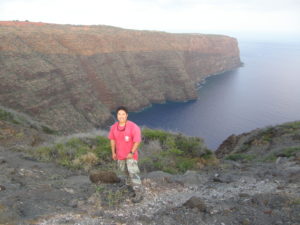
Dean Tokishi poses at the cliffs of Kamohio, located along the southern shore of Kahoʻolawe.

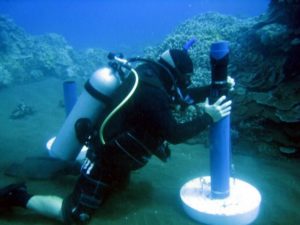
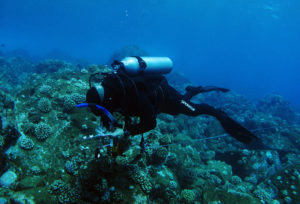
Dean Tokishi installs underwater sediment traps to monitor the rate of terrestrial run off that is
coming off of Kaho‘olawe and into the marine environment.

Dean Tokishi records data on coral and fish density and abundance along a line transect, as part
of his work to understand the condition of Kahaoʻolaweʻs nearshore reefs and to educate the public
about them.