
Posts

Free July 7 Zoom Presentation by Dr. Craig Downs and Hawaii Senator Mike Gabbard: “Education vs. Enforcement: Next Steps Beyond the Enactment of Hawaii’s Sunscreen Law”

in /by

KIHEI, HI— Hawaii’s ban on sunscreens containing the reef-harming chemicals oxybenzone and octinoxate went into effect on January 1, but is the law effective in protecting our local coral reefs and marine animals as intended? Is the ban being enforced? What’s the latest scientific evidence about the chemicals that are replacing these two ingredients in some brands of sunscreen? Are new laws needed?

Get the answers to these important questions on Wednesday, July 7 at 5:30 p.m. via a free Zoom presentation featuring special guest speakers: Dr. Craig Downs, whose groundbreaking research educated the world about sunscreen chemicals and their role in coral reef decline; and Hawaii Senator Mike Gabbard, who authored the legislation that resulted in Hawaii’s ban on the sale of sunscreens that contain the chemicals oxybenzone and octinoxate.

The presentation titled “Education vs. Enforcement: Next Steps Beyond the Enactment of Hawaii’s Sunscreen Law” is sponsored by the County of Maui Mayor’s Office of Economic Development and hosted by Maui Nui Marine Resource Council as part of the organization’s “Know Your Ocean Speaker Series.”

This event is free, but advanced reservations are required. To reserve your spot, please visit https://bit.ly/SunscreenWebinar.

Downs graduated from Hiram College with a B.A. in philosophy and biology, received his M.Sc. from Syracuse University, and received his Ph.D. from the University of Hawaii in cell and molecular biology. He has published over 50 scientific papers and a number of book chapters in scientific textbooks, and is the co-editor of the CRC press veterinary book, Diseases of Corals, as well as founded a number of companies and nonprofits relating anywhere from animal welfare to environmental conservation and exploration.

Downs has held positions as research professor at University of Hawaii’s School of Medicine and Sweet Briar College. He is currently an invited professor at Sorbonne University (France) and is the Executive Director of Haereticus Environmental Laboratory, a non-profit scientific organization dedicated to increasing the scientific, social and economic knowledge of natural environmental habitats in order to better conserve and restore threatened environmental habitats and resources.

Gabbard, who has represented District 20 since 2006, which includes Kapolei, Makakilo, and portions of Kalaeloa, Waipahu, and Ewa, has authored 54 bills that became law relating to energy efficiency, renewable energy, endangered species protection, industrial hemp, the environment, public safety, and more.

One of those bills that became law in 2018, SB 2571, is the ban of sale or distribution in the state of any sunscreen that contains oxybenzone or octinoxate, or both. Last session, Gabbard introduced SB 366, which would ban the sale, offer of sale, or distribution in Hawaii of any sunscreen that contains two more chemicals, avobenzone or octocrylene.

The speakers plan to address whether or not sunscreen pollution is a symptom of unsustainable tourism and coastal development, how we get visitors and residents to comply with the new sunscreen law, and who is responsible for enforcing it.

This panel will also provide information and tips on how you can help to protect the marine environment.

Maui Nui Marine Resource Council’s “Know Your Ocean Speaker Series” events are held monthly via Zoom. Support for these events is provided by the County of Maui Mayor’s Office of Economic Development.

The virtual event’s emcee will be Darla Palmer-Ellingson, local radio show host of the public affairs program, Island Environment 360 Maui’s only commercially broadcast public affairs show on environmental and related Hawaiian cultural topics, aired on the stations of H-Hawaii Media.

To reserve your spot at this free Zoom webinar, please visit https://bit.ly/SunscreenWebinar.

Free Presentation on “Growing Up Fast: A Land-Based Coral Nursery for Restoring Hawaii’s Reefs” Offered During Earth Week

in /by


KIHEI, HI— In honor of Earth Day and Earth Week, the public is invited to a free presentation on “Growing Up Fast: A Land-Based Coral Nursery for Restoring Hawaii’s Reefs” on Zoom on Wednesday, April 21 at 5:30 pm.

The presenter will be coral specialist Christina Jayne of the Dept. of Land and Natural Resources Division of Aquatic Resources Hawaii Coral Restoration Nursery. The talk is hosted by Maui Nui Marine Resource Council, as part of its monthly “Know Your Ocean Speaker Series.”

Coral reef restoration is the process of raising new corals — often from fragments of coral salvaged from the wild — in a protected, nurturing environment, then transplanting them out into the ocean to grow and form new reefs. When combined with efforts to improve coral reef habitat, it is viewed as a way to help coral reefs survive the stresses of climate change and warming ocean waters.

For the past two years, Jayne has worked for the Dept. of Land and Natural Resources Division of Aquatic Resources as a coral restoration specialist at the Hawaii Coral Restoration Nursery on Oahu with director David Gulko. Before moving to Honolulu, she earned her bachelor’s in Marine Biology from the University of California San Diego and her masters from Scripps Institution of Oceanography at UC San Diego.“Hawaii’s reefs are extremely unique and Hawaiian corals have some of the slowest growth rates in the world, which is why the State has taken an innovative, land-based approach to coral restoration,” notes Jayne.
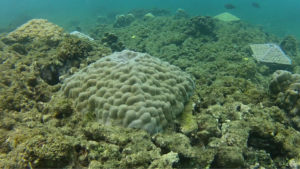
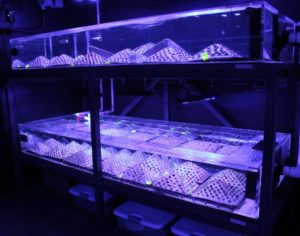
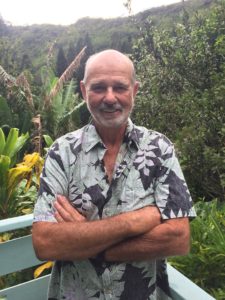
Hawaii’s first state coral nursery, which is managed by DAR, opened in 2016 at the Anuenue Fisheries Research Center on Oahu.

Corals are brought to the Coral Restoration Nursery and are rapidly grown using a series of aquarium-based techniques that help them to generate large coral colony modules in a fraction of the time it would take naturally, which can be out-planted back on the reef.

The nursery typically uses corals for out-planting from harbors because of their lower ecological value compared to corals from natural areas, says DAR, and they may also be more resilient to any challenges and environmental changes.

University of Hawaii Sea Grant researchers are also conducting experiments at the Anuenue facility to understand different environmental conditions, like light and water movement, that are useful for growing corals quickly. Creating the best environment for the corals to grow rapidly will help to restore local reefs after disturbance events such as bleaching or physical damage.

Maui Nui Marine Resource Council’s “Know Your Ocean Speaker Series” events are held monthly via Zoom. Support for these events is provided by the County of Maui Mayor’s Office of Economic Development.

The virtual event’s emcee will be Darla Palmer-Ellingson, local radio show host of the public affairs program, Island Environment 360 Maui’s only commercially broadcast public affairs show on environmental and related Hawaiian cultural topics, aired on the stations of H-Hawaii Media.

To reserve your spot at this free Zoom webinar, please visit https://bit.ly/coralnurserywebinar


Public invited to free webinar on “Shark Research in Hawaii – With an Emphasis on Maui” by Dr. Kim Holland on Wednesday, March 3

in /by

KIHEI, HI – Recent shark attacks that occurred off the coast of Maui in November (2020), December (2020) and January (2021), as well as an incident in February (2021) which involved a large shark biting a kayak, have many ocean users concerned and curious about the sharks found in our nearshore waters. The public is invited to learn more about our local sharks at a free Zoom presentation titled “Shark Research in Hawaii – With an Emphasis on Maui’ by Dr. Kim Holland. Dr. Holland is the Research Professor at the Hawaii Institute of Marine Biology, (HIMB) at University of Hawaii at Manoa and the founder of the Shark Research Group at HIMB.

This free talk is hosted by Maui Nui Marine Resource Council’s “Know Your Ocean Speaker Series” and will take place on Wednesday, March 3 at 5:30 pm via Zoom. The presentation is free, but advance reservations are required. To reserve your spot, please visit https://bit.ly/SharkWebinar

For over 40 years Dr. Holland’s research has focused on the biology and movement patterns of large marine fishes such as tuna, billfishes and sharks. He has been a pioneer in helping to develop and deploy cutting edge tracking technologies that allow unprecedented insight into the movement patterns of marine fishes.
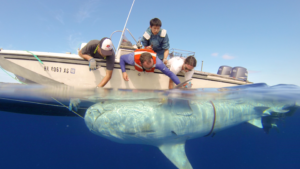
His presentation will include a brief overview of tracking technologies with an emphasis on what has been learned about the movements of sharks around Maui Nui.

“While many Maui residents and visitors are fearful about sharks, it’s important to remember that sharks play an important role in maintaining Hawaii’s ocean ecosystems,” said Anne Rillero, Communications, Community Outreach and Development Manager at Maui Nui Marine Resource Council. “We’re looking forward to learning more about Dr. Holland’s findings and insights about Hawaii’s sharks.”

Maui Nui Marine Resource Council’s “Know Your Ocean Speaker Series” events are held monthly via Zoom. Support for these events is provided by the County of Maui Mayor’s Office of Economic Development.

The emcee for this event is Darla Palmer-Ellingson, local radio show host of the public affairs program, Island Environment 360 Maui’s only commercially broadcast public affairs show on environmental and related Hawaiian cultural topics, aired on the stations of H-Hawaii Media.

To reserve your spot at this free Zoom webinar, please visit https://bit.ly/SharkWebinar


Experts tag a tiger shark with a tracking device in the waters off Maui. The satellite tag gets attached to the shark’s dorsal fin and sends a signal every time the fin surfaces the water. Photo Credit: HIMB

Public invited to free Zoom presentation about unique collaboration of 7 environmental projects funded by Maui CARES

in /by

Program provided employment for more than 70 Maui and Molokai residents

“It’s like Maui County’s own version of the Civilian Conservation Corps”

KIHEI, HI – During the Great Depression, the government-sponsored Civilian Conservation Corps (CCC) provided paychecks for 3 million unemployed young men and provided valuable labor for conservation projects across the country.

With unemployment at record levels due to COVID-19, a new program followed this historical CCC model and put more than 70 Maui and Molokai residents to work in November, providing seven local conservation nonprofits with needed labor to benefit coral reefs, cultural resources and the environment.

The public is invited to a free presentation on Weds. January 27 at 5:30 pm on Zoom to learn about this unique collaborative employment and workforce training program and the impact it had on our local environment. The presentation will include videos, photos and firsthand accounts of the projects and accomplishments, with information on how the projects incorporated traditional Hawaiian cultural practices and modern technology to prevent sediment pollution in the ocean and protect valuable cultural resources.

It’s free, but registration is required. To sign up, visit https://bit.ly/mauiCARES

This unique collaborative employment and workforce training program was made possible through the County of Maui Office of Economic Development’s Maui CARES program, which was funded by the Federal CARES Act. As the fiscal sponsor, Maui Nui Marine Resource Council oversaw the administration of the Maui CARES funding for the projects and managed the rapid employment of more than 70 new hires with the help of simplicityHR by ALTRES.

The workers participated in conservation and restoration projects in Olowalu, Waihe’e, Keanae, Kipahulu, Hana and Moloka’i. All of the projects were rooted in Hawaiian cultural practices and values which serve as the foundation of our community. Their work was filmed by Inflatable Film of Kula. The evening will include video premieres exclusively for webinar attendees.

“Through this presentation, attendees will be immersed in a virtual experience to feel the importance of Kuleana, ʻOhana, Kōkua, Aloha ʻAina, Mālama ʻAina, and Hānai ʻAina, said Ekolu Lindsey, President of Maui Cultural Lands and a principal organizer of this program. “Be inspired to follow in the footsteps of those who have come before us, as we share our legacies with you.”

The participating nonprofits include:

Ka Honua Momona on Molokai worked to restore two ancient fishponds, which will help trap sediment before it reaches the open ocean – with the benefit of also producing fish for local people.

Kipahulu ‘Ohana in East Maui improved a lo’i, or wetland taro farm. The taro plants will slow the flow of stormwater, allowing time for sediment in the water to settle, rather than flow out to sea.

Hawaiian Islands Land Trust in Waihe’e worked to remove invasive species along approximately 3,000 linear feet of Kalepa Stream to lower sediment loads in the nearshore waters off Waihe’e and protect offshore corals.

Ke Ao Hali‘i (KAH) in Hana worked on 27 acres of publicly owned land at Mokae/Kaholaiki and another ~2 acres of contiguous land, directly above Hamoa Beach. Their project included invasive plant removal and native habitat restoration for seabirds and insects, and a biological survey of ‘opihi as a baseline for a possible ‘opihi rest area in the future.

Kipuka Olowalu in West Maui reestablished washed out and damaged lo’i (taro fields), rebuilt vanished lo’i and prepared lo’i for planting in the Olowalu Cultural Reserve. Workers removed overgrowth, fire hazards and invasive plants; planted native plants and crops and repaired infrasturcture.

Na Moku ‘Aupuni O Ko‘olau Hui in East Maui worked on watershed management and stream maintenance, as well as stream and ditch monitoring in the East Maui Irrigation system to establish accurate data for stream and ditch flow and loss as a basis for making sound future management decisions related to this resource and delivery infrastructure.

Each of the nonprofits will be presenting their work and accomplishments through photos, video and stories from the field.

Na Mamo o Mu‘olea in East Maui focused on land and shoreline management on a county parcel (which Nā Mamo O Mū’olea has a 50 year lease). It included removal of invasive plants around a rock wall that is on the historic registry, and preparation for wall restorations, maintenance of two heiau on the property, installation of new fencing around an area designated for native trees and medicinal plants, and maintenance and repair of feral animal controls.

“This presentation is a celebration of all that was accomplished and learned,” said Lindsey. “We encourage the public to attend to connect with these organizations and the workers who put heart and soul into these challenging and impactful projects.“

The emcees for this event are Ekolu Lindsey and Darla Palmer-Ellingson, local radio show host of the public affairs program, Island Environment 360 Maui’s only commercially broadcast public affairs show on environmental and related Hawaiian cultural topics, aired on the stations of H-Hawaii Media.

About Maui Nui Marine Resource Council

Maui Nui Marine Resource Council is a community-based nonprofit organization celebrating 13 years of working for healthy coral reefs, clean ocean water and abundant native fish throughout Maui County. Our work includes co-managing the Hui O Ka Wai Ola Ocean Water Quality Monitoring Program in South and West Maui, efforts to reduce pollution in Mā‘alaea Bay (through erosion-control efforts in the Pohakea watershed and using oysters to filter sediment and pollutants from ocean water), coral reef research, visitor education programs and more. Learn more at www.mauireefs.org.

Free Webinar: “Exploring the Octopus: How to Learn from Animal Behavior”

in /by

Photo courtesy Don Bloom

“Exploring the Octopus: How to Learn from Animal Behavior” is Topic of November 18 “Know Your Ocean Speaker Series” Free Webinar

Octopuses explore the world around them with their flexible arms, which can touch — and actually taste — to help them quickly identify prey. Maui Nui Marine Resource Council invites the public to learn more about the specialized octopus cells that make this unique ability possible at a free Zoom webinar titled “Exploring the Octopus: How to Learn from Animal Behavior” on Wednesday, November 18 at 3 pm. This presentation is part of MNMRC’s monthly “Know Your Ocean Speaker Series.”
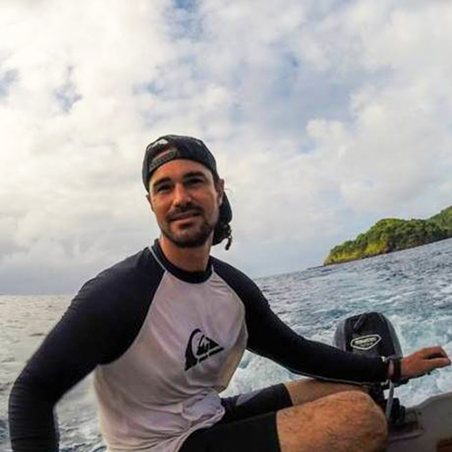
The guest speaker will be Peter Kilian, Research Assistant and Aquatic Animal Technician at the Bellono Lab at the Department of Molecular and Cellular Biology at Harvard University. The lab studies how diverse organisms sense and respond to changes in their environment.

Peter will be sharing his work on a paper which he co-authored that was recently published in Cell titled, “Molecular Basis of Chemotactile Sensation in Octopus.” Stories about this report, which describes how octopus can both touch and taste with their arms, have appeared in numerous newspapers, magazines, tv news shows and online journals, including The New York Times, CNN, Smithsonian Magazine and others.

As a research assistant and aquatic animal technician at Bellono Lab, Peter spends most of his time working with fish, sharks, cephalopods, and various other marine invertebrates to try and learn how and why they behave the way they do.

“So many of us on Maui are fascinated with octopuses, especially after ‘My Octopus Teacher’ launched on Netflix,” says Meredith Beeson, Project and Research Coordinator at Maui Nui Marine Resource Council. “We are excited to host this presentation by Peter Kilian, which will describe how Harvard researchers looked at the octopus at the molecular level to learn how the nervous system in the octopus’ arms — which operate largely independently from its centralized brain — allows these animals to both touch and taste their prey.”

The guest emcee will be Darla Palmer-Ellingson, local radio show host of the public affairs program, Island Environment 360 Maui’s only commercially broadcast public affairs show on environmental and related Hawaiian cultural topics. Her  program is made possible by H-Hawaii Media.

Maui Nui Marine Resource Council offers its monthly “Know Your Ocean Speaker Series” via Zoom, usually on the first Wednesday of the month. This month’s presentation was delayed due to Election Day and Veteran’s Day. Please note that this event will start at 3 pm, earlier than other “Know Your Ocean Speaker Series” talks, because the speaker is located in Massachusetts. If you wish to view the presentation, but cannot attend at 3 pm, please email [email protected] to receive emailed information about where and how to view the presentation later in the day.

To make a reservation for the live Zoom presentation, please visit https://bit.ly/OctopusTalk

The “Know Your Ocean Speaker Series” is made possible with support from the County of Maui Mayorʻs Office of Economic Development.

About our speaker:
Peter Kilian, Research Assistant and Aquatic Animal Technician at the Bellono Lab at the Department of Molecular and Cellular Biology at Harvard, has been interested in the mystery of animal behavior since a young age. His drive to work with animals originates from countless trips to the local zoo and aquarium when he was growing up. This curiosity continued to evolve in college, where Peter dove into his passion for animal work. While in college he spent time working as a beekeeper, a penguin aquarist at the New England Aquarium, and a pygmy octopus husbandry specialist in the mariculture lab at the Marine Biological Laboratory in Woods Hole, MA. He has since graduated from college, and now works full time in the Bellono Lab at Harvard as a research assistant and aquatic animal technician. He spends most of his time working with fish, sharks, cephalopods, and various other marine invertebrates to try and learn how and why they behave the way they do.


“Sewage Impacts on Hawaiʻi’s Coastlines: Past, Present and Future” a “Know Your Ocean” Webinar

in /by

Part of Maui Nui Marine Resource Councilʻs Online “Know Your Ocean Speaker Series”

Watch the presentation on our YouTube channel: https://youtu.be/80r7tzV3RiU

What will determine the future impacts of sewage on Hawai’i’s nearshore ecosystems and public health? Daniel Amato, Ph.D., presented “Sewage Impacts on Hawaiʻi’s Coastlines: Past, Present and Future” which included recent research and the latest information on Hawaiʻi’s wastewater saga. The webinar took place on Wednesday, October 7 and was presented by Maui Nui Marine Resource Council as part of their monthly “Know Your Ocean Speaker Series.” Advance reservations are recommended as the Zoom webinar is limited to 100 attendees.
“My talk will share reports on how injection wells and cesspools continue to pollute Hawaiʻi’s waters, with an emphasis on recent Maui studies,” says Dr. Amato. ”I will also present recent decisions from the Hawaiʻi State Legislature and the current status of their effort to phase out cesspools.”

Dr. Amato will also discuss the current situation with sewage pollution in Hawai’i, and will present community efforts and new technological developments in sewage detection that show promise for the future.

A water quality specialist, Dr. Amato’s professional work focuses on the detection and impacts of land-based pollution in the Pacific Ocean and the development of new technology to assist in detecting the DNA of fecal indicator bacteria (FIB) in the water. Dr. Amato is a Marine Research Specialist at the University of Hawaiʻi at Manoa, an Environmental Scientist at Element Environmental LLC, and serves as the coordinator for Surfrider-Oahu’s Blue Water Task Force.

“We are offering this webinar by Dr. Amato to share important information about sewage and its impact on Maui’s coastlines, including ocean water quality and our nearshore coral reefs,” says Amy Hodges, Programs and Operations Manager at Maui Nui Marine Resource Council. “It’s a critically important topic, at a time when our coral reefs need the benefit of clean ocean water, to survive the impacts of climate change and warming water.”

“We thank the County of Maui Mayorʻs Office of Economic Development for supporting our Know Your Ocean Speaker Series,” says Hodges.

Want to learn more? Watch the presentation on YouTube – click below. You can also read about some ways to help in this article in Maui Times about wastewater in Maui County: https://mauitimes.news/flushing-money-down-the-drain/.

About Maui Nui Marine Resource Council:
Maui Nui Marine Resource Council is a community-based nonprofit organization celebrating 12 years of working for healthy coral reefs, clean ocean water, and abundant native fish throughout Maui County. Our work includes co-managing the Hui O Ka Wai Ola Ocean Water Quality Monitoring Program in South and West Maui, efforts to reduce pollution in Mā‘alaea Bay (through erosion-control efforts in the Pohakea watershed and using oysters to filter sediment and pollutants from ocean water), coral reef research, visitor education programs and more.

Free Oct. 7 Webinar by Daniel Amato, Ph.D. on “Sewage Impacts on Hawaiʻi’s Coastlines: Past, Present and Future”

in /by

Part of Maui Nui Marine Resource Councilʻs Online “Know Your Ocean Speaker Series”

What will determine the future impacts of sewage on Hawai’i’s nearshore ecosystems and public health? Learn more at a free Zoom webinar titled “Sewage Impacts on Hawaiʻi’s Coastlines: Past, Present and Future” by Daniel Amato, Ph.D., which will include recent research and latest information on Hawaiʻi’s wastewater saga. The webinar will take place on Wednesday October 7 at 5:30 pm and is free and open to the public. It is presented by Maui Nui Marine Resource Council as part of their monthly “Know Your Ocean Speaker Series.” Advance reservations are recommended as the Zoom webinar is limited to 100 attendees. Make your free reservation at https://bit.ly/MauiSewage

“My talk will share reports on how injection wells and cesspools continue to pollute Hawaiʻi’s waters, with an emphasis on recent Maui studies,” says Dr. Amato. ”I will also present recent decisions from the Hawaiʻi State Legislature and the current status of their effort to phase out cesspools.”

Dr. Amato will also discuss the current situation with sewage pollution in Hawai’i, and will present community efforts and new technological developments in sewage detection that show promise for the future.

A water quality specialist, Dr. Amato’s professional work focuses on the detection and impacts of land-based pollution in the Pacific Ocean and the development of new technology to assist in detecting the DNA of fecal indicator bacteria (FIB) in the water.Dr. Amato is a Marine Research Specialist at the University of Hawaiʻi at Manoa, an Environmental Scientist at Element Environmental LLC, and serves as the coordinator for Surfrider-Oahu’s Blue Water Task Force.

“We are offering this webinar by Dr. Amato to share important information about sewage and its impact on Maui’s coastlines, including ocean water quality and our nearshore coral reefs,” says Amy Hodges, Programs and Operations Manager at Maui Nui Marine Resource Council. “It’s a critically important topic, at a time when our coral reefs need the benefit of clean ocean water, to survive the impacts of climate change and warming water.”

“We thank the County of Maui Mayorʻs Office of Economic Development for supporting our Know Your Ocean Speaker Series,” says Hodges.

For reservations for this talk, visit https://bit.ly/MauiSewage.

About Maui Nui Marine Resource Council:
Maui Nui Marine Resource Council is a community-based nonprofit organization celebrating 12 years of working for healthy coral reefs, clean ocean water and abundant native fish throughout Maui County. Our work includes co-managing the Hui O Ka Wai Ola Ocean Water Quality Monitoring Program in South and West Maui, efforts to reduce pollution in Mā‘alaea Bay (through erosion-control efforts in the Pohakea watershed and using oysters to filter sediment and pollutants from ocean water), coral reef research, visitor education programs and more. Learn more at www.mauireefs.org.

Free webinar: home gardening without toxic chemicals

in /by

Part of Maui Nui Marine Resource Council’s Know Your Ocean Speaker Series

Americans are taking up gardening in record numbers during the COVID-19 pandemic, and Maui residents are joining the trend.

Growing your own produce, as well as doing your own landscaping and yard care, are great ways to save money, get exercise, be outdoors and engage your keiki in hands-on science learning.

Unfortunately, many people turn to toxic herbicides and chemicals when weeds and pests appear. In fact, the average yard contains 10 times more chemicals per acre than a typical commercial farm, says Consumer Reports.

Learn tips for skipping those toxic herbicides and pesticides and growing a productive garden and a beautiful yard at a free Zoom presentation by landscape and gardening expert Duane Sparkman on Thursday, June 4 at 3:30 pm. Sparkman is the Assistant Chief Engineer and Landscaping Manager at The Westin Maui Resort & Spa.

Our guest emcee is Darla Palmer-Ellingson, local radio show host and owner of 360 Social Business.

Sparkman will take you into his own yard via Zoom to demonstrate non-toxic gardening and landscaping practices in action. You’ll discover how you can achieve great results in your yard, save money and keep family and pets safer. Because chemicals travel through Maui’s porous soil into the ocean, switching to organic methods will also help protect our local coral reefs and nearshore fish populations.

This free Zoom presentation is part of Maui Nui Marine Resource Council’s “Know Your Ocean Speaker Series” now being held via Zoom due to COVID-19. To make a free reservation, please go to https://bit.ly/MauiGardeningWebinar.

Sparkman offers a wealth of practical firsthand experience about what works to control pests and weeds based on his years of experience as a professional landscaper, designing and maintaining luxury resort properties and private residences, his work at Haleakala National Park’s Vegetation Management Division and recently, as the Assistant Engineer and Landscaping Manager at The Westin Maui.

At The Westin Maui, Sparkman has successfully implemented measures to reduce the resort’s use of herbicides and pesticides, showcasing alternatives that are safer and more environmentally friendly.

“We are offering this presentation with the hope that more people will resolve to find ways to protect our coral reefs and marine environment by reducing or avoiding the use of herbicides and pesticides in their home gardens and yards,” says Robin Newbold, Chair of Maui Nui Marine Resource Council.

Newbold points out that most people don’t realize how porous our soil is on Maui and how readily chemicals from pesticides and herbicides find their way into the ocean, causing harm to fish, birds and corals.

According to the NOAA Ocean Service Education website, pesticides are designed to be toxic to a target organism, but they often kill other organisms as well: “The insecticide azinphos-methyl, for example, which is used to control insects such as biting mites and aphids, is also very toxic to fish and birds.”

The website notes that many of the compounds used today are toxic at very low concentrations.

Herbicides also penetrate coral tissues and rapidly, within minutes, can reduce the efficiency of the beneficial algae (zooxanthellae ) that live within the corals, reports the book, Chemical Pollution on Coral Reefs: Exposure and Ecological Effects. The zooxantellae convert the energy from the sun into food for the corals through photosynthesis, providing corals with about 90% of their food. When herbicides enter the ocean, they can cause the corals to suffer due to reduced food availability.

“We owe it to our coral reefs and ocean water to find better ways to manage pests and weeds without adding harmful chemicals to our land- and marine-ecosystems,” says Newbold. “We’re grateful that Duane Sparkman is willing to share his practical, hands-on knowledge and experience with us all.”

Special thanks to the County of Maui Mayor’s Office of Economic Development for supporting Maui Nui Marine Resource Council’s “Know Your Ocean” Speaker Series.


About Duane Sparkman:
A resident of Maui since 1995 arriving here from Texas, Duane is an avid photographer who aspires to capture “rare moments”. His life’s passion is to preserve intact Hawaiian forests and the perpetuation of Hawaiian Culture. Duane is a professional landscaper by trade, designing and maintaining luxury resort properties, private residences, and working on projects within the Haleakala National Park, Vegetation Management Division. When he is not working or volunteering his time with various Hawaiian reforestation projects “putting back what belongs” he enjoys spending time with his wife, Erin and 2 children, Evan and Isabella cultivating his back yard native forest.

About The Westin Maui Resort & Spa:
Centrally located on pristine Ka’anapali Beach, the spectacular transformations within this resort will completely reimagine many areas of the 12-acre tropical paradise. Surrounded by lush gardens with cascading waterfalls, the 770-room beachfront resort abounds with ways to rejuvenate. Guests can indulge in six outdoor pools that include a brand new family pool and dedicated adults-only pool, spa rejuvenation, unique dining experiences and cultural activities. It is mere steps away from snorkel and sunset cruises, neighboring Whalers Village and championship golfing. Visit www.westinmaui.com.

About Maui Nui Marine Resource Council:
Maui Nui Marine Resource Council is a community-based nonprofit organization celebrating 11 years of working for healthy coral reefs, clean ocean water and abundant native fish throughout Maui County. Our work includes co-managing the Hui O Ka Wai Ola Ocean Water Quality Monitoring Program at 41 sites in South and West Maui, efforts to reduce pollution in Ma‘alaea Bay (through erosion-control efforts in the Pohakea watershed and using oysters to filter sediment and pollutants from ocean water), coral reef research, visitor education programs and more. Learn more at www.mauireefs.org.

About Darla Palmer-Ellingson:
With a strong passion for volunteerism on environmental issues, Darla produces and hosts Maui’s only commercially broadcast public affairs show on environmental and related Hawaiian cultural topics. Darla is a member of the County of Maui Citizens Advisory Committee on the Climate Crisis and a member of Vice President Al Gore’s Reality Project, Hawaii chapter. Her company, 360 Social Business, LLC provides website design, content, social media management, general business and marketing consulting.

Public Invited to Free Presentation on “Sunflower Farming: A Sustainable Model for Maui’s Former Sugar Cane Lands That Benefits Local Coral Reefs” on Wednesday, October 3 

in /by

Can fields of cheerful golden-yellow sunflowers be a model for creative and sustainable ways to use Maui’s former sugar cane lands that also have a positive impact on Maui’s coral reefs? Come explore this topic at a free presentation by Pacific Biodiesel at Maui Nui Marine Resource Council’s monthly meeting on Wednesday, October 3 from 5:30 to 7:30 pm at Pacific Whale Foundation’s classrooms at the Ma’alaea Harbor Shops. The public is invited, admission is free and refreshments will be served.

“Maui Nui Marine Resource Council is a local nonprofit that works for clean ocean water, healthy coral reefs and restoring an abundance of native fish,” says Robin Newbold, co-founder and chair of the organization. “We strongly believe that coral reef conservation requires a ‘mauka to makai’ (mountains to sea) approach, which means looking at upslope activities including use of our island’s former sugar cane lands. We’re pleased to present this talk about one farming model that ties together sustainable agriculture and protection of our local environment, including the reefs.”

The presenter will be Joy Galatro, marketing director at Maui-based Pacific Biodiesel, a renewable energy company that has devoted the past two decades to keeping used cooking oil out of our local landfill by recycling it into a renewable fuel. Trilogy Excursions and Extended Horizons use this non-toxic, biodegradable fuel (called biodiesel) to help power their vessels for snorkeling, whalewatching and other cruises.

During the past two years, Pacific Biodiesel has converted 200 acres of former sugar cane land in Maui’s central valley into fields of sunflowers, raised without pesticides or herbicides, no GMO crops, requiring little irrigation and home to 15 thriving bee hives. Once harvested, the sunflower seeds are pressed into a full-flavored oil that has won favor by local chefs.

Recently, the company has incorporated the oils into its new Kuleana® natural beauty products line — including its newly launched Kuleana® Sunscreens made from plant-based oils including the company’s Maui Sunflower Oil, minerals, and other reef-safe natural ingredients. The new sunscreen does not contain ecologically harmful chemicals such as oxybenzone and octinoxate – two chemicals known to be toxic to corals and other marine life and recently banned by Hawaiʻi’s new sunscreen law.

In addition to its environmentally friendly formulation, Kuleana Sunscreen aims to support environmental organizations in the state through its membership in 1% for the Planet, a global organization that connects dollars and doers to accelerate smart environmental giving.

“We are proud to offer consumers another natural product that aligns with our state’s environmental goals to protect and preserve fragile marine ecosystems, including coral reefs,” said Galatro, “Practicing sustainability and protecting the environment are central to our company’s mission.” For more information, visit Biodiesel.com and KuleanaBeauty.com.

About Maui Nui Marine Resource Council:
A Maui-based nonprofit organization founded in 2007, Maui Nui Marine Resource Council is working for healthy coral reefs, clean ocean water and abundant native fish for the islands of Maui County. Current projects include ocean water quality testing in South and West Maui, work to improve ocean water quality in Ma’alaea Bay, ongoing studies of corals in Olowalu and Ma’alaea, and outreach programs to educate visitors about protecting Maui’s coral reefs. To learn more, visit www.mauireefs.org.

Free Talk: “Dr. Dolittle Meets CSI on the Coral Reefs of Maui” on September 5, 2018

in , /by

Forensics and diagnostics are all part of the scientific study of coral reefs, which is why Bob Richmond Ph.D., Research Professor and Director of Kewalo Marine Laboratory at the University of Hawaii at Manoa, will be presenting a free talk titled, “Dr. Dolittle Meets CSI on the Coral Reefs of Maui” at the upcoming September 5 meeting of the Maui Nui Marine Resource Council. This event will take place from 5:30 to 7:30 pm at Pacific Whale Foundation’s classrooms at the ocean-facing lower level of the Ma’alaea Harbor Shops, 300 Ma’alaea Road, Ma’alaea (next to Maui Ocean Center).

Dr. Richmond’s talk will explain how his team is using diagnostics and forensics to identify causes of stress to Maui’s reefs at Olowalu, Waihikuli, amd Honokowai, along with ways to enhance the reef’s resistance to these stressors.
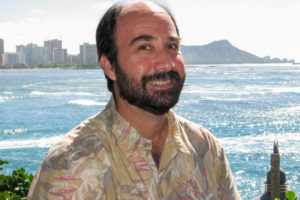
Dr. Richmond’s childhood fascination with Dr. Dolittle helped inspire his approach to studying reefs by “listening” to coral reefs and other reef creatures through the use of ecological indicators and molecular biomarkers.

“Maui has some of the most well developed coral reefs in the Main Hawaiian Islands, but these have been negatively affected by local and global stressors including land-based sources of pollution and sedimentation from watershed discharges, overfishing, and bleaching due to climate change,” said Dr. Richmond.

“Our research blends traditional ecological knowledge with ecology and molecular biology to both diagnose and treat the causes of coral reef decline,” he noted. “Our approach can best be described as Dr. Dolittle meets CSI (crime scene investigations) on coral reefs and uses a combination of diagnostics and forensics.”

“The results of our reef studies on reefs at Waihikuli, Honokowai and Olowalu will be presented and ideas for helping these reefs recover will be discussed,” he said.

Dr. Richmond is the Chair of the Maui Coral Reef Recovery Team, a group of Hawaii’s most recognized coral reef scientists, resource managers, fishers, cultural advisors and communitymembers, first convened by Maui Nui Marine Resource Council in 2010. The group wrote the Maui Coral Reef Recovery Plan, a 101-page science-based plan that outlines specific goals and steps to protect Maui’s coral reefs. Team members continue to meet regularly to provide guidance and monitor progress toward implementing the plan.

Dr. Richmond has spent the majority of his professional career studying coral reefs in Micronesia, Hawaii, Japan, Central America, the Galapagos Islands and the Caribbean. His research interests are in the area of marine conservation biology, with a focus on coral reefs. His research programs include studies of coral reproductive biology, ecotoxicology, coral reef ecology, the impacts of climate change and bridging sound science to policy development and implementation.

Dr. Richmond received a Ph.D. in Biological Sciences from the Dept. of Ecology and Evolution, SUNY at Stony Brook, and subsequently spent two years as a postdoctoral fellow at the Smithsonian Tropical Research Institute in Panama, 18 years on the faculty of the University of Guam Marine Laboratory, and has been a Research Professor at the Pacific Biosciences Research Center, University of Hawaii at Manoa, since 2004.

Maui Nui Marine Resource Council is funding Dr. Richmond’s studies of corals in Olowalu and Ma’alaea. A nonprofit organization founded in 2007, Maui Nui Marine Resource Council is working for clean ocean water, healthy coral reefs and an abundance of native fish for the islands of Maui County. To learn more, visit www.mauireefs.org.

View movie about this talk.