
Posts

50th Anniversary of Earth Day

in /by

Due to COVID-19, big gatherings are not part of Earth Day 2020, the 50th Anniversary of Earth Day. But there’s so much you can do at home in honor of Earth Day to help shape a better future for our planet and our island home.

Check out these ideas:

1. Get informed. Learn what sea level rise caused by climate change will do to the shorelines, reefs and your favorite beaches in Maui County. Visit the Hawaii Sea Level Rise Viewer at https://www.pacioos.hawaii.edu/shoreline/slr-hawaii/.

2. Share what you’re observing here in Hawaii — beach loss, shoreline erosion, declining coral reefs, fewer reef fish — with friends and family worldwide. We need an informed public to understand what’s at stake and to vote for candidates who will actively work to fight climate change.

3. Help keep Maui County’s corals as resilient and as healthy as possible by keeping reef-harming chemicals out of the ocean. Choose sunscreens that don’t contain reef-harming oxybenzone and octinoxate. Learn more at https://www.mauireefs.org/sunscreens/

4. Remember, whatever you use in your home or yard will eventually find its way into the ocean. Pledge to stop using pesticides and herbicides in your landscaping, home and place of business. If you live in a condo, talk with your property manager about choosing non-toxic alternatives.

5. Dispose of unwanted or expired prescription medicines properly — never flush them down your toilet. When medications are flushed down a toilet or drain, they enter our wastewater treatment systems, which are not designed to remove medications. Some medications such as hormones and antidepressants include endocrine disrupting compounds (EDCs), which interfere with the reproduction and normal growth of many aquatic species, including fish.

Visit https://www.cvs.com/content/safer-communities-locate to find the CVS location nearest you that will accept unwanted medications.

6. Join the movement to prevent plastic pollution. Carry a set of lightweight cutlery in your purse or car so you can skip single use plastic utensils. Consider packaging as well as price when you shop. Learn more about the bill passed recently by the Maui County Council that bans nearly all sales and use of plastic disposable food ware in Maui County. Encourage Maui County Mayor Michael Victorino’s to approve it.

https://www.mauinews.com/news/local-news/2020/04/near-ban-on-plastic-disposable-utensils-okd/

7. Help prevent sediment-laden stormwater runoff; it is harmful to Maui’s nearshore reefs. In your yard, cover bare soil with mulch or plants to prevent runoff. Create a small soil berm in a ring around new plants to contain water. Incorporate permeable materials (like permeable pavers) into your patios, driveway, and walkways.

8. Educate the next generation. Check out the American Museum of Natural History’s curated list of Earth Day videos and plan an Earth Day watch party with your family. https://www.youtube.com/playlist?list=PLrfcruGtplwH76Sryqpk7nXf0YIEM0piZ

Humanity is working together in amazing ways to fight the coronavirus pandemic. The impossible is possible if we all work together for our planet. Happy Earth Day!
How the 2015 bleaching event impacted Maui’s corals

in /by

Maui Nui Marine Resource Council was honored to host a presentation by Russell Sparks, Aquatic Biologist, State of Hawaii’s Department of Aquatic Resources ( Department of Land and Natural Resources) at our March 2018 meeting.

Sparks presented reports on the toll of the 2015 coral bleaching event that occurred in Hawai’i and worldwide due to El Nino conditions.

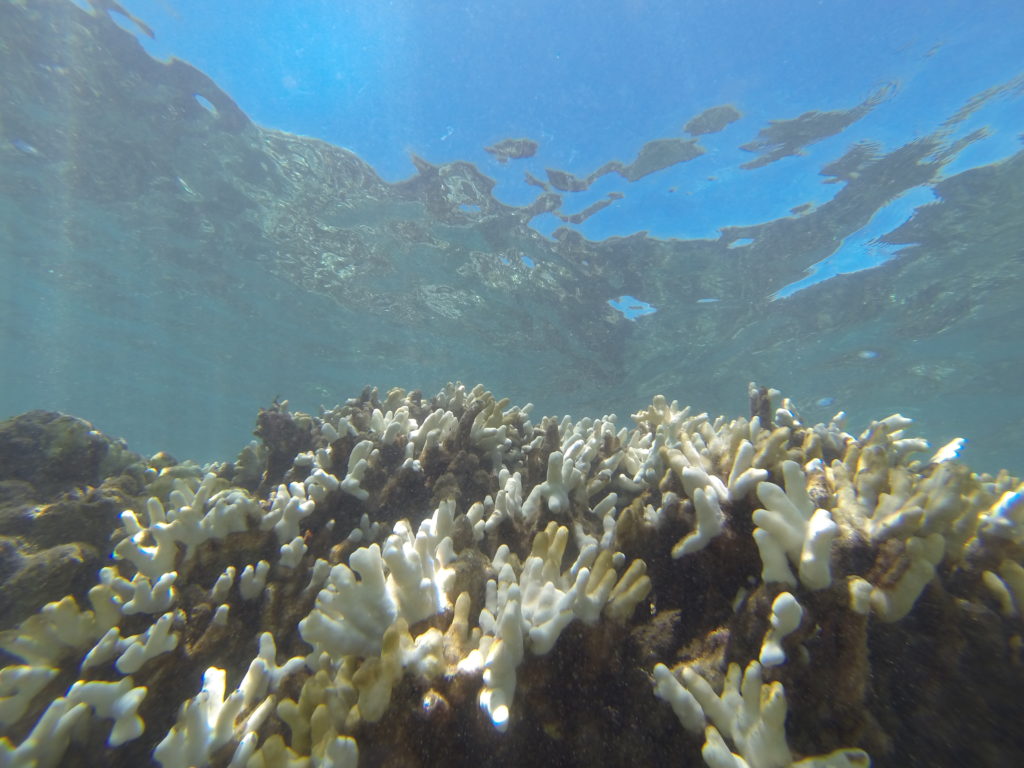
Sheltered from cooling breezes and waves, Maui’s leeward shores saw especially warm ocean conditions in 2015 and bleaching events were widespread. That summer, biologists watched in horror as a massive 400 year old coral nicknamed “Big Mama” succumbed to bleaching and perished in November of 2015.

DCIM100GOPRO

Sparks noted that almost all of the cauliflower coral off Maui’s coasts bleached. Lobe coral suffered the most impacts of bleaching and bleaching-related deaths. Smaller colonies of corals had higher rates of mortality, while bigger colonies showed more fragmentation during the bleaching event.

Biologists noted that some reefs did not die, and are striving to learn why they showed greater resistance.

Following this event, marine biologists have noted that there’s been a shift toward smaller sized coral colonies across the leeward nearshore areas of Maui.

In order for corals to adapt and survive into the future with the ongoing global warming concerns, we all need to do more to help reefs develop resiliency to these changes.  Corals can survive and adapt if we reduce local threats such as overfishing, sedimentation and nutrient pollution.  Support local efforts to address these man made local threats and coral reefs should better adjust to the warming world oceans.

Learn more about why corals bleach. 

Please follow this link to learn more about MNMRC’s work for clean ocean water to give our corals the best environment possible for survival.

Why do corals bleach?

in /by


There are many news stories about coral bleaching that’s occurring around the world. But what exactly is coral bleaching — and what can you do about it?

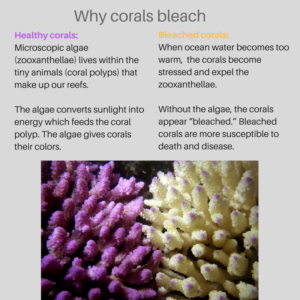
To understand, we need to look at the mutually beneficial (symbiotic) relationship that corals have with a type of microscopic one-celled algae known as zooxanthellae.

The algae lives right within the tiny living animals known as coral polyps that make up our reefs. The corals provide a home for the algae. In turn, the algae converts sunlight into energy and provides that nourishment to the coral polyp. The algae also gives corals their colors. It’s a win-win for both the coral polyp and the algae.

DCIM100GOPRO


Corals do best when ocean water is between 73 degrees F and 84 degrees  F. If the water becomes too warm or if it contains toxic chemicals, the corals expel their symbiotic algae. Without the algae, the corals appear white or “bleached.”

Unfortunately, bleached corals are more susceptible to death and disease.

Severe bleaching events occurred in Hawaii in 2014 and 2015, when ocean temperatures reached 88 degrees F.

In August 2014, warm weather in the North Pacific Ocean caused bleaching throughout the Hawaiian islands. More severe bleaching occurred in the summer of 2015.

Official reports state that 20 to 40% of Maui’s corals were lost following the 2015 bleaching event.

What can you do to prevent coral bleaching?

First, become an advocate in the fight to stop climate change. Do all you can to reduce your carbon footprint. Install a solar PV system at your home. Switch to LED lights. Buy a fuel-efficient hybrid or an electric car fueled with solar power. Drive less, and bike or walk more. Choose foods from local farms or local sources. Eat one or more vegetarian meals per week.

Second, help address other serious causes of stress to our coral reefs. For example, sediment run-off and near shore ocean water pollution are not international problems. These problems begin right here on the islands of Maui County and can be solved right here by people working together.

Last, avoid sunscreens with oxybenzone and octinoxate, two chemicals known to damage or kill corals. For more info visit here.

Learn more! Read the State of Hawaii Coral Bleaching Recovery Plan.