Posts

Free Presentation on “Growing Up Fast: A Land-Based Coral Nursery for Restoring Hawaii’s Reefs” Offered During Earth Week

in /by


KIHEI, HI— In honor of Earth Day and Earth Week, the public is invited to a free presentation on “Growing Up Fast: A Land-Based Coral Nursery for Restoring Hawaii’s Reefs” on Zoom on Wednesday, April 21 at 5:30 pm.

The presenter will be coral specialist Christina Jayne of the Dept. of Land and Natural Resources Division of Aquatic Resources Hawaii Coral Restoration Nursery. The talk is hosted by Maui Nui Marine Resource Council, as part of its monthly “Know Your Ocean Speaker Series.”

Coral reef restoration is the process of raising new corals — often from fragments of coral salvaged from the wild — in a protected, nurturing environment, then transplanting them out into the ocean to grow and form new reefs. When combined with efforts to improve coral reef habitat, it is viewed as a way to help coral reefs survive the stresses of climate change and warming ocean waters.
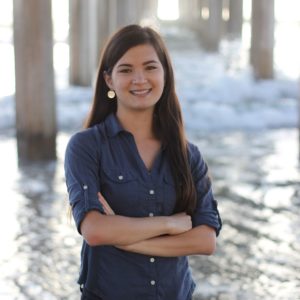
For the past two years, Jayne has worked for the Dept. of Land and Natural Resources Division of Aquatic Resources as a coral restoration specialist at the Hawaii Coral Restoration Nursery on Oahu with director David Gulko. Before moving to Honolulu, she earned her bachelor’s in Marine Biology from the University of California San Diego and her masters from Scripps Institution of Oceanography at UC San Diego.“Hawaii’s reefs are extremely unique and Hawaiian corals have some of the slowest growth rates in the world, which is why the State has taken an innovative, land-based approach to coral restoration,” notes Jayne.

Hawaii’s first state coral nursery, which is managed by DAR, opened in 2016 at the Anuenue Fisheries Research Center on Oahu.

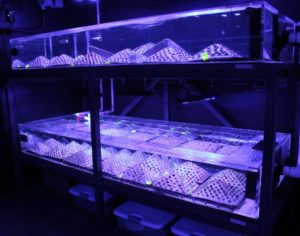
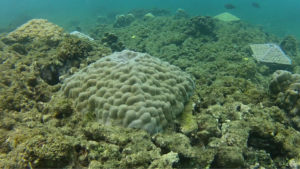
Corals are brought to the Coral Restoration Nursery and are rapidly grown using a series of aquarium-based techniques that help them to generate large coral colony modules in a fraction of the time it would take naturally, which can be out-planted back on the reef.

The nursery typically uses corals for out-planting from harbors because of their lower ecological value compared to corals from natural areas, says DAR, and they may also be more resilient to any challenges and environmental changes.

University of Hawaii Sea Grant researchers are also conducting experiments at the Anuenue facility to understand different environmental conditions, like light and water movement, that are useful for growing corals quickly. Creating the best environment for the corals to grow rapidly will help to restore local reefs after disturbance events such as bleaching or physical damage.

Maui Nui Marine Resource Council’s “Know Your Ocean Speaker Series” events are held monthly via Zoom. Support for these events is provided by the County of Maui Mayor’s Office of Economic Development.

The virtual event’s emcee will be Darla Palmer-Ellingson, local radio show host of the public affairs program, Island Environment 360 Maui’s only commercially broadcast public affairs show on environmental and related Hawaiian cultural topics, aired on the stations of H-Hawaii Media.

To reserve your spot at this free Zoom webinar, please visit https://bit.ly/coralnurserywebinar
 

Public invited to free webinar on “Shark Research in Hawaii – With an Emphasis on Maui” by Dr. Kim Holland on Wednesday, March 3

in /by

KIHEI, HI – Recent shark attacks that occurred off the coast of Maui in November (2020), December (2020) and January (2021), as well as an incident in February (2021) which involved a large shark biting a kayak, have many ocean users concerned and curious about the sharks found in our nearshore waters. The public is invited to learn more about our local sharks at a free Zoom presentation titled “Shark Research in Hawaii – With an Emphasis on Maui’ by Dr. Kim Holland. Dr. Holland is the Research Professor at the Hawaii Institute of Marine Biology, (HIMB) at University of Hawaii at Manoa and the founder of the Shark Research Group at HIMB.

This free talk is hosted by Maui Nui Marine Resource Council’s “Know Your Ocean Speaker Series” and will take place on Wednesday, March 3 at 5:30 pm via Zoom. The presentation is free, but advance reservations are required. To reserve your spot, please visit https://bit.ly/SharkWebinar

For over 40 years Dr. Holland’s research has focused on the biology and movement patterns of large marine fishes such as tuna, billfishes and sharks. He has been a pioneer in helping to develop and deploy cutting edge tracking technologies that allow unprecedented insight into the movement patterns of marine fishes.
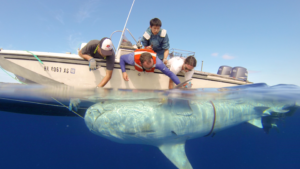
His presentation will include a brief overview of tracking technologies with an emphasis on what has been learned about the movements of sharks around Maui Nui.

“While many Maui residents and visitors are fearful about sharks, it’s important to remember that sharks play an important role in maintaining Hawaii’s ocean ecosystems,” said Anne Rillero, Communications, Community Outreach and Development Manager at Maui Nui Marine Resource Council. “We’re looking forward to learning more about Dr. Holland’s findings and insights about Hawaii’s sharks.”

Maui Nui Marine Resource Council’s “Know Your Ocean Speaker Series” events are held monthly via Zoom. Support for these events is provided by the County of Maui Mayor’s Office of Economic Development.

The emcee for this event is Darla Palmer-Ellingson, local radio show host of the public affairs program, Island Environment 360 Maui’s only commercially broadcast public affairs show on environmental and related Hawaiian cultural topics, aired on the stations of H-Hawaii Media.

To reserve your spot at this free Zoom webinar, please visit https://bit.ly/SharkWebinar


Experts tag a tiger shark with a tracking device in the waters off Maui. The satellite tag gets attached to the shark’s dorsal fin and sends a signal every time the fin surfaces the water. Photo Credit: HIMB

Public invited to free Zoom presentation about unique collaboration of 7 environmental projects funded by Maui CARES

in /by

Program provided employment for more than 70 Maui and Molokai residents

“It’s like Maui County’s own version of the Civilian Conservation Corps”

KIHEI, HI – During the Great Depression, the government-sponsored Civilian Conservation Corps (CCC) provided paychecks for 3 million unemployed young men and provided valuable labor for conservation projects across the country.

With unemployment at record levels due to COVID-19, a new program followed this historical CCC model and put more than 70 Maui and Molokai residents to work in November, providing seven local conservation nonprofits with needed labor to benefit coral reefs, cultural resources and the environment.

The public is invited to a free presentation on Weds. January 27 at 5:30 pm on Zoom to learn about this unique collaborative employment and workforce training program and the impact it had on our local environment. The presentation will include videos, photos and firsthand accounts of the projects and accomplishments, with information on how the projects incorporated traditional Hawaiian cultural practices and modern technology to prevent sediment pollution in the ocean and protect valuable cultural resources.

It’s free, but registration is required. To sign up, visit https://bit.ly/mauiCARES

This unique collaborative employment and workforce training program was made possible through the County of Maui Office of Economic Development’s Maui CARES program, which was funded by the Federal CARES Act. As the fiscal sponsor, Maui Nui Marine Resource Council oversaw the administration of the Maui CARES funding for the projects and managed the rapid employment of more than 70 new hires with the help of simplicityHR by ALTRES.

The workers participated in conservation and restoration projects in Olowalu, Waihe’e, Keanae, Kipahulu, Hana and Moloka’i. All of the projects were rooted in Hawaiian cultural practices and values which serve as the foundation of our community. Their work was filmed by Inflatable Film of Kula. The evening will include video premieres exclusively for webinar attendees.

“Through this presentation, attendees will be immersed in a virtual experience to feel the importance of Kuleana, ʻOhana, Kōkua, Aloha ʻAina, Mālama ʻAina, and Hānai ʻAina, said Ekolu Lindsey, President of Maui Cultural Lands and a principal organizer of this program. “Be inspired to follow in the footsteps of those who have come before us, as we share our legacies with you.”

The participating nonprofits include:

Ka Honua Momona on Molokai worked to restore two ancient fishponds, which will help trap sediment before it reaches the open ocean – with the benefit of also producing fish for local people.

Kipahulu ‘Ohana in East Maui improved a lo’i, or wetland taro farm. The taro plants will slow the flow of stormwater, allowing time for sediment in the water to settle, rather than flow out to sea.

Hawaiian Islands Land Trust in Waihe’e worked to remove invasive species along approximately 3,000 linear feet of Kalepa Stream to lower sediment loads in the nearshore waters off Waihe’e and protect offshore corals.

Ke Ao Hali‘i (KAH) in Hana worked on 27 acres of publicly owned land at Mokae/Kaholaiki and another ~2 acres of contiguous land, directly above Hamoa Beach. Their project included invasive plant removal and native habitat restoration for seabirds and insects, and a biological survey of ‘opihi as a baseline for a possible ‘opihi rest area in the future.

Kipuka Olowalu in West Maui reestablished washed out and damaged lo’i (taro fields), rebuilt vanished lo’i and prepared lo’i for planting in the Olowalu Cultural Reserve. Workers removed overgrowth, fire hazards and invasive plants; planted native plants and crops and repaired infrasturcture.

Na Moku ‘Aupuni O Ko‘olau Hui in East Maui worked on watershed management and stream maintenance, as well as stream and ditch monitoring in the East Maui Irrigation system to establish accurate data for stream and ditch flow and loss as a basis for making sound future management decisions related to this resource and delivery infrastructure.

Each of the nonprofits will be presenting their work and accomplishments through photos, video and stories from the field.

Na Mamo o Mu‘olea in East Maui focused on land and shoreline management on a county parcel (which Nā Mamo O Mū’olea has a 50 year lease). It included removal of invasive plants around a rock wall that is on the historic registry, and preparation for wall restorations, maintenance of two heiau on the property, installation of new fencing around an area designated for native trees and medicinal plants, and maintenance and repair of feral animal controls.

“This presentation is a celebration of all that was accomplished and learned,” said Lindsey. “We encourage the public to attend to connect with these organizations and the workers who put heart and soul into these challenging and impactful projects.“

The emcees for this event are Ekolu Lindsey and Darla Palmer-Ellingson, local radio show host of the public affairs program, Island Environment 360 Maui’s only commercially broadcast public affairs show on environmental and related Hawaiian cultural topics, aired on the stations of H-Hawaii Media.

About Maui Nui Marine Resource Council

Maui Nui Marine Resource Council is a community-based nonprofit organization celebrating 13 years of working for healthy coral reefs, clean ocean water and abundant native fish throughout Maui County. Our work includes co-managing the Hui O Ka Wai Ola Ocean Water Quality Monitoring Program in South and West Maui, efforts to reduce pollution in Mā‘alaea Bay (through erosion-control efforts in the Pohakea watershed and using oysters to filter sediment and pollutants from ocean water), coral reef research, visitor education programs and more. Learn more at www.mauireefs.org.

Free Webinar: “Exploring the Octopus: How to Learn from Animal Behavior”

in /by

Photo courtesy Don Bloom

“Exploring the Octopus: How to Learn from Animal Behavior” is Topic of November 18 “Know Your Ocean Speaker Series” Free Webinar

Octopuses explore the world around them with their flexible arms, which can touch — and actually taste — to help them quickly identify prey. Maui Nui Marine Resource Council invites the public to learn more about the specialized octopus cells that make this unique ability possible at a free Zoom webinar titled “Exploring the Octopus: How to Learn from Animal Behavior” on Wednesday, November 18 at 3 pm. This presentation is part of MNMRC’s monthly “Know Your Ocean Speaker Series.”
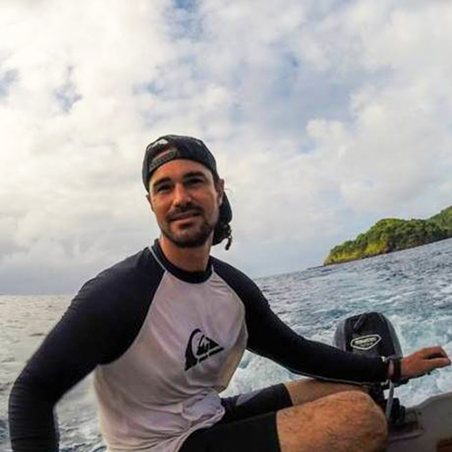
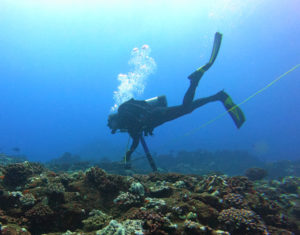
The guest speaker will be Peter Kilian, Research Assistant and Aquatic Animal Technician at the Bellono Lab at the Department of Molecular and Cellular Biology at Harvard University. The lab studies how diverse organisms sense and respond to changes in their environment.

Peter will be sharing his work on a paper which he co-authored that was recently published in Cell titled, “Molecular Basis of Chemotactile Sensation in Octopus.” Stories about this report, which describes how octopus can both touch and taste with their arms, have appeared in numerous newspapers, magazines, tv news shows and online journals, including The New York Times, CNN, Smithsonian Magazine and others.

As a research assistant and aquatic animal technician at Bellono Lab, Peter spends most of his time working with fish, sharks, cephalopods, and various other marine invertebrates to try and learn how and why they behave the way they do.

“So many of us on Maui are fascinated with octopuses, especially after ‘My Octopus Teacher’ launched on Netflix,” says Meredith Beeson, Project and Research Coordinator at Maui Nui Marine Resource Council. “We are excited to host this presentation by Peter Kilian, which will describe how Harvard researchers looked at the octopus at the molecular level to learn how the nervous system in the octopus’ arms — which operate largely independently from its centralized brain — allows these animals to both touch and taste their prey.”

The guest emcee will be Darla Palmer-Ellingson, local radio show host of the public affairs program, Island Environment 360 Maui’s only commercially broadcast public affairs show on environmental and related Hawaiian cultural topics. Her  program is made possible by H-Hawaii Media.

Maui Nui Marine Resource Council offers its monthly “Know Your Ocean Speaker Series” via Zoom, usually on the first Wednesday of the month. This month’s presentation was delayed due to Election Day and Veteran’s Day. Please note that this event will start at 3 pm, earlier than other “Know Your Ocean Speaker Series” talks, because the speaker is located in Massachusetts. If you wish to view the presentation, but cannot attend at 3 pm, please email [email protected] to receive emailed information about where and how to view the presentation later in the day.

To make a reservation for the live Zoom presentation, please visit https://bit.ly/OctopusTalk

The “Know Your Ocean Speaker Series” is made possible with support from the County of Maui Mayorʻs Office of Economic Development.

About our speaker:
Peter Kilian, Research Assistant and Aquatic Animal Technician at the Bellono Lab at the Department of Molecular and Cellular Biology at Harvard, has been interested in the mystery of animal behavior since a young age. His drive to work with animals originates from countless trips to the local zoo and aquarium when he was growing up. This curiosity continued to evolve in college, where Peter dove into his passion for animal work. While in college he spent time working as a beekeeper, a penguin aquarist at the New England Aquarium, and a pygmy octopus husbandry specialist in the mariculture lab at the Marine Biological Laboratory in Woods Hole, MA. He has since graduated from college, and now works full time in the Bellono Lab at Harvard as a research assistant and aquatic animal technician. He spends most of his time working with fish, sharks, cephalopods, and various other marine invertebrates to try and learn how and why they behave the way they do.


Free Oct. 7 Webinar by Daniel Amato, Ph.D. on “Sewage Impacts on Hawaiʻi’s Coastlines: Past, Present and Future”

in /by

Part of Maui Nui Marine Resource Councilʻs Online “Know Your Ocean Speaker Series”

What will determine the future impacts of sewage on Hawai’i’s nearshore ecosystems and public health? Learn more at a free Zoom webinar titled “Sewage Impacts on Hawaiʻi’s Coastlines: Past, Present and Future” by Daniel Amato, Ph.D., which will include recent research and latest information on Hawaiʻi’s wastewater saga. The webinar will take place on Wednesday October 7 at 5:30 pm and is free and open to the public. It is presented by Maui Nui Marine Resource Council as part of their monthly “Know Your Ocean Speaker Series.” Advance reservations are recommended as the Zoom webinar is limited to 100 attendees. Make your free reservation at https://bit.ly/MauiSewage
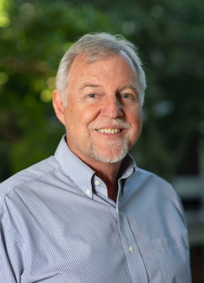
“My talk will share reports on how injection wells and cesspools continue to pollute Hawaiʻi’s waters, with an emphasis on recent Maui studies,” says Dr. Amato. ”I will also present recent decisions from the Hawaiʻi State Legislature and the current status of their effort to phase out cesspools.”

Dr. Amato will also discuss the current situation with sewage pollution in Hawai’i, and will present community efforts and new technological developments in sewage detection that show promise for the future.

A water quality specialist, Dr. Amato’s professional work focuses on the detection and impacts of land-based pollution in the Pacific Ocean and the development of new technology to assist in detecting the DNA of fecal indicator bacteria (FIB) in the water.Dr. Amato is a Marine Research Specialist at the University of Hawaiʻi at Manoa, an Environmental Scientist at Element Environmental LLC, and serves as the coordinator for Surfrider-Oahu’s Blue Water Task Force.

“We are offering this webinar by Dr. Amato to share important information about sewage and its impact on Maui’s coastlines, including ocean water quality and our nearshore coral reefs,” says Amy Hodges, Programs and Operations Manager at Maui Nui Marine Resource Council. “It’s a critically important topic, at a time when our coral reefs need the benefit of clean ocean water, to survive the impacts of climate change and warming water.”

“We thank the County of Maui Mayorʻs Office of Economic Development for supporting our Know Your Ocean Speaker Series,” says Hodges.

For reservations for this talk, visit https://bit.ly/MauiSewage.

About Maui Nui Marine Resource Council:
Maui Nui Marine Resource Council is a community-based nonprofit organization celebrating 12 years of working for healthy coral reefs, clean ocean water and abundant native fish throughout Maui County. Our work includes co-managing the Hui O Ka Wai Ola Ocean Water Quality Monitoring Program in South and West Maui, efforts to reduce pollution in Mā‘alaea Bay (through erosion-control efforts in the Pohakea watershed and using oysters to filter sediment and pollutants from ocean water), coral reef research, visitor education programs and more. Learn more at www.mauireefs.org.

Free Oct. 7 Webinar by Daniel Amato, Ph.D. on “Sewage Impacts on Hawaiʻi’s Coastlines: Past, Present and Future”

in /by

What will determine the future impacts of sewage on Hawai’i’s nearshore ecosystems and public health? Learn more at a free Zoom webinar titled “Sewage Impacts on Hawaiʻi’s Coastlines: Past, Present and Future” by Daniel Amato, Ph.D., which will include recent research and latest information on Hawaiʻi’s wastewater saga. The webinar will take place on Wednesday October 7 at 5:30 pm and is free and open to the public. It is presented by Maui Nui Marine Resource Council as part of their monthly “Know Your Ocean Speaker Series.” Advance reservations are recommended as the Zoom webinar is limited to 100 attendees. Make your free reservation at https://bit.ly/MauiSewage

“My talk will share reports on how injection wells and cesspools continue to pollute Hawaiʻi’s waters, with an emphasis on recent Maui studies,” says Dr. Amato. ”I will also present recent decisions from the Hawaiʻi State Legislature and the current status of their effort to phase out cesspools.”

Dr. Amato will also discuss the current situation with sewage pollution in Hawai’i, and will present community efforts and new technological developments in sewage detection that show promise for the future.

A water quality specialist, Dr. Amato’s professional work focuses on the detection and impacts of land-based pollution in the Pacific Ocean and the development of new technology to assist in detecting the DNA of fecal indicator bacteria (FIB) in the water.Dr. Amato is a Marine Research Specialist at the University of Hawaiʻi at Manoa, an Environmental Scientist at Element Environmental LLC, and serves as the coordinator for Surfrider-Oahu’s Blue Water Task Force.

“We are offering this webinar by Dr. Amato to share important information about sewage and its impact on Maui’s coastlines, including ocean water quality and our nearshore coral reefs,” says Amy Hodges, Programs and Operations Manager at Maui Nui Marine Resource Council. “It’s a critically important topic, at a time when our coral reefs need the benefit of clean ocean water, to survive the impacts of climate change and warming water.”

“We thank the County of Maui Mayorʻs Office of Economic Development for supporting our Know Your Ocean Speaker Series,” says Hodges.

For reservations for this talk, visit https://bit.ly/MauiSewage.

About Maui Nui Marine Resource Council:
Maui Nui Marine Resource Council is a community-based nonprofit organization celebrating 12 years of working for healthy coral reefs, clean ocean water and abundant native fish throughout Maui County. Our work includes co-managing the Hui O Ka Wai Ola Ocean Water Quality Monitoring Program in South and West Maui, efforts to reduce pollution in Mā‘alaea Bay (through erosion-control efforts in the Pohakea watershed and using oysters to filter sediment and pollutants from ocean water), coral reef research, visitor education programs and more. Learn more at www.mauireefs.org.


Dr. Steven Businger to Speak on “Severe Weather in a Warming World”

in /by

MA’ALAEA, HI – A free presentation titled “Severe Weather in a Warming World” will be offered by Dr. Steven Businger on Wednesday, August 7 at The Sphere at Maui Ocean Center, as part of Maui Nui Marine Resource Council’s monthly meeting. The talk takes place from 5:30 pm to 7 pm. Doors open at 5 pm.

This presentation is open to the public and admission is free. Seating is limited so advance reservations are recommended. For reservations, visit https://bit.ly/hurricanetalk

Dr. Businger is the Professor and Chair of the Department of Atmospheric Sciences at the University of Hawaii and has devoted the past 30 years to researching the evolution and structure of destructive atmospheric storms.

“My talk will cover the evolution of recent hurricanes and other severe weather events that have threatened Hawaii, including how and why they form, how their structure affects the hazards they produce, and the role that a warming climate may play in these events,” said Dr. Businger. “I will also cover the similarities and differences between hurricanes and kona lows (a winter half year phenomenon).”

“We are offering this presentation because hurricanes have a profound impact on Maui’s coastal areas, causing erosion, storm surges and damage to homes and property – and possibly to coral reefs,” said Robin Newbold, co-founder and Chair of Maui Nui Marine Resource Council. “The weather and the future of our reefs are inextricably linked.”

“Right now, we are fortunate to have our local coral reefs providing an estimated $377.1 million worth of protection from storm surges and big waves to Maui’s coastlines every year, according to a recently released study from the U.S. Geological Survey, The Nature Conservancy and UC-Santa Cruz,” noted Newbold.

“However, coral bleaching caused by warming ocean temperatures can make corals weak and brittle, and more likely to be broken off in strong waves,” said Newbold. “If the height of our corals is reduced, we can expect more storm-related damage along our coasts. If sea level rises, it will also be harder for corals to break up big waves.”

“Please attend this talk to learn about hurricanes and severe weather events in Hawaii, so we can all be better prepared and safer,” says Newbold.

A nonprofit Maui-based organization working for healthy coral reefs and clean ocean water, Maui Nui Marine Resource Council hosts monthly meetings on the first Wednesday of each month featuring guest presenters speaking on issues, ideas and new advances relating to Maui County’s nearshore ocean environment. The meetings are free and open to all. Maui Ocean Center generously donates space for these monthly meetings at The Sphere, its new high-tech facility featuring advanced audio and visual projection and comfortable movie-style amphitheater seating.

About Dr. Steven Businger:
Dr. Steven Businger is Professor and Chair of the Department of Atmospheric Sciences at the University of Hawaii. He has made notable contributions to the atmospheric sciences in several important, yet diverse areas. For the past 30 years Professor Businger has been active in researching the evolution and structure of destructive atmospheric storms, resulting in fundamental contributions to our understanding of the formation of storm systems in cold air streams and in the tropics (e.g., Kona lows and tropical cyclones). To date he has over 80 peer-reviewed journal publications, published 2 academic textbooks, and seven book chapters.

Dr. Businger was elected Fellow of the American Meteorological Society (AMS) in 2010. He is an AMS Certified Consulting Meteorologist, and in 2011 Professor Businger received the UH Mānoa Chancellor’s Citation for Meritorious Teaching.

About Maui Nui Marine Resource Council:
An award-winning, community-based organization, Maui Nui Marine Resource Council is celebrating 11 years of working for healthy coral reefs, clean ocean water and abundant native fish. Maui Nui Marine Resource Council co-founded and co-manages Hui O Ka Wai Ola, a unique volunteer-based ocean water quality monitoring program that gathers data at 39 shoreline locations in South and West Maui. Maui Nui Marine Resource Council is working to restore clean ocean water at Ma’alaea Bay, through a pilot program to use oysters to improve ocean water quality in Ma’alaea Harbor and through upslope projects in the adjoining Pohakea Watershed. The organization also sponsors visitor education programs to encourage respect, protection and responsible use of our local coral reefs. To learn more visit www.mauireefs.org.

Maui Nui Marine Resource Council to Host Free Talk on 
“Catch and Release:  Large Whale Entanglement Response” by Edward Lyman On Tuesday, July 2

in /by

During the 4th of July holiday week when the United States celebrates freedom and liberty, Maui Nui Marine Resource Council will be hosting a free talk about freeing large whales from ropes, nets and other life-threatening entanglements.

This free presentation, titled, “Catch and Release: Large Whale Entanglement Response,” will be offered by Edward Lyman on Tuesday, July 2 at 5:30 pm at The Sphere at Maui Ocean Center. The event is open to the public. The presentation will include amazing video footage from pole- and helmet-mounted cameras showing some of the whale rescues in Hawaii by the network of responders that are authorized to assist with such entanglements,

Seating is limited, so reservations (free of charge) are recommended and can be arranged at https://bit.ly/WhaleRescueTalk.

Lyman, the Hawaiian Islands Humpback Whale National Marine Sanctuary’s Natural Resources Management Specialist, has responded more than 120 times to calls to free large whales and other marine animals from entangling gear over the past 25 years, resulting in more than 50 large whales being freed.

“For over 17 years the Hawaiian Islands Humpback Whale National Marine Sanctuary, working with NOAA Fisheries’ Marine Mammal Health and Stranding Response Program and the on-water community, has led a successful community-based network of experienced responders to free large whales, like the humpback whales found seasonally around Hawaiʻi, from life-threatening entanglements,” said Lyman. “As a result, the sanctuary and its partners have removed gear from more than 30 large whales and gained a wealth of information to mitigate the threat and its broad impacts.”

During his presentation, Lyman will describe the difficult and sometimes dangerous task of disentangling 40-ton, likely free-swimming whales, using techniques modified from those employed to catch large fish or used historically by whalers to kill the animals.

The talk will be part of the July monthly meeting of Maui Nui Marine Resource Council, a nonprofit organization working for healthy coral reefs and clean ocean water. It will take place at The Sphere at Maui Ocean Center, located at 192 Maʻalaea Road at the Maʻalaea Harbor Shops.

Doors will open at 5 pm and the talk will begin promptly at 5:30 pm.

“We are grateful to Maui Ocean Center for generously donating the use of The Sphere for this presentation,” said Amy Hodges, Programs Manager at Maui Nui Marine Resource Council. “We are also very thankful to Ed Lyman for making time to give this talk during a holiday week celebrating ʻlife, liberty and the pursuit of happinessʻ — important for whales as well as people.”

About Edward Lyman:
Ed Lyman is currently the Hawaiian Islands Humpback Whale National Marine Sanctuary’s Natural Resources Management Specialist and Large Whale Entanglement Response Coordinator under NOAA’s Office of National Marine Sanctuaries. He works closely with NOAA Fisheries, and under their Marine Mammal Health and Stranding Response Program. For more than 25 years Ed has worked with NOAA, state agencies, and others to better understand the animals and to address the threats that impact them, especially ship-strikes and entanglements. His efforts encompass Alaska, the East and West Coasts, Hawaiʻi and other countries. Ed has worked with the Hawaiian Islands Humpback Whale National Marine Sanctuary for more than 17 years.

Ed has participated in over 120 disentanglement efforts and helped free more than 50 large whales – 30 off Hawaiʻi. He assists NOAA in coordinating a community-based network to provide safe and authorized response to entangled large whales. However, the ultimate goal is working with fishermen, scientists, managers, and others to gain valuable information that may reduce entanglement threat in the future.

Ed graduated from the University of New Hampshire, where he received a Master’s of Science studying semi-aquatic mammals and island biogeography. He worked for the Shoals Marine Laboratory and Sea Education Association, where he gained a strong marine background. He has studied whales since 1994, when he worked for the Provincetown Center for Coastal Studies, a non-profit whale research and rescue organization. Ed also worked for the Massachusetts Division of Marine Fisheries, where he worked with fishermen to reduce entanglement impacts.


About Maui Nui.Marine Resource Council:
Maui Nui Marine Resource Council is a Maui-based nonprofit organization celebrating 11 years of working for healthy coral reefs, clean ocean water and an abundance of native fish for the islands of Maui County. In addition to co-managing the Hui O Ka Wai Ola ocean water quality testing program, which tests ocean water quality at 39 locations along the south and west shores of Maui, the nonprofit is working to improve ocean water quality in Ma’alaea Harbor through the installation of caged oysters in the harbor. Maui Nui Marine Resource Council is also working in the Pohakea watershed above Ma’alaea Bay to prevent stormwater runoff to protect ocean water quality and the coral reefs located in the bay. To learn more, visit www.mauireefs.org


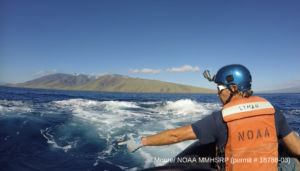
A video camera mounted on Ed Lyman’s helmet records the many steps involved in rescuing entangled large whales. Videos of whale rescues and disentanglements will be shown at Ed Lyman’s talk on July 2 at The Sphere at Maui Ocean Center.          Moore/ NOAA MMHSRP (permit # 18786-03)
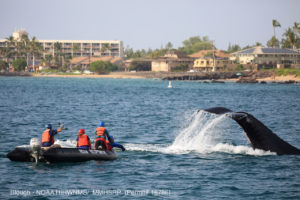
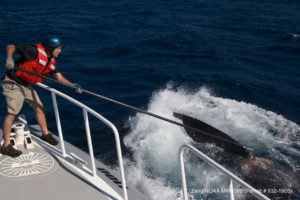
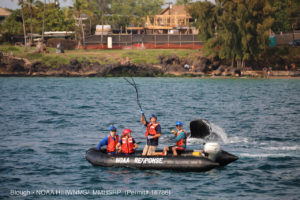
Ed Lyman works with a trained and NOAA-authorized response team to free an entangled humpback whale off Maui.

Ed Lyman uses a hooked knife on the end of a pole to disentangle a whale. Once approachable, rescuers safely assess the animal and entanglement, and attempt to free the animal of all entangling gear.

Ed Lyman lifts coaxial cable the team has just cut free of a humpback whale off Maui. Over 800 feet of the cable was removed and recovered. Entangling gear is not always fishing gear.

June 5 Meeting of Maui Nui Marine Resource Council 
to Feature Free Presentation on Carrying Capacity Study of Popular Oahu Snorkeling Site

in /by

When considering Maui’s most popular reefs, how many snorkelers are too many? What’s the impact of hundreds or possibly thousands of snorkelers per day at our reefs? How do we determine the right amount of snorkelers at our local reefs?

If you’ve wondered about the answers to these questions, Maui Nui Marine Resource Council invites you to a free talk that will share methodology and findings from a carrying capacity study of O‘ahu’s heavily visited Hanauma Bay by researchers from The Coral Reef Ecology Lab (CREL). The free presentation will take place at the Wednesday, June 5 meeting of Maui Nui Marine Resource Council from 5:30 pm to 7:30 pm at The Sphere at Maui Ocean Center. Doors open at 5 pm. Seating is limited so advance reservations are strongly recommended. To reserve, visit https://bit.ly/snorkelers

The featured guest presenters will be Sarah Jane Leicht Severino, Research Associate, and Ku‘ulei Rodgers, PhD, Principal Investigator of The Coral Reef Ecology Lab (CREL) at the University of Hawai‘i, Hawai‘i Institute of Marine Biology campus. They will speak about CREL’s Hanauma Bay Biological Carrying Capacity study, which quantifies the extent of human influence and determines the acceptable limits of disturbance to the marine resources of Hanauma Bay. For the past year, CREL has performed observational and manipulative experimentation within the Bay documenting the interactions between visitors and the marine environment as they relate to human use, coral tramping, sedimentation, and visual water clarity.

“The findings of the Hanauma Bay research should prove valuable in helping communities throughout Maui County evaluate the impacts of snorkelers at our popular reefs,” says Amy Hodges. “This talk is an excellent opportunity to explore how Maui County might most effectively answer the question of how many snorkelers — and under what circumstances — are too many snorkelers  at our local reefs?” 

About Dr. Ku’ulei Rodgers:

Dr. Ku‘ulei Rodgers has been working at the Hawai‘i Institute of Marine Biology’s (HIMB) Coral Reef Ecology Lab since 1992 under the direction of Drs. Paul Jokiel and Fenny Cox, as an HIMB faculty member since 2005 and as the Principal Investigator of the Coral Reef Ecology Lab since 2016. Over 100 of her articles have been published in peer-reviewed journals, published reports, and conference proceedings. She was in the top five most read PeerJ journal articles in 2017.

Since 2005, she has provided graduate advising, mentoring, and training for 15 graduate students, 40 undergraduates, interns, and technicians, and 2 post-docs. Ku‘ulei has been heavily involved as Principal Investigator, Co-Principal Investigator or research assistant on 25 funded projects since her appointment, conducting research at sites on every island. She has secured funding through grants of over $3.5 million assisting in student support and research needs.

Many of her research projects are of an interdisciplinary nature involving close collaborations with over 20 UH researchers from the oceanography, engineering, and zoology departments and over 50 cooperative relationships with managers and scientists from federal and state agencies, non-governmental organizations, and private industry. Her research has been widely disseminated through extensive media coverage with well over 200 documented local television news interviews, newspaper articles, and media events, global webcast video coverage, national and international newspaper and web articles and radio interviews

Ku‘ulei was one of the co-founders along with Dr. Paul Jokiel, Dr. Eric Brown, and Will Smith of the ongoing Coral Reef Assessment and Monitoring Program established in 1999 and continues to serve as PI along with the State Division of Aquatic Resources.

About Sarah Jane Leicht Severino:
Sarah Jane Leicht Severino earned her MS in Marine Science at Hawai‘i Pacific University (HPU) in 2015. For her master’s research she developed a technique, the Fluorescence Census Technique (FCT), that utilizes the natural fluorescent pigmentation found within some species of corals to non-destructively census their smallest size classes in-situ under daylight conditions.

After graduate school, Sarah worked as a First Mate on HPU’s Research Vessel, Kaholo, for two years. In addition to managing fieldwork on HPU’s Research Vessel, she was recruited by the Navy to manage field operations for a project studying the structure of marine resources within the main Pearl Harbor shipping channel.  The FCT was used in the Pearl Harbor shipping channel to quickly and accurately quantify the abundance and recruitment patterns of juvenile coral colonies on their natural reef substrate. 

Since starting in the Coral Reef Ecology Lab, Sarah has been working toward establishing a biological carrying capacity for Hanauma Bay Marine Life Conservation District (MLCD). By analyzing historical data and performing several field experiments, she seeks to quantify changes in the benthic community of reefs at Hanauma Bay in response to pressure from human use.

About Maui Nui Marine Resource Council:

Established in 2007, Maui Nui Marine Resource Council (MNMRC) is an award-winning nonprofit 501(c)(3) organization working for healthy coral reefs, clean ocean water and abundant native fish for the islands of Maui County.

During the past 11 years since our organization’s establishment, we have been based on Maui and have achieved recognition for working with our local community to create culturally appropriate, effective science-based solutions to serious local threats facing our reefs. Many problems facing Maui County’s local reefs originate on land, which is why our projects and programs are community-based and work from mountains (mauka) to sea (makai). To learn more, visit www.mauireefs.org.

Free talk on the status of Maui’s streams, estuaries and native freshwater species by Aquatic Biologist Skippy Hau

in /by

The status of Maui’s streams, estuaries and the native freshwater species that live there will be the subject of a free presentation by Skippy Hau, Aquatic Biologist with the State of Hawaii Department Land and Natural Resources Division of Aquatic Resources, at the Wednesday, November 7 meeting of Maui Nui Marine Resource Council. The meeting will take place at Pacific Whale Foundation’s classrooms at the Ma‘alaea Harbor Shops at 300 Ma‘alaea Road. Hau will also be discussing his work with Maui’s sea turtles, including nesting sea turtles, hatchlings and the removal of an 8-pound tumor from a turtle.

The public is invited and refreshments will be served starting at 5:00 pm when the doors open. The presentation by Skippy Hau will begin at 5:30 pm. The meeting will conclude at 7:30 pm.

According to Hau, Hawai‘i’s streams were once prime habitats for an abundance of native freshwater species including five native species of fishes, two species of crustacean and three species of mollusk.

Hau will discuss his research about Maui’s streams and estuaries and will present information on what happened to them and the animals that once inhabited them in great numbers. He will also be presenting information on the impact of recent moves to restore water flow to Maui’s streams.

“We are delighted that Skippy Hau will be our featured presenter at our November meeting of Maui Nui Marine Resource Council,” says Amy Hodges, Programs Manager at Maui Nui Marine Resource Council. “He is a wealth of knowledge about Maui’s streams and estuaries, and is passionate about sharing his findings about these aquatic resources with the public.”

“The health of our streams, estuaries and watersheds has a direct impact on the health of our coral reefs and the quality of our nearshore ocean water,” says Hodges. “We are especially curious about how stream health has improved since the recent restoration of freshwater to our streams and look forward to Skippy’s observations on this topic.”

Skippy Hau has served as the Aquatic Biologist with the State of Hawaii Department of Land and Natural Resources Division of Aquatic Resources on Maui for 33 years.

He grew up in Kaneohe (Oahu) and attended public schools (Benjamin Parker Elementary, Samuel Wilder King Intermediate, and James B. Castle High School.) He obtained his Bachelor of Science in Biology and a Marine Option Program Certificate at the University of Hawaii at Manoa.

After graduating from University of Hawaii in 1979, Hau worked his way up to Aquatic Biologist at the Hawaii Department of Land and Natural Resources Division of Aquatic Resources and worked on projects including the Waikiki-Diamond Head Fisheries Management Project; Topminnow Baitfish Project; and Northwestern Hawaiian Islands Bottomfish Surveys Project before moving to Maui in 1985.

Maui Nui Marine Resource Council, the host of the meeting, is a nonprofit organization founded in 2007 by marine biologist Robin Newbold and the late Hawaiian activist/kupuna Edwin Lindsey. The organization works for clean ocean water, healthy coral reefs and an abundance of native fish for the islands of Maui County. To learn more, visit www.mauireefs.org.