
Posts

Is it Ash? Is it Oil? No! It’s Trichodesmium!

in /by

During recent coastal water quality and habitat surveys, we’ve come across slicks of what turned out to be blue-green alga, also known as cyanobacteria, in this case, an alga called Trichodesmium.  A biologist at the Division of Aquatic Resources confirmed that these slicks or “scuzzes” are known to periodically occur around Maui but the abundance this year appears unusual.
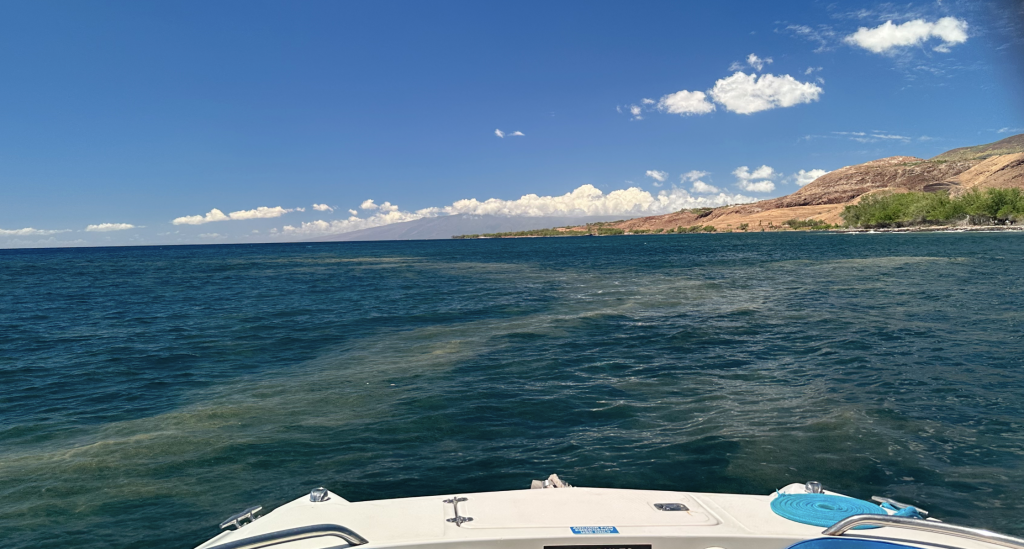
Trichodesmium scuzz by Olowalu, Maui, Hawaii. September 2023.

Trichodesmium scuzz by Olowalu, Maui, Hawaii. September 2023.

A sample collected off Kihei on September, 2023 proved to belong to the genus Trichodesmium. Trichodesmium, also called “sea sawdust” due to its appearance, plays a pivotal role in marine ecosystems. These microscopic organisms are widely distributed throughout tropical and subtropical oceans, forming distinct colonies that can be visible to the naked eye. Trichodesmium is actually ecologically important, as it is a primary producer in the marine food web and also contributes to nutrient cycling and nitrogen fixation, benefiting marine life and the planet as a whole.

A little bit of ecology

Trichodesmium is crucial to the health of marine ecosystems. These cyanobacteria are photosynthetic, using sunlight to convert carbon dioxide and nitrogen gas into organic matter – a process known as nitrogen fixation. This ability to fix atmospheric nitrogen makes Trichodesmium a critical source of bioavailable nitrogen in nutrient-poor ocean regions, such as Hawai’i and much of the tropical Pacific. As a result, it provides essential nutrients to a variety of marine organisms, including phytoplankton, zooplankton, and filter-feeding invertebrates. By supporting the base of the marine food chain, Trichodesmium indirectly sustains the health of larger marine species, all the way up to fish and marine mammals.
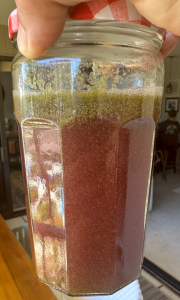
Trichodesmium from a 2023 scuzz in Kaanapali, Maui, Hawaii. Photo: Trey Garnes.

Trichodesmium from a 2023 scuzz in Kaanapali, Maui, Hawaii. Photo: Trey Garnes.

Blooms and Causes

Trichodesmium blooms are periodic and can cover vast stretches of ocean surface. These blooms occur due to a combination of factors, including warm water temperatures, nutrient availability, and calm sea conditions. The warm waters of tropical and subtropical regions create ideal conditions for Trichodesmium growth, while the presence of nutrients like iron and phosphorus can stimulate bloom formation. There is some speculation that ash from the recent Maui wildfires may have dropped enough nutrients into our coastal waters to trigger the blooms we are now seeing close to shore.

Calm seas and low wind speeds can further allow Trichodesmium colonies to remain at the ocean’s surface, forming visible mats that can stretch for kilometers, which is what we are currently seeing around Maui. These blooms can have both positive and negative effects on marine ecosystems, promoting productivity but also potentially leading to oxygen depletion and harmful algal blooms under certain conditions.

Health Concerns

While Trichodesmium is an essential component of marine ecosystems, it is not suitable for human consumption. Ingesting or touching Trichodesmium colonies can cause skin irritation and, in some cases, lead to respiratory problems due to the release of certain toxins and irritants. It is advised to avoid direct contact with these cyanobacteria. Moreover, the ecological consequences of large-scale Trichodesmium blooms, such as oxygen depletion and changes in water chemistry, can have negative effects on marine life and local fisheries.
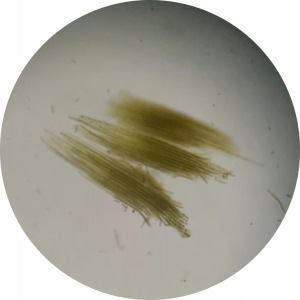
Trichodesmium

Trichodesmium

Fun fact

There are several species of Trichodesmium. Some make little urchin-like balls made up of individual strands others look more like bundles of rods on close inspection.  All species have spaces (vacuoles) that hold gas and as a Trichodesmium rolls around underwater, the flash of light off these bubbles can give the water a sparkly appearance.

Report your sightings!
If you see a Trichodesmium scuzz washing up on the beach or while you are out on the water, please share your observation.  Date, time and location are important details. A photograph or video of the bloom would be appreciated.

Please share your sightings with us by email at [email protected].
 

Maui Nui Marine Resource Council Launches Campaign to Encourage Chemical-Free Landscaping to Protect Coral Reefs and Marine Wildlife

in /by

MAUI, HI – As part of its work to protect and promote healthy coral reefs, clean ocean water and abundant native fish in Maui County, Maui Nui Marine Resource Council has launched an educational campaign to encourage private and public landowners, golf courses and landscapers to switch to organic land management. The organization launched this campaign after gathering research on the impacts that toxic pesticides, fungicides, herbicides and synthetic fertilizers have on coral reefs and marine wildlife.

“Many people want to help protect the ocean, but they aren’t aware that they can do that through organic land management,” says Grace Silver, Project and Research Coordinator at Maui Nui Marine Resource Council. “This campaign will educate and encourage private and public landowners to give up use of landscape chemicals to protect the ocean environment and create a healthier and thriving microclimate on their own land.”

Maui Nui Marine Resource Council is working with Beyond Pesticides, National Organic Farming Association and local organic land management experts to provide the community with helpful information for landowners and land management experts to make the switch to organic land management. Because cumulative impacts can be so detrimental, every single property that makes the switch will make a difference towards creating a cleaner and healthier environment around them.

“Numerous scientific studies have shown that the use of synthetic chemicals on land have significant and adverse impacts to coral reef ecosystems and aquatic species,” reports Silver. “Some of these negative impacts include coral reef bleaching, eutrophication, biomagnification, reproduction inhibition and increased disease in fish and marine wildlife.”

“Through our research, we’ve found that a majority of chemicals applied to our land for landscaping and pest control often end up in the ocean,”  explains Meredith Beeson, Project and Research Coordinator at Maui Nui Marine Resource Council. “Once these chemicals make their way into aquatic environments, they harm coral reefs by hindering their ability to feed and reproduce.”

“In order to protect our oceans, this chemical runoff needs to be reduced (or ideally stopped) from reaching the ocean,” says Beeson. “The solution is organic land management.”

According to a study published in the Journal of Agricultural and Environmental Ethics by David Pimentel, less than 0.1% of pesticides applied for pest control reach their target pests. Thus, more than 99.9% of pesticides used move into the environment where they adversely affect public health and beneficial biota, and contaminate soil, water, and atmosphere of the ecosystem.

Problems caused by landscaping chemicals and synthetic fertilizers entering the marine environment include:
• Tumor-causing diseases in turtles, as documented by the University of Hawaii, Manoa by Celia Smith and Walter Zimmermann.
• Creation of dead zones through the process of eutrophication, as documented by InTeGrate in “Managing Runoff to Reduce the Dead Zone.”
• Degradation of coral reefs, leading to economic impacts, as documented by University of Hawaii, Manoa in “Economic Value of Hawaii’s Nearshore Reefs.”
• Death of zooxanthelle (coral symbiont) which leads to coral bleaching, as documented by the Marine Pollution Bulletin by C.M. Shaw, J. Brodie, and J.F. Mueller.
• Potential human health impacts through chemical exposure, as documented by the Agency for Toxic Substances and Disease Registry.

“Whether you have a small yard or run a large-scale farm, organic land management can help protect Maui’s coral reefs and aquatic organisms” says Beeson. “Another benefit of organic landscaping is that it ultimately allows the land to sustain itself without large amounts of human intervention, saving time, energy and money in the long run.”

Maui Nui Marine Resource Council has created a webpage at https://www.mauireefs.org/what-we-do/pesticides/ with resources to help land managers, owners and landscapers obtain more information on organic land management. These resources focus on common issues found in Maui County.


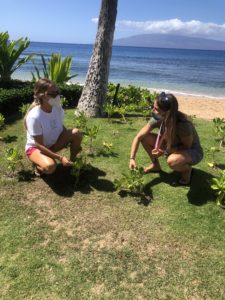
Maui Nui Marine Resource Council staff members Meredith Beeson and Grace Sliver examine landscaping plants and discuss organic land care methods as part of our new Pesticide Education Program.