Posts

New Sunblock Dispensers Urge South Maui Ocean-Goers to “Love the Ocean the Right Way” on Valentine’s Day

in /by

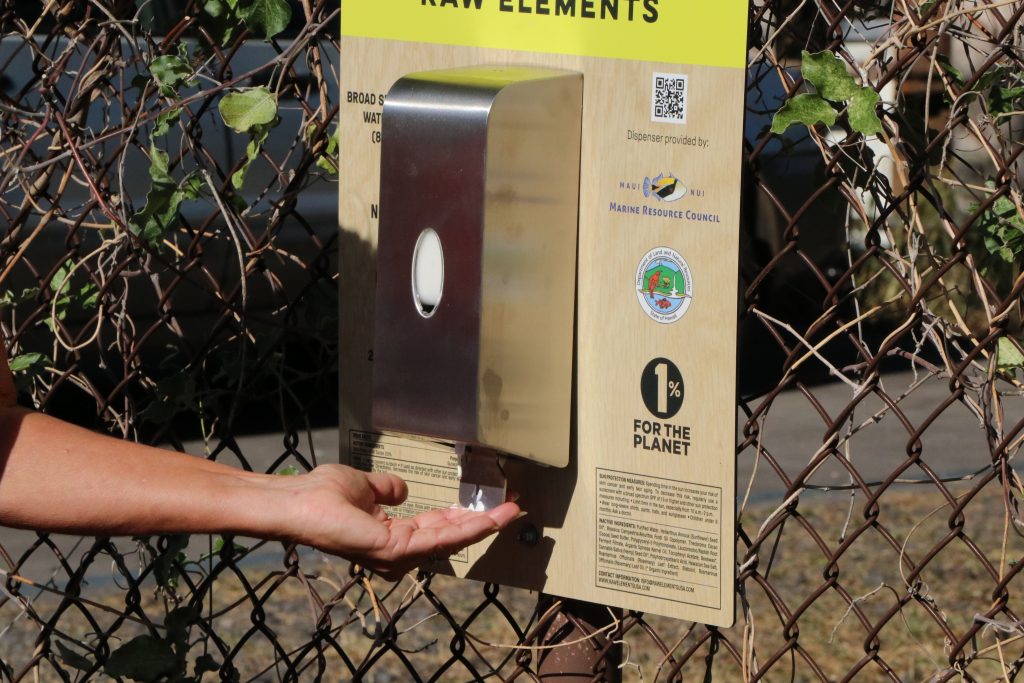
KIHEI – Four mineral sunblock dispensers are up on this Valentine’s Day on south Maui shores, encouraging all to “love the ocean the right way.” Two are at the ‘Āhihi-Kīna‘u  Natural Area Reserve and a pair are to be installed at Mākena State Park. Thousands of people enter the ocean at these locations every day.

The dispensers hold non-nano, zinc, mineral sunscreen. Products with these active ingredients are safe for people and marine life because those elements already exist in sea water. Dermatologists say mineral-based products are the most effective protection for people, as they block out both UVB and UVA rays from the sun.

The Maui installations were inspired by a sunblock dispenser at Waialea Bay at Hāpuna State Recreation Area on Hawai‘i Island. Kelli Lundgren, board member of the Robert F. Orr Charitable Foundation, decided Maui needed dispensers. “As a volunteer at ‘Āhihi-Kīna‘u I’ve communicated with hundreds of visitors about the effectiveness and protection of mineral sunscreens. As people understand the mineral alternative and discover that sprays and bottles labeled “reef safe” actually can be harmful, they wanted an alternative.”

The Robert F. Orr Charitable Foundation through the Maui Nui Marine Resource Council, and with support from the State of Hawai‘i and County of Maui, helped with the placement of dispensers at the Maui beaches. “I hope this will be the start of additional protection for Maui’s corals, fishes, and other abundant, beautiful, and essential sea life,” Lundgren added.

“Once people try mineral sunscreens, they see how easy they are to use,” said Mike Fogarty, Executive Director at Maui Nui Marine Resource Council. “We hope these dispensers give people an introduction to a better way of protecting themselves and marine life. Using mineral-based sunscreens also help protect the fish that many in our community rely on for food.”

Beginning on October 1, Maui County will be the first place in the country to ban the sale and use of sunscreen products with petrochemicals as active ingredients. Many of those products are labeled as “reef safe” with no scientific backing to the claims. The historic ordinance was passed unanimously by the Maui County Council and was signed into law by Mayor Michael Victorino last December.

It is intended to protect reefs and ocean food sources from continuous, daily chemical contamination. A 2018 state-wide law only banned the sale of two chemicals but allowed the continued sale of many other chemical ingredients.The Maui ordinance is stronger because it allows only the sale of mineral products. It prohibits the sale or use of any chemical compounds currently in use as well as any new compounds created in  the future.

Council member Kelly King introduced the bill and commented, “Non-mineral sunscreens are an aggressive pollutant. Our coral reefs are our first defense against climate change and sea level rise. This includes impacts such as erosion, runoff from storms and development, and seepage from wastewater injection wells. Our ordinance is one important step toward protecting the health and resilience of our reefs and marine life by removing a significant ecological stressor. Making a better choice in sun protection is one thing we can  all do immediately. What better day than Valentine’s to make a change and show your love for the kai?”
Peter Landon, of the DLNR Division of Forestry and Wildlife, manages ‘Āhihi-Kīna‘u Natural Area Reserve. Landon said, “Thanks for the generous donations and everyone’s work on this issue. The     installation of these dispensers is a welcome addition to our outreach efforts, giving us a way to help visitors who were unaware of the chemical sunscreen pollutants, or thought they bought something ‘reef safe’. We appreciate it when people hear our messageand want to do the right thing.”

Raw Elements USA supplied the dispensers and product. Chis Wagaman of the company remarked, “We’re honored and proud to be a part of this project with great people participating in positive change for Maui. It is incredible to see the steps taken to educate and provide an incredible experience for everyone who goes into the ocean.”
# # #

To view video please click on photo or view at this link: https://vimeo.com/677415105

More information about mineral sunscreens and reefs:  https://www.mauireefs.org/sunscreens

More information about Maui’s ordinance: https://www.mauicounty.gov/DocumentCenter/View/130826/Ord-5306

Media Contact:  Dan Dennison 
Senior Communications Manager 
Hawai’i Dept. of Land and Natural Resources 
[email protected] 
808-587-0396
Public Invited to “Talk Story with Maui Nui Marine Resource Council” on Wednesday, December 1 at 5:30 pm

in /by

KIHEI, HI — 10,000 oysters cleaning the water in Māʻalaea Harbor. Hundreds of ocean water quality samples gathered and analyzed. Three new solar-powered monitoring buoys providing data for scientists worldwide. A major new grant to help prevent coastal flooding in Kihei. Education programs to help visitors protect Mauiʻs reefs as they enjoy our island’s beaches. And much more. 

The public is invited to learn about the many projects underway at Maui Nui Marine Resource Council during a “Talk Story” evening with their staff on Wed. Dec. 1 from 5:30 to 6:30 pm on Zoom.

During the evening, attendees will learn about ways that this Maui-based nonprofit is working for healthy coral reefs, clean ocean water and a sustainable population of native fish for the islands of Maui County. Questions and suggestions will be welcomed, and door prizes will be awarded.

“We’re looking forward to sharing the latest news and developments at Maui Nui Marine Resource Council at this annual event,” said Mike Fogarty, Executive Director. “It’s been a very busy year for our staff, resulting in some exciting progress in our work to protect Maui’s reefs and nearshore waters.”

The evening will include details about an initiative to promote reef-friendly landscaping in South Maui, new technology that’s being used to identify ocean water quality issues along Maui’s coasts, and steps taken during 2021 to prevent ocean pollution caused by wildfires, feral axis deer, and marine debris transported into the ocean from Maui streams and gulches.

“We guarantee you’ll learn a lot about coral reef protection and why it is so important to the future of our island,” noted Amy Hodges, Programs and Operations Manager at Maui Nui Marine Resource Council. “And in turn, we want to hear from our community, to learn about your ideas and suggestions for protecting Maui’s coastal waters.”

Due to Covid-19, this annual event will once again be held by Zoom. Preregistration is required. To sign up, visit https://bit.ly/MNMRCUpdates.

Free July 7 Zoom Presentation by Dr. Craig Downs and Hawaii Senator Mike Gabbard: “Education vs. Enforcement: Next Steps Beyond the Enactment of Hawaii’s Sunscreen Law”

in /by

KIHEI, HI— Hawaii’s ban on sunscreens containing the reef-harming chemicals oxybenzone and octinoxate went into effect on January 1, but is the law effective in protecting our local coral reefs and marine animals as intended? Is the ban being enforced? What’s the latest scientific evidence about the chemicals that are replacing these two ingredients in some brands of sunscreen? Are new laws needed?

Get the answers to these important questions on Wednesday, July 7 at 5:30 p.m. via a free Zoom presentation featuring special guest speakers: Dr. Craig Downs, whose groundbreaking research educated the world about sunscreen chemicals and their role in coral reef decline; and Hawaii Senator Mike Gabbard, who authored the legislation that resulted in Hawaii’s ban on the sale of sunscreens that contain the chemicals oxybenzone and octinoxate.

The presentation titled “Education vs. Enforcement: Next Steps Beyond the Enactment of Hawaii’s Sunscreen Law” is sponsored by the County of Maui Mayor’s Office of Economic Development and hosted by Maui Nui Marine Resource Council as part of the organization’s “Know Your Ocean Speaker Series.”

This event is free, but advanced reservations are required. To reserve your spot, please visit https://bit.ly/SunscreenWebinar.

Downs graduated from Hiram College with a B.A. in philosophy and biology, received his M.Sc. from Syracuse University, and received his Ph.D. from the University of Hawaii in cell and molecular biology. He has published over 50 scientific papers and a number of book chapters in scientific textbooks, and is the co-editor of the CRC press veterinary book, Diseases of Corals, as well as founded a number of companies and nonprofits relating anywhere from animal welfare to environmental conservation and exploration.

Downs has held positions as research professor at University of Hawaii’s School of Medicine and Sweet Briar College. He is currently an invited professor at Sorbonne University (France) and is the Executive Director of Haereticus Environmental Laboratory, a non-profit scientific organization dedicated to increasing the scientific, social and economic knowledge of natural environmental habitats in order to better conserve and restore threatened environmental habitats and resources.

Gabbard, who has represented District 20 since 2006, which includes Kapolei, Makakilo, and portions of Kalaeloa, Waipahu, and Ewa, has authored 54 bills that became law relating to energy efficiency, renewable energy, endangered species protection, industrial hemp, the environment, public safety, and more.

One of those bills that became law in 2018, SB 2571, is the ban of sale or distribution in the state of any sunscreen that contains oxybenzone or octinoxate, or both. Last session, Gabbard introduced SB 366, which would ban the sale, offer of sale, or distribution in Hawaii of any sunscreen that contains two more chemicals, avobenzone or octocrylene.

The speakers plan to address whether or not sunscreen pollution is a symptom of unsustainable tourism and coastal development, how we get visitors and residents to comply with the new sunscreen law, and who is responsible for enforcing it.

This panel will also provide information and tips on how you can help to protect the marine environment.

Maui Nui Marine Resource Council’s “Know Your Ocean Speaker Series” events are held monthly via Zoom. Support for these events is provided by the County of Maui Mayor’s Office of Economic Development.

The virtual event’s emcee will be Darla Palmer-Ellingson, local radio show host of the public affairs program, Island Environment 360 Maui’s only commercially broadcast public affairs show on environmental and related Hawaiian cultural topics, aired on the stations of H-Hawaii Media.

To reserve your spot at this free Zoom webinar, please visit https://bit.ly/SunscreenWebinar.

Free Materials Available to Help Educate Public About Sunscreen Choices

in /by

KIHEI, HI – Want to help get the word out about switching to sunscreens that are free of reef-harming oxybenzone and octinoxate? Looking for ways to explain “reef safe” sunscreen choices to guests and customers?

The nonprofit Maui Nui Marine Resource Council, with support from the County of Maui Mayor’s Office of Economic Development, has materials to help.

Maui Nui Marine Resource Council recently printed wallet-sized sunscreen information cards that provide a friendly, simple explanation about avoiding sunscreens with reef-harming oxybenzone and octinoxate. The cards are being offered free to Maui businesses and concierge, for distribution to visitors and residents.

“The cards require very little space on a counter or desk, yet provide all of the information needed to help a guest or customer avoid reef-harming oxybenzone and octinoxate, two chemicals that have been proven to harm or kill corals,” says Anne Rillero, Communications, Community Outreach and Development Manager at Maui Nui Marine Resource Council.

For those with more space, Maui Nui Marine Resource Council is offering free 8 1/2” x 11” color posters, with the message, “Get a Jump on Protecting Maui’s Coral Reefs: Make the Sunscreen Switch Today.”

Rillero notes that Hawaii’s sunscreen ban of these two reef-harming ingredients doesn’t go into effect until January 1, 2021, but our local coral reefs need help – which is why Maui Nui Marine Resource Council is urging all ocean users to make the sunscreen switch now. Maui Nui Marine Resource Council is partnering with Maui Visitors Bureau and the County of Maui Mayor’s Office of Economic Development on a campaign to raise awareness about sunscreen choices.

“The sale of sunscreens containing oxybenzone and octinoxate will be banned under Hawaii’s sunscreen law in 2021, but why wait until then?,” said Robin Newbold, co-founder and chair of Maui Nui Marine Resource Council. “Coral reefs in Hawaii and around the world are under stress due to warming ocean waters, sediment runoff, pollution and other human-related causes. While it’s important that we tackle those issues, switching to a more environmentally friendly sunscreen now is an easy way for individuals and families to help protect the reefs.”

Newbold noted that new sunscreen products made without oxybenzone and octinoxate are readily available and easy to use.

Maui Nui Marine Resource Council has also produced a short video about sunscreen choices which can be viewed at https://youtu.be/szB9xNZV85A .

The organization provides a website page that offers details on safer-for-the-reef sunscreens at https://www.mauireefs.org/sunscreens/.

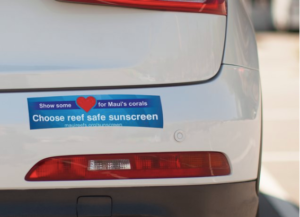
Maui Nui Marine Resource Council has also printed bumperstickers, with the message, “Show some love for Maui’s corals. Choose reef-safe sunscreen” that are offered free to the public.

To arrange for any of these free materials, please email [email protected]. Please include the name of your business, resort or vacation rental, along with your name and contact information, and the items requested.


A Maui-based nonprofit organization founded in 2007, Maui Nui Marine Resource Council is working for healthy coral reefs, clean ocean water and abundant native fish for the islands of Maui County. Current projects include ocean water quality testing in South and West Maui, work to improve ocean water quality in Ma’alaea Bay, ongoing studies of corals in Olowalu and Ma’alaea, and outreach programs to educate visitors about protecting Maui’s coral reefs.

10 Ways to Become More Sunscreen Smart

2 Comments/in /by

Hawaiʻi recently became the first state in the nation to pass a law banning the sale of sunscreen products containing oxybenzone and octinoxate, two common ingredients known to harm coral reefs.

The law goes into effect in January of 2021, to give manufacturers and retailers time to transition to reef-safer sunscreen options.

But you certainly shouldnʻt wait to make the change. Worldwide, coral reefs are in danger, and switching to a reef-friendly sunscreen option is one way you can help.

Here are 10 practical tips to help you make the switch away from sunscreens that contain oxybenzone and octinoxate.

1. Read the fine print
Read the ingredients on your current sunscreen stash and toss any that contain oxybenzone and octinoxate. Check out your skin care collection, too. Moisturizers, face creams, lip balms and even some shampoos offering “SPF protection” probably contain oxybenzone and octinoxate.

2. Skip the sprays
Spray-on sunscreens often rely on chemicals like oxybenzone or octinoxate — strike one against them. When you use spray-on sunscreen at the beach, the chemicals land in the sand and eventually get washed into the ocean.  Spray on products pose an inhalation risk for you and nearby beach-goers, especially children.

3. Go for zinc oxide and/or titanium dioxide
Seek out products that feature zinc oxide and/or titanium dioxide as the primary ingredient. Both are mineral sunscreens, which sit on top of your skin (rather than get absorbed into your skin and bloodstream). Added bonus: both are water resistant! Zinc oxide is the only single active ingredient that protects against UVA and UVB rays.

4. Shop smart
At this time, many sunscreens on most store shelves contain oxybenzone or octinoxate. Some diligent label reading will help you avoid these chemicals. You may have more luck by looking for brands for babies; some are free of oxybenzone and octinoxate, but again, itʻs essential that you read the ingredient panel.

You can also check out the selection at your nearby dive shop or natural foods stores — but even there, review the ingredient labels. Or shop online, using the list of recommended products from Environmental Working Group to help guide you.

5. Considerations for babies and kids
Doctors generally advise avoiding sunscreen in favor of physical barriers like clothing and umbrellas for babies under 6 months. For older kids, visit Environmental Working Group for their list of recommended sunscreen products.

6, Donʻt like the white?
Because zinc oxide/titanium dioxide based sunscreens sit upon your skin, they can create a whitish cast, especially when wet. Wear it proudly, knowing youʻre doing your part for your skin and the coral reefs. Some manufacturers (Raw Elements and Badger) offer zinc oxide-based options with a light skin-colored tint.

7. Choose clever cover ups
Use less sunscreen with reusable clothing cover ups. Invest in a packable wide brimmed hat for all outdoor adventures. Add a rash guard (a lightweight top made of spandex or polyester) when youʻre heading into the water to protect your back, shoulders and arms. Swim tights (similar to stretchy yoga pants) can be found online in fun colors and styles — and as an added bonus, will help protect you from jellyfish stings.

8. Nano or not?
According to the Environmental Working Group, some sunscreen makers are using zinc oxide nano particles to create products that have less white tint. If youʻre concerned about nano particles and want to avoid them, look for brands advertising “non nano” zinc oxide. Learn more. 

9. Chemicals to avoid
In addition to oxybenzone and oxtinoxate, avoid other chemicals like avobenzone, octisalate, octocrylene and homosalate. Environmental Working Group also recommends that you also avoid products containing retinyl palmitate (vitamin A) because “studies by federal government scientists indicate that it may trigger development of skin tumors and lesions when used on skin in the presence of sunlight. “ Read more about these chemicals here:

10. Keep corals in mind, even when far from the ocean
Even if you live away for the ocean, keep in mind that the chemicals you wash off your body eventually find their way into the water table and ultimately into the ocean.

Sunscreen chemicals can also be found in your urine within 20 minutes of application, which is why sewage is a leading carrier of these chemicals. So be sunscreen smart wherever you live, to do your part to protect your skin and coral reefs.

Read more about Maui Nui Marine Resource Councilʻs work to prevent sunscreen pollution.